
Uncategorized
Digital Billboard Truck: Boost Your Campaign with Mobile Ads
Picture this: you take the flash and spectacle of a Times Square billboard, slap it on the back of a truck, and send it wherever
So, you're wondering what a video wall really costs. Let's get straight to it.
You'll see prices ranging from $10,000 for a small, basic system to well over $100,000 for large, high-resolution installations. The final price is a spectrum, not a single number, and it all comes down to the technology, size, and where you plan to use it.
Let's cut through the noise. A video wall's price tag isn't just for the screens; it's for a complete system. The best way to set clear expectations is to start with some practical, real-world price ranges for different applications. This gives you a realistic starting point before we dig into all the little details that drive the numbers up or down.
This approach lays a solid foundation for budgeting and planning your investment. It’s also worth noting that for big-ticket items, many businesses explore options like leasing electronics to cut costs to get the latest tech without a huge upfront payment.
To give you a clearer starting point, I’ve put together a table that breaks down estimated prices based on common uses. Think of it as a cheat sheet to connect your project idea to a tangible budget.
Just remember, these are ballpark estimates for a complete, turn-key system—including the essential controllers and basic mounting. Your final quote will definitely shift based on your unique needs.
Here's a quick-glance table showing typical starting price ranges for complete video wall systems in different environments. These are just estimates, of course, and can vary based on your specific requirements.
| Application Type | Typical Size Range | Common Pixel Pitch | Estimated Price Range (USD) |
|---|---|---|---|
| Indoor Retail & Lobby | 8 ft x 5 ft to 15 ft x 8 ft | 1.8mm – 2.9mm | $20,000 – $60,000+ |
| Outdoor Billboard | 20 ft x 10 ft to 48 ft x 14 ft | 6mm – 10mm | $70,000 – $250,000+ |
| Control Room | 12 ft x 4 ft to 30 ft x 8 ft | 1.2mm – 1.8mm | $45,000 – $150,000+ |
| Premium Home Theater | 10 ft x 6 ft to 18 ft x 10 ft | 0.9mm – 1.5mm | $50,000 – $200,000+ |
As you can see, there’s a huge difference between a standard lobby display and a massive outdoor billboard. The specific technology needed for each—from pixel density to weatherproofing—is what really drives the final price.
We'll use these ranges as our foundation as we dive deeper into the key cost drivers next.
To really wrap your head around a video wall quote, you have to look past the final number on the page. The total price is actually a sum of several crucial parts, and each one plays a big role in both performance and cost. Getting a handle on these seven drivers means you can ask the right questions and feel confident you're putting your money where it counts for your specific project.
This concept map gives you a quick visual of how the physical size of your display and what you plan to do with it directly shape the final cost.
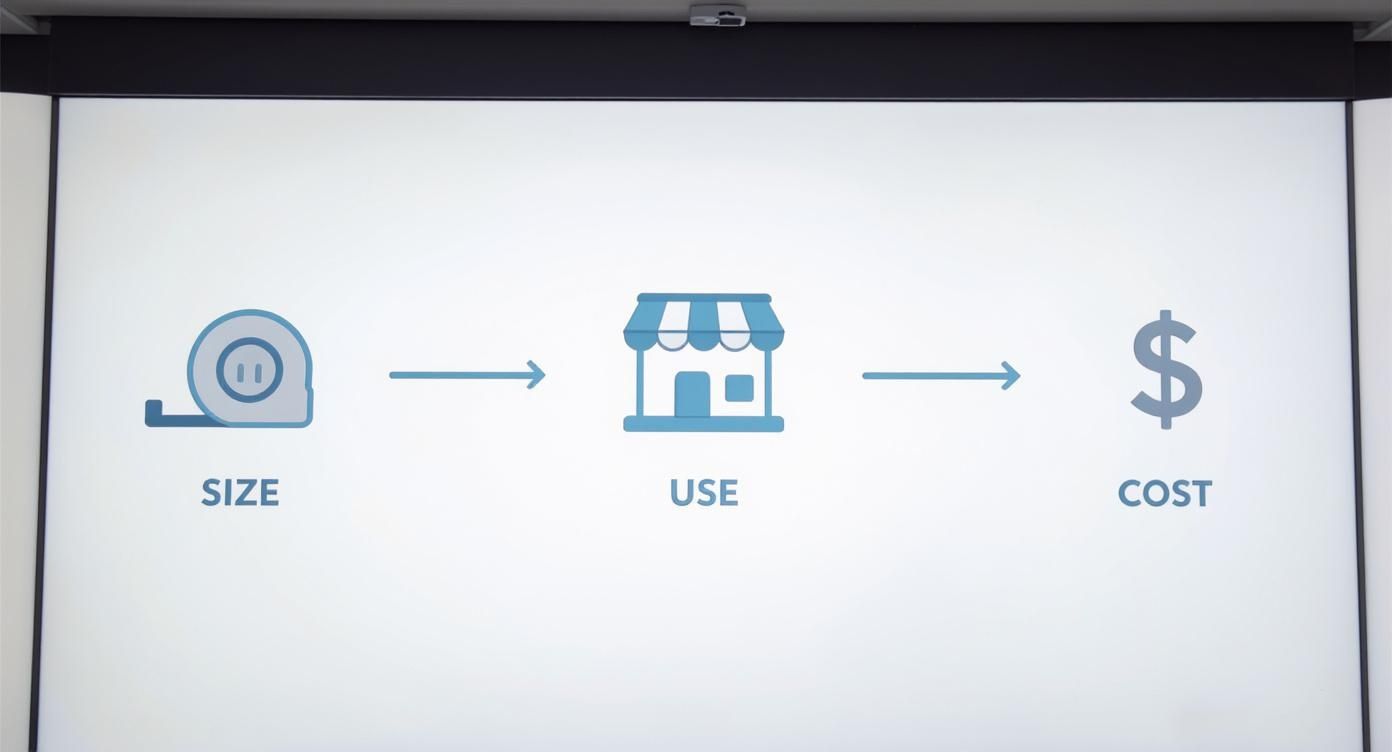
As you can see, bigger displays and tougher jobs (like outdoor use) naturally demand a bigger investment. It really drives home how all these factors are connected.
Think of pixel pitch as the video wall version of a TV's resolution—it’s the difference between watching in standard definition versus stunning 4K. It's simply the distance, measured in millimeters, from the center of one tiny LED light to the center of the one next to it.
A smaller number, like 1.5mm, means the LEDs are packed together tightly. This creates a super-dense, high-resolution image that looks razor-sharp even when you're standing right in front of it. A larger number, like 6mm, is perfectly fine for viewers who will be far away, like drivers seeing a billboard on the highway.
The rule is simple: the smaller the pixel pitch, the higher the cost. That's because you're packing more individual LED diodes and much more precise manufacturing into every square foot of the screen.
This one’s pretty straightforward. A larger video wall needs more LED panels to build it, which directly drives up the material cost. A 20-foot wide display will always cost more than a 10-foot one if they use the exact same tech.
But here’s where it gets interesting: size and pixel pitch work together. For that massive screen in a stadium, you probably don't need an ultra-fine pixel pitch because nobody is viewing it up close. Choosing a larger pitch for a larger screen can help balance out the overall price, so it's all about finding that sweet spot for your viewing distance and budget.
Brightness, which we measure in nits, is all about how well your display’s image can compete with the light around it. An indoor display in a hotel lobby might only need 600-800 nits to look brilliant and pop off the wall.
Take that same screen outside, though, and it would look completely washed out. An outdoor sign facing direct sunlight needs to crank out 5,000 nits or more just to be seen clearly. Achieving that level of brightness requires more powerful (and more expensive) LED diodes and beefier power supplies to run them.
The individual LED modules that make up your screen are housed inside cabinets. These are the building blocks of your video wall, and their design and material have a big impact on the final price, durability, and how easy it is to service down the road.
If the LED panels are the brawn, the video wall controller or processor is the brain. This is the piece of hardware that takes your content—from a computer, camera, or media player—and intelligently splits the signal across all the individual panels so they work together as one seamless, perfect image.
A simple setup might get by with a basic processor. But if you’re planning on complex layouts with multiple video sources, custom windowing, or 4K content, you’ll need a more advanced—and pricier—controller. Skimping here is a classic mistake; it can bottleneck the performance of an otherwise incredible screen.
How you physically attach your video wall to a structure is a huge, and often overlooked, cost factor. The mounting hardware isn't just a simple bracket; it has to be precisely engineered to handle the screen's weight and ensure every single panel aligns perfectly.
A few common methods include:
Each approach requires totally different hardware, engineering, and labor, all of which get factored into the project’s bottom line.
Finally, professional installation is not a place to cut corners. This is where the magic happens. Expert technicians make sure every panel is perfectly aligned to make the seams disappear, that all the cabling is neat and secure, and that the entire structure is safe.
Once it's built, the team performs a final calibration. This step ensures that the color and brightness are perfectly uniform across every single panel on the wall. It’s the last touch that transforms a collection of individual screens into one stunning, cohesive canvas. The size of the wall and the complexity of the job site will ultimately shape this final cost.
Knowing the individual cost drivers is one thing, but seeing how they all click together on a real project is where the lightbulb really goes on. The final price of a video wall isn't just a sum of its parts; it's a direct reflection of what you're trying to achieve.
Let’s connect the dots between the technical specs and your bottom line with a few practical examples.
Each scenario we'll look at prioritizes different features, which completely reshapes the budget. A high-end retail store has totally different needs than an outdoor advertiser, and their video wall prices will prove it. This is exactly why a one-size-fits-all quote is impossible—the application always dictates the investment.
This push for custom-fit solutions is a huge trend in the market. In fact, the global LED video wall market was valued at $24.37 billion in 2024 and is on track to nearly double by 2032. This incredible growth is happening because component costs are coming down, making these powerful displays a realistic option for more and more industries. You can dig into more insights on this expanding market over at Maximize Market Research.
To make this more concrete, the table below gives a few illustrative examples of how different project requirements affect the final price. Keep in mind, all figures are ballpark estimates to show you how the pieces fit together.
| Project Scenario | Key Specifications | Primary Cost Drivers | Estimated Total Cost |
|---|---|---|---|
| High-End Retail Display | 12' x 7' Wall, Indoor | Ultra-fine pixel pitch (1.5mm), 4K-capable controller, premium aesthetics | $35,000 – $70,000+ |
| Rugged Outdoor Billboard | 40' x 12' Wall, Outdoor | Extreme brightness (>7,000 nits), IP65 weatherproof cabinets, large format | $90,000 – $250,000+ |
| Mission-Critical Control Room | 25' x 6' Wall, 24/7 Ops | Redundant power/data, sophisticated multi-source processor, long-life components | $60,000 – $150,000+ |
| Premium Home Theater | 135" Diagonal Screen, Indoor | Fine pixel pitch (0.9mm-1.5mm), superior color calibration, quiet operation | $50,000 – $200,000+ |
As you can see, two walls of a similar size can have vastly different price tags simply because one needs to survive a hurricane while the other needs to show perfect cinematic color. Let's break down these scenarios a bit further.
Imagine a luxury fashion brand wants a jaw-dropping 12-foot by 7-foot video wall right behind its main counter. The goal here is pure, unadulterated visual impact, showing off high-fashion videos with flawless detail to customers standing just a few feet away.
That steep price is driven almost entirely by the pixel density. Every millimeter you shave off the pitch dramatically increases the number of individual LEDs and the complexity of manufacturing. It’s a premium investment in visual perfection.
Now, let's picture a massive 40-foot by 12-foot digital billboard towering over a busy highway. The mission is simple: grab the attention of drivers from hundreds of feet away, whether it's day or night, rain or shine.
In this case, the sheer size and the robust, weather-sealed construction are what drive the video wall prices up, not the pixel density.
Think about a security operations center that needs a 24/7 video wall to monitor dozens of camera feeds all at once. The screen might be a super-wide 25 feet across but only 6 feet tall, creating an ultra-wide digital canvas.
For this kind of project, the investment is less about creating dazzling visuals and more about rock-solid, non-stop performance and the powerful brain needed to manage complex streams of information.
Finally, let's head home to a dedicated cinema with a 135-inch (about 10 feet wide) LED video wall. The goal is to create an immersive, cinematic experience that blows traditional projectors out of the water.
Here, you're paying a premium for refined, movie-theater-quality images, silent operation (no fan noise!), and the specialized processing that makes it all feel effortless. Each of these examples tells a story—and shows that your final video wall price is written by your specific priorities.
The initial quote for your video wall is a great starting point, but it's exactly that—a start. To make a truly smart investment, you need to look past the upfront hardware cost and consider the Total Cost of Ownership (TCO). This means accounting for all the related, and often overlooked, expenses that are absolutely essential for a successful project.
Thinking about these factors from the get-go is the best way to prevent nasty budget surprises down the road. It shifts the entire conversation from "How much does this cost?" to "What's the real long-term value here?" Acknowledging potential hidden expenses is critical. For example, anyone in construction knows how common expensive modeling mistakes during the architectural planning phase can derail a budget, and the same principle applies here. You have to anticipate costs beyond the obvious.

It’s amazing how many extra costs can pop up after you’ve already agreed to the initial video wall prices. Getting ahead of them allows for much more realistic financial planning.
Here are a few of the usual suspects to factor into your budget:
While it's smart to keep a close eye on costs, the other side of the equation is the Return on Investment (ROI). A well-executed video wall isn't just an expense; it’s a powerful tool that actively generates value for your business. This mindset is exactly why the global video walls market, valued at a massive USD 10.23 billion in 2024, is projected to nearly double by 2030 as more industries catch on.
By focusing on ROI, you transform the video wall from a capital expenditure into a strategic asset. It becomes a mechanism for growth, efficiency, and engagement.
For a retail store, this could mean running dynamic ads that send sales of a specific product through the roof. In a corporate headquarters, it might streamline communication and boost operational efficiency, saving thousands in valuable staff time. For an advertiser, the ROI is even more direct—a digital billboard becomes a reliable, consistent revenue stream. When you weigh the outdoor LED sign cost against its massive advertising potential, the investment becomes crystal clear.
By planning for all the costs and focusing on the long-term value, you ensure your video wall doesn't just look good, but delivers a powerful return.
Navigating the quoting process for a big-ticket item like a video wall can feel like a maze. But trust me, getting a precise and reliable quote isn't as hard as it seems, as long as you come to the table prepared. The secret is to think beyond just the screen's dimensions and give your potential vendor the full story of your project.
It’s a lot like commissioning a custom paint job for a car. The painter can't give you a real price without knowing the make and model, its current condition, and the exact finish you're dreaming of. In the same way, your video wall provider needs the right details to nail down a price without any nasty surprises popping up later.
Before you even think about picking up the phone or filling out a contact form, take a few minutes to gather some critical details. Having this info ready to go will make your conversations infinitely more productive and ensure the first quote you get is actually in the same zip code as your final cost.
Try to have solid answers for these questions:
A detailed brief leads to a detailed quote. The more information you can provide upfront, the fewer variables a vendor has to guess at, which always results in a much more accurate estimate of your video wall prices.
One of the smartest ways to keep costs in check and get straight answers is to work directly with a manufacturer. When you cut out the middlemen, you're not just dodging unnecessary markups—you're also getting a direct line to the engineering and support teams who know these products inside and out.
That direct communication is priceless, especially when you have technical questions or need a custom-tailored solution. For a full playbook on how this works, our guide on how to buy an LED sign breaks it all down step-by-step. Using an online cost calculator is also a fantastic first move; it can give you an immediate ballpark figure so you can start planning your budget with confidence.
After breaking down all the cost drivers, a few practical questions usually pop up. This is where the rubber meets the road, so let's tackle the most common things we get asked about video wall pricing.
My goal here is to clear up any final points of confusion. I want you to walk away feeling totally confident about the investment you're considering.
This is a big one, and it really comes down to the underlying technology and what you’re trying to accomplish. Think of LCD video walls as a collection of high-end commercial TVs with super-thin borders, or bezels. They're a solid, cost-effective choice for smaller indoor setups where having a few faint grid lines is acceptable and you don't need sun-outshining brightness.
LED video walls, on the other hand, are a whole different beast. They're built from individual, seamless modules that join together to create a single, uninterrupted canvas. This is what gives them that incredible "wow" factor. They're also massively brighter, which makes them the only real choice for large venues and any kind of outdoor use.
The price of an LED wall climbs with its resolution. The finer the pixel pitch—which just means how tightly packed the tiny LED lights are—the higher the resolution and the higher the cost. So, while a small LCD wall might seem cheaper upfront, a big, high-res LED wall delivers that seamless, vibrant picture that truly makes an impact and justifies the investment.
I know it’s tempting to think you can cut a major line item from the budget by going the DIY route, but for video walls, this is one area you really don't want to skimp. We strongly, strongly advise against it.
These aren't just big TVs you hang on a wall. They are complex ecosystems that demand precision. You need perfectly aligned modules, custom-built mounting structures, and a deep understanding of power distribution and data cabling. Get any of that wrong, and you're in trouble.
Worse yet, you need a professional to calibrate the entire wall to get that flawless, uniform image. A bad installation can lead to damaged panels (which are expensive to replace), create serious safety hazards, and leave you with a blotchy, disappointing display. It almost always costs you far more in repairs and headaches than you would have saved.
Think of professional installation as an insurance policy on your investment. It guarantees the system is set up correctly and safely, and it's tuned for peak performance and a long, healthy lifespan.
This is the question that gets overlooked all the time, but it’s absolutely critical. A video wall is just a blank canvas; the content is the art. The cost can swing wildly depending on what you want to show.
It's absolutely essential to plan your content strategy and budget right alongside the hardware. Remember, the most expensive video wall in the world is completely useless without amazing content to put on it. The content is what delivers your ROI, plain and simple.
Ready to get a clear, factory-direct price for your project? The team at Smart LED Inc. can help you navigate every decision, from pixel pitch to installation. Use our online calculator for a quick estimate or contact us today for a detailed, no-obligation quote.
Picture this: you take the flash and spectacle of a Times Square billboard, slap it on the back of a truck, and send it wherever
A wall of TV screens is exactly what it sounds like: a big, impressive display made by tiling multiple TVs together so they act like

Picking the right displays for shows can feel like a high-stakes guessing game. Get it right, and you create an immersive world that captivates your
"*" indicates required fields