
Uncategorized
Digital Billboard Truck: Boost Your Campaign with Mobile Ads
Picture this: you take the flash and spectacle of a Times Square billboard, slap it on the back of a truck, and send it wherever
When people first ask about the cost of a video wall, the honest answer is: it depends. A basic setup might start in the $10,000 to $50,000 range, but a full, turnkey system can go much higher depending on the size, technology, and sheer complexity of the project.
The final price is so much more than just the screens themselves. You're investing in a complete visual ecosystem, including the processors that drive the content, the mounts that hold it all together, and the expert installation that makes it all look seamless.
Trying to pin down a video wall budget can feel like hitting a moving target. It’s not an off-the-shelf purchase; it’s a custom-built system where high-tech hardware and essential services all come together. The final number is the sum of several critical parts working in harmony to bring your vision to life.
To make sense of it all, let's break down the core components that drive the cost:
To give you a clearer starting point, it helps to look at the bigger picture. The global video wall market is already massive, hitting USD 21.4 billion, and it's only getting bigger. As the technology gets better and more efficient, it’s also becoming more accessible, with some setups now starting around $5,000-$10,000 per square meter.
We've seen countless businesses get a return on their investment in under two years. This is especially true in retail, where a stunning video wall can drive a sales lift of up to 30%.
The table below gives you a quick snapshot of what to expect for some common projects. Think of it as a ballpark estimate to help frame the conversation before we dive into the nitty-gritty details that really shape the final numbers. And if you're weighing this against other options, our guide on LED signs for businesses offers some great additional context.
| Application Type | Typical Size | Technology | Estimated Turnkey Cost Range |
|---|---|---|---|
| Retail Storefront | 8' x 4.5' (16:9) | Fine-Pitch LED | $20,000 – $45,000 |
| Corporate Lobby | 12' x 7' (16:9) | LCD or LED | $30,000 – $70,000 |
| Control Room | 20' x 6' (Custom) | Narrow Bezel LCD | $50,000 – $120,000 |
| Outdoor Billboard | 24' x 12' (2:1) | Outdoor-Rated LED | $75,000 – $200,000+ |
These figures provide a practical baseline, whether you're just starting to explore a simple digital display for your storefront or planning a massive screen for a stadium.
Let’s be honest: the single biggest line item in any video wall quote is the hardware itself. The screens are the engine of your entire project. Their power, precision, and performance will define the visual experience and make up a huge chunk of the total cost. Getting this part right is everything.
Your first major decision is choosing between two core technologies: LCD and direct-view LED. Each has its place, but they deliver fundamentally different results.
An LCD video wall is like a high-tech quilt. It’s made by tiling multiple commercial-grade TV screens together to form one larger image. This can be a great, budget-friendly route for certain high-resolution needs, but you’ll always see the thin lines—the bezels—between each screen. It creates a grid-like effect that can break the immersion.
A direct-view LED video wall, on the other hand, is a completely seamless digital canvas. It's built from individual modules packed with tiny light-emitting diodes that form one continuous, uninterrupted picture. No gaps, no seams, just a stunningly immersive visual. This is why it has become the gold standard for dynamic, show-stopping displays.
This breakdown shows the essential components that drive the final cost of a video wall system, from the screens to the controller and installation.
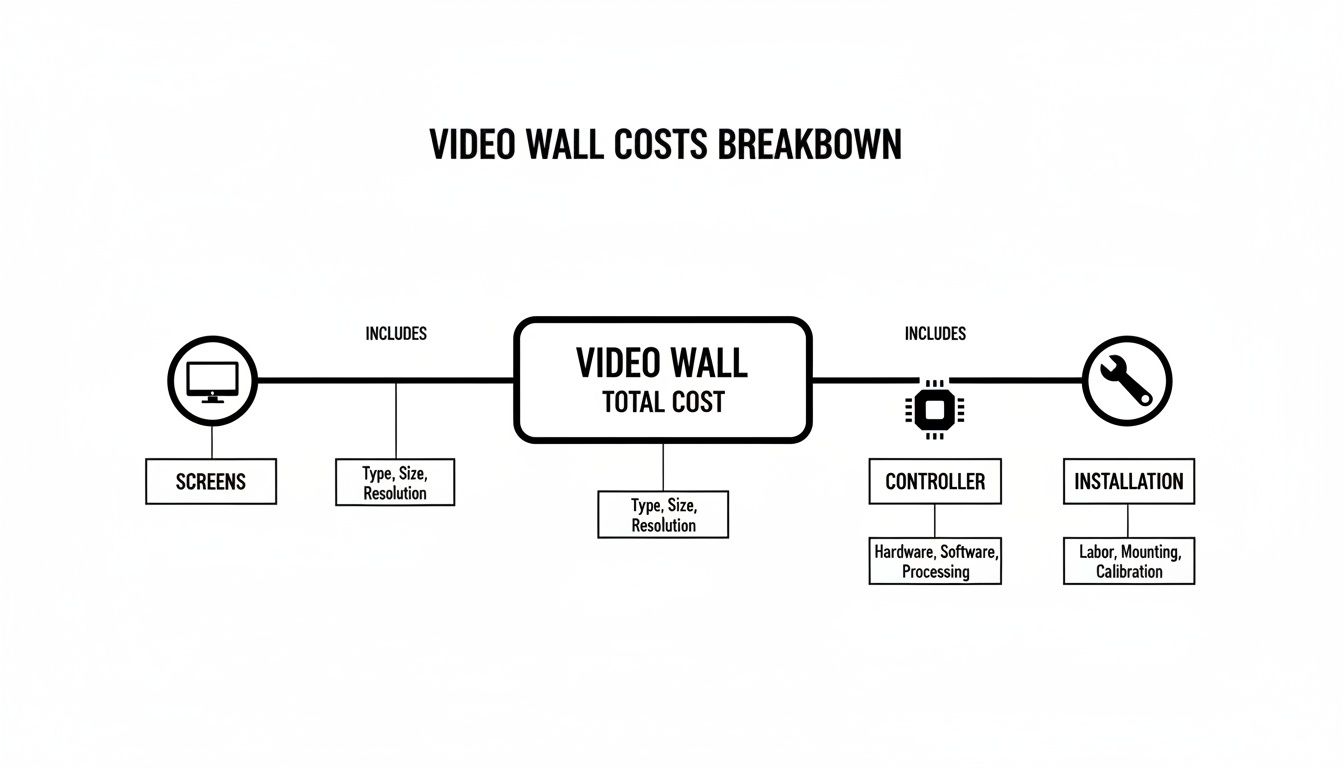
As you can see, while the screens are a major expense, components like the controller and professional installation are just as critical for a system that actually works flawlessly.
Once you’ve settled on LED, the next factor that dramatically sways your cost is pixel pitch. It sounds technical, but it’s simple: it’s the distance, in millimeters, from the center of one tiny LED light to the center of the next.
Think of it like the thread count on a high-quality bedsheet. A higher thread count means the threads are woven closer together, creating a smoother, more detailed fabric. Pixel pitch is the exact same concept for an LED display.
A smaller number (like 1.9mm) means the LEDs are packed in tight, giving you a higher resolution and a crystal-clear image that looks amazing even up close. A larger number (like 6mm) is perfect for viewers who are far away, like people driving past a highway billboard.
The key takeaway is this: you only need to pay for the resolution your audience can actually perceive. Choosing a pixel pitch that is too fine for your viewing distance is a common way to overspend without any tangible benefit to the viewer.
This decision directly hits your budget because a finer pitch requires exponentially more LEDs per square meter, which bumps up the manufacturing complexity and, you guessed it, the price.
The smartest way to manage hardware costs is to match your pixel pitch to your typical viewing distance. You don't need a 4K-equivalent screen for an audience standing 100 feet away. The table below breaks down this crucial relationship.
| Pixel Pitch (mm) | Optimal Viewing Distance | Common Use Case | Relative Cost Index |
|---|---|---|---|
| 0.9mm – 2.5mm | ~3 ft to 10 ft (Close-up, intimate viewing) | Corporate boardrooms, control rooms, retail | $$$$ (Highest) |
| 2.6mm – 5mm | ~10 ft to 25 ft (Moderate distance) | Church stages, event venues, large lobbies | $$ – $$$ (Balanced) |
| 6mm – 10mm+ | ~25 ft and beyond (Long-distance viewing) | Outdoor billboards, stadiums, arenas | $ (Most Affordable) |
As the table shows, a finer pitch is essential for up-close clarity, while a coarser pitch provides excellent value for large-scale, long-distance applications.
The market for LED video walls is exploding, projected to hit USD 53.01 billion by 2032, largely because the technology is getting better and more affordable. For example, fine-pitch LED walls that cost over $4,000 per square meter just a few years ago now run between $1,500-$3,000. Add in their long lifespan and the fact they can deliver up to 60% lower energy costs compared to older tech, and the investment becomes even more attractive. You can find more insights on the LED video wall market's growth on gminsights.com.
By putting yourself in your audience’s shoes, you can pick hardware that delivers that "wow" factor without paying for pixel density you simply don’t need.
It’s easy to do. When budgeting for a video wall, people often pour 90% of their focus into the price of the screens themselves. But the panels, while obviously a huge part of the cost, are just one piece of a much bigger puzzle. A video wall isn’t just a collection of screens; it's a complete, integrated system.
Think of it like buying a high-performance engine for a car. That powerful engine is useless on its own. You still need a transmission, a chassis, wheels, and a sophisticated electrical system to actually get it on the road. Your video wall is the same—the panels need a whole support structure of hardware and logistics to bring your vision to life.
These "hidden" costs aren't sneaky upsells. They're essential components for a successful, reliable installation. Let's pull back the curtain.
First up is the video wall controller, or processor. This is the command center, the brains behind the whole operation. It takes your content source—whether it’s a laptop, a live camera feed, or a dedicated media player—and intelligently stitches it together across all the individual panels to create one giant, seamless image.
A simple media player just can't cut it. It won't know how to manage the unique, massive resolutions of a video wall, juggle multiple video feeds, or let you create dynamic layouts with different windows. A dedicated processor is what gives you that power, letting you display a single stunning image or a dozen simultaneous feeds with perfect synchronization.
These can range from a few thousand dollars for a basic setup to tens of thousands for an advanced system in a mission-critical command center.
A great controller ensures your expensive new display looks flawless and just works. Skimping here is like putting a cheap computer chip in a supercomputer—it just bottlenecks the entire system and you'll never see the true potential of your screens.
Next is the mounting hardware. This isn't just a few brackets screwed to the wall; it’s an engineered steel framework that holds your entire video wall securely and in perfect alignment. One misaligned panel can ruin the entire illusion, and the mounting system is what prevents that from happening.
The complexity here directly impacts your budget.
The price gap between a standard mount and a custom-engineered structure can easily run into the thousands, making it a line item you can't ignore.
Finally, there are the logistical and infrastructure costs that are easy to forget but are absolutely non-negotiable. These are the details that often catch first-time buyers by surprise.
First, shipping and freight. LED panels are heavy, expensive, and surprisingly delicate. They don't just get tossed in a box; they're shipped in custom-built crates via specialized freight to prevent any damage. The cost for this reflects the care required, especially for a large project.
Next, you have to think about power and cooling. A big video wall pulls a lot of electricity and almost always requires dedicated circuits installed by a licensed electrician. All those electronics also generate a fair amount of heat. In a confined space, you might need to upgrade your HVAC or add dedicated cooling fans to keep the displays running at their optimal temperature. Overheating is a primary cause of premature failure.
These needs are critical for both indoor and outdoor setups. As we detail in our guide to outdoor LED sign costs, managing the elements is a huge factor in the overall price.
By planning for these essential components—controllers, mounts, and infrastructure—you'll build a realistic, all-in budget that ensures your project is a stunning success right from the start.
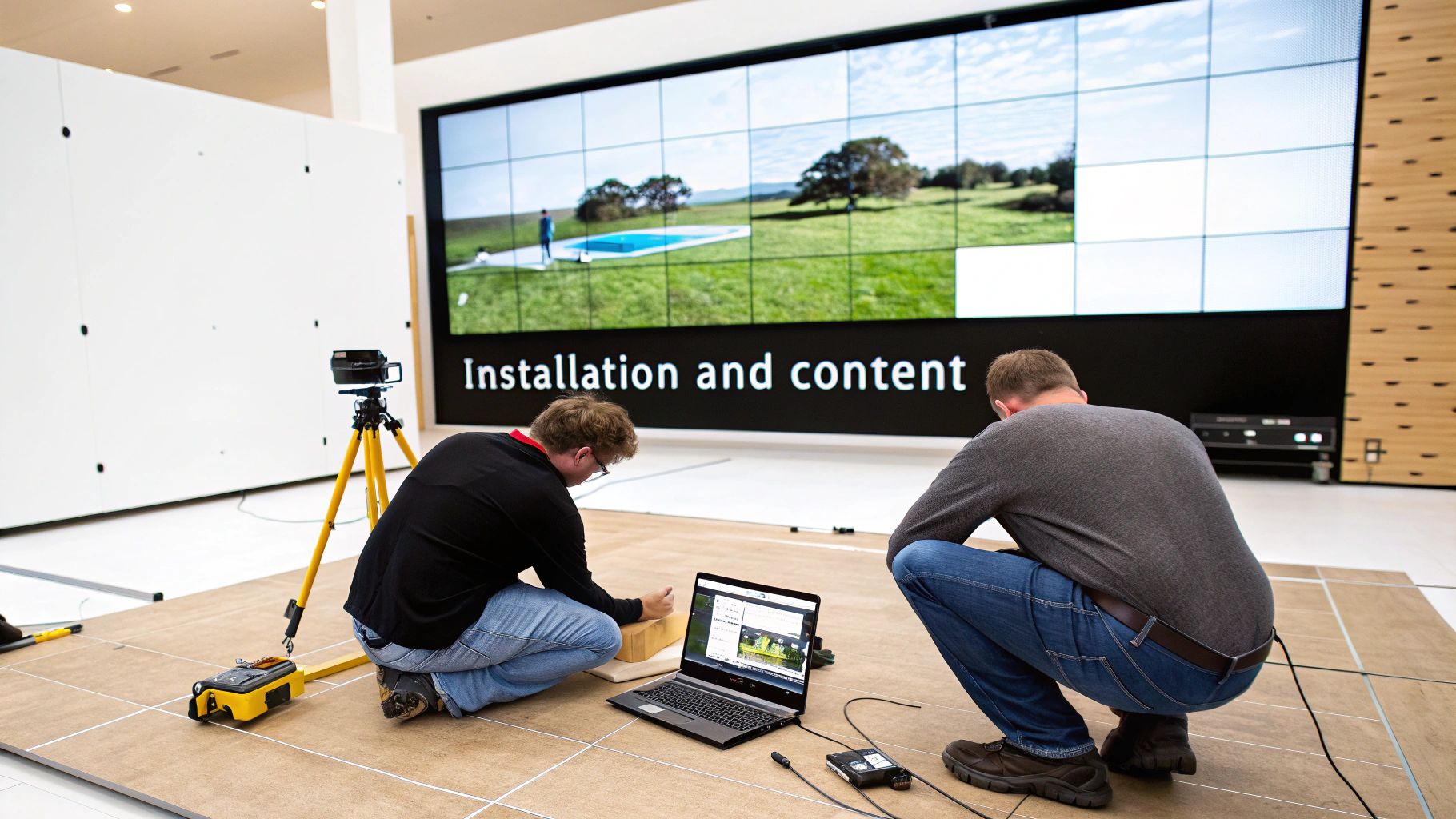
The LED panels themselves are just the beginning of the story. A brilliant screen is only as good as the team that installs it and the content that plays on it. Think of it like buying a world-class race car—it’s just a shiny piece of metal until you add a skilled driver and high-octane fuel.
Professional installation and compelling content are what transform a pile of hardware into a powerful communication tool. They're not afterthoughts; they are a significant part of your overall video wall investment, and budgeting for them upfront is critical for success.
This isn't a weekend DIY project. Professional installation is a highly specialized craft, and it’s a non-negotiable part of the process. A pro team does so much more than just hang screens on a wall; they ensure your investment performs flawlessly and safely for years to come. This meticulous service often accounts for 10-20% of the total project budget.
So, what are you actually paying for? It’s a multi-stage operation that demands engineering precision, deep technical knowledge, and an artist’s eye for detail.
Trying to self-install to shave a few dollars off the budget is a huge gamble. It's a fast track to damaged components, voided warranties, and a final product that looks misaligned and amateurish. Expert installation isn't an expense; it's insurance for your investment.
Once your wall is installed and calibrated, it’s an empty stage waiting for a performance. The content is that performance, and it deserves its own dedicated budget. There’s nothing more disappointing than seeing a beautiful, expensive screen showing blurry, poorly designed, or outdated visuals. It's a massive wasted opportunity.
Content creation costs can swing wildly, from simple template-based solutions to high-end custom productions. To get the most visual punch, it's crucial that your content is created at the exact right size for your new display; a great place to start is by understanding video aspect ratios.
Your content budget should line up with your goals:
Remember, research shows that dynamic digital displays can increase brand awareness by nearly 50%. By planning for both expert installation and a strategic content pipeline from day one, you ensure your video wall doesn't just get built—it gets results.
Theory is one thing, but seeing how these cost drivers stack up in a real project is where the rubber meets the road. Let’s move past the line items and build out a few common scenarios to give you a concrete feel for what a full video wall project actually costs.
Each of these examples is a complete, turnkey project. That means the budget isn't just for a pile of screens delivered to your door. It includes the panels, the controller, all the mounting hardware, professional installation, and even a basic content package to get you started. Think of these as all-in, "ready-to-go" estimates.
Picture a chic clothing boutique on a busy city street. Their goal is simple: stop people in their tracks. They want to showcase their latest collection with stunning, dynamic video and create an atmosphere that screams premium and modern. They need a display right behind their main window that looks absolutely flawless to people walking just a few feet away.
For this kind of up-close-and-personal application, a seamless LED wall is the only real choice. An LCD setup would leave a distracting grid of bezels, cheapening the whole look. Since the viewing distance is so short, a fine pixel pitch is non-negotiable for a sharp, high-end image.
Project Breakdown:
This isn't just a screen; it's a powerful visual merchandising tool that turns a static window into a dynamic advertising platform you can update in seconds.
Now let's shift gears completely to a massive digital billboard on a major highway. Here, the goal is pure revenue generation from ad sales. The screen has to be enormous, bright enough to punch through direct sunlight, and tough enough to handle years of rain, snow, and heat.
No one's looking at this up close. The entire audience is in cars whizzing by hundreds of feet away. This is great news for the budget because it allows for a much larger, more cost-effective pixel pitch.
Project Breakdown:
It's a significant initial outlay, for sure. But a digital billboard in a prime location can become a money-printing machine, generating substantial, recurring advertising income and delivering a killer ROI.
Our last scenario takes the retail concept and cranks it up a notch with interactivity. This is for a flagship electronics store that doesn't just want to show ads—they want to create an immersive brand experience. Customers can actually touch the screen to explore product features, watch tutorials, or even place an order right there. The wall goes from being a passive display to an active sales tool.
Adding interactivity is a proven way to get customers to stick around. When users can actually control the content, their dwell time—how long they engage with the display—can jump by as much as 35-50%. That translates directly to higher sales.
This kind of magic requires specialized hardware, like an infrared (IR) touch frame that fits perfectly over the video wall, plus more sophisticated software to run the interactive content.
The market for interactive walls, currently valued at a staggering USD 19.37 billion, is set to explode as more businesses catch on. Adding touch capability typically adds a 40-60% premium over a standard wall, but when it can boost sales by over 20%, many businesses see a full return on their investment in just 12 to 18 months. You can discover more insights on the growth of interactive displays in recent market analysis.
Project Breakdown:
This is the kind of forward-thinking investment that blurs the line between digital and physical retail, creating a memorable experience that builds both brand loyalty and direct revenue.
Getting a jaw-dropping video wall doesn't have to mean liquidating your entire capital budget. With a little strategic thinking, you can get stunning results without breaking the bank. It all comes down to smart planning and focusing on real-world value, not just chasing the highest specs on a sheet.
The single biggest mistake we see people make? Paying for technology their audience will never even notice. For example, buying an ultra-fine pixel pitch display for a wall that will only ever be seen from 50 feet away is like buying a Ferrari to sit in city traffic—you're paying a premium for performance you simply can't use. The quickest way to get your hardware costs under control is to match the pixel pitch to your actual viewing distance.
Another powerful move is to phase your project. You don't have to build the entire dream system on day one. You can start with a smaller, high-impact display right now, but design it with the backbone to easily expand later on as your budget frees up. This lets you align a major investment with your actual cash flow.
A truly smart investment looks at the complete picture, not just the number on the initial quote. This is where the concept of Total Cost of Ownership (TCO) becomes your best friend. TCO forces you to account for every expense over the entire life of your video wall, including things like:
Thinking in terms of TCO helps you pick a system that delivers far better long-term value, even if another option looks a little cheaper at first glance. This is especially critical for permanent installations like the kinds you might see in our gallery of digital outdoor signage.
One of the most effective ways to stretch your budget is to rethink how you buy the hardware in the first place. When you work directly with a factory provider like Smart LED Inc., you completely cut out the layers of distributors and resellers who each add their own markup along the way.
By going factory-direct, you eliminate the "middleman tax" that can inflate video wall costs by 20-30% or more. You can either pocket those savings or reinvest them into a bigger, higher-resolution screen.
This direct relationship also gives you priceless access to expert engineers and support through the entire journey, from the first sketch to the final installation. And for businesses looking to get the most out of their screen, understanding broader video marketing strategies can offer some fantastic, budget-friendly ideas for creating content. At the end of the day, a smarter purchasing model is the surest way to get the most powerful visual solution for every single dollar you invest.
When you're getting serious about a project, a few big questions always bubble to the surface. Getting them answered upfront isn't just helpful—it’s essential for making sure there are no surprises down the road and moving forward with confidence.
Let's break down the most common ones we hear.
Pricing can come at you in a few different ways: per panel, per square foot, or as one big turnkey package. While it's good to know the hardware cost per unit, the turnkey price is almost always the most useful number. Why? Because it wraps everything—the screens, the software, the mounting hardware, and the professional installation—into a single, clear figure.
When you're comparing quotes, always ask what's actually included. You need to be sure you're comparing apples to apples. A factory-direct approach, like ours, usually simplifies this by offering more inclusive pricing from the start, which cuts way down on those "gotcha" fees later on.
Once your wall is up and running, the initial investment is done, but there are some day-to-day costs to keep in mind. The main ones are electricity, any potential software subscriptions for your content management system, creating or updating your content, and any long-term maintenance.
Modern LED walls are incredibly reliable and built to last with minimal fuss, but a service agreement is a smart way to protect your investment for years to come. Plus, opting for energy-efficient LEDs from the get-go is one of the single best moves you can make to keep your total cost of ownership low.
Look, I get the temptation. It seems like a straightforward way to trim the budget. But for a professional-grade video wall, a DIY installation is a huge gamble that almost never pays off. These systems require razor-thin precision in alignment, rock-solid mounting, and expert calibration to create that flawless, single-canvas look.
One wrong move and you could damage a very expensive panel, void your warranty, or end up with a glitchy, misaligned display that completely undermines the whole point of your investment. Think of professional installation not as a cost, but as an insurance policy on performance, safety, and longevity. It guarantees your wall looks and works exactly as it should from the moment it’s switched on.
Ready to transform your space with a stunning visual centerpiece? The experts at Smart LED Inc. are here to help you design the perfect video wall solution for your budget and goals. Explore our custom options and get a direct quote today.
Picture this: you take the flash and spectacle of a Times Square billboard, slap it on the back of a truck, and send it wherever
A wall of TV screens is exactly what it sounds like: a big, impressive display made by tiling multiple TVs together so they act like

Picking the right displays for shows can feel like a high-stakes guessing game. Get it right, and you create an immersive world that captivates your
"*" indicates required fields