
Uncategorized
Digital Billboard Truck: Boost Your Campaign with Mobile Ads
Picture this: you take the flash and spectacle of a Times Square billboard, slap it on the back of a truck, and send it wherever
Think of a video display wall as a way to turn a blank surface into one massive, seamless digital canvas. It's not just a big TV—it's a system of individual screens working together to create powerful, immersive visuals that can captivate an audience in just about any environment.
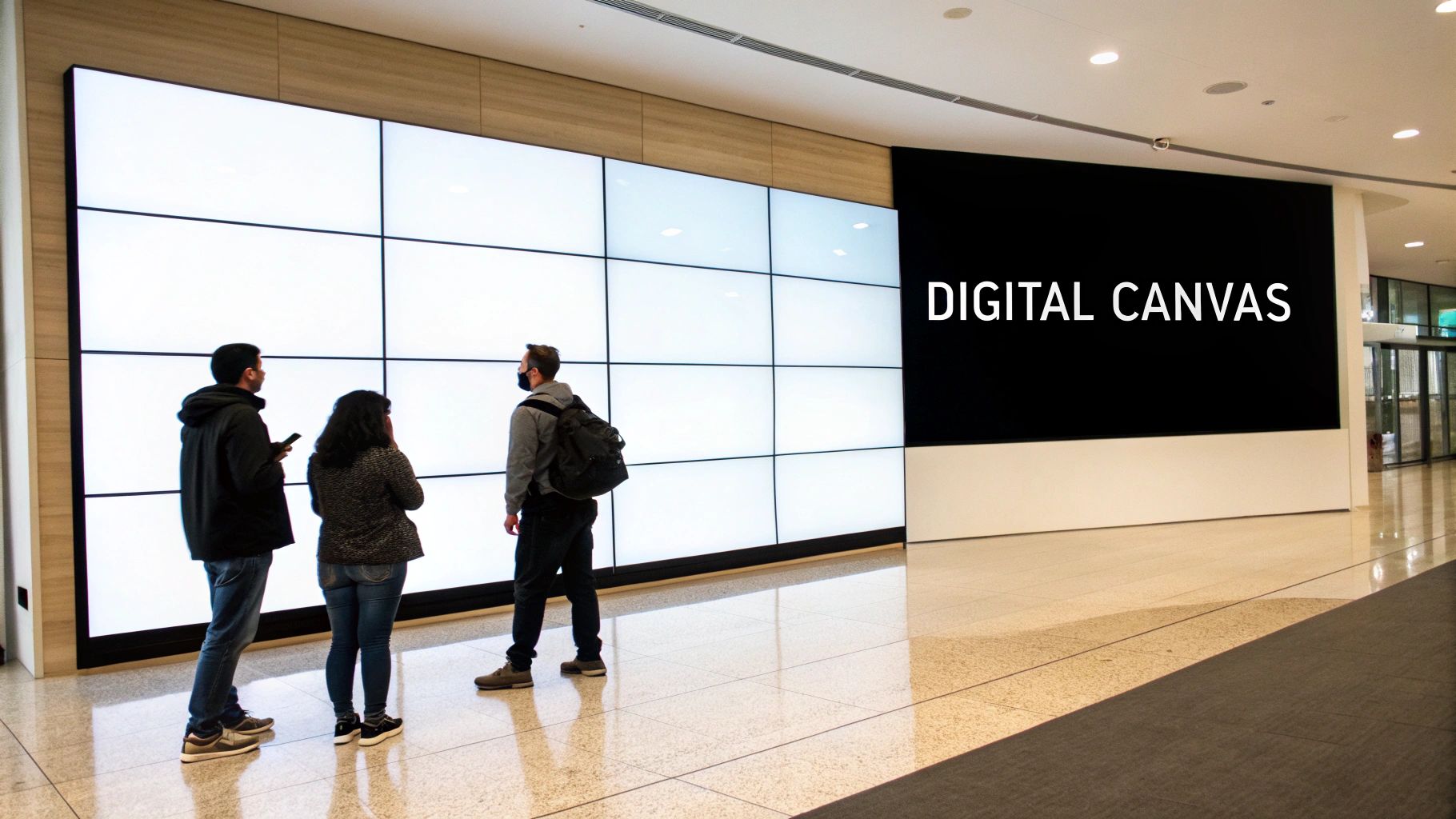
Picture walking into a corporate lobby where an entire wall comes alive with a stunning, high-definition welcome message. Or imagine a retail storefront that stops you in your tracks with vibrant, larger-than-life product showcases. That's the power of a video display wall. It’s a system of individual displays—like LED panels or LCD screens—tiled together to function as a single, large-scale visual surface.
Unlike a standalone TV or a projector, a video wall is completely modular. This design gives you incredible flexibility to create displays of virtually any size, shape, or scale. You can build a standard rectangle for a control room or get creative with an artistic, freeform arrangement in a museum. The goal is always the same: deliver high-impact content that a smaller screen simply can't, turning a passive space into an active, engaging environment.
At the heart of every video wall are two core technologies that define how it looks, performs, and where it works best. Getting a handle on these is the first step in planning your project.
A video display wall is not just about size; it's about impact. It transforms a physical space into a powerful storytelling medium, capable of communicating a brand's message, displaying critical data, or creating an unforgettable atmosphere.
The move toward these massive displays isn't just a fleeting trend; it’s a real shift in how we communicate visually. The global video wall market, currently valued at USD 2.0 billion, is expected to skyrocket to USD 7.98 billion by 2032, growing at a healthy 9.76% CAGR.
LED technology is clearly leading the charge, pulling in over 59% of global revenue thanks to its superior brightness and seamless visuals—exactly what Smart LED Inc. specializes in for both our indoor and outdoor solutions. With North America accounting for over 35% of the market, the demand for high-impact displays in retail, corporate, and entertainment venues is only getting stronger. You can dive deeper into these video wall market findings to see the full picture.
When you’re deciding on a video display wall, you're not just buying a screen; you're choosing the canvas for your digital masterpiece. The choice almost always boils down to two heavyweight contenders: Direct View LED (DV-LED) and Liquid Crystal Display (LCD). Getting to the heart of their differences is the secret to matching the right tech to your vision and environment.
Think of an LCD video wall as a high-tech jigsaw puzzle. It’s built by tiling together a bunch of individual TV-like panels to create one giant image. It works, but there's a catch: each panel has a thin border called a bezel. These bezels create a visible grid of seams that can break up your content, which is especially noticeable when you're standing close.
A DV-LED video wall, on the other hand, is more like a perfectly smooth, seamless digital mosaic. It’s constructed from smaller LED modules that fit together without any borders or gaps at all. The result? A completely uninterrupted, single-surface picture that delivers a truly immersive experience, free from those distracting grid lines you see on LCD walls.
Before we dive deeper, here's a quick side-by-side look at how these two technologies stack up.
This table provides a head-to-head comparison of the two main video wall technologies, helping you quickly identify the best option for your needs based on key performance characteristics.
| Feature | Direct View LED (Smart LED Inc. Specialty) | LCD Video Wall |
|---|---|---|
| Seamlessness | Completely seamless; creates one unified image. | Visible seams (bezels) between panels. |
| Brightness | Extremely high; suitable for direct sunlight and outdoor use. | Good for indoors; struggles in bright ambient light. |
| Design Flexibility | Highly flexible; can create curves, corners, and custom shapes. | Limited to flat, rectangular configurations. |
| Longevity | 8-10+ years of continuous operation. | Typically 5-7 years. |
| Color Uniformity | Excellent and consistent across the entire display over time. | Can degrade over time, with panels aging at different rates. |
| Best Use Cases | High-impact retail, large venues, outdoor advertising, stages. | Control rooms, corporate meeting rooms, smaller indoor displays. |
| Initial Cost | Higher upfront investment, but lower total cost of ownership. | Lower initial cost, especially for smaller standard sizes. |
As you can see, while both have their place, Direct View LED offers a level of visual impact and flexibility that LCD simply can't match.
There's a reason the entire display industry is moving full-steam ahead with Direct View LED. The biggest win is the total lack of seams, which gives you flawless, continuous visuals across any size or shape you can imagine. This is what makes it the go-to choice for dynamic stage backdrops or jaw-dropping displays in corporate lobbies where making a premium impression is everything.
Another massive strength is its raw brightness. DV-LED panels can pump out incredibly vibrant images that stay crisp and punchy even in direct sunlight. This makes them the only real choice for outdoor billboards and super-bright indoor spaces like shopping malls or airport terminals.
And then there's the design freedom. Because it's a modular system, you can arrange the panels in almost any configuration—curves, corners, even abstract shapes that flow with the building's architecture. To see how these versatile displays are being used in all kinds of settings, check out our guide on Smart LED indoor LED wall panels.
While LED is grabbing the headlines, LCD video walls still have their corner of the market. Their main advantage is pixel density. Since LCD panels are manufactured as single, self-contained units, they can pack in incredibly high resolutions (like 4K) into a relatively small space. This makes them a good fit for applications where people will be standing very close to the screen, like looking at detailed data in a control room.
Historically, LCD was also the more budget-friendly option, especially for smaller, standard-sized installations. But as LED technology has gotten better and more affordable, that cost gap has shrunk dramatically, particularly when you factor in the total cost of ownership over the display's lifetime.
The most significant distinction is the viewing experience. LCDs present a gridded, multi-screen image, while DV-LEDs deliver a single, unified canvas. For ultimate visual impact, the seamless nature of LED is unmatched.
The market trends tell the same story. The global LED video wall market was valued at USD 14.98 billion and is on track to hit USD 33.87 billion by 2033. DV-LED technology is leading that charge, holding a commanding 51.23% share. This explosive growth is being driven by huge demand in sports arenas, retail, and corporate communications, pushing the U.S. market alone toward a projected USD 5.64 billion by 2033. You can dig into more of these numbers in the comprehensive LED video wall market report.
Jumping into the technical side of a video display wall can feel a lot like trying to read a foreign language. You hear terms like "pixel pitch" and "nits" thrown around, but what do they actually mean for the final picture? Let’s cut through the jargon and get to what really impacts the viewing experience.
Nailing these key metrics is what separates a good investment from a great one. It gives you the power to glance at a spec sheet and know exactly how a display will perform in your space, whether that's an intimate corporate boardroom or a sun-blasted storefront window.
Think of pixel pitch like the thread count in a set of luxury bedsheets. A higher thread count means the threads are woven tighter, creating a smoother, softer feel. It’s the same idea here: a lower pixel pitch number means the individual pixels—the tiny dots of light on an LED panel—are packed closer together.
This proximity creates a denser, higher-resolution image that looks razor-sharp and totally seamless, even when you’re standing right in front of it. A display with a fine pixel pitch, like 1.2mm, is perfect for a boardroom where people are up close. On the other hand, a massive billboard on the side of a highway might use a much larger pitch, like 10mm, because the viewing distance makes the individual pixels blend together perfectly.
The golden rule for pixel pitch is simple: the closer your audience is to the screen, the smaller (or "finer") the pixel pitch needs to be to deliver a smooth, pixel-free image.
Ever tried to watch a TV in a bright, sun-filled room? The screen gets washed out, and it's almost impossible to see what's happening. That's a battle of brightness, and it’s a make-or-break spec for any video wall.
Brightness is measured in a unit called nits. Your TV at home probably puts out around 250-350 nits, which is fine for a dark living room. But an outdoor digital billboard has to go head-to-head with the sun, so it needs a staggering 5,000 nits or more to stay vibrant and readable.
This concept map breaks down the fundamental difference in how LED and LCD technologies produce light, which is at the core of their performance.
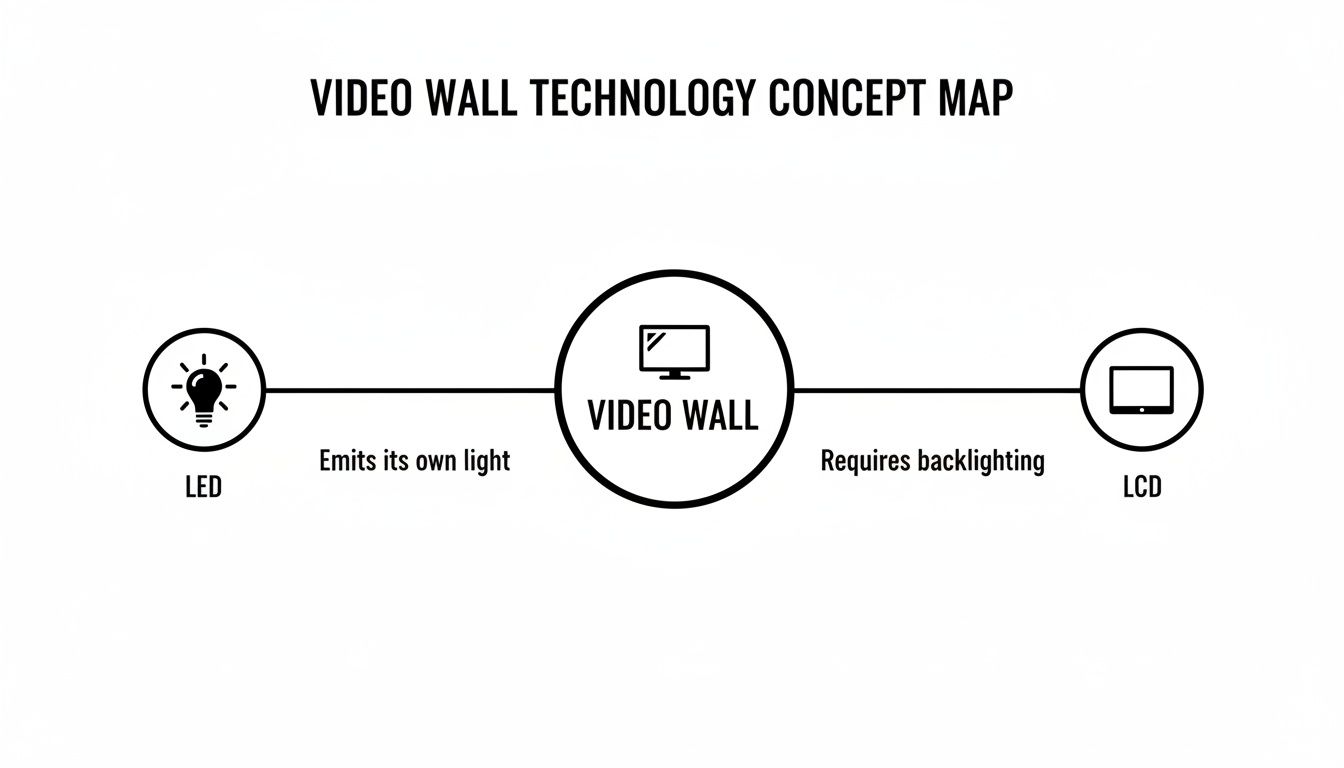
As you can see, LEDs are self-emissive. Each tiny pixel is its own light source, which gives them incredible control over brightness and contrast compared to LCDs, which need a separate backlight.
Finally, two more specs are the secret ingredients to a truly premium and immersive experience. They might sound technical, but they have a huge impact on what you see.
Remember flipbooks? The faster you flip the pages, the smoother the animation looks. Refresh rate, measured in Hertz (Hz), is the digital version of that. It tells you how many times per second the image on the screen gets updated. A high refresh rate, like 3840Hz, delivers buttery-smooth motion without any of that annoying blurring or stuttering, which is a must-have for watching sports or action-packed video.
Contrast ratio, meanwhile, is what creates visual depth and richness. It’s the difference between the brightest white and the darkest black a display can create. A high contrast ratio means you get deep, inky blacks and brilliant, punchy whites. This is what makes colors pop and gives the image a dynamic, almost cinematic quality, preventing dark scenes from looking gray and washed out.
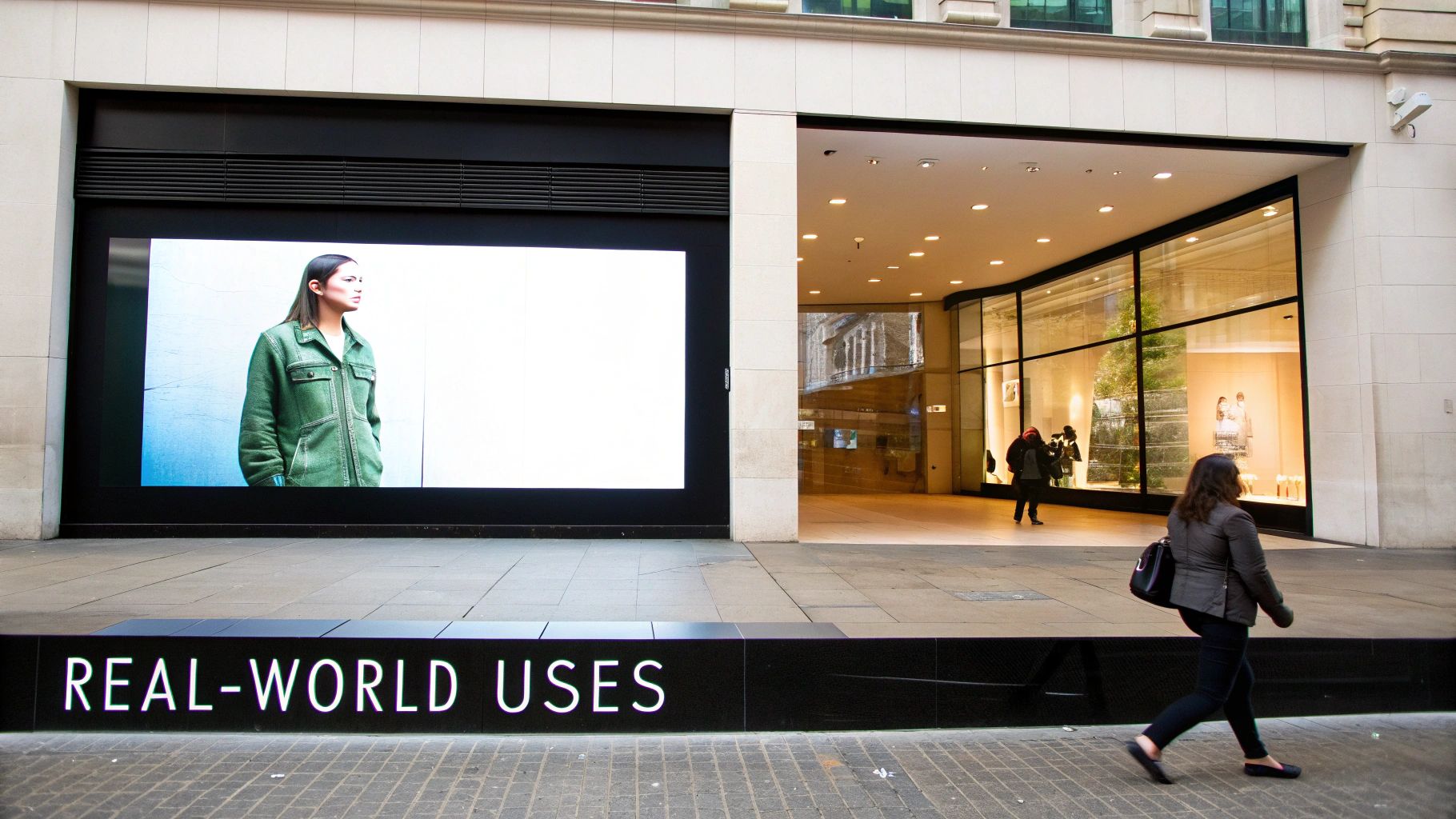
It’s one thing to understand the tech specs of a video display wall, but it’s another thing entirely to see how one can completely transform a space. That’s where the real magic happens.
This technology is incredibly versatile, going far beyond simple signage to create unforgettable experiences pretty much anywhere you can imagine. From retail floors to mission-critical command centers, a video wall becomes a living, breathing focal point.
Let's dive into the real-world applications where these impressive displays are making the biggest splash. It'll help you see exactly how a video wall could bring your own goals to life.
In the hyper-competitive worlds of retail and Digital Out-of-Home (DOOH) advertising, grabbing attention is the name of the game. A video display wall isn't just a sign; it's a powerful magnet for foot traffic, turning a passive storefront into an active, can't-miss brand statement.
Picture a small business using a brilliant, seamless LED sign to show off new products with vibrant, life-sized video. That kind of dynamic content is worlds more compelling than a static poster. It literally stops people in their tracks and pulls them inside.
For bigger retailers, massive in-store displays can create entire immersive brand zones or spotlight promotions with stunning clarity, influencing buying decisions right there on the spot. You can explore our guide on how LED signs for businesses can drive these kinds of results.
In a corporate environment, a video display wall completely redefines how teams communicate and collaborate. Think of a boardroom with an ultra-wide, high-resolution screen presenting complex data, video conferences, and presentations all on a single, seamless canvas. Everyone in the room—and everyone dialing in remotely—gets a crystal-clear view of what matters.
It's the same story in university lecture halls and corporate training centers. Video walls are used to deliver rich multimedia content that genuinely keeps an audience plugged in. From detailed diagrams to live video feeds, the sheer scale and clarity of the display make complex information easier to absorb and far more impactful.
The next frontier is interactivity. Touch-enabled video walls are transforming how people engage with digital content, creating collaborative and personalized experiences that were once impossible.
This interactive trend is backed by some serious market growth. The global interactive video wall market, valued at USD 24.98 billion, is projected to rocket to USD 59.78 billion by 2033, with LED displays already holding a 51.7% market share. This boom is fueled by applications that boost engagement, like event spaces seeing a 25% rise in attendance with touchless interfaces.
For live events, houses of worship, and performance venues, the atmosphere is everything. A video display wall can serve as a stunning, dynamic stage backdrop that elevates every concert, sermon, or presentation to a new level. Its ability to show custom graphics, abstract visuals, and live video feeds creates an immersive environment that connects with the audience on a deeper level.
For events and exhibitions, a video display wall often becomes the central visual anchor, much like other specialized dynamic event backdrops, dialing up the atmosphere and engagement.
The same idea holds true for luxury home theaters. A seamless LED video wall delivers a true cinema-grade experience, with perfect color accuracy and deep, inky blacks that make you feel like you're part of the action. It completely eliminates the distracting bezels and projection issues of other systems, creating the ultimate viewing environment for film buffs.
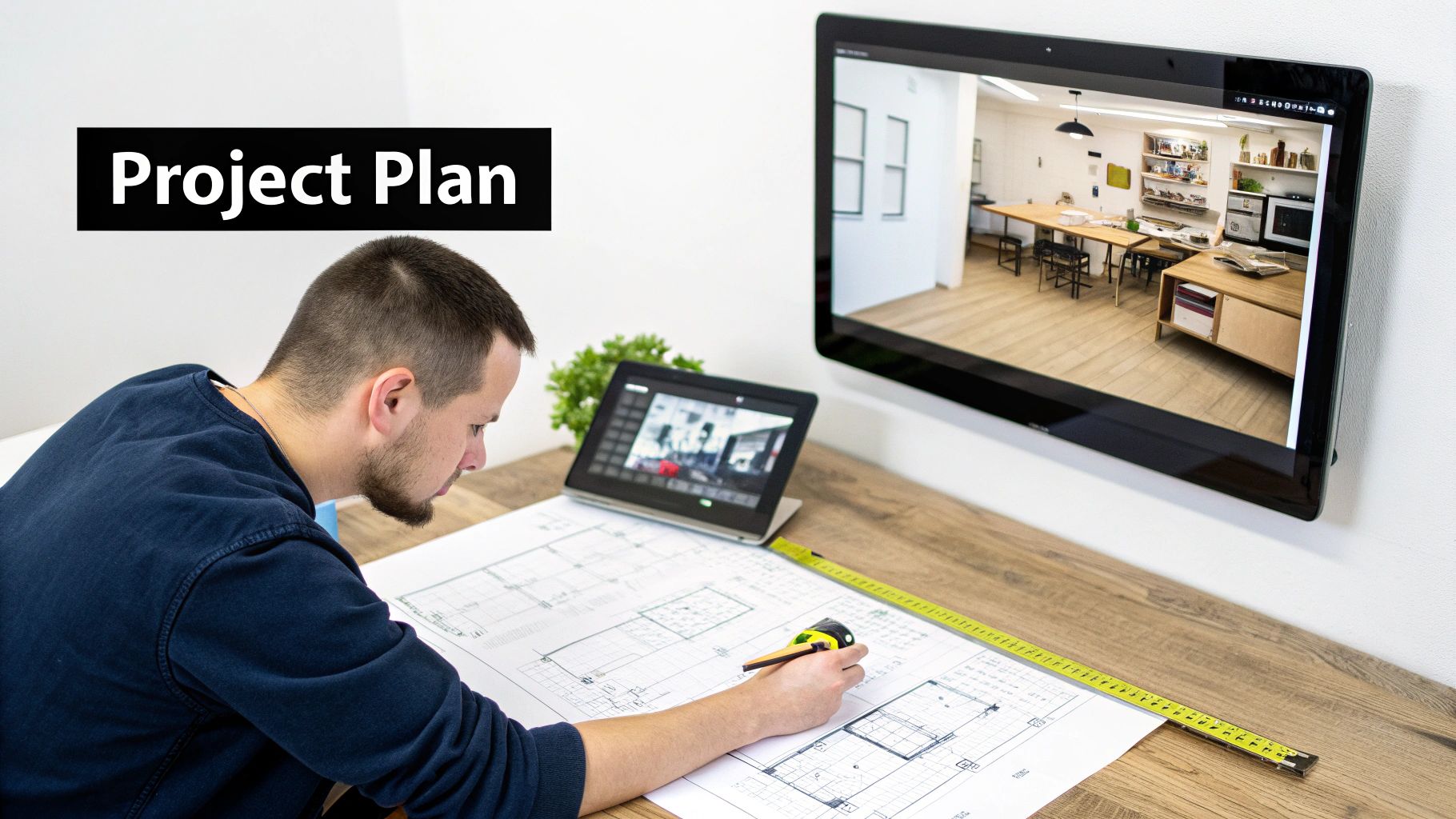
Turning a blank wall into a dynamic digital canvas is an exciting thought, but a truly successful outcome always starts with careful planning. A video display wall is a serious investment in your space, and mapping out the critical details beforehand is the only way to ensure you get the performance, look, and durability you’re paying for.
This goes way beyond just picking a screen size. You have to think about how your audience will actually see and interact with the display, what kind of content it will show, and the physical realities of the room it’s going into. A clear roadmap isn't just a nice-to-have; it's the first step toward a stunning final product.
Let's walk through what it takes to bring your video wall from a concept on paper to a brilliant reality.
First things first: you have to match the display’s physical specs to its purpose and location. This is where you decide on the right dimensions and the nitty-gritty technical details, all guided by two main things: viewing distance and content resolution.
Think about your audience. Where will they be standing? The distance from their eyes to the screen is what determines the perfect pixel pitch. A display in a boardroom, where people are just a few feet away, needs a very fine pitch (like 1.5mm) to look smooth and sharp. On the other hand, a massive video wall in an atrium viewed from 50 feet away can get away with a larger pitch without anyone noticing a difference.
Just as important are the wall's dimensions and its ability to hold everything up.
Once your design is locked in, the next step is figuring out how the video wall will physically become part of your space. The mounting solution you choose doesn't just affect how the display looks; it also impacts how easy it is to service down the line.
The most common approach is a direct wall-mounted setup, which puts the display flush against a surface. This is perfect for that sleek, built-in appearance you see in lobbies, control rooms, or high-end home theaters. But if you don't have a suitable wall or need a temporary setup, a free-standing structure gives you incredible flexibility.
A professional installation isn't just a recommendation; it's essential for safety, performance, and longevity. Certified technicians ensure the structure is secure, the panels are perfectly aligned, and the system is calibrated for optimal image quality.
Creative installations can also make a huge statement. Curved video walls can wrap around columns or create immersive, C-shaped displays. Corner installations can turn a dead space into a visual centerpiece. This is where the modular nature of LED really shines, allowing for custom shapes and sizes that are simply impossible with old-school LCD panels.
One of the biggest advantages of a Direct View LED video wall is its incredible durability and simple maintenance. It's a different world from LCD walls, where one failed panel can cause a major headache and disruption.
Our LED video walls are built from individual modules. If one ever has an issue, it can be popped out from the front and replaced in minutes—no need to take the whole display apart. This modular design means far less downtime and a much lower cost of ownership over the long haul. High-quality LED panels are rated for 8-10+ years of continuous use, making them a reliable asset you can count on for years.
While the initial investment for a video wall can feel big, its ROI is about more than just direct revenue. It cuts long-term costs by getting rid of printed signs and posters and gives you an incredibly powerful platform for building your brand. If you're looking at outdoor displays, understanding all the cost factors is key. You can get some great insights in our detailed guide on outdoor LED sign costs.
Making the right call on a video display wall is a big deal. It’s a serious investment, and to make sure it pays off with incredible visuals and rock-solid reliability, you need to ask the right questions before you sign on the dotted line. Think of this checklist as your roadmap, turning everything we've talked about into a simple, actionable guide.
Following this process is like drawing up a blueprint for your project. You'll move from a vague idea to a specific, well-thought-out plan. The result? A final product that absolutely nails your goals.
First things first: what is this display for? Pinpointing its core purpose is the single most important step, as it immediately starts narrowing down your technology choices.
Next, you have to get real about the space where your video wall will live. The environment itself will dictate the technical specs you need for the screen to look its best.
The most common mistake we see is underestimating the impact of ambient light. A display that looks absolutely brilliant in a dark showroom can look completely washed out in a bright, sunlit atrium. This makes brightness (measured in nits) a non-negotiable spec to get right.
Think about how far away people will be. Is your audience just a few feet away in a boardroom, or are they hundreds of feet back at a stadium? This viewing distance is the key factor in determining the perfect pixel pitch for a smooth, seamless image. The closer the viewer, the finer (smaller number) the pixel pitch needs to be.
Once you've locked in your goals and understand your environment, it's time to nail down the final details and pick the right team to work with.
By walking through this checklist, you're not just buying a screen; you're making a smart, informed decision. You’re setting yourself up for a display that doesn't just meet your expectations but blows them away.
Even after you've seen the tech and dreamed up the possibilities, some practical questions always pop up. It's a big decision, and you want to get it right. To help you feel confident moving forward, we’ve put together straight-to-the-point answers for the questions we hear most often from our clients.
Let's dig into the details that come up when you're getting serious—from budgeting and lifespan to controlling your content. Nailing these things down is what makes a project a true success from day one.
This is the big one, and the honest answer is: it varies—a lot. The final price tag depends on a few key things: the technology you choose (LED is usually a bigger upfront investment than LCD), the sheer size of the wall, and the pixel pitch. A smaller indoor LCD setup for a conference room might be in the low thousands, while a massive, super-fine-pitch outdoor LED screen is a much more significant investment.
But the sticker price is only part of the story. You have to think about the total cost of ownership. That includes:
Here’s where modern display tech really shines. A high-quality Direct View LED video wall is built for the long haul, typically rated for an incredible 100,000 hours of operation. That’s more than 11 years of running 24/7. In comparison, LCD video walls usually clock in around 50,000 to 60,000 hours.
Of course, a little TLC goes a long way. Simple things like regular cleaning and making sure the unit has good airflow will help you get the most out of any display wall. The cool thing about LED walls is that they're modular. If one little diode ever goes out, you don't have to panic—you can just swap out that single panel, which means the system can keep running pretty much indefinitely.
This part is way easier than most people think. Everything is run by a Content Management System (CMS). The best way to think of a CMS is as the "brain" of your video wall. It’s where you upload your images, videos, and graphics, then create a schedule to tell them when and how to play.
Most modern systems are incredibly user-friendly and can be controlled from any computer with an internet connection. That means you can change a daily special at your restaurant or switch up the presentation in a boardroom from halfway across the world. It gives you amazing flexibility and makes printed signs a thing of the past.
A lot of people assume video walls are a technical nightmare to operate. The reality? A well-designed system with a good CMS makes updating content as simple as posting on social media. It empowers your team to keep your messaging fresh and exciting without needing an IT degree.
Ready to transform your space with a visual centerpiece that truly wows? At Smart LED Inc., we are factory-direct leaders in creating high-impact indoor and outdoor video display wall solutions. We handle everything from design to installation, ensuring you get a seamless, reliable system that captivates your audience and delivers results for years to come. Explore your options and start your project today at https://smartledinc.com.
Picture this: you take the flash and spectacle of a Times Square billboard, slap it on the back of a truck, and send it wherever
A wall of TV screens is exactly what it sounds like: a big, impressive display made by tiling multiple TVs together so they act like

Picking the right displays for shows can feel like a high-stakes guessing game. Get it right, and you create an immersive world that captivates your
"*" indicates required fields