
Uncategorized
Digital Billboard Truck: Boost Your Campaign with Mobile Ads
Picture this: you take the flash and spectacle of a Times Square billboard, slap it on the back of a truck, and send it wherever
Ever been to a concert or a big corporate event and been completely mesmerized by the massive, brilliant screen behind the performers? That's a stage led screen. It’s not a giant TV; it’s a massive digital canvas built from individual light-emitting diode (LED) panels, all working together to create one seamless, stunning image.
This technology has quickly become the industry standard, leaving old-school projectors in the dust thanks to its incredible brightness and crystal-clear quality.
Think of a stage LED screen less like a single display and more like a high-tech mosaic. It's constructed from smaller, interlocking tiles called LED modules. Each of these modules is packed with thousands of tiny light sources—the LEDs, or pixels—that combine to form a single, cohesive picture. This modular design is its superpower, allowing crews to build screens of almost any size or shape imaginable.
These individual modules are protected by sturdy frames called cabinets. To build the final screen, these cabinets are either stacked from the ground up or rigged to fly from overhead structures. The "brain" of the whole operation is a central video processor. It takes a feed from a source like a laptop or a live camera and tells every single pixel what color and brightness to be, orchestrating the entire visual experience.
For a long time, projectors were the only game in town for large-scale visuals. But anyone who’s tried to use one in a well-lit room knows their fatal flaw: they struggle with ambient light and often produce washed-out, disappointing images. A stage LED screen doesn't have that problem.
To get a real feel for what's possible, checking out different LED video wall solutions can show you just how varied and specialized these systems can be. This technological leap has completely reshaped the live events industry.
This market's expansion is not just about replacing older tech; it’s about enabling new creative possibilities. The ability to build custom visual experiences is why LED technology now dominates stages worldwide.
The growth numbers are staggering. The global LED display market, which includes the stage led screen segment, was valued at around USD 8.96 billion in 2023. That’s up more than 30% from 2020, and it's on track to blow past USD 12 billion by 2028. You can discover more insights about the LED market to see just how fast things are moving. With this basic understanding down, we can start getting into the nitty-gritty details that will matter for your specific project.
Diving into the world of stage LED screens means staring down a spec sheet full of technical terms. It can feel like trying to read a different language, but every number tells a crucial part of the story about how the screen will actually perform in your space.
Understanding these core specs is the key to choosing a screen that delivers a jaw-dropping visual experience, not just one with the biggest numbers on paper. It's a lot like buying a camera—you wouldn't just look at megapixels. You’d think about the lens quality, sensor size, and how it handles low light. A stage led screen is no different; a few key metrics determine its real-world impact.
Let's break them down.
Here’s a simple look at how the core components of a stage LED screen system all connect and talk to each other.
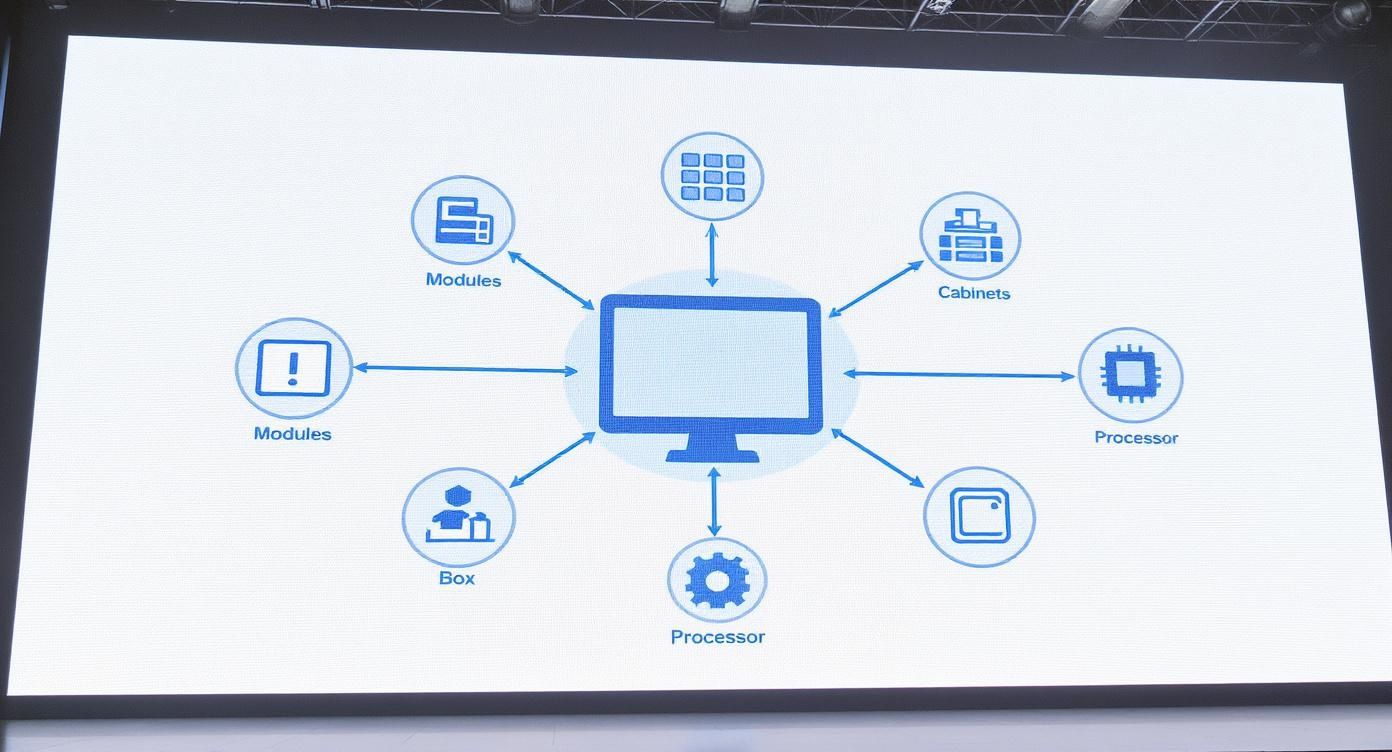
As you can see, the processor is the brain of the operation. It sends signals to individual cabinets, which are built from smaller modules, all working together to create that final, seamless image.
Pixel pitch is arguably the most important spec you'll run into. It’s simply the distance, in millimeters, from the center of one pixel to the center of the next. The smaller the pixel pitch, the tighter the pixels are packed together.
Think of it like a photograph made of tiny dots. From far away, any photo looks clear. But as you get closer, a photo with fewer, larger dots starts to look blocky or "pixelated." One with millions of tiny, dense dots stays sharp even when your nose is almost touching it. A stage led screen works the exact same way.
A smaller pixel pitch number (like P2.5) means higher resolution and a closer minimum viewing distance. A larger number (like P6) is better suited for audiences who are much farther away.
The market for small pixel pitch screens tells an interesting story. In 2023, while the total sales value for these high-res screens dipped slightly, the total area shipped grew by a massive 16.7% to over a million square meters. This shows that while prices are getting more competitive, the demand for sharp, up-close displays is absolutely booming. You can dig into the numbers in this in-depth LED market analysis.
Getting the pixel pitch right is all about your audience's viewing distance. Here's a quick guide to help you match the right pitch to your space.
| Pixel Pitch (mm) | Minimum Viewing Distance (Meters) | Optimal Viewing Distance (Meters) |
|---|---|---|
| P2.5 | 2.5 | 5 |
| P3.91 | 4 | 8 |
| P4.81 | 5 | 10 |
| P6 | 6 | 12 |
| P10 | 10 | 20 |
This table gives you a solid starting point for figuring out what resolution you truly need, preventing you from overspending on a pixel pitch that your audience won't even notice.
An LED screen's brightness is measured in nits. A nit is just a standard unit of brightness, and the number you need depends entirely on where you're putting the screen. An indoor screen for a corporate event or church might only need 800-1,500 nits to look brilliant.
But an outdoor music festival? That screen needs to be a powerhouse of light to be seen under direct sunlight. These outdoor displays often require 5,000 nits or more just to avoid looking washed-out. Picking a screen that’s too dim for your environment is a recipe for a flat, disappointing image.
Ever tried filming a screen with your phone and seen those annoying flickering lines? That’s a low refresh rate in action. Measured in Hertz (Hz), the refresh rate tells you how many times per second the screen redraws the image.
Finally, contrast ratio defines the difference between the brightest white and the darkest black the screen can produce. A high contrast ratio is what gives you those deep, inky blacks and makes colors pop off the screen. It's the secret ingredient for a truly cinematic and immersive visual, much like you'd find in high-quality LED signs for businesses.
By getting a handle on these four specs—pixel pitch, brightness, refresh rate, and contrast ratio—you can cut through the marketing noise. You'll be ready to look at a spec sheet and confidently choose a stage led screen that’s a perfect fit for your venue, audience, and content.
You’ve got a handle on the tech specs that separate a great LED screen from a mediocre one. Now comes the big question, the one that directly hits your bottom line: should you rent a screen for your event, or buy one outright?
There’s no single right answer here. The best move depends entirely on how often you’ll use it, what your budget looks like, and what your long-term vision is. Let’s break down the pros and cons of each path to help you make a smart financial call.
For temporary or one-off needs, renting is almost always the way to go. Think about a touring production, a corporate conference that happens once a year, or an annual music festival. These events need massive visual impact but don’t justify the huge capital expense—not to mention the logistical headache—of owning a screen.
When you rent, you’re getting a full-service solution. The rental company handles everything: delivery, setup, operation, and teardown. It’s a model that gives you access to the latest and greatest tech without the burdens of maintenance, storage, or watching your investment depreciate.
Renting is all about flexibility and convenience. It lets you pick the perfect screen—pixel pitch, size, and shape—for a specific event without getting locked into a single piece of hardware. This is the ideal approach for event producers who need to adapt to different venues and creative concepts for every single project.
Here are a few scenarios where renting is a no-brainer:
By renting, you're not just getting hardware; you're gaining a technical partner. The expertise of the rental company's technicians, who handle setup and operation, is an invaluable part of the package.
On the flip side, buying a stage led screen is a serious long-term investment that makes a ton of sense for venues with consistent programming. Houses of worship, theaters, conference centers, and live music venues can see a powerful return on their investment from a permanent installation.
Owning your screen gives you complete creative freedom. You can instantly transform your space for a Sunday service, a midweek conference, or a weekend concert without having to call up a rental company. This unlocks new possibilities for dynamic stage designs and environmental branding that become part of your venue’s core identity. For a deeper dive into the buying journey, our guide on how to buy an LED sign offers a solid framework you can adapt for stage screens.
Better yet, a permanent screen can become a brand-new revenue stream. Venues can sell ad space to sponsors, offer enhanced visual packages to clients booking the space, or even increase ticket value with a more immersive production. Yes, the initial cost is substantial, but over several years, the screen can pay for itself and start generating profit, turning it into a powerful asset for your facility.
A massive, brilliant LED screen is an impressive sight, but what you see is only half the story. The other, more critical half is how it’s put together. An improperly installed video wall weighing several tons isn't just a technical hiccup—it's a serious safety hazard. To plan a safe and successful event, you need to understand the two core methods for building these walls: ground stacking and flying.
These two approaches solve different problems and work within different venue constraints. The choice between them is a foundational one, affecting everything from your budget and creative options to your setup timeline.
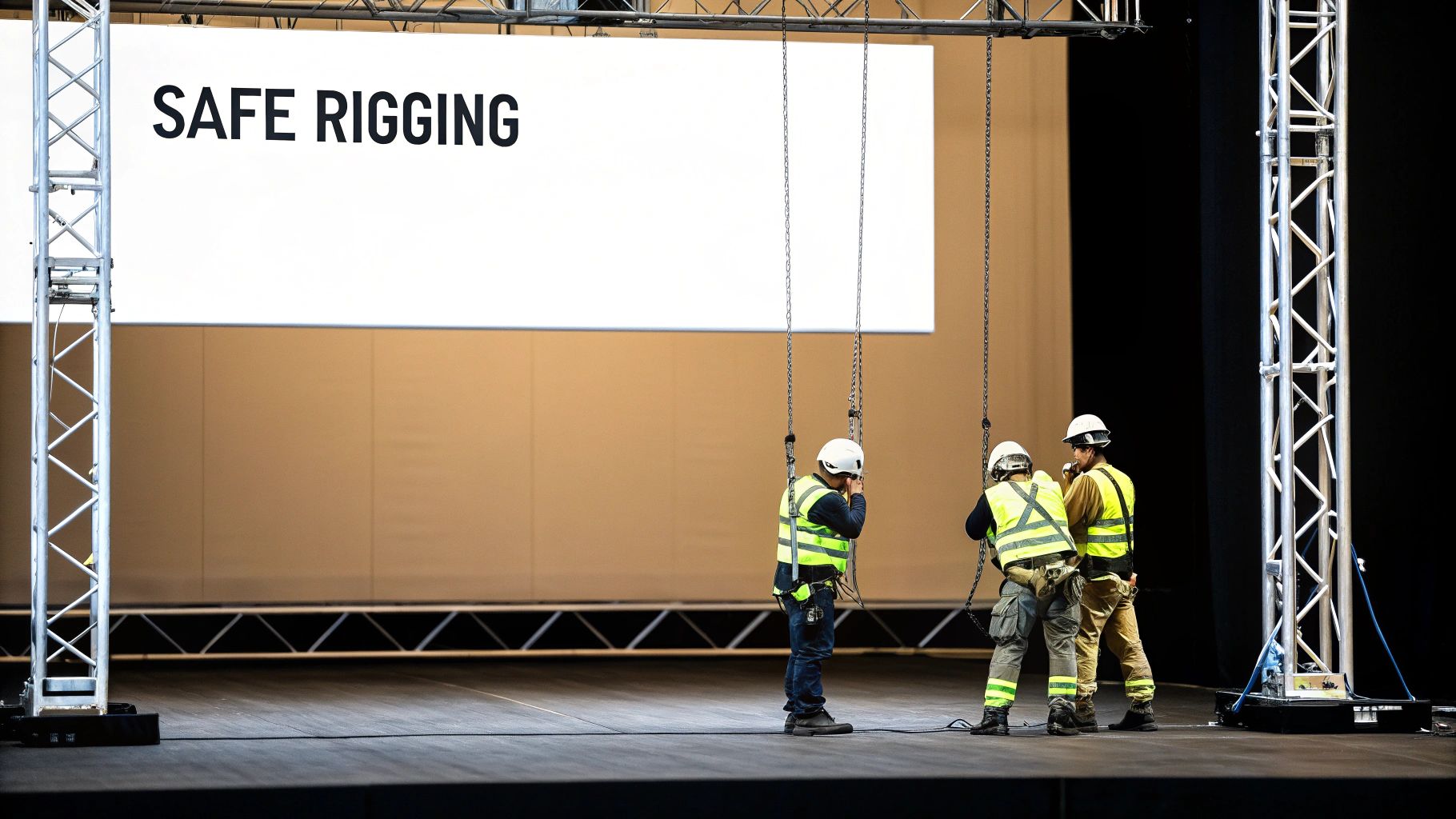
The most straightforward way to build a stage led screen is ground stacking. It’s exactly what it sounds like: you build the screen from the ground up, one panel at a time. The cabinets lock together using specialized hardware, all supported by a sturdy base structure that creates a stable, self-supporting wall.
This method is popular for a few key reasons:
Of course, ground stacking has its limits. The height is capped by the stability of the base, so it's best for small to medium-sized screens. For any ground-stacked wall, ensuring the surface is perfectly level and using proper bracing aren't just suggestions—they are non-negotiable safety requirements.
When you need a huge screen floating high above the stage for maximum visibility, you have to "fly" it. This involves suspending the entire screen from an overhead structure, like a roof truss system or a dedicated grid. Flying a screen is a complex job that requires meticulous planning and the expertise of certified professionals.
This is absolutely not a DIY project. Here’s why professional riggers are essential:
Safety is the absolute priority in rigging. An improperly flown screen poses a severe risk to performers and the audience. Always hire certified and insured rigging professionals who understand the physics and engineering behind suspending heavy loads.
The structural planning gets even more complicated when you move beyond a simple flat wall. Modern stage designs often feature creative shapes that add another layer of complexity to the rigging plan.
Ultimately, your creative vision and the physical realities of your venue will dictate the right mounting method. Both ground stacking and flying are safe and effective when done correctly, but understanding their requirements is the first step in bringing your visual concept to life without ever compromising on safety.
An LED stage screen, no matter how big or bright, is really just an empty canvas. The real show happens behind the scenes, in the control room. That's where the brains of the operation live—the powerful systems that translate your creative vision into a stunning visual reality.
Understanding how a simple video file on a laptop becomes a jaw-dropping image spread across millions of pixels is the key to running a flawless event. This isn't a simple plug-and-play situation like hooking up a computer monitor. Instead, the signal has to be processed, scaled, and distributed with absolute precision.
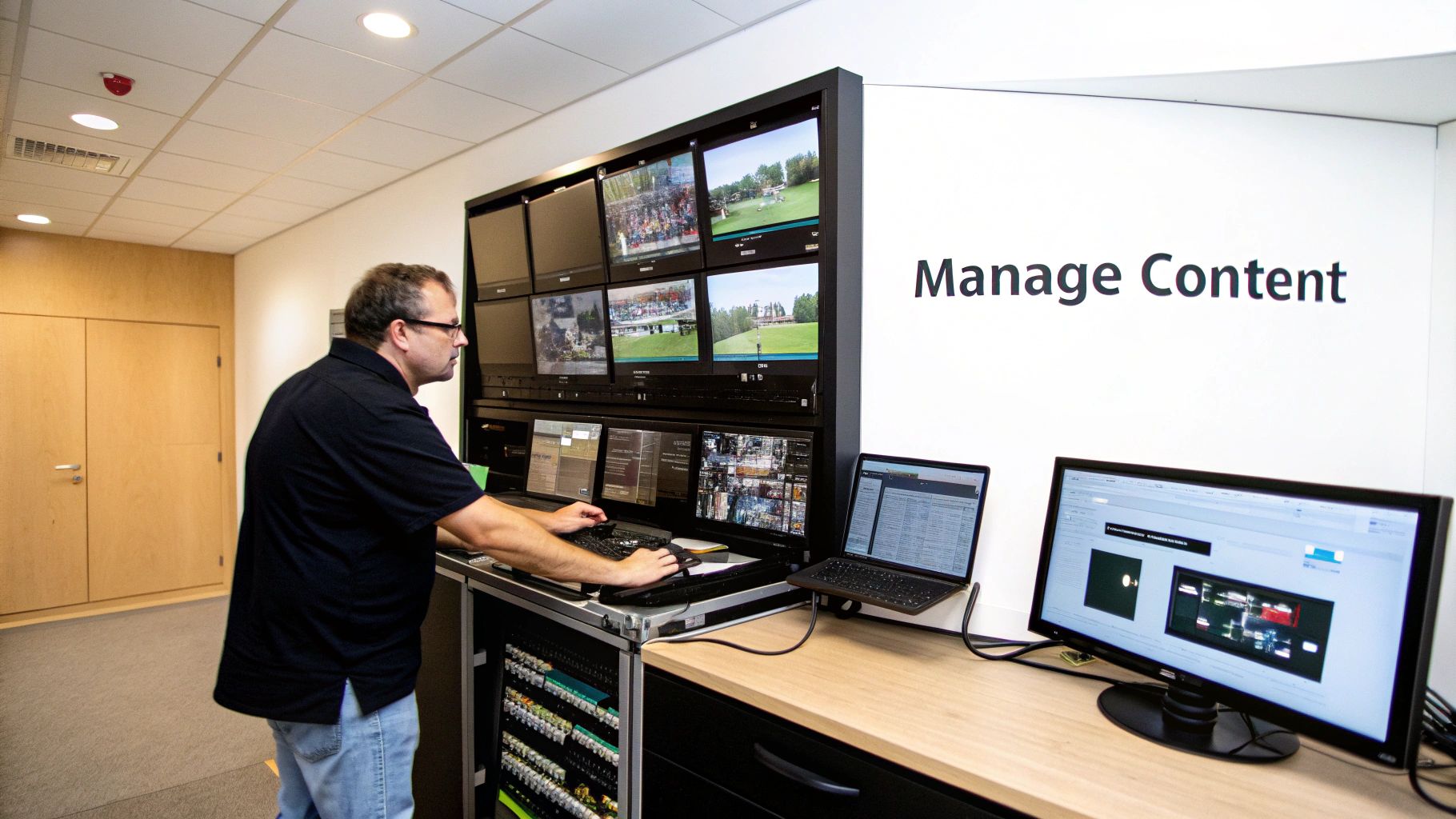
At the heart of any professional setup, you’ll find two critical pieces of gear: the media server and the video processor.
Think of the media server as your digital library and playback deck rolled into one. It's a high-performance computer built to store, manage, and play all your visual content, from pre-rendered animations to live camera feeds.
From there, the signal is sent to the video processor. This device is the translator. It takes a standard video signal (like HDMI or DisplayPort) from the media server and converts it into the specific language the LED panels understand. It also juggles crucial tasks like color calibration, brightness adjustments, and perfectly scaling the image to fit the unique dimensions of your screen. A robust processor, like a studio-grade LED video processor, is non-negotiable for delivering clean, artifact-free video.
Finally, the processor sends data through "sending cards" to "receiving cards" inside each cabinet, telling every single pixel exactly what color and brightness to be at any given moment.
Not every LED screen setup has the same job, which is why there are two main control philosophies. The one you choose boils down to a simple question: is your event happening live, or is the content pre-scheduled?
A synchronous system is like a live television broadcast. It displays content in real-time, perfectly mirroring whatever is coming from the control source. This is the industry standard for concerts, corporate keynotes, worship services, and any event that needs live camera feeds or on-the-fly operator control.
An asynchronous system, on the other hand, works more like a digital billboard. You pre-load content onto the screen's internal memory and set it to play on a schedule. This is a great fit for simpler jobs where you don't need real-time changes, like an info display in a venue lobby or a static digital backdrop.
A truly effective workflow is about more than just plugging things in. It means looking at the entire production ecosystem. For example, if your event involves integrating with a live streaming setup, your control system needs to seamlessly manage outputs for both the people in the room and the audience watching online.
Here are a few things to keep in mind:
The demand for LED stage screens is exploding, driven by incredible advances in resolution and flexible screen designs. A big part of this shift is the move toward smarter, more integrated control systems. Having a setup that is both powerful today and flexible enough for tomorrow ensures your investment will continue to deliver unforgettable experiences for years to come.
Figuring out the true cost of a stage LED screen means looking way beyond the initial price tag. Sure, the screen panels themselves are the biggest single line item, but that’s just one piece of the puzzle. A smart, long-term investment means you’ve got to account for every single cost from day one.
If you don't map out the entire budget, you're setting yourself up for nasty surprises—unexpected expenses that can stall your project or force you to cut corners on quality. To get it right, you have to factor in all the gear, labor, and ongoing costs. This gives you the real picture: the total cost of ownership, not just the price to get the boxes in the door.
That "sticker price" for an LED wall? It's just the starting point. Several other major costs are absolutely essential to get a complete, working system up and running. Think of it less like buying a new TV and more like adding a new wing to your building—the main structure is just the beginning.
Here’s a quick rundown of the key expenses you need to build into your budget:
Before we dive into ROI, it helps to see how these costs stack up. While every project is different, this table gives you a general idea of how a budget for a permanent installation might be allocated.
| Cost Component | Estimated Percentage of Total Budget | Description |
|---|---|---|
| LED Panels & Cabinets | 50% – 60% | The core of your investment. This is the cost of the physical screen modules themselves. |
| Mounting & Rigging Structure | 10% – 15% | Includes the steel frame, trusses, or custom hardware required to safely support the screen's weight. |
| Control System & Processing | 10% – 15% | The "brains" of the operation: video processors, media servers, sending/receiving cards, and software. |
| Installation Labor | 10% – 15% | The cost for certified technicians and engineers to assemble, install, and commission the entire system. |
| Shipping & Logistics | 3% – 5% | Covers freight transportation, insurance, and handling from the manufacturer to your venue. |
| Spare Parts Package | 2% – 5% | A recommended kit of extra modules, power supplies, and cards for quick on-site repairs. |
| Training & Commissioning | 1% – 3% | On-site training for your team to operate and maintain the system effectively. |
Keep in mind, these are just ballpark figures. A complex, custom-curved screen will have higher rigging costs, while a simple ground-stacked wall will be on the lower end. The key is to get quotes that break these items out so you know exactly what you're paying for.
A stage LED screen is a serious investment, no doubt. But it’s also a powerful asset that can deliver some serious returns. Thinking through your potential ROI helps turn the conversation from "how much does it cost?" to "what can this do for us?"
The ROI for an LED screen isn't just measured in dollars. It's measured in audience engagement and brand perception. A killer visual experience creates memories and instantly elevates how people see your events, your brand, or your venue.
Here’s how to think about the returns, both the ones you can count and the ones you can feel:
Even after you've got a handle on the basics, a few specific questions always seem to pop up during the planning phase. Let's tackle some of the most common ones that event planners and venue managers run into when choosing and using a stage LED screen.
Figuring out the perfect screen size really comes down to your venue's layout and where your audience is sitting. You want something that feels impactful but doesn't completely overshadow the performers on stage. A good rule of thumb is to make sure it’s big enough for the folks in the very back row to see everything clearly.
When it comes to resolution, the most important thing is the distance to your front row. There’s a simple guideline we call the "1-meter rule": for every 1mm of pixel pitch, you need at least 1 meter of viewing distance. So, if your closest audience member is 4 meters away, you'll want a screen with a 4mm pixel pitch (P4) or finer. This ensures the image looks crisp and seamless, not like a bunch of distracting little dots.
The two biggest differences are brightness and weatherproofing. It’s pretty straightforward when you think about it.
Outdoor screens have to compete with direct sunlight, which means they need to be incredibly bright—we're talking 5,000 nits or more—just to stay visible. Indoor screens, on the other hand, look fantastic at a much more comfortable 800-1,500 nits.
Beyond that, outdoor screens are built tough to handle whatever Mother Nature throws at them. They come with an Ingress Protection (IP) rating, like IP65, which certifies they’re sealed against dust and rain. Indoor screens live in controlled environments, so they don't need that kind of armor.
Choosing the wrong type of screen for your environment is one of the most common and costly mistakes. An indoor screen used outdoors will be a washed-out, unviewable mess in daylight. Conversely, an outdoor screen used indoors can be blindingly bright for the audience if you don't dial it way, way down.
Thankfully, modern LED screens don't ask for much to keep them running smoothly for years. A little regular care is all it takes to protect your investment.
Ready to bring your stage to life with a stunning visual centerpiece? The team at Smart LED Inc. offers factory-direct pricing on a wide range of indoor and outdoor LED solutions, backed by expert guidance from design to installation. Explore your options and get a custom quote today!
Picture this: you take the flash and spectacle of a Times Square billboard, slap it on the back of a truck, and send it wherever
A wall of TV screens is exactly what it sounds like: a big, impressive display made by tiling multiple TVs together so they act like
Picking the right displays for shows can feel like a high-stakes guessing game. Get it right, and you create an immersive world that captivates your
"*" indicates required fields