
Uncategorized
Digital Billboard Truck: Boost Your Campaign with Mobile Ads
Picture this: you take the flash and spectacle of a Times Square billboard, slap it on the back of a truck, and send it wherever

Think of outdoor digital signage as a tough, all-weather screen built to broadcast stunning video, images, and information right where the action is. Unlike a static billboard, you can update the content in real-time, making it an incredibly powerful way to advertise, communicate, and connect with people on the go.
Imagine a classic billboard as a printed photograph—it's fixed, unchanging, and you need to physically swap it out to show something new. An outdoor digital display, on the other hand, is like a massive high-definition screen. It can run full-motion commercials, flash new promotions instantly, and shine bright enough to see even on the sunniest days.
This technology is so much more than just a fancy ad space; it’s about creating dynamic, unmissable experiences. These displays are engineered to be the workhorses of modern communication. They’re built to shrug off everything from torrential rain to scorching heat, all while delivering crisp, vivid messaging day in and day out. That kind of reliability makes them an essential tool for just about any business imaginable.
The worldwide boom in outdoor digital signage tells you everything you need to know about its impact. Valued at a massive US$ 1,739 million in 2024, the market is on track to hit US$ 2,451 million by 2031. This explosive growth is being fueled by businesses in busy urban centers who need a high-impact way to cut through the noise. Learn more about the rising demand for outdoor displays and see why this market is moving so fast.
By their very nature, outdoor digital displays turn passive viewing into an active experience. They can adapt their content based on the time of day, weather, or even live events, making every message feel relevant and timely.
This is where businesses gain a serious competitive edge. A café can promote its breakfast burrito special in the morning and automatically switch to happy hour deals in the afternoon—no ladders, no vinyl, no fuss. That kind of flexibility is a complete game-changer when you compare it to the high costs and slow turnaround of traditional print ads.
Let's break down the core differences.
For a long time, the only option was a static sign. But technology has opened up a world of possibilities, and the contrast between old and new is stark. Here’s a quick look at how they stack up.
| Feature | Static Signage (e.g., Printed Billboard) | Outdoor Digital Signage Display |
|---|---|---|
| Content | Fixed; one message per print run | Dynamic; unlimited video, images, text |
| Updates | Manual, costly, and slow (requires physical replacement) | Instant, remote, and free (update from a computer) |
| Engagement | Passive; easy to ignore | Active; eye-catching motion grabs attention |
| Targeting | One-size-fits-all message | Can schedule content for different times or events |
| Brightness | Relies on external lighting at night | Self-illuminated; high brightness for 24/7 visibility |
| Longevity | Prone to fading, tearing, and weather damage | Built for harsh weather; long operational lifespan |
| ROI | High recurring costs for new campaigns | Higher initial investment, but lower long-term costs |
The takeaway is clear: while static signs served their purpose, digital displays offer a level of flexibility and impact that's simply in a different league. They're not just signs; they're communication platforms.
Not too long ago, this kind of powerful tech was only within reach for giant corporations with bottomless advertising budgets. But that’s all changing.
Direct-from-factory providers like Smart LED Inc. are breaking down those barriers. By cutting out the retail markups and middleman fees, we’re making high-end outdoor digital signage a realistic option for a much wider range of organizations—from local shops to community centers. This direct approach means you get more than just a screen; you get expert guidance and a solution that’s perfectly matched to your needs, helping you boost your visibility and connect with your audience like never before.
An outdoor digital sign isn't just a big TV you stick outside. It’s a sophisticated piece of engineering, built from the ground up to perform day-in and day-out under some seriously tough conditions. To really get why one sign shines while another fades, we need to look under the hood at the core specs that separate the great from the mediocre.
Getting these details right is the difference between a sign that turns heads and one that just blends into the background.
This map breaks down what makes a successful outdoor sign tick. It’s a blend of three things: dynamic, engaging content; tough-as-nails hardware; and a smart plan for getting it all in place.
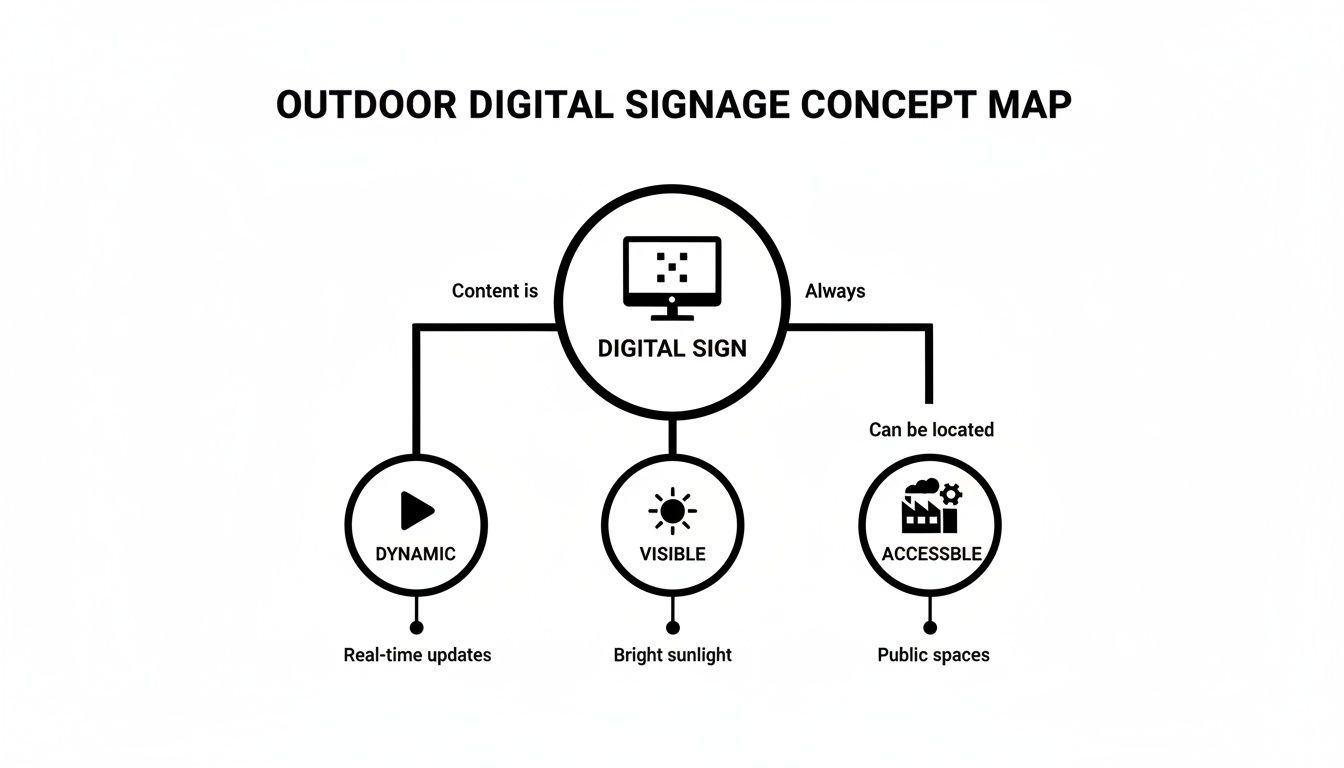
Think of these as the three legs of the stool. If one is weak, the whole investment can wobble. Understanding them is key to making a choice you’ll be happy with for years to come.
The biggest enemy of any outdoor display? The sun. It's a relentless opponent. Your living room TV or office monitor probably puts out around 300 to 500 nits of brightness, which is plenty for an indoor space. But take that same screen outside on a sunny day, and it becomes a washed-out, unreadable mess.
This is where nits, the unit for measuring light output, become your most important spec. For an outdoor sign to stay vivid and punchy under direct sunlight, it needs a bare minimum of 2,500 nits. But if you want a truly brilliant image that slices right through the harshest midday glare, the gold standard is 5,000 nits or more. This ensures your message pops from dawn until dusk.
A display without enough brightness is like trying to whisper in a crowded stadium. Your message might be brilliant, but if no one can see it, it doesn’t matter. High-nit displays are non-negotiable for making an impact.
Okay, so your sign is bright enough. But is it clear? That all comes down to pixel pitch.
Simply put, pixel pitch is the distance, in millimeters, from the center of one tiny LED pixel to the center of the next. The smaller the number, the closer the pixels are packed together. More pixels in the same space means higher resolution and a sharper, more detailed picture.
It’s a bit like creating a mosaic. If you use big, chunky tiles spaced far apart, the image will look blocky and crude up close. But if you use tiny tiles packed tightly together, you can create a masterpiece full of fine detail.
The right pixel pitch for you depends entirely on one thing: how far away your audience will be.
Matching pixel pitch to your typical viewing distance is the smartest way to balance stunning visual quality with a sensible budget.
An outdoor sign lives a tough life. It’s constantly exposed to the elements—driving rain, swirling dust, freezing cold, and blistering heat. The hardware has to be built like a tank. This is where the Ingress Protection (IP) rating comes in.
An IP rating is a simple two-digit code that tells you exactly how well a device’s enclosure is sealed against solids (like dust) and liquids (like water).
For most outdoor displays, IP65 is the rating you want to see. This means the unit is totally sealed against dust (that’s the ‘6’) and can handle being sprayed with low-pressure water jets from any direction (the ‘5’). This level of protection keeps the sensitive electronics inside safe and dry, ensuring your investment is built to last.
Knowing the tech behind an outdoor digital sign is one thing. Seeing it in action? That’s where you really get it. Across all kinds of industries, these screens aren't just fancy ads—they're powerful tools for growth, connection, and getting people engaged. They deliver real, measurable results that completely change how a business talks to its community.
From the local diner on the corner to a massive corporate campus, the ways to use these signs are as varied as the businesses themselves. The real magic is being able to show the right message, to the right person, at exactly the right time. That's what turns a boring, passive sign into an active part of your business strategy.

Think about a local restaurant trying to pull in the lunch crowd. With a dynamic outdoor menu board, they can instantly flash a "Lunch Combo Special" from 11 AM to 2 PM. The bright, moving pictures of delicious food are way more convincing than a static sign, grabbing the attention of office workers and people just walking by. The result? A clear spike in foot traffic and a direct jump in sales for that specific meal.
This idea works everywhere in the retail and hospitality world.
Beyond making direct sales, an outdoor digital sign is a fantastic communication hub. Property managers in busy commercial buildings or shopping centers use them for digital directories and event calendars. Even better, they can sell ad space to tenants or other local businesses, creating a brand-new revenue stream that can pay for the sign itself over time.
Schools and community centers use their signs to share urgent news, promote upcoming events, and celebrate student achievements. In an emergency, that sign becomes a critical tool for broadcasting safety instructions in an instant.
For many organizations, the outdoor digital display becomes the public face of their brand. It’s their 24/7 announcer, promoter, and information officer, working tirelessly to keep the community informed and engaged.
This strategic use is fueling some incredible market growth. The out-door signage market is on track to balloon from USD 32,100 million in 2025 to a massive USD 69,800 million by 2035, growing at a CAGR of 8%. This boom is being driven by huge urban infrastructure projects and the global shift toward smart, data-driven displays in major cities.
The real power of an outdoor digital sign is its flexibility. The same screen that promotes a product one minute can provide directions the next and display community art the minute after that. This adaptability ensures the technology stays relevant and valuable for years. When you invest in the right display, you're not just buying an advertisement; you're getting a multi-talented communication platform. For anyone looking to dig deeper into the options, our complete guide on LED signs for businesses is a great place to start.
To see more examples of how businesses are using this kind of display technology, it's worth checking out companies offering Intouch interactive digital signage solutions. In the end, a well-planned digital sign pays for itself not just through sales, but through a stronger brand image, a better customer experience, and deeper community ties. It's a true cornerstone of any modern business strategy.
Deciding to invest in an outdoor digital display is a big move, and it's essential to see the full financial picture before you dive in. The price tag on the screen itself is really just the starting point. To build a budget that won’t surprise you later, you need to think in terms of Total Cost of Ownership (TCO).
This approach covers everything—from the initial purchase to all the ongoing operational costs that keep your sign running beautifully. It’s about making sure your investment is not just powerful on day one, but sustainable for years to come.
The upfront hardware cost is the number everyone focuses on, but it’s only one piece of a much larger puzzle. A truly comprehensive budget needs to account for all the interconnected parts that make up the real TCO of your display.
Here’s a look at what you need to factor in:
The Display Hardware: This is the physical screen, and its cost is driven by a few key specs: size, resolution (pixel pitch), and brightness (nits). It makes sense that a massive, ultra-high-resolution screen built to shine in direct sunlight will have a higher upfront cost than a smaller, standard-brightness model for a shadier spot.
Software and Content Management: A great screen is useless without a brain. That’s where a Content Management System (CMS) comes in. It’s the software that lets you upload, schedule, and manage everything that appears on your display. Some CMS solutions come with a one-time license fee, while many others operate on a monthly or annual subscription.
Installation and Mounting: Getting a heavy, high-tech sign safely and securely mounted is a job for the pros. This part of the budget includes the physical mounting hardware (like a pole or wall bracket), skilled labor, specialized equipment like a crane, and the electrical work to run power and data to the sign’s location.
Permitting and Compliance: Don't forget the red tape. Most towns and cities have strict zoning laws for outdoor signage. The process of applying for and securing permits involves fees and can sometimes require you to hire someone for site surveys or architectural drawings, all of which adds to the initial outlay.
A few key variables can dramatically swing your project's final cost. Understanding them from the get-go helps you make smart trade-offs and align the project with your financial goals.
This table breaks down the primary cost drivers to help you budget more effectively.
| Cost Factor | Description | Budget Impact (Low/Medium/High) |
|---|---|---|
| Screen Size | The physical dimensions of the display. Larger screens require more materials and LEDs, which directly increases the cost. | High |
| Pixel Pitch | The density of pixels on the screen. A lower number (tighter pitch) means higher resolution and a higher price tag. | High |
| Installation Complexity | A simple wall mount is far less expensive than a custom-built monument sign or a towering pylon that needs a new concrete foundation. | Medium |
| Software Features | Basic content scheduling software is affordable, while advanced systems with analytics, live data integration, and automation cost more. | Medium |
| Ongoing Maintenance | While modern LED displays are incredibly reliable, it’s wise to budget for potential component replacements or service calls down the road. | Low |
Thinking through each of these factors will give you a much more realistic view of the total investment required.
One of the single most effective ways to manage your budget is to change how you buy the hardware. When you work directly with a factory-source provider like Smart LED Inc., you fundamentally alter the cost structure of your project. This approach completely cuts out the multiple layers of distributors and resellers, whose markups can inflate the final price by 20-40% or more.
Going factory-direct means your budget goes further. Instead of paying middlemen, you invest that money directly into higher-quality components, better features, or even a larger display—maximizing the impact of every dollar spent.
This model doesn't just save you a significant amount of money; it also gives you direct access to expert guidance. You'll get professional help choosing the exact right specs for your specific needs and environment. This ensures you don't overspend on features you don't need or, just as importantly, under-invest in critical ones like brightness or weatherproofing.
For a much deeper dive and some incredibly helpful estimation tools, our complete guide on understanding outdoor LED sign costs is an invaluable resource. Careful, informed budget planning is the first and most important step toward a successful outdoor digital display that delivers real impact.
Buying a powerful outdoor digital sign is a huge first step, but the journey doesn't stop when the delivery truck leaves. A truly successful project depends on two things: a flawless installation and a smart, consistent maintenance plan. This is how you ensure your display doesn't just look amazing on day one but keeps performing reliably for years to come.
Think of it like a high-performance car. The thrill is in the drive, but you'd never skip the professional setup or the regular tune-ups needed to keep it in peak condition. The same logic applies here. To protect your investment, professional installation and ongoing care are non-negotiable.
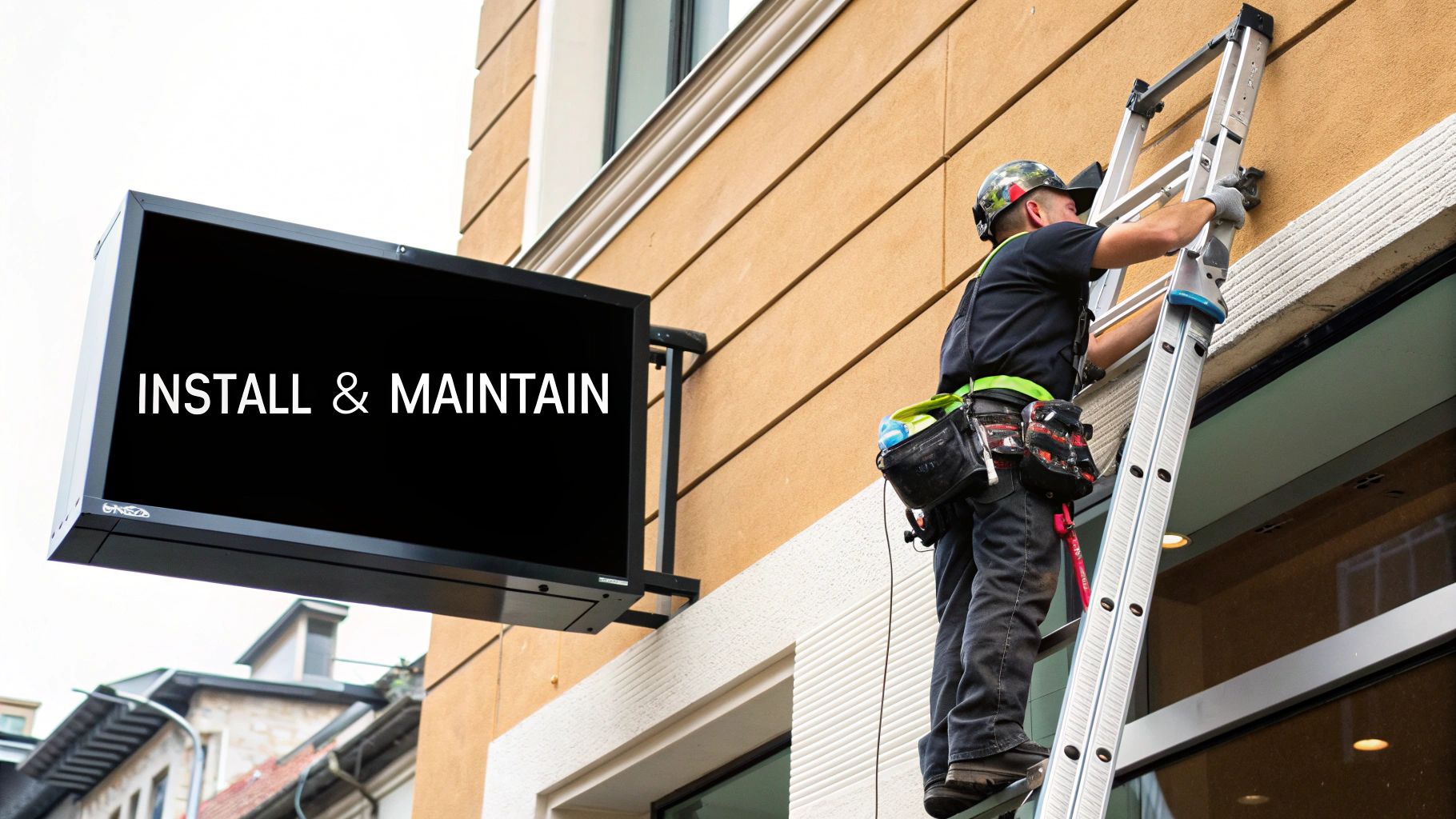
How and where you mount your sign has a massive impact on its visibility, safety, and the overall impression it makes. Each mounting style serves a different purpose and comes with its own structural demands, so it's critical to pick the one that fits your location and your goals perfectly.
Here are a few of the most common solutions you'll see:
Professional installation isn’t just about hanging a sign—it’s about ensuring structural integrity, running electrical safely, and making sure everything is up to local building codes. A DIY job can quickly turn into a nightmare of costly damage, safety hazards, and even legal trouble.
Your outdoor display has two lifelines: a stable power source and a reliable data connection. These aren't afterthoughts; they need to be planned and installed by qualified pros who know how to build systems that can handle the brutal outdoor environment.
For power, that means dedicated, weather-resistant electrical lines that can easily handle the sign's energy load. The data connection is just as crucial—it's how you'll push content to your screen. While Wi-Fi might work for some situations, a hardwired Ethernet connection is almost always the better bet for rock-solid stability and security. It guarantees your content updates go through every single time, without a hitch.
Once your display is up and running, a simple maintenance routine will keep it shining for years. This isn't about complicated technical work. It's about regular, common-sense check-ups to catch small issues before they snowball into big problems.
A consistent care schedule is the secret to getting the most out of your outdoor digital signage. For those who want the ultimate in low-maintenance durability, it's worth checking out products like the Outdoor Elite Series of fully sealed waterproof panels, which are specifically engineered to minimize upkeep in even the harshest conditions.
Here's a simple checklist to follow:
Working with a supportive partner who has a nationwide network can make this whole process—from the first screw to ongoing care—completely painless. They can guide you through every stage, making sure your display remains a powerful and reliable asset for your business.
An outdoor digital sign is a serious investment. So, how do you make sure it's actually delivering real value? Calculating your Return on Investment (ROI) is about much more than just seeing an immediate bump in sales. It’s about understanding how your display influences customer behavior, shapes your brand's perception, and drives direct, trackable actions that grow your business for the long haul.
Instead of thinking of it as an expense, view your display as a strategic asset that actively works for you. The trick is to set clear goals right from the start and lock in on the right metrics to measure what success looks like.
To get the full picture of your ROI, you need to track both direct and indirect results. Looking at both gives you a much clearer sense of your sign's total impact.
To truly nail down the impact of your interactive content, robust QR code campaign analytics and reporting tools are essential for tracking who's engaging and what's converting.
Once you start tracking your performance, you can get to work on actively boosting your ROI. A "set it and forget it" approach just won't cut it. The most successful displays use dynamic, relevant content to keep people looking.
Your outdoor display should be a living, breathing part of your marketing strategy, not just a digital poster. By continuously optimizing your content and timing, you turn a passive screen into an active business driver.
One of the most powerful strategies is content scheduling. Don't show the same ad 24/7. Promote your breakfast specials in the morning, lunch deals around noon, and happy hour in the evening. Aligning your content with the rhythm of your audience's day makes it exponentially more effective. Tying in dynamic data feeds for things like the current weather or local news can also make your messaging feel incredibly timely and relevant.
This kind of forward-thinking approach is exactly why the outdoor digital signage market is growing so fast. Projections show the sector is expected to climb to $55.7 billion by 2032, a huge jump from $40.3 billion in 2023. This growth is being fueled by advancements that make these displays smarter and more interactive than ever before. By measuring what matters and constantly adapting your strategy, you'll ensure your display delivers a powerful return for years to come.
Once you start looking into outdoor digital signage, a few practical questions always come up. It's smart to think about longevity, what you can actually show on the screen, and the red tape involved. Getting these answers sorted out early is a huge part of a successful project.
A well-built outdoor LED display is a serious investment, and it's engineered to last. You can typically expect these signs to be rated for 100,000 hours of operation. If you run it 24/7, that's more than 11 years of non-stop performance.
Of course, the final lifespan really hinges on the quality of the internal components, how well the sign keeps itself cool, and the robustness of its weatherproofing. A little bit of routine maintenance goes a long way in protecting your investment and making sure it hits that 11-year mark and beyond.
This is where the fun begins. The creative possibilities are pretty much endless—you can run full-motion video, slick animations, crisp images, and even hook it up to live data feeds for things like weather forecasts or breaking news.
Modern Content Management Systems (CMS) make it incredibly simple to schedule your content, too. A restaurant, for instance, could automatically display its breakfast menu in the morning, then seamlessly switch to happy hour specials in the afternoon without anyone having to lift a finger. The key to great content? Make it bright, bold, and instantly readable from a distance.
The most impactful content plays to the medium's strengths. Think dynamic motion and vivid color that a static sign could never dream of matching. That’s how you grab someone’s attention and make your message stick.
Almost certainly, yes. This is one area you can't afford to overlook. Zoning laws and permit requirements for outdoor signs can vary wildly from one town to the next.
Your local municipality will likely have rules dictating everything from the sign's maximum size and brightness to where it can be placed and how quickly the on-screen content is allowed to change. This is where working with a seasoned provider becomes critical. They've been through the permitting maze countless times and can navigate the process for you, ensuring your sign is fully compliant and saving you from potential fines or costly delays.
Ready to bring your vision to life with a high-impact outdoor digital display? The team at Smart LED Inc. offers factory-direct pricing and the expert guidance you need to find the perfect solution for your business. Explore our outdoor LED signs today
Picture this: you take the flash and spectacle of a Times Square billboard, slap it on the back of a truck, and send it wherever
A wall of TV screens is exactly what it sounds like: a big, impressive display made by tiling multiple TVs together so they act like

Picking the right displays for shows can feel like a high-stakes guessing game. Get it right, and you create an immersive world that captivates your
"*" indicates required fields