
Uncategorized
Digital Billboard Truck: Boost Your Campaign with Mobile Ads
Picture this: you take the flash and spectacle of a Times Square billboard, slap it on the back of a truck, and send it wherever
Ever seen a classic roadside billboard? For decades, it was a static picture, a single message stuck in time for weeks on end. Now, imagine that same space, but instead of a faded print, there's a brilliant, high-definition screen. It might show a steaming cup of coffee during the morning commute, then seamlessly switch to a happy hour special as evening traffic rolls in.
That fundamental leap—from static to dynamic—is the heart of out of home digital advertising, or DOOH for short.
DOOH is the evolution of public advertising. It takes the traditional, one-message-fits-all approach of old-school signs and injects it with the flexibility and intelligence of digital media. Instead of being stuck with one ad, a single screen can cycle through multiple, targeted messages, turning public spaces into far more responsive and relevant communication channels.
It's the difference between a printed photograph and a vibrant, adaptable video that can change its message in an instant to capture real-world attention.
To really get what makes DOOH so powerful, it helps to think of it as standing on three key pillars that set it miles apart from traditional advertising:
By blending these elements, DOOH creates a communication channel that isn't just seen—it's experienced. It transforms advertising from a passive monologue into an active dialogue with people as they go about their day.
This strategic shift is fueling some serious market growth. The format's resilience and appeal are undeniable, with the Out of Home Advertising Association of America (OAAA) reporting that digital OOH snagged 36% of all OOH sales in the second quarter of 2025. Even more telling, its revenue shot up by an impressive 9.2% year-over-year. You can dig into more of this growth data in the OAAA's full report.
Ultimately, the game is about delivering the right message, to the right person, at exactly the right moment. The technology behind digital outdoor signage is what makes this a reality, giving businesses of all sizes a powerful way to connect with their communities. This guide will walk you through the formats, strategies, and technologies that bring it all to life.
Alright, let's move from theory to what you’ll actually see out on the street. It’s one thing to talk about DOOH as a concept, but it's another to see how it comes to life. This isn't just a boring list of screen types; it's a look at how different formats—and the tech that makes them tick—are used to hit specific business goals.
The world of DOOH is incredibly diverse. You’ve got everything from those colossal digital billboards you see towering over highways to the smaller, more personal screens in airports and shopping malls.
Getting a handle on this variety is the first step in building a smart campaign. A massive screen on a busy interstate is perfect for a national car brand trying to blast out a message to everyone. But a street-level digital kiosk? That’s gold for a local cafe wanting to tempt passersby with a lunch special. Each format has its own job to do and connects with people in a completely different way.
This is where you see the real power of DOOH. It’s built on three core ideas that separate it from old-school advertising.
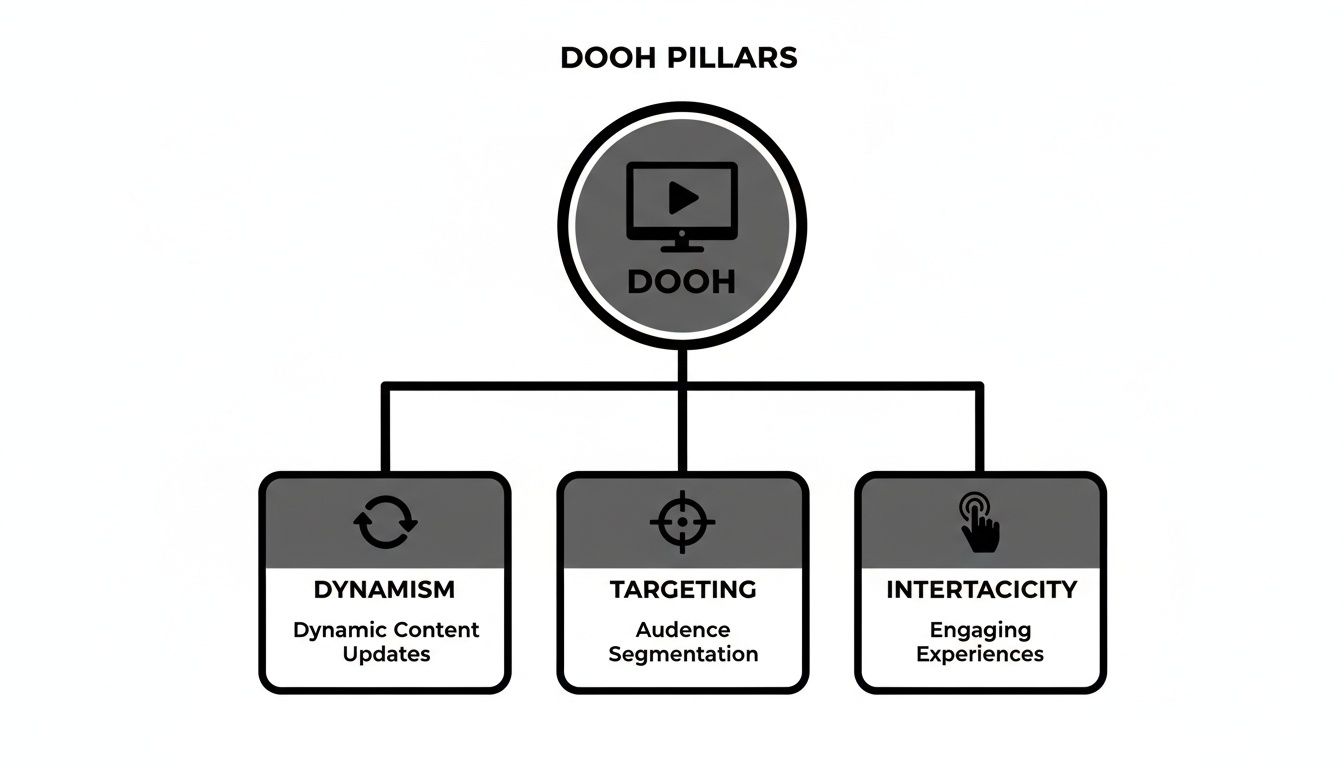
The image above nails it: the ability to change content on the fly (dynamism), reach the right people in the right place (targeting), and even get them to interact (interactivity) are what make this medium so effective.
To pick the right tool for the job, you need to know what’s in your toolbox. The most common DOOH formats each offer unique advantages depending on where you are and what you're trying to achieve.
The rush to adopt these formats isn't just a passing trend; it's a fundamental shift in where advertising dollars are going. Global spending on DOOH advertising shot up by 15.0% in 2024 and is on track to climb another 14.9% in 2025, hitting an estimated $17.6 billion. By 2025, DOOH is expected to make up nearly 42% of all OOH ad revenue as brands fall in love with its flexibility and measurable results. You can explore the bright future of digital out-of-home in 2025 with more of the latest market data.
To make sense of these options, this table breaks down how each format lines up with common business goals.
| DOOH Format | Typical Location | Primary Business Goal | Example Use Case |
|---|---|---|---|
| Digital Billboards | Major highways, city centers | Broad brand awareness, mass reach | A new movie studio promoting its summer blockbuster to millions of drivers. |
| Street Furniture | Bus shelters, urban panels | Geo-targeted promotions, foot traffic | A coffee shop running a "2-for-1" ad on a kiosk just down the street. |
| Place-Based Networks | Airports, malls, gyms | Reaching niche audiences | A fitness apparel brand advertising its new running shoes on screens inside a gym. |
As you can see, the format you choose directly impacts who you reach and what you can realistically accomplish.
Behind every great DOOH campaign is some serious hardware built to survive in the real world. A screen that looks incredible in a conference room can be a washed-out, invisible mess in direct sunlight. Understanding a few key technical specs is crucial to making sure your message actually gets seen.
The success of a digital sign isn't just about the creative—it's about whether the hardware is fit for its environment. The right technology ensures your ad is vibrant and legible, no matter the time of day or weather conditions.
Here are the core tech concepts you absolutely need to grasp:
Pixel Pitch: This is simply the distance between the center of one pixel and the center of the next, measured in millimeters. A smaller pixel pitch means a higher resolution and a sharper image. This is vital for screens viewed up close, like on a storefront. For a highway billboard that people see from hundreds of feet away, a larger pixel pitch works just fine.
Brightness (Nits): Brightness is measured in "nits," and when it comes to outdoor signs, more is always better. Your indoor TV might have 300-500 nits, but an outdoor digital sign needs at least 5,000 nits to stand a chance against direct sunlight. Without that kind of power, your ad will look faded and unreadable during the day.
Weatherproofing (IP Rating): An Ingress Protection (IP) rating tells you how well a display is sealed against things like dust and water. For any outdoor installation, a high IP rating (like IP65) is non-negotiable. It ensures the hardware can handle rain, snow, and humidity, protecting your investment for the long haul.
Alright, let's move past the technical jargon and get to the real question: why should your business care about digital out-of-home advertising? The answer is simple. Brands aren't just buying ad space anymore; they're investing in a dynamic channel that drives real, measurable results. This is where a DOOH strategy stops being just another line item on a marketing budget and becomes a true engine for growth.
The magic of DOOH lies in its unique ability to blend high-impact brand building with the kind of direct-response tactics you’d expect from an online campaign. Unlike digital ads that viewers can block, skip, or scroll past, DOOH is woven into the physical world. It's an unmissable part of the daily consumer journey.
And that constant presence really pays off. Research shows that consumers are 48% more likely to engage with a mobile or online ad after seeing the same campaign in an out-of-home format first. That synergy turns DOOH into a powerful amplifier for your entire marketing mix, making every other channel you use work that much harder.
The old way of measuring outdoor ads was all about estimated "eyeballs"—a metric that was vague at best. Today, the ROI of digital out-of-home advertising is far more concrete. Thanks to sophisticated tracking methods that connect what someone sees on a screen to what they do in the real world, a modern DOOH campaign is an accountable, performance-driven investment.
A well-executed DOOH strategy isn't just an advertising expense—it's a measurable driver of tangible business outcomes. Success is no longer about how many people might have seen your ad, but what they did after seeing it.
So, how does this actually work? Marketers now have a whole toolkit of direct attribution methods at their disposal:
This level of accountability completely changes the conversation around outdoor advertising, including the initial investment. Suddenly, understanding the outdoor LED sign cost becomes a strategic calculation—not just a capital expense—because you can directly link it to increased revenue and new customers.
The strategic applications for DOOH are incredibly versatile. Imagine a B2B tech company looking to build authority. By running ads on digital screens near a major industry conference, they can grab the attention of thousands of relevant decision-makers at the exact moment their services are most top-of-mind.
Or think about a local restaurant. They could use a street-level digital sign to display a mouth-watering lunch special from 11 AM to 2 PM, then have it automatically switch to a happy hour promotion as the evening commute kicks off. That kind of hyper-relevant, real-time messaging drives immediate action and fills seats.
The market data backs this up. Billboards are still the dominant format, accounting for 74.5% of OOH revenues in early 2025, with global spending projected to hit nearly $49.8 billion. Even more telling is how consumers behave: 65% of people conduct an online search after seeing an OOH ad. If you want to dive deeper, you can discover more insights about OOH advertising statistics from StackAdapt. This proves DOOH's power to bridge the physical and digital worlds, guiding customers from public awareness straight to direct engagement.
Launching a great out-of-home digital advertising campaign isn't just about slapping a pretty picture on a big screen. It’s a strategic process that has to blend clear goals with can't-miss creative and the right technology. Think of it like building a bridge between your brand and your audience out in the real world—you need a solid blueprint before you ever start mixing the concrete.
This playbook will walk you through the whole process, breaking it down into simple, manageable steps. From figuring out what you want to achieve to picking the perfect screens and using new tech, you'll get a clear framework for planning with confidence. Let's dive in with the most important first step: knowing what you're trying to accomplish.
Before you do anything else, you have to define what success actually looks like. Are you trying to get your brand name known across an entire city? Drive more people into a new store? Maybe you just want to push a limited-time sale. Your goals will steer every single decision you make from here on out.
Start by setting clear Key Performance Indicators (KPIs). Fuzzy goals like "increase sales" just won't cut it. You need specific targets, like "achieve a 15% lift in store visits" or "drive 500 QR code scans per week." These measurable goals give your campaign a real sense of direction and make it possible to prove its value when all is said and done.
Once your objectives are locked in, it’s time to get crystal clear on your audience. Who are you actually talking to? A campaign aimed at business travelers zipping through an airport is going to feel completely different from one targeting college students hanging out near campus. Use demographic and behavioral data to paint a detailed picture of your ideal customer—what they do, where they go, and how they move through their day. This insight is gold when it comes to picking the right locations.
With a sharp picture of your audience, choosing locations becomes a much more strategic game. You're not just looking for busy spots; you're looking for places where your people are concentrated. Modern planning tools can help you pinpoint hotspots like specific neighborhoods, transit lines, or shopping districts that match your customer profile. The entire point is to put your message squarely in their path.
Now, let's get creative. In the world of DOOH, you have only seconds to make an impact. Your design has to grab someone's attention and get a message across almost instantly.
Your ad is competing with traffic, conversations, and the general chaos of public life. Simplicity and clarity aren't just design principles—they're absolute must-haves for success.
To make sure your message cuts through all that noise, stick to these creative best practices:
The last piece of the planning puzzle is figuring out how you'll actually buy your ad space. Going directly to the media owners is still a common route, but programmatic DOOH is quickly becoming the go-to choice for its speed and precision.
Think of programmatic DOOH as a smart, automated way to buy ad placements. Instead of locking in a certain number of screens for a fixed amount of time, you can use data to buy impressions on screens that reach your specific audience at just the right moments. This gives you incredible flexibility, letting you tweak your campaign on the fly based on performance, weather triggers, or even what’s happening at a live event.
And for anyone serious about campaign reporting and proof of play, visual verification is non-negotiable. It's worth your time understanding ad screenshots and tear sheets and how they confirm your ads ran exactly as planned.
While renting space on existing ad networks has its place, nothing beats the control and long-term value of owning your own hardware. For businesses ready to make that leap, purchasing and installing your own digital signage is a game-changing investment. But let's be clear: this isn't a plug-and-play project. It demands careful planning to make sure your sign is turning heads from day one.
The real work starts long before anyone picks up a tool. Your first and most important decision is the location. A serious look at your intended installation site will drive almost every other choice you make. You have to think about traffic patterns, the most common viewing angles, and how far away people will be when they see the sign.
This site analysis directly tells you what pixel pitch you need—that's just a fancy term for how close together the LEDs are on your screen. If your sign is facing a highway where people see it from a distance, a larger pixel pitch is perfectly fine. But for a screen that pedestrians will walk right past, you need a smaller, tighter pixel pitch to deliver a sharp, flawless image.
An outdoor digital sign isn't just a big TV—it's a rugged piece of engineering designed to perform day in and day out, no matter the weather. When you're looking at hardware, zoom in on the features that guarantee it will last.
Investing in high-quality, durable hardware from the get-go is the single best way to lower your total cost of ownership. A cheaper, less resilient sign often leads to higher maintenance bills and a shorter lifespan, wiping out any initial savings in a hurry.
This is where working with a factory-direct provider really pays off. When you cut out the middleman, you get better pricing, but more importantly, you get direct access to expert support and solid warranties. It's about investing in a solution built for the long haul. For simpler setups, technologies like Power over Ethernet (PoE) can also streamline the cabling and installation process.
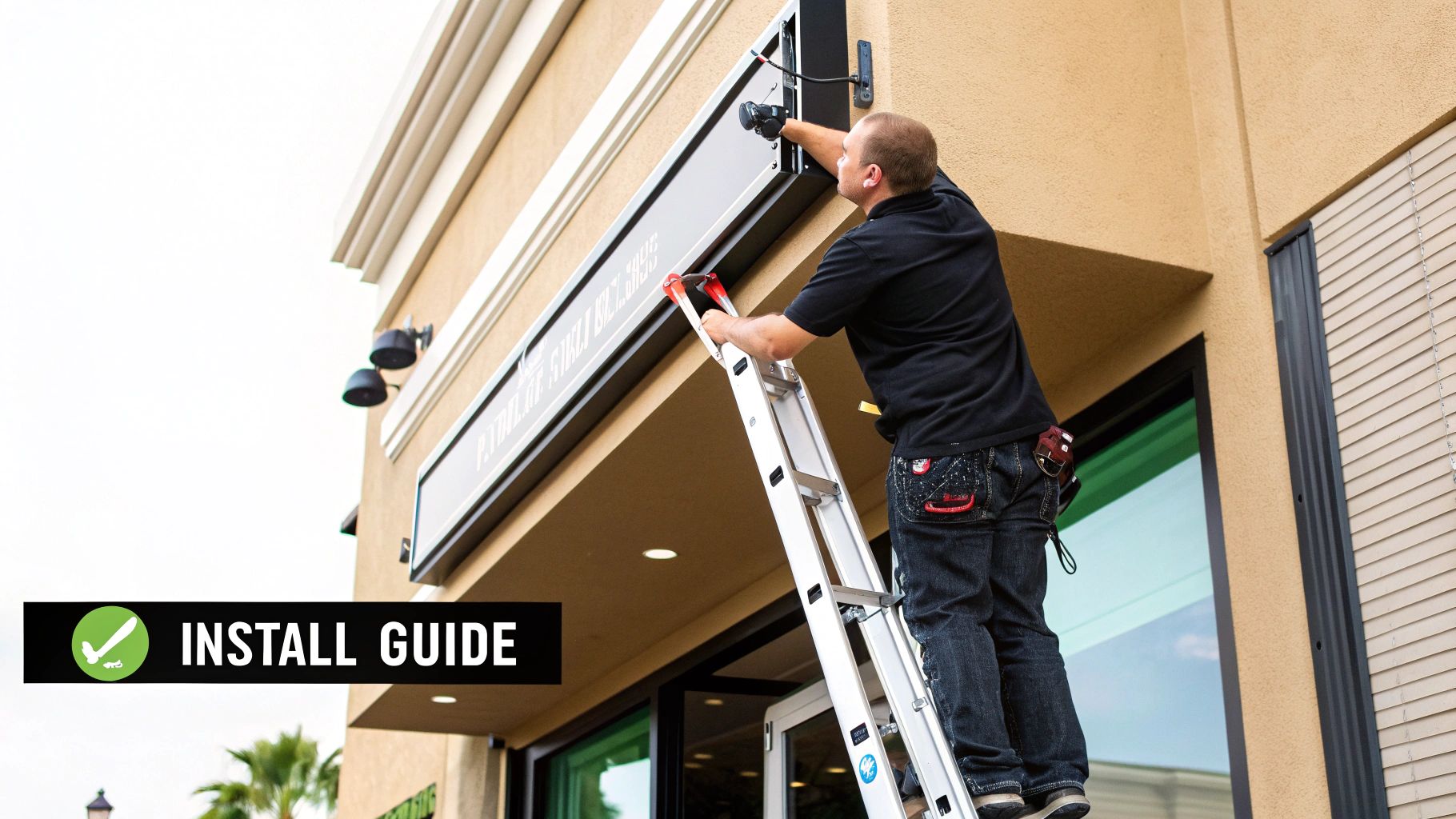
The installation itself is a major project that calls for professionals. This is not a DIY job. It’s a mix of structural engineering, electrical work, and navigating local zoning laws.
Here’s a quick look at what you can expect:
Partnering with a provider who handles everything—from sourcing and design to installation—is critical. Taking some time to explore the different types of LED signs for businesses will help you see what’s possible and find a solution that fits your goals and budget. Making this smart investment turns your physical location into your most powerful advertising asset.
The world of out of home digital advertising is picking up serious speed. We're rapidly moving beyond simple, looping videos and into a new era where the medium is genuinely intelligent and responsive. The next big leap isn't just about bigger, brighter screens—it's about the brains behind them.
We're heading toward a future where ads aren't just seen, but are experienced in ways that feel personal and perfectly timed.
At the heart of this shift are artificial intelligence (AI) and machine learning. Instead of thinking of a DOOH screen as a digital poster, picture it as a smart chameleon. It has the power to change its message on the fly based on what's happening in the real world, right now.
Imagine an ad that switches from promoting umbrellas to sunglasses the second a weather app updates. Or a screen near a stadium that erupts with celebratory graphics the moment the home team scores. This is where we're going—from a pre-set playlist to a live, adaptive conversation with the public.
The line between our physical and digital worlds is getting blurrier by the day, and DOOH is right on the cutting edge of this trend. Future campaigns will do more than just broadcast a message; they'll invite people to step inside the ad itself. This creates those unforgettable, "wow" moments that build a much deeper connection to a brand.
These immersive experiences are already starting to take some exciting shapes:
The goal is to move beyond one-way communication and create a participatory experience. When a person can interact with and influence an ad, the message becomes far more personal and impactful.
Of course, the hardware itself is also getting a major upgrade. We're seeing huge strides in more energy-efficient display technologies, which is a massive deal. It lowers the day-to-day operating costs and shrinks the environmental footprint of these always-on networks—something that's becoming a top priority for cities and brands alike.
At the same time, screens are being designed to blend more seamlessly into the urban landscape. Think less "tacked on" and more "built-in." This creates a cityscape that feels more cohesive and visually stunning, where out of home digital advertising feels like a natural, integrated part of the architecture.
Getting ready for these trends means building a strategy that puts a premium on flexibility, data, and pure, unadulterated creativity.
Even after you get the big picture, diving into a new advertising channel always kicks up a few questions. Let's tackle the most common ones people have about digital out-of-home, with straightforward answers to help you figure out where it fits in your strategy.
This is the big one, and the honest answer is: it varies—a lot. The cost of a DOOH campaign can swing wildly depending on a few key things: the location’s prestige, the screen size, how long your ad runs, and the sheer number of eyeballs you’re reaching. A single screen in a quieter town might only set you back a few hundred dollars. On the other hand, a premium digital billboard in Times Square? That can run into the tens of thousands.
Programmatic DOOH has been a game-changer here, adding a ton of flexibility. It lets you buy ad space based on impressions (the classic CPM model), which means you can find options that fit just about any budget. But for businesses that want to own their presence, the main cost is the one-time investment in the LED sign itself.
The long-term upside of owning your own hardware is huge. You get total control over your messaging and say goodbye to recurring media rental fees. It turns a one-time capital expense into an advertising asset that works for you 24/7. A factory-direct provider can even offer an LED sign calculator to give you a real-world estimate of hardware costs, so you know exactly what you're getting into.
Gone are the days of just guessing how many people might have seen your billboard. Measuring DOOH effectiveness has gotten incredibly sophisticated, giving you real data on how your campaigns are actually influencing customer behavior.
Here’s how it works now:
The trick is to set clear KPIs before you launch—like aiming for a 10% increase in store visits or getting 200 coupon redemptions. With those goals in place, calculating your return on investment becomes simple arithmetic.
Absolutely. In fact, it can be a secret weapon for them. DOOH is incredibly scalable and can be laser-focused for small businesses. Think about a local restaurant using a single digital sign to flash its daily specials or happy hour deals. That’s going to drive immediate foot traffic far more effectively than a static sign that gets ignored after a week.
Programmatic platforms have also leveled the playing field, making the medium more accessible than ever. Small businesses can now buy hyper-targeted ad space on established networks with even modest budgets. By zeroing in on a tight geographic area and running timely messages, small businesses can punch well above their weight and see a direct, positive impact on their sales.
Ready to take control of your on-premise advertising? Smart LED Inc. is a factory-direct leader in high-impact digital signage that helps businesses like yours stand out. Explore our custom LED solutions today.
Picture this: you take the flash and spectacle of a Times Square billboard, slap it on the back of a truck, and send it wherever
A wall of TV screens is exactly what it sounds like: a big, impressive display made by tiling multiple TVs together so they act like
Picking the right displays for shows can feel like a high-stakes guessing game. Get it right, and you create an immersive world that captivates your
"*" indicates required fields