Uncategorized
Digital Billboard Truck: Boost Your Campaign with Mobile Ads
Picture this: you take the flash and spectacle of a Times Square billboard, slap it on the back of a truck, and send it wherever
Ever seen a massive, vibrant screen light up a city square and just stop you in your tracks? That’s the magic of LED screen advertising. It’s the difference between a static roadside poster—a single, silent snapshot—and a living, breathing story that can change by the minute. It turns a simple message into a moving, unforgettable experience.
At its core, LED screen advertising uses large digital displays, powered by thousands of tiny light-emitting diodes, to broadcast dynamic videos, images, and messages in public spaces. This isn't just a digital billboard; it's a communications powerhouse.
Think about the flexibility. A restaurant can showcase its breakfast specials at 8 AM, switch to lunch deals at noon, and then roll out its dinner menu in the evening—all on the same screen, without anyone lifting a finger. That ability to deliver the right message at exactly the right time is what truly sets it apart from old-school print.
To really get what makes these screens tick, you just need to understand a few key ingredients. They're simple concepts, but they're what separate a decent display from a spectacular one.
This technology is booming for a reason. The global LED display market was valued at around USD 9.39 billion and is expected to climb to USD 15.15 billion soon. And the biggest piece of that pie? Advertising, which makes up a massive 34.8% share. This isn't just a niche product; it's rapidly becoming the standard for modern marketing.
A great LED screen is more than just hardware; it's a communication platform. It connects brands with audiences in real-time, turning passive viewers into engaged customers with content that is relevant, timely, and visually compelling.
For businesses trying to cut through the noise, high-quality retail digital signage solutions are a direct line to engaging customers in ways print just can't match. It’s a fundamental shift in how brands speak to people in the real world.
Let's break down the core differences between the old way and the new way.
This table offers a quick look at how traditional static advertising stacks up against the dynamic power of LED screens.
| Feature | Static Advertising (e.g., Printed Billboard) | LED Screen Advertising |
|---|---|---|
| Content | Single, fixed message | Dynamic video, images, and text |
| Flexibility | Zero. Requires physical replacement to update. | Instant updates via a remote CMS. |
| Engagement | Passive viewership. Easy to ignore. | High-impact visuals capture attention. |
| Targeting | Broad, one-size-fits-all message. | Can run different ads by time of day. |
| Cost | High initial print and installation costs per campaign. | Higher upfront hardware cost, but zero printing costs. |
| Lifespan | Limited by weather and campaign duration. | Long-term asset with 10+ year lifespan. |
As you can see, while static ads have their place, LED screens open up a whole new world of possibilities for creating timely, relevant, and captivating advertising.
Picking the right LED display is a bit like choosing a vehicle. You wouldn't show up to a construction site in a sports car, and you wouldn’t try to navigate a tight city street in a semi-truck. In the world of LED screen advertising, the same logic applies—it’s all about matching the right tool to the job.
Not all screens are built the same, and figuring out what you want to achieve is the very first step. The choice really boils down to three main formats: the massive outdoor billboards you see on highways, the immersive video walls inside buildings, and the synchronized digital out-of-home (DOOH) networks that connect them all. Each has its own strengths, and knowing them will make it clear which one is right for you.
Outdoor LED billboards are the heavy hitters of the advertising world. These are the giant, brilliant displays you see towering over highways, bustling city squares, and major intersections. Their one and only job is to blast high-impact brand messages to a massive, moving audience—all in a matter of seconds.
Think about a car dealership setting up a huge billboard along a busy freeway. They’re not going to list every single feature of the latest model. Instead, they’ll show a stunning, looping video of the car in action, catching the eye of thousands of commuters stuck in traffic. The message has to be big, bold, and something you can understand instantly.
These displays are built tough, designed to battle the elements and win. Their key features include:
Once you move indoors, the game completely changes. Indoor LED video walls are all about up-close-and-personal engagement. They’re designed to transform a physical space and influence customers right where they’re making decisions. The focus shifts from shouting at the masses to creating a captivating brand experience.
Picture a flagship retail store in a high-end mall. Instead of boring old posters, they’ve installed a seamless, floor-to-ceiling video wall behind the checkout counter. That screen could be showing anything from high-fashion runway shows to live social media feeds or special promotions that change by the hour. The goal here is to hold attention, elevate the store's vibe, and ultimately, drive sales.
Indoors, the LED screen stops being just an ad. It becomes part of the architecture, a key piece of the customer journey that creates a memorable, engaging environment.
These screens are all about visual perfection. They’re known for:
Finally, we have Digital Out-of-Home (DOOH) networks, which offer a powerful, scalable way to run a unified campaign. This isn’t about just one screen; it’s a whole system of connected displays running in sync across different locations—whether that’s across a city, a region, or even the entire country.
Imagine a national coffee chain launching a new seasonal latte. With a DOOH network, they can push the same slick promotional video to hundreds of screens inside train stations, office building elevators, and urban sidewalk panels, all at the same time. This strategy delivers incredible reach and consistency, guaranteeing that the same compelling message hits diverse audiences everywhere. Best of all, it's all controlled from a central hub, allowing for instant updates and targeted scheduling, making it a seriously potent tool for big-time campaigns.
Choosing an LED screen can feel like learning a new language. You're suddenly hit with terms like pixel pitch, nits, and IP ratings. It’s easy to get lost in the jargon, but getting a handle on these core specs is what separates a smart investment from an expensive mistake.
You’re not just buying a screen; you're buying a performance tool. Getting the specs right means your led screen advertising will look crisp, vibrant, and stay reliable, whether it's fighting the midday sun or grabbing attention from just a few feet away. Let's break down what really matters.
If you only learn one term, make it pixel pitch. This is simply the distance, in millimeters, between the center of one pixel and the center of the next. Think of it like the resolution on your TV. A smaller pixel pitch number means the LEDs are packed tighter, creating a denser, sharper, and higher-resolution image.
So, why not just get the smallest number possible? It all comes down to viewing distance. A massive highway billboard seen from hundreds of feet away can have a wide pixel pitch (like P10 or P16) and still look perfectly sharp to drivers. But an indoor video wall in a retail shop needs a much tighter pitch (like P2.5 or P1.9) so customers standing close don't see a blocky, pixelated mess.
Choosing the right pixel pitch isn’t about chasing the smallest number—it’s about matching the screen’s resolution to how your audience will actually see it. This is the single biggest factor in balancing jaw-dropping image quality with your budget.
Finding that sweet spot is everything. You can explore a variety of LED signs for businesses to see how different pixel pitches work in the real world, which is the best way to ensure your investment delivers the biggest bang for your buck.
Once you’ve nailed clarity, the next two hurdles are brightness and durability—especially for outdoor displays. These specs determine whether your screen can actually do its job and survive the elements for years to come.
Brightness, measured in nits, tells you how much light a display pumps out. An indoor screen might only need 500-1,000 nits to look great in a controlled environment. But an outdoor screen needs to be a powerhouse, often requiring 5,000 nits or more to cut through direct sunlight. A screen that's too dim will look washed out and completely useless during the day.
IP Rating (Ingress Protection) is your screen’s armor rating. It's a simple two-digit code that tells you how well it’s sealed against solids (like dust) and liquids (like rain).
For any outdoor sign, an IP65 rating is the industry standard. It’s fully protected from dust and can handle anything the weather throws at it, safeguarding your investment for the long haul.
Finally, there’s refresh rate, measured in Hertz (Hz). This number tells you how many times per second the screen redraws the image. Why does this matter? A low refresh rate can cause nasty flickering or scan lines, especially when someone tries to take a picture or video of your screen.
If your sign shows up on social media looking like a glitchy mess, that’s a bad look. A high refresh rate of 1920Hz or higher (ideally 3840Hz) ensures smooth, fluid motion that looks incredible both in person and on camera.
The image below breaks down the common types of LED displays you'll see in different advertising environments.
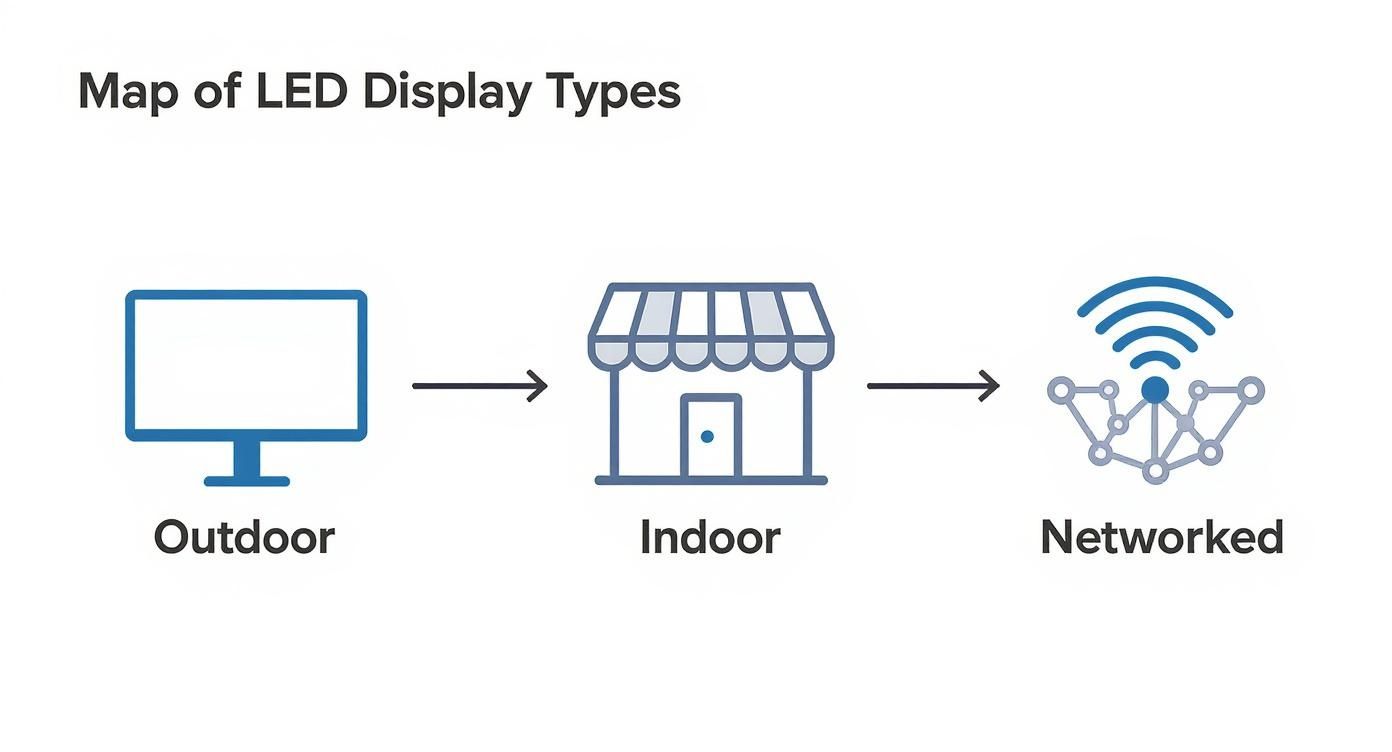
This distinction between outdoor, indoor, and networked displays drives home why the tech specs must align with the job at hand. You wouldn't use an indoor screen on a highway billboard, and you wouldn't need a weatherproof, ultra-bright screen inside a climate-controlled mall.
To make it even clearer, here’s a quick guide to help you match the right technology to the right place. Think of this as your cheat sheet for talking to vendors.
| Specification | Indoor Retail (Close Viewing) | Outdoor Billboard (Distant Viewing) | Large Event Venue |
|---|---|---|---|
| Pixel Pitch | P1.5 – P2.5 (Sharpness up close) | P6 – P16 (Clarity from a distance) | P3 – P6 (Balanced for varied distances) |
| Brightness (Nits) | 500 – 1,500 (Comfortable indoor levels) | 5,000+ (Must overcome direct sunlight) | 2,000 – 5,000 (Handles bright stage lighting) |
| IP Rating | IP20 – IP40 (Protected from dust/touch) | IP65 (Fully weatherproof) | IP43 – IP65 (Depends on indoor/outdoor use) |
| Refresh Rate | 3840Hz (Looks great on camera) | 1920Hz+ (Smooth motion for traffic) | 3840Hz+ (Essential for broadcasting/recording) |
Using this as a starting point will ensure the hardware you choose is perfectly suited for its environment, delivering maximum impact without paying for features you don't need.
A state-of-the-art LED screen is a beautiful thing, but it’s only as powerful as the content you put on it. One of the most common—and expensive—mistakes we see is a brilliant, high-resolution screen showing a dull, confusing message. Creating content that genuinely captures attention requires a totally different mindset than designing for a website or a magazine.
Out in the real world, the environment is chaotic and your audience is almost always on the move. The secret is to blend bold, unmissable visuals with smart, context-aware strategies that make your message impossible to ignore. It’s about turning your screen from a digital poster into a living, breathing marketing asset that drives real-world results.
For a roadside digital billboard, you have a razor-thin window to make an impact. We call it the “three-second rule.” A driver glancing at your screen has just a moment to see your ad, get the point, and remember it. This means your creative has to be ruthlessly efficient.
To win in that tiny timeframe, your content needs to follow a few core principles:
Once you’ve nailed the basics of clear, punchy creative, you can start using one of the most powerful features of digital screens: scheduling. Dayparting is simply the practice of running different ads at specific times of day or days of the week. It’s about reaching the right people with the right message at the right moment.
Think of it as having a conversation with the daily rhythm of your community. You wouldn’t try to sell coffee at 10 PM or dinner specials at 7 AM, right? Dayparting aligns your advertising with people's actual lives, making your content feel relevant and helpful, not just like another ad screaming for attention.
When you tailor content to the time of day, your screen stops being just another advertisement and starts becoming a helpful local resource. A screen showing a traffic update during rush hour and a happy hour special in the evening is suddenly part of the neighborhood's fabric.
Here’s how it looks in the real world:
The final evolution in creating captivating content is making it dynamic. Dynamic content is a game-changer; it automatically pulls in and displays live data, creating ads that are incredibly timely and contextually aware. This approach turns your screen from a simple display into a real-time information hub that responds to the world around it.
Instead of showing the same static loop, your screen can react to what's happening right now, making your brand feel intelligent and connected. Imagine an ad that changes based on the weather, a live event, or even the current traffic.
This is where public messaging becomes truly personal. A home improvement store could automatically trigger ads for umbrellas and rain gear when its system sees rain in the forecast. During a heatwave, a grocery store's screen could feature specials on ice cream and cold drinks. A sports bar could pull in live scores during a big game, drawing fans inside to catch the rest of the action. This level of real-time relevance is what makes modern LED screen advertising so incredibly effective.
A stunning LED screen is an asset, but let's be honest—the real question is whether it's actually making you money. To justify the investment, you need to go way beyond fuzzy "impression" counts like how many cars drove by. You need to connect your led screen advertising directly to real-world business results. The good news is, modern tech makes this easier than ever.
Measuring the impact of out-of-home advertising used to feel like a guessing game. Not anymore. Today’s tools offer surprisingly clear insights. For instance, many platforms now use anonymized mobile location data to track foot traffic lift. They can tell you how many people who saw your ad later walked into your store, creating a direct line between that glowing screen and your cash register.
Other methods are even more direct. Building a QR code or a unique, trackable URL right into your ad creative lets you measure digital responses in real time. When someone scans that code or types in that URL, you know for a fact your screen drove that action—whether it was a website visit, a coupon download, or an online sale.
To really get a handle on what's working and fine-tune your campaigns, it's essential to focus on mastering advertising effectiveness measurement. This is how you make sure every dollar you spend is pulling its weight.
Just as critical as measuring ROI is picking a budgeting model that actually fits your business. There’s no single "right" answer here. Your choice will depend on your long-term goals, how much capital you have on hand, and how much control you want. It's a huge decision that directly shapes your campaign's flexibility and overall cost.
This choice is even more important when you consider how fast the market is growing. The global digital signage market, which is built on LED technology, was valued at USD 28.83 billion and is expected to rocket to USD 45.94 billion in the next six years, growing at a rate of 8.1% annually. That kind of growth means you need to find a smart, sustainable way in.
Budgeting for an LED screen really comes down to a strategic choice: do you want to own the asset or just rent the exposure? Owning gives you total control, while renting offers flexibility with a much lower barrier to entry.
The most common approaches break down into three main categories:
Bringing a powerful LED screen to life involves a lot more than just picking the right tech. The real work begins when the plan meets the pavement—dealing with the physical installation and the often-tricky maze of local rules. A successful launch hinges on meticulous planning, ensuring your screen is not only structurally sound but also a welcome, fully compliant part of the community.
Think of it like building a house. You wouldn't rush the foundation, and you can't cut corners here either. The process starts long before a single LED panel arrives on-site, beginning with a professional site survey. This is where experts assess the building's structural integrity, check for clear sightlines, and confirm you have enough power and a stable internet connection to run everything without a hitch.
A proper installation is a careful, multi-step process that absolutely demands professional expertise. Each stage is critical to the longevity and safety of your investment. Skipping a step or trying to wing it can lead to costly delays or, even worse, a failed installation.
Here’s a look at the key stages:
For newcomers, this is often the most daunting part of the journey. Every city, county, and town has its own rulebook for digital signage. Navigating this legal maze isn't optional—an unpermitted sign can result in huge fines and an order to tear it all down.
Securing the right permits isn't just a bureaucratic hurdle; it's an essential step that protects your investment and ensures your sign operates as a welcome part of the community, not a public nuisance.
Some common regulations you’ll almost certainly run into include:
Before you even think about committing to a location, you need to understand the full scope of local requirements. For a deeper dive into what these projects entail, you can find some valuable insights on digital outdoor signage that will help you prepare.
To get your approval process moving, start by walking into your local planning or zoning department and asking these key questions:
Getting straight answers to these questions right from the start will save you a world of headaches and ensure your LED screen advertising project launches smoothly, safely, and on the right side of the law.
Even after you've got the basics down, you're bound to have some practical questions. It's only natural when you're considering an investment like this. We get it. Let's tackle some of the most common questions we hear from businesses getting ready to make the jump to digital.
This is the big one, and the honest answer is: it varies—a lot. The cost really hinges on whether you're buying a screen or just renting ad space on someone else's.
If you're renting a spot on a high-traffic digital billboard, you could be looking at anywhere from a few hundred to several thousand dollars a week, depending on the location.
Buying your own screen is a whole different ballgame. It's a serious capital investment. A smaller indoor screen might start around $10,000, but a massive, high-resolution outdoor billboard can easily sail past the $200,000 mark. And don't forget the other costs—you'll need to budget for installation, permit fees, ongoing maintenance, and of course, creating the content to display.
A well-made outdoor LED screen is built to last. These things are workhorses. Most high-quality displays are rated for around 100,000 hours of use. In the real world, that usually shakes out to about 10-12 years of continuous, reliable operation.
Now, things like harsh weather or skipping out on maintenance can shorten that lifespan. The brightness of the individual LEDs will naturally dim a bit over a decade, but a screen that's been taken care of will still be a powerful, effective tool for years and years.
An LED screen is a long-term asset, not a short-term expense. Its durability and extended operational life are key factors that contribute to a strong return on investment over time.
Absolutely. In fact, this is one of the biggest perks of going digital. Modern LED screens almost always run on a cloud-based Content Management System (CMS).
Think of it as your screen's mission control. This software lets you upload new videos or images, schedule ads to run at specific times (a technique called dayparting), and tweak your entire content playlist from any computer with an internet connection. It gives you incredible agility to react to market changes, run flash sales, or update messaging on the fly.
Yes, and you'll want to pay close attention to them. Restrictions are very common and are typically enforced by the screen's owner or the local city or county government. The number one reason for these rules is public safety, especially avoiding driver distraction.
Here are a few of the usual suspects:
Before you even start designing your ad, make sure to check with your local municipality and the media owner to get a crystal-clear picture of the content guidelines for your specific location.
Ready to transform your visibility with a stunning, durable display? The experts at Smart LED Inc. offer factory-direct pricing on a huge range of indoor and outdoor LED screens, helping you find the perfect solution without the middleman markup. Find your perfect LED solution with Smart LED Inc.
Picture this: you take the flash and spectacle of a Times Square billboard, slap it on the back of a truck, and send it wherever
A wall of TV screens is exactly what it sounds like: a big, impressive display made by tiling multiple TVs together so they act like
Picking the right displays for shows can feel like a high-stakes guessing game. Get it right, and you create an immersive world that captivates your
"*" indicates required fields