
Uncategorized
Digital Billboard Truck: Boost Your Campaign with Mobile Ads
Picture this: you take the flash and spectacle of a Times Square billboard, slap it on the back of a truck, and send it wherever
Imagine your storefront doing more than just showing off products. What if it could become your hardest-working salesperson, pulling in customers 24/7? That’s exactly what an LED light window display can do. It transforms a simple pane of glass into a dynamic, active marketing powerhouse. This guide is your roadmap to using these high-impact tools to literally stop traffic and get people through your door.
Your physical storefront is the first handshake you have with a potential customer. It’s what makes the difference between someone walking by without a second glance and someone feeling compelled to come inside. Traditional displays with mannequins and props have their place, but in a world of constant digital noise, they’re silent. An LED light window display, on the other hand, is a broadcast—a living, breathing tool that shouts your brand’s story, builds excitement, and drives foot traffic around the clock.
This isn’t about just swapping out a paper poster for a screen. It’s about creating an experience. We're going to walk through everything, from that first spark of an idea all the way to a brilliant installation that generates real revenue and sets you miles apart from the competition. Think of it as upgrading from a static billboard to a captivating TV commercial, right on your own sidewalk.
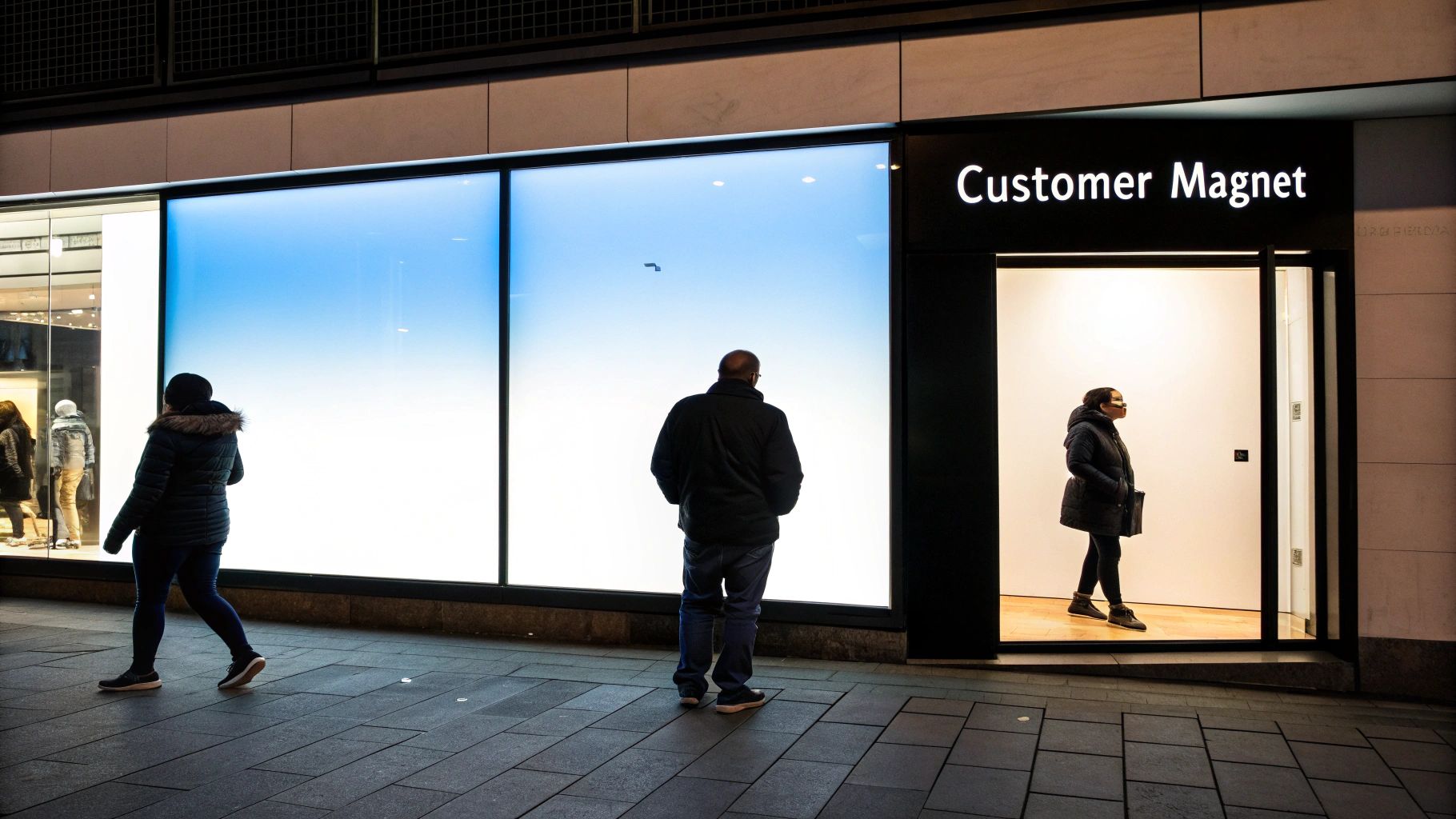
The right display doesn’t just show pictures; it tells your story. Modern LED technology has leveled the playing field, giving businesses of all sizes the power to compete for attention on crowded streets—an arena once dominated only by the biggest retailers.
The numbers don't lie. Outdoor LED applications command a massive 55% share of the total LED market for a reason. And it's been proven that dynamic ads can boost foot traffic by a staggering 30-50%. Fixed installations, which are perfect for permanent window setups, are driving the majority of this growth, especially with fine pixel pitches that keep visuals crystal-clear even in direct sunlight. You can dig into the specifics in this LED display market research report.
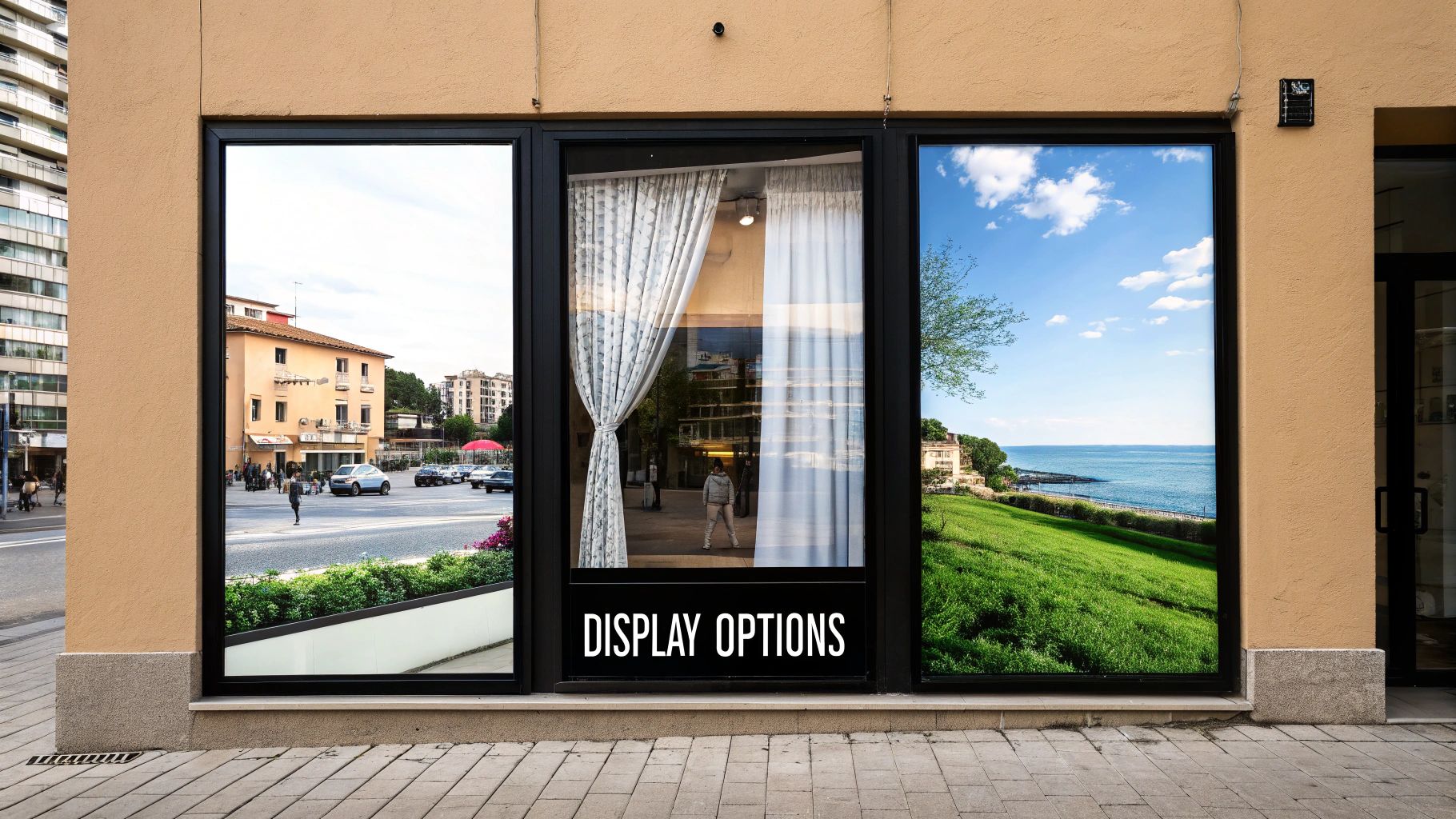
Choosing the right led light window display can feel like you’re learning a whole new language, but it’s a lot simpler than you might think. Honestly, each technology is just a different tool for a specific job.
The real key is matching the right tool to what you want to achieve, the physical reality of your storefront, and, of course, your budget. Let’s break down the main players with some straightforward analogies. Once you get the core strengths of each, you’ll go from feeling overwhelmed to feeling confident, ready to pick the perfect display to turn heads and bring people in the door.
Think of a static LED sign as the modern-day digital poster. It's built to do one thing and do it exceptionally well: display a fixed message with incredible brightness and clarity. These are the absolute workhorses of window advertising, perfect for getting essential info across that doesn't change every five minutes.
Their power is in their simplicity and rock-solid reliability. You can put up your business name, hours of operation, a bold "Now Open" message, or highlight a core service. They are ridiculously effective at establishing your presence and making sure key details are always visible, day or night.
Sure, they don't play video, but that focused purpose makes them a smart, cost-effective choice for any business needing consistent, high-impact messaging without the fuss of creating dynamic content. It's a massive upgrade from a printed sign, no contest.
Now, picture a set of high-tech blinds that can play full-motion video. That's the magic behind transparent LED mesh and curtain displays. These screens are brilliantly designed with gaps between the LED strips, which lets a huge amount of natural light pass right through into your store.
This transparency, often ranging from 60% to over 90%, is their knockout feature. It means you can cover an entire window with a stunning, moving advertisement without plunging your storefront into darkness. From the street, people see a vibrant video display. From inside, you and your customers can still see out. It’s pretty amazing.
This dual functionality makes transparent displays a total game-changer for retail. You get the full visual punch of a video wall while keeping the open, inviting atmosphere of your interior. It's truly the best of both worlds—uncompromised advertising and a welcoming in-store experience.
For the absolute biggest visual impact, you have the high-resolution LED video wall. This is basically like putting a massive, brilliant, commercial-grade TV in your window. It gives you a solid, seamless canvas for showing off rich, detailed, and totally immersive content.
These are the displays you choose when you really want to tell a story—running high-production video ads, showcasing your brand's journey, or creating a visual centerpiece that just stops people in their tracks. A restaurant could show mouth-watering videos of its signature dishes; a real estate office could run virtual property tours. The creative possibilities are endless.
Because they're made of solid panels, they don't have the see-through quality of a mesh display. This makes them a better fit for closed-back window designs or any situation where blocking the view is okay, or even preferred. When you need maximum visual punch, a high-resolution led light window display is the undeniable champion. For a deeper dive into all the different configurations, you can explore the wide range of LED signs for businesses available today.
Feeling clearer on the options? This quick comparison table can help you zero in on which technology is the best fit for your specific goals, content style, and storefront.
| Display Type | Best For | Content Style | Typical Cost |
|---|---|---|---|
| Static LED Sign | Permanent info like logos, hours, & "Open" signs | Text, simple graphics | $ |
| Transparent Mesh | Full-window video without blocking natural light | Dynamic video, animations | $$ |
| Video Wall | Maximum visual impact for brand storytelling | High-res video, detailed images | $$$ |
By looking at your needs through this lens, you can easily see whether the simple reliability of a static sign, the innovative transparency of a mesh display, or the raw power of a video wall will give you the best return for your investment.
Two technical details can make or break your investment in an LED light window display: brightness and pixel pitch. Nail these, and you've got a display that looks stunningly professional. Get them wrong, and you're left with one that’s blurry, washed out, or just plain unreadable. These are the foundations that make sure your content is seen exactly how you imagined it.
A question I hear all the time is, "Why can't I just stick a regular TV in my storefront window?" The answer is simple: a TV screen is no match for the sun. It was designed for your living room, not to compete with direct daylight, which will turn it into a dim, black mirror. This is where our first key metric comes into play.
The brightness of an LED display is measured in a unit called nits. Think of nits as the horsepower of your screen—the more you have, the more power it has to cut through ambient light and harsh sun glare. For context, a typical indoor TV puts out around 250-350 nits, which is perfectly fine for a dimly lit room.
A commercial-grade LED light window display, on the other hand, plays in a completely different league. Your specific needs will come down to your storefront's location and which way it faces.
Getting the nit rating right ensures your investment works for you from sunrise to sunset, preventing that washed-out look that screams unprofessional and ineffective.
Once you’ve solved for brightness, the next critical piece of the puzzle is image sharpness. This is all about pixel pitch. Remember looking closely at a newspaper photograph and seeing it's made of tiny dots? The closer those dots are, the sharper and more detailed the image looks.
Pixel pitch is the exact same concept. It’s the distance, measured in millimeters, from the center of one LED pixel to the center of the next. A smaller pixel pitch number (like P2.5) means the pixels are packed tightly together, creating a high-resolution image that looks crisp even when you’re standing right in front of it. A larger number (like P10) means the pixels are farther apart—fine for viewing from a distance, but it will look blocky and pixelated up close.
This detail is so important that the global market for LED displays, expected to grow to USD 25.98 billion by 2030, is being driven by the demand for these smaller pixel pitch screens. It's no surprise, as these fine-pitch displays are a major reason businesses report a 20-40% uplift in customer engagement after installation. You can dig into more of these market trends in this detailed LED display research report.
So how do you figure out the right pixel pitch for your window? Forget complex formulas. There's a simple, practical trick.
Go outside and stand where your target customers will be. This could be on the sidewalk right out front, across the street, or from the nearest intersection. Now, measure the distance from that spot back to your window.
That distance is your guide. The rule of thumb we use in the industry is that for every meter of viewing distance, you need about 1mm of pixel pitch.
Viewing Distance and Pixel Pitch
| Your Measured Viewing Distance | Recommended Pixel Pitch |
|---|---|
| Close (Under 10 feet / 3 meters) | P2 to P3 |
| Medium (10-20 feet / 3-6 meters) | P4 to P6 |
| Far (Over 20 feet / 6+ meters) | P8 to P10 |
Taking a few minutes to measure your real-world viewing distance is a crucial step. It allows you to confidently choose a pixel pitch that guarantees your content looks sharp and professional, not like a blurry mess. It's how you make sure every dollar you invest in your LED light window display translates into a clear, compelling message that grabs your audience.
A brilliant, high-resolution LED light window display is really just a powerful canvas. It's the artwork you put on it—your content—that truly stops people in their tracks. Forget about flashy, over-the-top animations for a moment. The most effective digital content is all about clear, immediate communication.
Your mission is to grab someone's attention and land a message in the few seconds they glance your way while walking by.
This means putting clarity first. Think high-contrast color combinations that pop in any lighting condition, like a bold yellow on black or a crisp white on deep blue. Your font choice is just as critical. Stick with thick, bold, sans-serif fonts that can be easily read from across the street. That delicate script font might look great up close, but from a distance, it just turns into an unreadable smudge.
In the fast-paced world of storefront advertising, you've got about three seconds to make an impression. That’s it. If a passerby has to stop, squint, and try to figure out what you're saying, you've already lost them. Your content has to be understood in a single glance.
This "three-second rule" is a great gut-check that forces you to be disciplined and direct.
Instead of a long-winded message like, "We are excited to announce our special seasonal promotion on all winter apparel," slash it down to the core: "WINTER SALE: 50% OFF." It’s punchy, direct, and gets the point across instantly. Simple animations can be your best friend here—a gently pulsing price or a product sliding into view is often all you need to catch the eye without muddying the message.
This decision tree infographic gives a great visual for how viewing distance and content design are deeply connected.
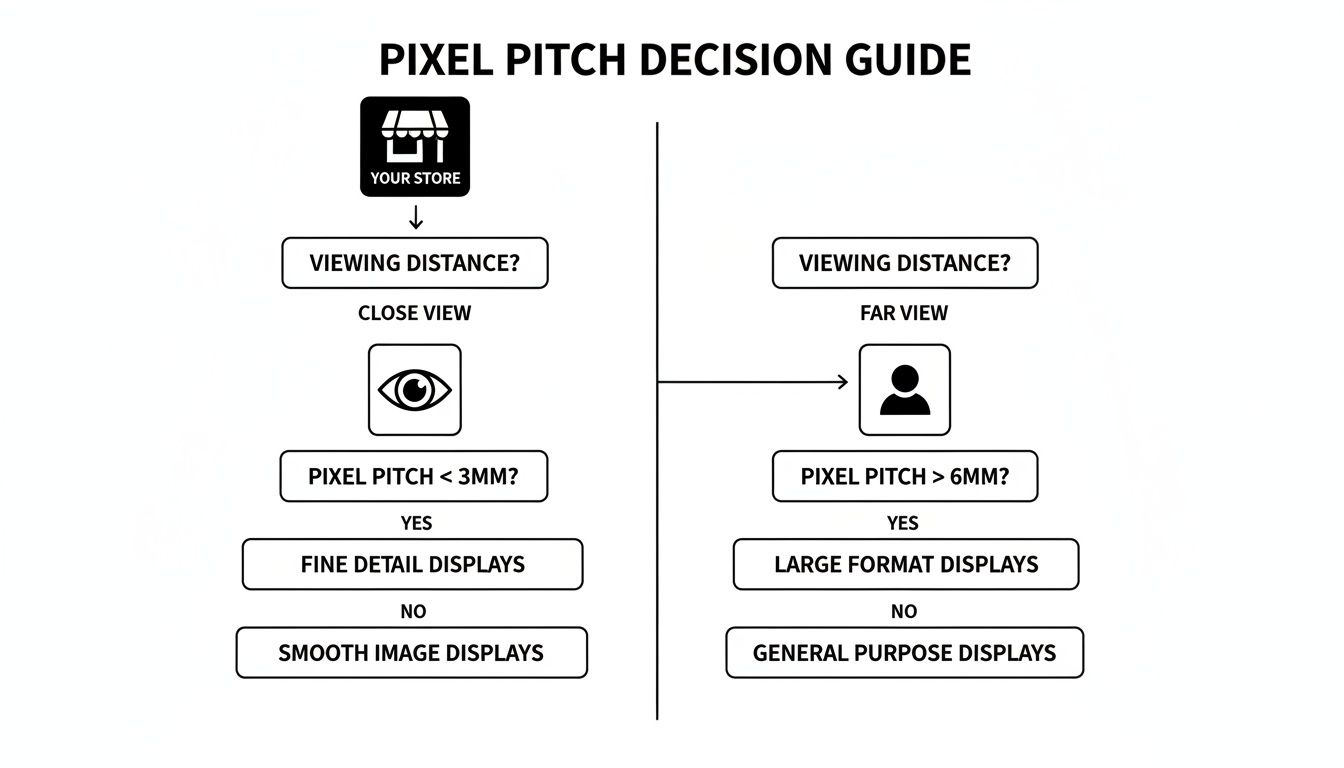
It really drives home a key principle: what works for someone standing right at your window is completely different from what you need to attract someone across the street.
One of the biggest advantages of an LED light window display is its ability to change on a dime. This lets you schedule content that syncs up perfectly with the daily rhythm of your business and your customers' lives. Modern management software makes this incredibly simple, allowing you to plan out your promotions for maximum impact without needing to be a design expert.
Think about how you could put this to work:
By tailoring your content to specific times of the day, you create relevant, timely offers that feel personal and urgent. This dramatically increases the chance of converting a passerby into a customer. This isn't just advertising; it's smart, responsive marketing that works for you 24/7.
This level of control transforms your display from a static sign into an active, dynamic part of your sales strategy. You can react to a sudden rainstorm by promoting umbrellas, hype up a local festival, or even launch a flash sale during a slow period with just a few clicks. It’s all about making sure your storefront is always working its hardest to bring people inside.
Once you've got a vision for your content, the next big step is actually bringing your LED light window display to life. This is where we get into the nuts and bolts—the practical side of things. We're talking about everything from the physical installation and power requirements to making sure your investment can handle the daily grind of a commercial environment for years to come. Thinking through these details now saves a ton of headaches down the road and ensures everything goes smoothly, from the day you buy it to the day you flip the switch.
First up, how are you going to physically mount the display in your window? There’s no single right answer here. The best method really depends on your storefront’s design and the specific type of display you’ve chosen. Each option offers a totally different look and feel.
Mounting is so much more than just hanging a screen. It’s about integrating it cleanly into your space for a professional finish that grabs the most attention. The three most common approaches give you plenty of flexibility for almost any window setup.
No matter which way you go, professional installation is non-negotiable. It's the only way to guarantee stability, safety, and proper connections for both power and data. You’ll also need access to a dedicated electrical circuit to handle the display’s power draw without tripping the breakers.
A storefront window is a surprisingly tough environment. It gets blasted with direct sunlight, deals with massive temperature swings, and can be exposed to plenty of dust and moisture. This is exactly why a commercial-grade display isn’t just a good idea—it’s a must. Unlike the TV in your living room, these displays are built for this kind of abuse.
A key spec you need to know is the IP rating, which stands for Ingress Protection. This simple two-digit code tells you how well a display is sealed against the elements.
An IP65 rating is a common gold standard for high-quality, outdoor-facing displays. The "6" means it's completely dust-tight, and the "5" means it can handle low-pressure water jets from any direction. Rain or a window washing? No problem.
This level of toughness ensures your display keeps running reliably, whether it's a scorching summer day or a frigid winter morning. And businesses are catching on. The market for outdoor modular LED displays—the kind perfect for robust window setups—was valued at a whopping USD 7.08 billion in 2023 and is projected to explode to USD 23.54 billion by 2032. This isn't just a trend; it's a massive shift as retailers recognize the power of super-bright, durable LEDs, with some seeing sales jump by 15-25% during peak hours after installing one. You can dig into the numbers in this in-depth analysis of the LED display market.
While a quality LED light window display is designed for the long haul, a little bit of upkeep will make sure it performs perfectly for its entire lifespan, which can be more than 100,000 hours.
Following these simple steps is all it takes to protect your investment and keep your storefront looking its best. To learn more about hardware that’s built to last, check out our guide on digital outdoor signage.
An LED window display isn't just a purchase; it's a powerful business asset. And like any smart investment, it needs a bit of financial planning. There’s no single price tag—the final cost is a direct reflection of your specific goals and the tech required to make them happen.
A few key factors will shape the total price. The physical size of the display is the most obvious one; bigger screens simply require more materials and labor. Likewise, a finer pixel pitch—which gives you that crisp, up-close clarity—will raise the cost because you're packing in more LEDs. Finally, installation complexity, like tricky electrical work or custom framing, will also factor into your budget.
Before you even think about finalizing a purchase, you absolutely must look into your local regulations. This is a big one. Many cities and towns have specific rules about the brightness, size, and even the type of content you can show on digital signs. Skipping this step can lead to hefty fines or, even worse, being forced to take down your brand-new display.
Get in touch with your local city planning or zoning department and ask about their sign ordinances, specifically for digital or illuminated signs. You’ll likely need to apply for a permit before installation, and that process can take several weeks. Getting this sorted out early will save you a world of headaches down the road.
Thinking of your LED display as just another expense is missing the bigger picture. This thing is a revenue-generating machine. Its true value becomes crystal clear when you start measuring its return on investment (ROI), which goes way beyond a quick bump in sales. Before making any significant investment, a thorough understanding of the project's financial viability is essential, as detailed in this practical guide to the financial study of feasibility in real estate.
Think about the long-term financial impact this one piece of equipment can have.
An LED light window display pays for itself in multiple ways. It's not just an advertising tool; it's a one-time investment that replaces recurring costs, boosts brand value, and directly drives customer action for years to come.
To really get a handle on your ROI, start tracking these key metrics:
By keeping an eye on these factors, you can build a rock-solid financial case for your investment. For a more detailed breakdown of what goes into the price, check out our guide on the factors that determine outdoor LED sign cost.
Jumping into any new technology brings up a few questions, and an LED light window display is no different. We get it. To help you feel completely confident, we’ve put together the most common questions we hear from business owners and answered them in a clear, straightforward way.
This is your final checklist before you turn that window into your most powerful marketing tool. These are the practical, nitty-gritty details that take an idea from a "maybe" to a definite "yes."
It's surprisingly easy and fast. Forget needing a designer on speed dial for every little change. Modern displays are managed with simple software you can run from a computer or even your smartphone.
You can schedule content for specific times—like a lunch menu that only appears from 11 am to 2 pm—and upload brand-new promotions in just a few minutes. Most systems use Wi-Fi, letting you make changes from your back office without ever touching the screen. This gives you total control to react instantly to a flash sale, a sudden rainy day, or a local event, making your advertising incredibly agile.
While it obviously uses power, modern LED technology is incredibly energy-efficient, especially when you compare it to old-school neon or fluorescent signs. The actual cost is minimal for most businesses—think of it as a small, predictable marketing expense that works for you 24/7, not a major utility drain.
That small cost is easily offset by the bump in sales you'll see and the money you save on printing traditional signs and banners. The return on this minor investment is huge.
This is a common thought, but it’s a mistake we strongly advise against. A standard television just isn't bright enough to be seen in daylight. To anyone passing by, it will look washed out or completely dark, creating an unprofessional and ineffective impression.
Commercial LED displays are specifically engineered with high brightness (measured in nits) to cut right through direct sun glare. TVs also aren't built for 24/7 commercial use and can suffer from overheating and permanent image burn-in. A purpose-built commercial display is a far more durable and effective investment, hands down.
A quality commercial LED light window display isn't a temporary fix; it's a long-term asset built to last. Most are rated for an incredible 100,000 hours of use.
To put that into perspective, if you ran your display for 12 hours every single day, it would last over 22 years before its brightness degraded to half its original level. When you invest in a reliable, commercial-grade unit from a trusted provider, you're getting a powerful marketing tool that will work for your business for decades to come.
Ready to turn your storefront into a landmark? The team at Smart LED Inc. offers factory-direct pricing on high-performance displays built to last. Explore our solutions and get a custom quote today.
Picture this: you take the flash and spectacle of a Times Square billboard, slap it on the back of a truck, and send it wherever
A wall of TV screens is exactly what it sounds like: a big, impressive display made by tiling multiple TVs together so they act like
Picking the right displays for shows can feel like a high-stakes guessing game. Get it right, and you create an immersive world that captivates your
"*" indicates required fields