Uncategorized
Digital Billboard Truck: Boost Your Campaign with Mobile Ads
Picture this: you take the flash and spectacle of a Times Square billboard, slap it on the back of a truck, and send it wherever
Thinking about getting into billboard advertising? It's a powerful move. But before you jump in, it's smart to understand the playing field. The whole process really boils down to four key steps: figuring out your goals, nailing down a realistic budget, picking between digital and static formats, and then, of course, finding that perfect location.
Get those four things right, and you’re setting yourself up for an investment that actually pays off.
Buying billboard space can feel like a huge undertaking, but it’s more straightforward than you might think. It’s not just for mega-corporations with bottomless marketing budgets anymore. With a solid plan, any business can tap into this medium to make a serious impact.
To really get a handle on it, it helps to see where billboard advertising fits into the bigger picture of What Is Media Buying?. This context helps frame your billboard purchase not as a one-off expense, but as a strategic piece of your overall marketing puzzle. The core steps are the same whether you're a local coffee shop or a growing regional brand.
This chart lays out the basic workflow—it’s all about getting your message up in lights the right way.
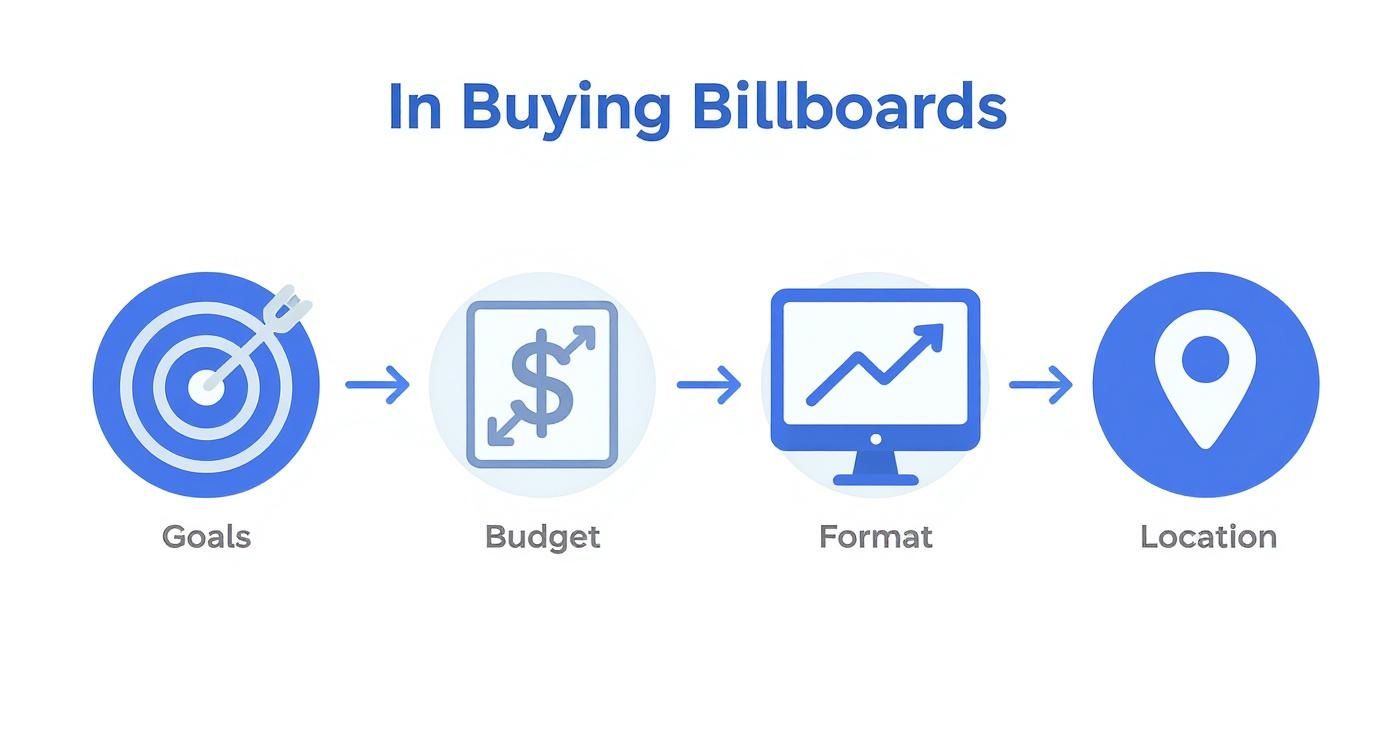
As you can see, a successful campaign always starts with strategy. You need clear goals and a firm budget before you even start thinking about the fun stuff like design and location.
The billboard world has gotten seriously sophisticated, especially with digital out-of-home (DOOH) advertising shaking things up. The global out-of-home (OOH) market is on track to blow past $40 billion, and believe it or not, traditional billboards still make up almost 65% of that. That’s a massive market, which means competition for prime spots can be fierce.
To give you an idea, a single static billboard in a city like Los Angeles could run you anywhere from $10,000 to $30,000 a month. A slot on a high-traffic digital screen? That could push $50,000.
The takeaway here is simple: buying a billboard is a major financial decision, not just a creative one. Your budget is going to shape every other choice you make, from the type of board you can afford to where you can place it and for how long.
This guide is here to walk you through it all, step by step, with practical advice you can actually use. We're going to demystify the process and turn what seems like a complex purchase into a clear, actionable plan. Let's get your first campaign off the ground.
Before you even think about billboard designs or locations, you have to start with the most critical question: Why?
A billboard without a clear purpose is nothing more than a very expensive piece of art. To get a real return on your investment, every decision you make needs to be guided by specific, measurable goals. Simply saying you want "more business" isn't going to cut it.
So, what are you actually trying to achieve?
The goal you choose completely changes the game. A broad brand awareness campaign might demand a high-traffic highway billboard seen by thousands daily. But for that grand opening? You'd be better off with a smaller, more focused board right down the street.
Once you know what you want to accomplish, you can start building a realistic budget. A huge mistake people make is thinking the cost of a billboard is just the monthly rental fee. It's not. Your total investment has to cover everything from the initial creative concept to the final takedown.
Remember, the cost of the ad space is only one piece of the puzzle. A smart budget accounts for creative development, production, and installation. Planning for these costs upfront saves you from nasty financial surprises down the road.
Let's break down the costs you can expect to run into:
Getting a handle on the full financial picture is non-negotiable. For a much more detailed look at the numbers, checking out a real analysis of outdoor LED sign cost will give you the context you need to set accurate budget expectations.
To see how this works in the real world, let's look at two very different businesses.
Scenario 1: The Local Coffee Shop
A neighborhood coffee shop wants to promote its new seasonal latte and get more people through the door during the morning rush. Their campaign is hyperlocal and has a short, four-week run.
Scenario 2: The Regional Tech Company
A growing B2B tech company is launching new software and needs to build brand recognition with professionals commuting into a major city.
As you can see, the goals dictate the budget. A tight, local campaign is far more affordable than a sweeping regional awareness push. By defining your objectives first, you can build a budget that makes sense for your business and gives your billboard campaign the best shot at success.
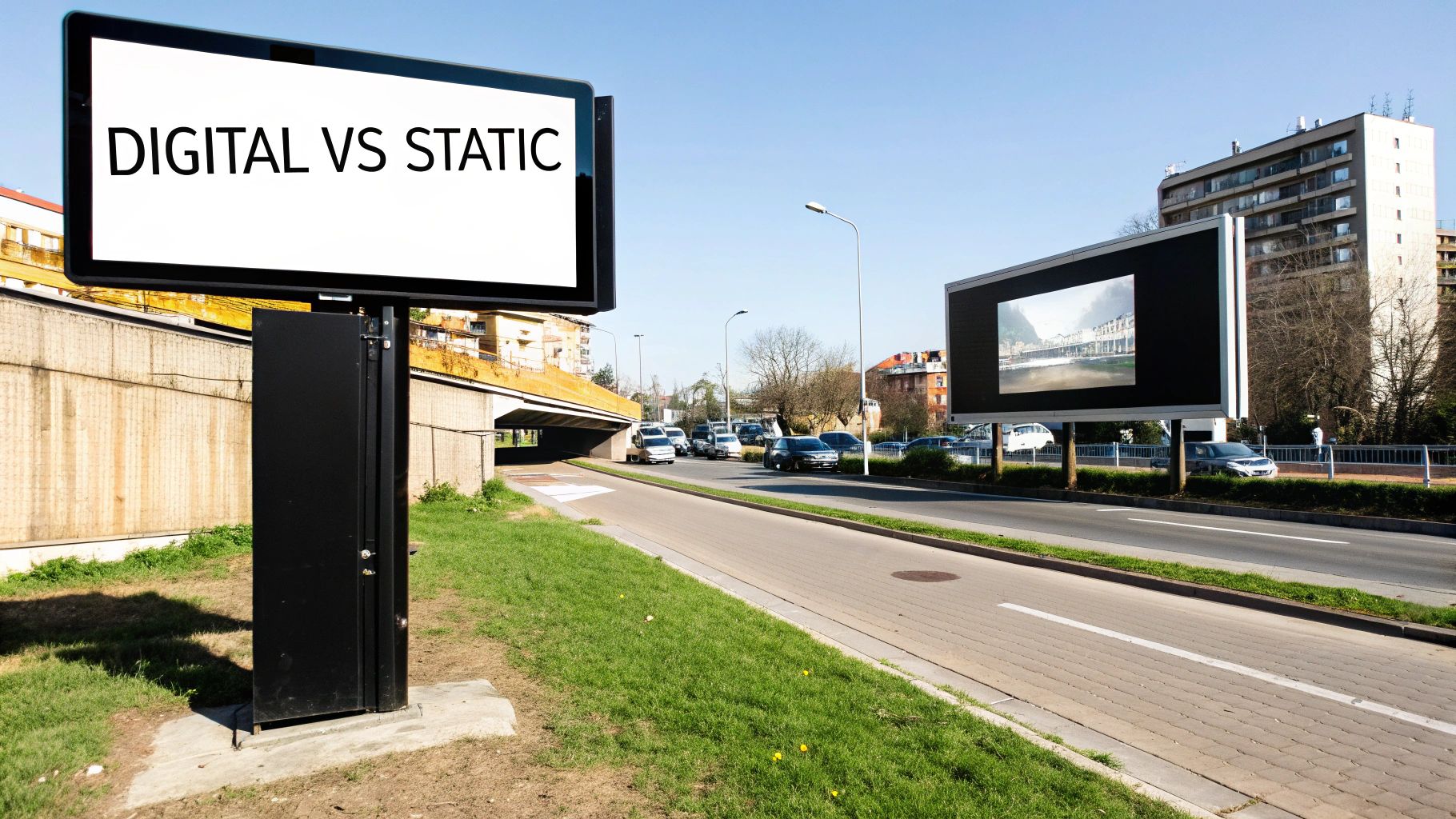
One of the first big forks in the road when buying a billboard is the choice between a classic static display and a modern digital screen. They each have their own strengths and are suited for very different campaign goals, budgets, and creative approaches. The path you take here will fundamentally shape how your message gets seen.
The traditional static billboard is the old guard of outdoor advertising for a reason. Its biggest asset is its constant, unwavering presence. Your ad owns that space 24/7, becoming a permanent fixture for the thousands of people who drive by daily. This kind of non-stop visibility is gold for brand-building campaigns where repetition and familiarity are everything.
Think about a local law firm trying to become the go-to name in their community. A static billboard with their name and tagline, seen day in and day out, builds a kind of deep-seated brand recognition that a fleeting digital ad might struggle to match. It’s a slow burn, meant to cement your brand in the local mindset.
On the other side of the coin, digital billboards bring an incredible level of flexibility and dynamism to the table. Instead of being locked into one design for weeks on end, you can cycle through multiple ads, show eye-catching video, and even change your message based on the time of day—a tactic called dayparting.
A great example is a fast-food restaurant. They could run a breakfast ad from 6 AM to 10 AM, switch to a lunch special until 2 PM, and then promote dinner deals for the evening commute. This ensures your message is always relevant, maximizing its impact. As you weigh your options, getting familiar with the underlying digital sign LED technology can really help clarify which is the better fit.
The move to digital has completely changed the game. It’s no longer just a monthly rental. In fact, digital billboards now pull in 41% of all out-of-home ad revenue worldwide, topping $20 billion. This model allows advertisers to buy slots by the hour or daypart, with a typical screen rotating between 6–8 different ads every minute.
Digital billboards give you the power to be reactive. Did a competitor just launch a sale? You can have a counter-offer live on your screen in hours, not weeks. That kind of agility is a game-changer in fast-moving industries.
At first glance, a digital billboard slot might look more expensive than a static one. But it's crucial to look beyond the sticker price and consider the overall value. With digital, you're sharing screen time, which often makes the cost per impression incredibly competitive.
Don't forget that static billboards come with ongoing production costs. Every time you want a new message, you have to pay for a new vinyl print and the crew to install it. Those costs add up fast, especially if you need frequent updates. With digital, you can upload new creative remotely with zero extra production expense. Seeing what's possible with digital outdoor signage can really open your eyes to how it can fit into your business.
To lay it all out, here’s a straightforward breakdown of the core differences. This table should help you weigh the trade-offs and align the right billboard format with your specific needs.
This comparison helps you decide which billboard format is right for your advertising campaign based on key factors.
| Feature | Digital Billboards | Static Billboards |
|---|---|---|
| Visibility | Shared rotation (typically 8-10 seconds per minute) | 100% share of voice, 24/7 visibility |
| Flexibility | High. Can change creative instantly and remotely. | Low. Requires new printing and installation. |
| Targeting | Can use dayparting for time-specific ads. | General targeting based on location only. |
| Upfront Cost | Higher rental fee for a slot. | Lower rental fee, but requires production cost. |
| Ongoing Costs | Minimal to none for creative changes. | Printing and installation costs for each change. |
| Lead Time | Short. Creative can go live in hours. | Long. Requires time for printing and scheduling installation. |
Ultimately, there's no single "best" choice—it all comes down to your goals. If you need a constant, dominant brand presence with a single, evergreen message, a static billboard is a powerful and efficient tool. But if your campaign thrives on timeliness, multiple messages, or the ability to pivot on a dime, the dynamic power of a digital billboard delivers unmatched value and impact.
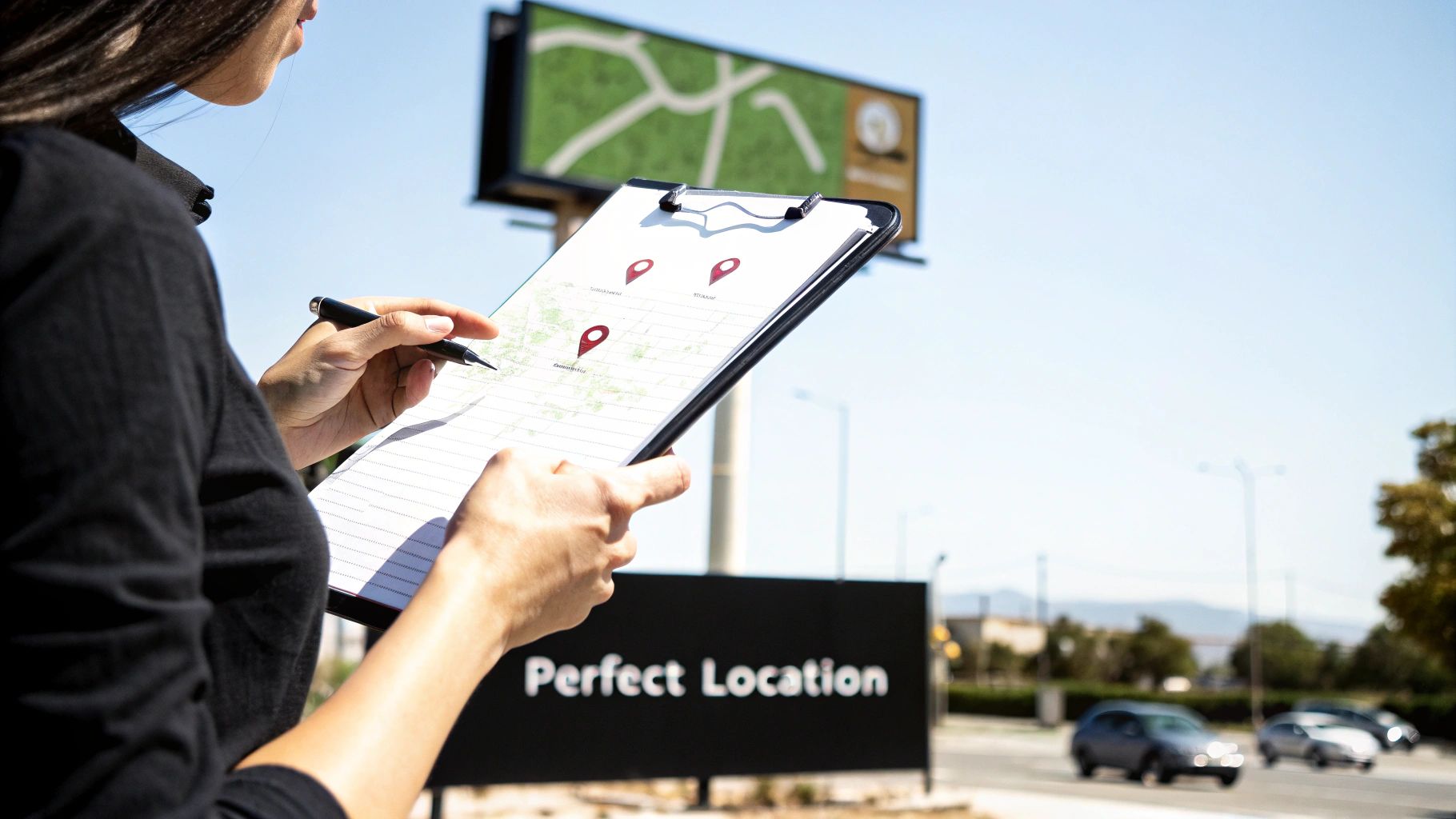
A stunning ad on the wrong billboard is just a brilliant idea wasted. Once you've nailed down your goals and picked a format, the next make-or-break step is pinpointing the perfect spot and finding the right partner. This is where the real work begins—blending hard data with a gut-level understanding of how people actually move through a city.
It's no secret that the market for outdoor advertising is hot right now. The global billboard market was recently valued at $38.32 billion and is expected to climb to $41.16 billion, growing at a steady clip of 8.1% annually through 2030. For anyone looking to buy, that means the best spots are more competitive—and more valuable—than ever.
Picking the right location is about so much more than just finding a busy road. You have to get inside the head of your audience and see the world from their driver's seat. A key metric you'll hear about is the Daily Effective Circulation (DEC), which is basically an estimate of the eyeballs—both in cars and on foot—that pass a sign each day. A high DEC is a great start, but it's far from the whole story.
Think about these critical elements when you're scouting locations:
A billboard’s location should be a direct extension of your campaign strategy. It’s not about getting the most eyes on your ad; it's about getting the right eyes on it, in the right context, at the right moment.
For instance, a local hardware store running a weekend sale would get way more bang for their buck with a billboard on a main road leading into residential neighborhoods. Putting that same ad on an interstate used mostly by out-of-town truckers would be a waste of money. This is the kind of smart, targeted thinking—like the strategy behind a prominent LED billboard installation in San Antonio—that ensures your advertising dollars are pulling their weight.
Once you have a few dream locations in mind, it's time to figure out who owns them. The industry is a mix of a few giant national players and a lot of smaller, local, and independent operators. Each has its pros and cons.
The big national companies like Lamar or Outfront have massive inventories along major highways and in big city centers. They often come with fancy data tools to help you plan. On the flip side, a local vendor might have exclusive dibs on prime spots in specific neighborhoods and could be more flexible on terms or pricing.
To find out who owns a board, look closely at the structure itself. There’s usually a small tag or plate somewhere on it with the owner's name and contact info. If you can't spot one, a quick Google search for "billboard advertising in [your city]" will pull up a list of operators you can start calling.
When you start talking to potential partners, don't be shy. This is a big investment, and you need a vendor who's transparent, responsive, and genuinely interested in your success.
Here's a quick checklist of questions to get the conversation started:
Choosing the right vendor is every bit as important as choosing the right location. A great partner will feel like an extension of your team, guiding you through the process and making sure your campaign knocks it out of the park.
Alright, you've pinpointed the perfect billboard location and found a vendor you feel good about. Now it's time to make it official. This is where the rubber meets the road—moving from planning and research to proposals, negotiations, and finally, signing on the dotted line.
Getting this part right can save you a ton of time, money, and future headaches.
The whole thing usually kicks off when you request a formal proposal or a rate card. This document is your first look at the real numbers, detailing the locations you’ve discussed, costs, contract lengths, and other terms. My advice? Don't treat this initial quote as the final word. It’s almost always just a starting point for a conversation.
When that proposal lands in your inbox, go over it with a fine-tooth comb. Does it list the specific billboard ID number you wanted? Does it include the Daily Effective Circulation (DEC) you discussed? Is every single cost clearly broken down? If anything looks off or is missing, now is the time to ask—and get the answers in writing.
Negotiation is a completely normal—and expected—part of buying a billboard. You’ve got more leverage than you might think.
A few things can give you the upper hand. For example, are you willing to sign a longer-term contract? Committing to six months or a year instead of a single four-week period will almost always get you a better monthly rate. Booking multiple boards or offering to pay a larger chunk upfront can also be powerful bargaining chips.
Don’t ever be afraid to make a counteroffer. A reasonable negotiation shows you’ve done your homework and you know what you're doing.
Once you’ve settled on the terms, the vendor will send over the official contract. This is where you need to slow down. I've seen people get excited and rush this step, which is a huge mistake that can come back to bite them later.
Think of the contract as the blueprint for your entire campaign. It lays out what you're responsible for and what the vendor is responsible for. A thorough review protects your investment and ensures there are no nasty surprises once your ad is live.
While every contract is a little different, they all contain a few standard sections. You'll want to pay extremely close attention to the fine print in these key areas to make sure the agreement is fair and your interests are protected.
As you read through the agreement, really zero in on these specific clauses. This is where potential problems love to hide.
By carefully reviewing the proposal, negotiating from a place of knowledge, and meticulously examining every clause in the contract, you can lock in your billboard purchase with complete confidence. This is the due diligence that ensures your campaign kicks off smoothly and is built on a solid, transparent agreement with your vendor.
Your billboard is finally live. After all the planning, designing, and negotiating, it’s up in lights for everyone to see. But here's the real question: is it actually working?
Seeing your ad out there is a great feeling, but you need to connect that visibility to real, tangible business results. Figuring out if a billboard campaign is a success is part art, part science, and it’s the only way to prove you made a smart investment.
How you measure success circles right back to the goals you set in the beginning. Were you chasing immediate, direct action? Or were you playing the long game to build your brand? Each path needs its own measurement toolkit.
If your main goal was to get people to do something right now, tracking your results is pretty straightforward. The trick is to give them a clear call to action with a unique hook that you can trace directly back to the billboard.
YourBrandRocks.com or YourCitySpecial.com. This lets you see exactly how many website visitors came from that specific ad.These aren't just vanity metrics; they provide hard data that turns a passive ad into an active lead-generation machine.
When you’re aiming for something broader, like boosting brand awareness, the lines get a little blurrier. But that doesn't mean you can't measure it. A classic method is running brand recall surveys before and after your campaign in that specific area. If more people recognize your name without being prompted, that’s a huge win.
With digital billboards, we can get even smarter. By using anonymized mobile location data, it’s now possible to track the actual increase in foot traffic to your physical store from devices that were near your digital ad. This is the holy grail—it closes the loop between seeing an ad and walking through your door.
Think about it: a restaurant can now see if people who drove past their digital billboard during lunch hours actually stopped by for a meal within the next 48 hours. That’s powerful stuff.
Finally, let’s talk about calculating a basic ROI. It doesn’t have to be complicated. Just take the total gain from your investment (like the total sales from your tracked phone number or the value of new website traffic) and subtract what the campaign cost you. Then, divide that number by the total cost.
(Campaign Gain - Campaign Cost) / Campaign Cost = ROI
Connecting these results back to your original goals is what brings everything full circle. It shifts your spending from a simple expense to a measurable investment and gives you the hard evidence you need to fine-tune your strategy for the next time you're ready to buy a billboard.
Diving into billboard advertising for the first time? It's natural to have questions. This is where we clear up some of the most common things we hear from first-time buyers.
Our goal is to tackle those nagging uncertainties so you can move forward with confidence.
This is the big one, and the honest answer is: it varies—a lot. You could find a smaller, static board on a rural road for as little as $750 per month. On the flip side, a premium digital billboard in a high-demand spot like New York City could easily cost $15,000 or more.
It really boils down to a few key things:
The industry standard is a four-week period, which you'll often hear called a "showing." But that’s just the starting point. Most vendors are happy to offer discounts for longer commitments.
Locking in a contract for six or twelve months can bring your monthly rate down quite a bit. This is a smart move for brand awareness campaigns where you need that constant, steady visibility to make an impact.
Insider Tip: When you're talking to vendors, always ask about their pricing tiers for different contract lengths. Committing to a longer campaign is one of the easiest ways to stretch your budget further when you're just learning how to buy billboards.
You'll want to get ahead of this, especially if you're eyeing a high-demand location. As a general rule, start the process at least 4-6 weeks in advance for a standard spot.
If you’re trying to lock down an iconic or premium location, you might need to book it several months out.
Giving yourself this buffer is key. It leaves you plenty of time for negotiating the best deal, reviewing the contract, and, most importantly, creating a killer ad design that will grab people's attention.
Ready to see your message light up a stunning digital display? The experts at Smart LED Inc. can walk you through every step, from picking the perfect sign to a flawless installation. Learn more on the Smart LED Inc. website.
Picture this: you take the flash and spectacle of a Times Square billboard, slap it on the back of a truck, and send it wherever
A wall of TV screens is exactly what it sounds like: a big, impressive display made by tiling multiple TVs together so they act like
Picking the right displays for shows can feel like a high-stakes guessing game. Get it right, and you create an immersive world that captivates your
"*" indicates required fields