Uncategorized
Digital Billboard Truck: Boost Your Campaign with Mobile Ads
Picture this: you take the flash and spectacle of a Times Square billboard, slap it on the back of a truck, and send it wherever
Ready to dive into the world of billboard advertising? It's more than just slapping a giant picture on a sign; it's a calculated process designed to grab attention on the street and drive real-world results for your business.
Thinking about buying a billboard? It really boils down to four key stages: nailing down your campaign goals, picking the right locations and ad formats, designing something truly eye-catching, and finally, measuring what worked. You can go directly to media owners if you're looking for a long-term, landmark presence, or tap into programmatic platforms for more flexible, data-driven digital campaigns.
Welcome to the ultimate guide on how to buy billboard advertising. This isn't just about renting space—it's about making a strategic move to capture attention where digital ads simply can't reach. Billboards are one of the last true broadcast mediums, hitting people in their daily lives, on their way to work, or heading out for the night.
And things have gotten a lot more interesting than old-school static vinyl prints. With innovations like Digital Out-of-Home (DOOH), you can now run stunning, animated content on brilliant LED screens, switch up your messaging on the fly, and track your campaign's impact with a surprising degree of precision. This guide will walk you through the whole process, cutting through the jargon and giving you the confidence to get started.
A successful billboard campaign isn't an accident. It's a structured journey that starts with a clear "why" and ends with measurable results, making sure every dollar you invest pulls its weight. While no two campaigns are exactly alike, the fundamental steps are always the same.
This flowchart breaks down the three pillars of the buying process, from initial strategy to the final report card.
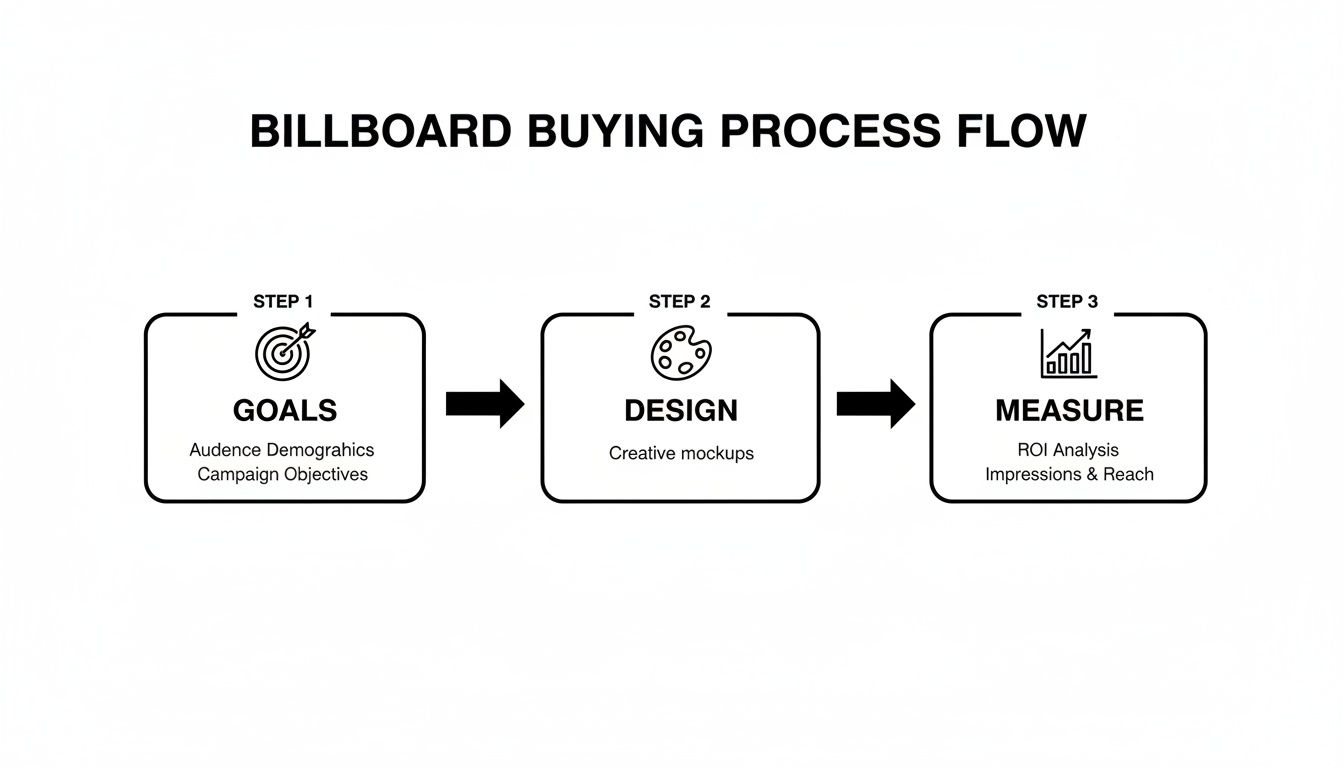
As you can see, it’s a logical flow: clear goals drive your creative, and solid measurement tells you if it all worked. Simple, right?
To give you a bird's-eye view, here's a quick-reference checklist of the core stages. Think of it as your high-level game plan for getting your ad up and running. We'll dig deeper into each of these areas as we go.
| Stage | Key Action | Primary Consideration |
|---|---|---|
| Strategy & Goals | Define specific KPIs for your campaign. | Are you aiming for brand awareness, direct response, or foot traffic? |
| Selection | Choose locations, formats (static/digital), and buying methods. | Does the location reach your target demographic effectively? |
| Creative | Design a simple, bold, and memorable ad. | Can someone understand your message in five seconds or less? |
| Execution | Finalize contracts and schedule installation or launch. | Have you confirmed all timelines, costs, and terms with the vendor? |
| Measurement | Track performance against your initial KPIs. | How will you attribute website visits, sales, or foot traffic to the billboard? |
This structured approach takes the guesswork out of the equation and sets your campaign up for success before you even sign a check.
Understanding how to buy billboard advertising is less about finding a sign and more about executing a plan. The most successful campaigns are strategic from day one, with clear goals that guide every decision from location choice to creative execution.
Jumping into billboard advertising without a clear goal is like setting sail without a map. Sure, you might see some interesting things along the way, but you’ll have no idea if you ever reached your destination. Before you even start daydreaming about locations or creative designs, you need to define what a "win" actually looks like for your business.
What are you really trying to accomplish?
This first step is the single most important part of the entire process. Your goals will shape every single decision that follows, from the type of billboard you choose to the message plastered across it. A campaign designed to build massive brand awareness across a city is a completely different beast than one meant to drive immediate foot traffic to a new retail store.
Most billboard advertising goals fall into one of three buckets. While your campaign might touch on more than one, zeroing in on a primary objective keeps your strategy sharp and your message crystal clear. Nailing down your "why" is the bedrock of a great campaign.
Let's break down the most common objectives:
Think about it: a new local coffee shop's main goal is almost certainly to drive foot traffic, while a regional insurance company is probably more focused on building brand awareness across several cities.
Once you've got your objective locked in, the next move is to attach specific Key Performance Indicators (KPIs) to it. KPIs are the hard numbers you'll use to measure success and figure out your return on investment. Without them, you're just guessing.
Your goal is the destination; your KPIs are the mile markers along the way. They provide tangible proof that your billboard advertising is actually working and moving the needle for your business.
Thinking about measurement from the get-go forces you to build tracking mechanisms directly into your campaign. Trust me, this is way more effective than trying to connect the dots after the fact.
So, how do you actually measure the impact of a giant physical sign? It’s more straightforward than you might think. With a little creativity, you can tie real-world views to tangible actions, both online and in-store.
Here’s how you can track performance for each objective:
For Brand Awareness:
For Driving Direct Response:
yourbrand.com/billboard) and put it on the ad. This lets you track every single visit generated directly from that billboard. A QR code can do the same job, just be sure it's scannable from a distance.For Increasing Foot Traffic:
So, you’re ready to get your brand up on a billboard. One of the first big calls you’ll have to make is choosing your canvas: do you go with a classic static billboard or its high-tech cousin, the digital billboard?
This isn’t just about looks. The choice you make here will shape everything from your campaign's cost and flexibility to its creative horsepower. Let’s break down which one is right for you.
Think of a traditional static billboard as the workhorse of outdoor advertising. It’s a single, printed vinyl message that stays put for your entire campaign, usually at least four weeks. Its biggest advantage? You get 100% share of voice. Your ad is the only one there, 24/7, with no competitors rotating in and out.
This constant, unchanging presence is a killer strategy for long-term brand building. If your goal is to become a household name in a specific neighborhood or along a key commuter route, the sheer repetition of a static board is tough to beat.
Imagine a local law firm trying to build trust. Placing a static billboard on a major highway into the city ensures every single commuter sees their name and face, twice a day, every single day. That kind of repetition builds a powerful sense of authority and permanence that a fleeting digital ad might struggle to match.
A static billboard is like owning a landmark. It becomes part of the local scenery, giving your brand an established, always-on presence that builds familiarity and trust over time.
Then you have the vibrant, eye-catching world of Digital Out-of-Home (DOOH). These are the massive LED screens lighting up highways and city centers. Instead of one fixed image, a digital billboard runs a loop of several ads, with each advertiser typically getting a slot of 6-10 seconds.
This format blows the doors wide open for creativity. Digital ads can be animated, feature text that changes on the fly, and even react to real-world triggers like traffic, weather, or the time of day. Picture a coffee shop advertising hot coffee on a chilly morning, then automatically switching to iced lattes when the afternoon sun comes out. That’s the power of DOOH.
And the market is responding. The global billboard industry is on a tear, projected to hit USD 60.81 billion by 2030, with this growth largely fueled by the switch to high-impact digital screens. In fact, digital billboards already pull in 41% of all OOH revenue worldwide, which tells you just how effective and popular they’ve become. Brands are flocking to DOOH because it lets them deliver sharp, relevant messages that static signs just can’t.
So, which one is best? The honest answer is: it depends entirely on your goals. Neither is inherently "better"—they're just different tools for different jobs. To help you decide, here’s a straightforward comparison of how they stack up.
| Feature | Static Billboard | Digital (DOOH) Billboard |
|---|---|---|
| Visibility | Constant, 24/7 presence (100% share of voice). | Shared rotation (typically 6-10 second slots). |
| Cost | Lower monthly rental; higher initial production cost. | Higher monthly rental; no production or printing costs. |
| Flexibility | Inflexible; creative is fixed for the campaign duration. | Highly flexible; creative can be changed instantly and remotely. |
| Best For | Long-term brand awareness, directional signs, establishing market presence. | Time-sensitive offers, dynamic messaging, event promotions, multi-ad campaigns. |
| Lead Time | Longer, due to printing and installation scheduling. | Shorter; creative can be uploaded and live within hours. |
By weighing these factors against your budget and campaign objectives, you can make a smart choice. And if you're curious about the technology that makes these stunning displays possible, exploring different digital outdoor signage options will give you a much deeper appreciation for what these screens can do.
Let's talk money. Navigating the costs of billboard advertising doesn't have to feel like guesswork. The final price tag is really a blend of a few key ingredients: the location, traffic volume, billboard size, and whether you go with a classic static board or a modern digital screen. Getting a handle on these elements is the first step to building a budget that actually works for your goals.
It’s pretty straightforward—a billboard in a packed downtown corridor is going to cost more than one on a quiet suburban street. Why? It all comes down to potential eyeballs. The more people who see your ad, the more valuable that space becomes.

The industry numbers back this up. Billboard advertising is seeing a great return on investment, with U.S. Out-of-Home (OOH) ad revenue projected to hit $9-10 billion. Even while 54% of marketers are trimming their overall ad spending, a solid 16% are actually planning to increase their OOH budgets. That tells you a lot about the medium's staying power and impact.
When you start getting quotes, you'll run into a few common ways that media owners price their space. Knowing the lingo is crucial for comparing your options and understanding what you’re paying for.
Flat-Rate Fee: This is as simple as it sounds and is most common with static billboards. You pay one set price for a specific time, usually four weeks. It's predictable and makes budgeting a breeze.
Cost Per Mille (CPM): A staple in the digital world, CPM stands for "Cost Per Thousand" impressions. Here, you're paying based on the estimated number of people who will see your ad. It’s a more data-focused approach, much like online advertising.
Gross Ratings Points (GRP): GRP is a more traditional metric that measures the total audience reach and frequency of your campaign in a specific market. One GRP equals 1% of the total market population seeing your ad.
A rookie mistake is to only look at the rental fee. The total cost includes your creative design, the printing and installation for static boards, and any agency fees if you're not buying direct. Always build these into your final budget.
For bigger campaigns, you need a more structured way to manage costs and pick the right partner. Learning about using RFQs and RFPs in procurement can be a real game-changer, helping you get competitive pricing and crystal-clear terms from media owners.
So, what should you actually plan to spend? The truth is, the range is massive. A static billboard out in a rural area might run you as little as $500 per month. On the other hand, a premium digital spot in Times Square could easily top $25,000. The trick is to match your budget to your target market.
But a smaller budget doesn't mean you're sidelined. Here are a few tried-and-true tips for stretching your investment:
A killer billboard location is only half the battle. If your creative doesn't make people look, you've wasted your money. You've got maybe three to seven seconds to grab a driver's attention, so subtlety is out. Your design has to be bold, simple, and instantly understandable.
An effective billboard is an exercise in minimalism. The single biggest mistake I see advertisers make is trying to cram their entire brand story onto one board. Your goal isn't to write a novel; it's to plant a single, memorable seed.
The cardinal rule of billboard design is what we call the "seven-word rule." If your message takes more than seven words to get across, it’s too complicated. People just don't have time to read a paragraph while merging onto the freeway.
Think of your billboard as a quick glance, not a magazine ad. The entire concept needs to click in the time it takes a car to whiz by. This requires ruthless editing and a laser focus on one central idea. A restaurant shouldn't list its menu; instead, a mouth-watering photo of its signature burger with the words "Hungry? Exit 42" is infinitely more powerful.
Beyond the word count, a few design principles are non-negotiable if you want to create outdoor advertising that actually works. These are the elements that ensure your message pops from a distance.
Your billboard is competing with traffic, other signs, and the driver's own thoughts. The only way to win is with a design so clear and compelling that it’s impossible to ignore.
Digital out-of-home (DOOH) screens open up a whole new playbook that static vinyl can't touch. The ability to use motion and context adds layers of relevance that can make your campaign far more engaging.
With digital, you can add subtle animations to draw the eye or even run a sequence of messages. Just remember, the same rules of simplicity apply. Too much motion is a dangerous distraction.
The real magic of DOOH is in context-aware advertising. Imagine your ad creative changing based on real-time data:
This kind of relevance makes your ad feel personal and timely, which dramatically boosts its impact. To get these ideas flowing and speed up the creative process, many brands now turn to AI ad generator tools to help with initial concept development.
Finally, getting the technical details right is crucial. A brilliant design concept means nothing if the file is prepped incorrectly. Every media owner will give you a "spec sheet," and you have to follow it to the letter.
Ignoring these specs can lead to a blurry, distorted, or oddly colored ad, flushing your investment down the drain. Always, always double-check the requirements before sending anything to production.
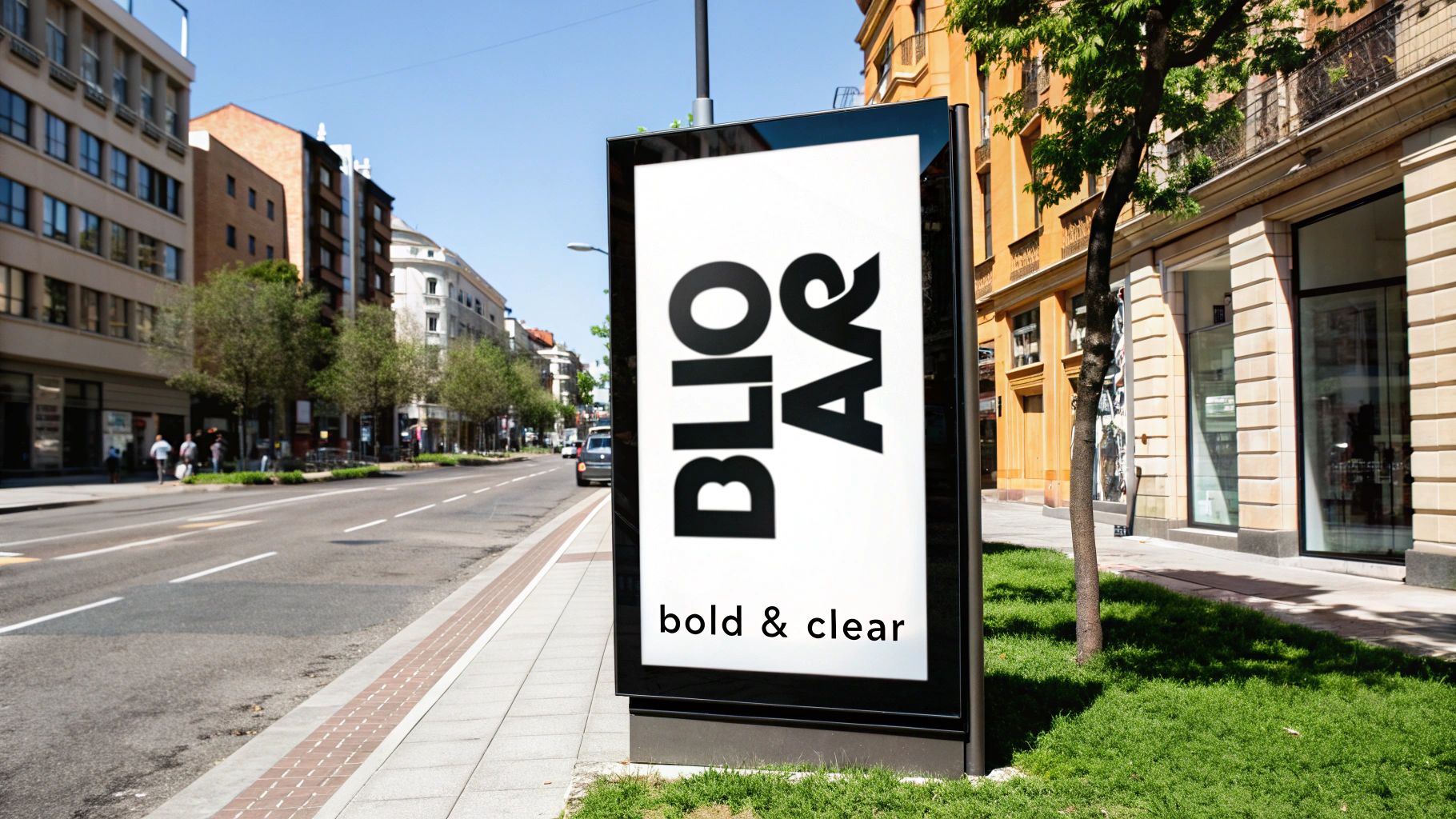
You’ve picked your locations and the creative is ready to go. Now comes the moment of truth: locking in the deal and, just as importantly, figuring out how you’ll prove it all worked. This is the final stage of buying billboard advertising. A handshake won’t cut it here—the contract is what protects your investment and makes sure everyone is on the same page.
Think of the agreement as the official rulebook for your campaign. It lays out the timelines, responsibilities, and what happens if things go wrong. Most outdoor campaigns run for at least four weeks, but many brands opt for 8-12 weeks or more to really drill the message home. Your contract needs to spell out exactly when your ad goes live and for how long.
Don't just give the contract a quick once-over. There are a few critical clauses that can make or break your entire experience. Getting these details right from the start ensures you get exactly what you paid for.
Think of your contract as the campaign’s insurance policy. It guarantees visibility and outlines remedies if things go wrong, ensuring your ad spend is protected. Getting these details right upfront prevents major headaches down the road.
Alright, now for the part your boss really cares about: proving the billboard actually did something. This is where you circle back to those initial goals you set and connect your ad spend to real results. We've moved way beyond just hoping for the best; today, you can gather hard data to quantify your return on investment.
These methods let you see the real-world impact of your outdoor ads on both digital behavior and actual foot traffic. For businesses looking to really make a statement, understanding what modern LED signs for businesses can do opens up a whole new world of dynamic, measurable advertising.
Here are a few powerful ways to track your billboard’s performance:
Analyze Web Analytics Spikes: This is a classic for a reason. Line up your campaign's live dates with your website's analytics. You’re looking for a clear lift in direct traffic, searches for your brand name, or just more overall sessions coming from the billboard's geographic area.
Deploy Unique URLs or Promo Codes: This is the most direct tracking method you have. A vanity URL (like YourBrand.com/DEAL) or a special discount code used only on the billboard gives you a clean, precise count of how many people took action.
Use Geofencing to Track Foot Traffic: This is where things get really interesting. Advanced analytics can now identify mobile devices that were in the vicinity of your billboard and later showed up at your physical store. It's powerful proof that your ad drove someone to walk through your doors.
Diving into the world of outdoor advertising can feel a bit overwhelming, and it's natural to have questions. We get them all the time. Here are some straightforward, no-fluff answers to the most common things people ask when they're learning how to buy billboard space.
This is always the first question, and the honest answer is: it depends. There’s no simple price tag. The cost swings wildly based on where the board is, how many people drive by it, and whether it’s a classic static sign or a modern digital one.
A static billboard on a quieter country road might only run you $500 a month. But if you're eyeing a prime digital spot in a place like New York City? That could easily top $25,000.
The only way to get a real number for your budget is to get quotes directly from the media owners in the specific areas you're targeting. That’s how you move from guesswork to a real financial plan.
Yes, absolutely. A giant digital screen in Times Square is obviously a different league, but there are countless effective and affordable options out there perfect for small and local businesses. You just need a smart strategy.
Here are a few ways to make it work on a smaller budget:
Billboard advertising isn't just for huge national brands. Local businesses can make a massive impact with the right strategy, zeroing in on high-value placements that speak directly to their own community.
For most campaigns, we recommend a bare minimum of four weeks. That's generally enough time to build solid message recall with the people who see it regularly.
But if your goal is to build real brand awareness and trust, you'll see much better results with longer campaigns of 8 to 12 weeks.
The magic of billboard advertising is all about repetition. Your ad has to be up long enough for people to see it over and over again on their daily commutes. That's how a message truly sinks in and becomes memorable.
Ready to make a big impact with your own high-visibility display? Smart LED Inc. is a factory-direct leader in outdoor LED signs and digital billboards, helping businesses command attention and drive growth. Cut out the middleman and see how our brilliant, reliable displays can elevate your brand by visiting https://smartledinc.com.
Picture this: you take the flash and spectacle of a Times Square billboard, slap it on the back of a truck, and send it wherever
A wall of TV screens is exactly what it sounds like: a big, impressive display made by tiling multiple TVs together so they act like
Picking the right displays for shows can feel like a high-stakes guessing game. Get it right, and you create an immersive world that captivates your
"*" indicates required fields