Uncategorized
Digital Billboard Truck: Boost Your Campaign with Mobile Ads
Picture this: you take the flash and spectacle of a Times Square billboard, slap it on the back of a truck, and send it wherever
Before you even start scouting for the perfect high-traffic corner, there’s a foundational decision you need to make. It’s the first, and arguably most important, fork in the road: are you going to lease advertising space, or are you going to buy the physical billboard itself?
For most businesses just looking to get their message out there, leasing is the hands-down winner. It’s faster, more flexible, and won’t require a massive capital outlay. But for others, ownership presents a powerful long-term asset. Let’s break down what each path really means for you.
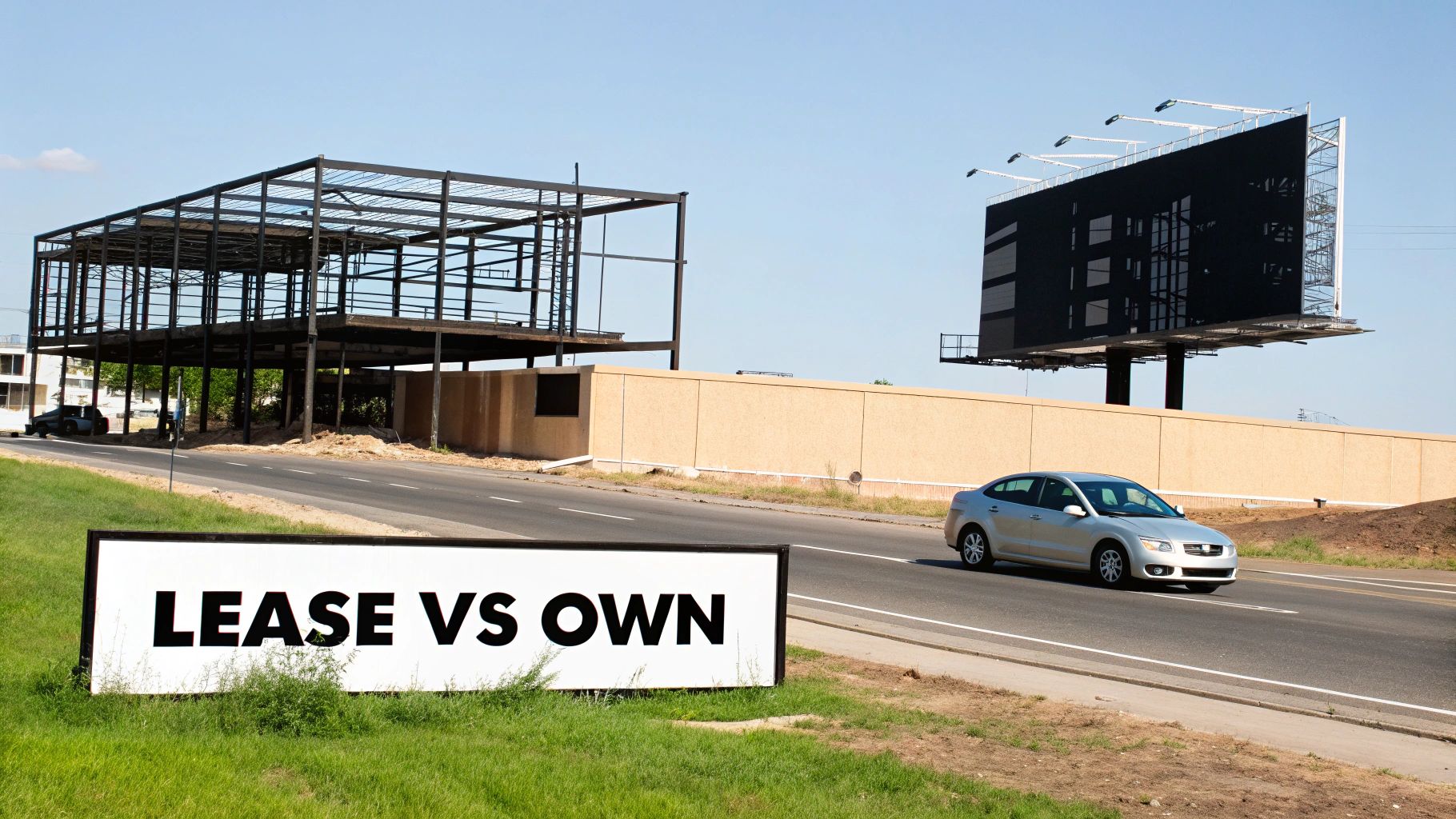
This isn’t just about location or design—it's about how you access the medium. Choosing between renting ad space and purchasing the entire structure will fundamentally shape your budget, your timeline, and all the legal red tape involved. Each option serves completely different business goals and financial realities.
Leasing space is pretty straightforward. Think of it like renting an apartment for your ad. You pay a recurring fee to a media company that owns and maintains the structure, and they put your creative up for a set period. It’s the go-to for campaign-based advertising.
On the flip side, buying and owning a billboard is a serious capital investment. You're not just placing an ad; you're essentially getting into the commercial real estate business. You become the landlord, responsible for everything from pouring the concrete and getting permits to fixing storm damage and selling ad space to other businesses.
For the vast majority of advertisers, leasing is simply the most logical choice. It keeps the financial risk low and the upfront costs from spiraling out of control.
Here’s why it’s so popular:
I always tell clients to think of it this way: Leasing is for advertising your business. Owning is for being in the billboard business. Making that distinction early on is critical for setting the right expectations and strategy from day one.
Owning a billboard is a much bigger strategic play. It’s for those looking to build a new revenue stream or secure a permanent, powerful advertising fixture for their own brand. This route demands a much deeper level of commitment.
When you own the structure, you're not just buying a one-time ad; you're acquiring an asset that can generate income for years. It can be an incredibly profitable venture if you've secured a prime location and can keep the ad space consistently rented out.
But with great reward comes great responsibility. You're now on the hook for property management, navigating complex zoning laws, and covering all the ongoing operational costs.
To see where billboards fit into the bigger marketing picture, it’s helpful to understand the full range of traditional marketing channels, including billboards. This broader context can help you decide if the commitment of ownership or the flexibility of leasing better aligns with your company's growth plan.
To make the choice even clearer, let’s put the two options side-by-side. This table breaks down the key differences at a glance.
| Consideration | Leasing Ad Space | Buying the Billboard Structure |
|---|---|---|
| Initial Cost | Low. Primarily the cost of the ad campaign. | Very High. Land, permits, materials, construction. |
| Commitment | Short-term. Flexible campaign lengths (weeks/months). | Long-term. A permanent real estate investment. |
| Responsibility | Minimal. Focus is on ad creative and ROI. | Total. Maintenance, repairs, insurance, taxes. |
| Revenue | None. You are the advertiser paying for space. | Potential. Earn income by leasing space to others. |
| Best For | Businesses running specific marketing campaigns. | Investors or companies seeking a long-term asset. |
Ultimately, your decision comes down to your primary goal. If your objective is purely to advertise your product or service, leasing is almost always the smarter, more efficient path. If you're looking to diversify your investments and enter the out-of-home media industry as a provider, then ownership is the game you want to play.
Before you even think about buying a billboard, you have to answer a much simpler question: why? A great campaign isn't just about being seen; it's about being seen by the right people, for the right reason. Your goals are the foundation for every other decision you'll make, from location and format to the final design and how much you spend.
Are you trying to blast your brand name across an entire metro area to build awareness? Or is it something more direct, like getting people to pull off the highway and into your newly opened coffee shop on Elm Street? Maybe you're just announcing a huge weekend sale at your furniture store.
Each of those goals demands a completely different playbook.
Think of your billboard as a specialized tool. A campaign designed to build brand trust might feature a simple, clean design with a powerful tagline, placed on a major highway and left there for months to build familiarity. Success here isn't measured in a spike in daily sales but in long-term brand recall.
On the other hand, if your goal is to drive local traffic to your real estate agency's website, a digital billboard near a busy business district makes more sense. You could flash a QR code or a catchy URL, and you'd track success by watching for a jump in website visits from that specific area.
Here are a few of the most common goals we see for billboard campaigns:
Once you've locked in your "why," it's time to tackle the "how much." Budgeting for a billboard is more than just paying the monthly rent for the ad space. This is a classic rookie mistake that can sink an otherwise solid plan. You need a complete picture of the costs.
Your total investment will usually fall into three main buckets: renting the space, creating the ad, and getting it installed.
The most effective billboard campaigns are the ones where the budget is a direct reflection of a well-defined goal. Throwing money at a prime location without a clear objective is like shouting into the wind—you’ll make noise, but you won’t know if anyone who matters is listening.
The global billboard and outdoor advertising market is massive, which gives us some useful cost benchmarks. With average monthly rents for a high-traffic board sometimes starting around $2,000, and the cost per thousand impressions (CPM) often in the low single-digit dollars, it's a channel that can scale with you. You can find more billboard market trend insights from industry analyses to help frame your expectations.
Let's get into the specific costs you need to plan for. Knowing these components upfront prevents surprise bills and makes sure your campaign is financially sustainable from day one.
1. Media Space Rental
This is the big one. It's what you pay the billboard owner for the right to display your ad. Prices are all over the map, driven by:
2. Ad Design and Production
This is the cost to actually create the visual. For a static billboard, that means hiring a graphic designer and paying for the physical printing of your message on a huge sheet of vinyl. Digital billboards need professionally designed digital files, which also comes with a design fee.
3. Installation and Maintenance
For static billboards, there’s a one-time fee to have the vinyl professionally installed on the structure. This can run a few hundred dollars. While the owner is usually responsible for ongoing maintenance, you have to account for that initial setup cost. For an in-depth look at what goes into the pricing of different signs, you can explore our complete guide on outdoor LED sign cost. It will give you a much clearer picture of how all these factors add up to the final price tag.
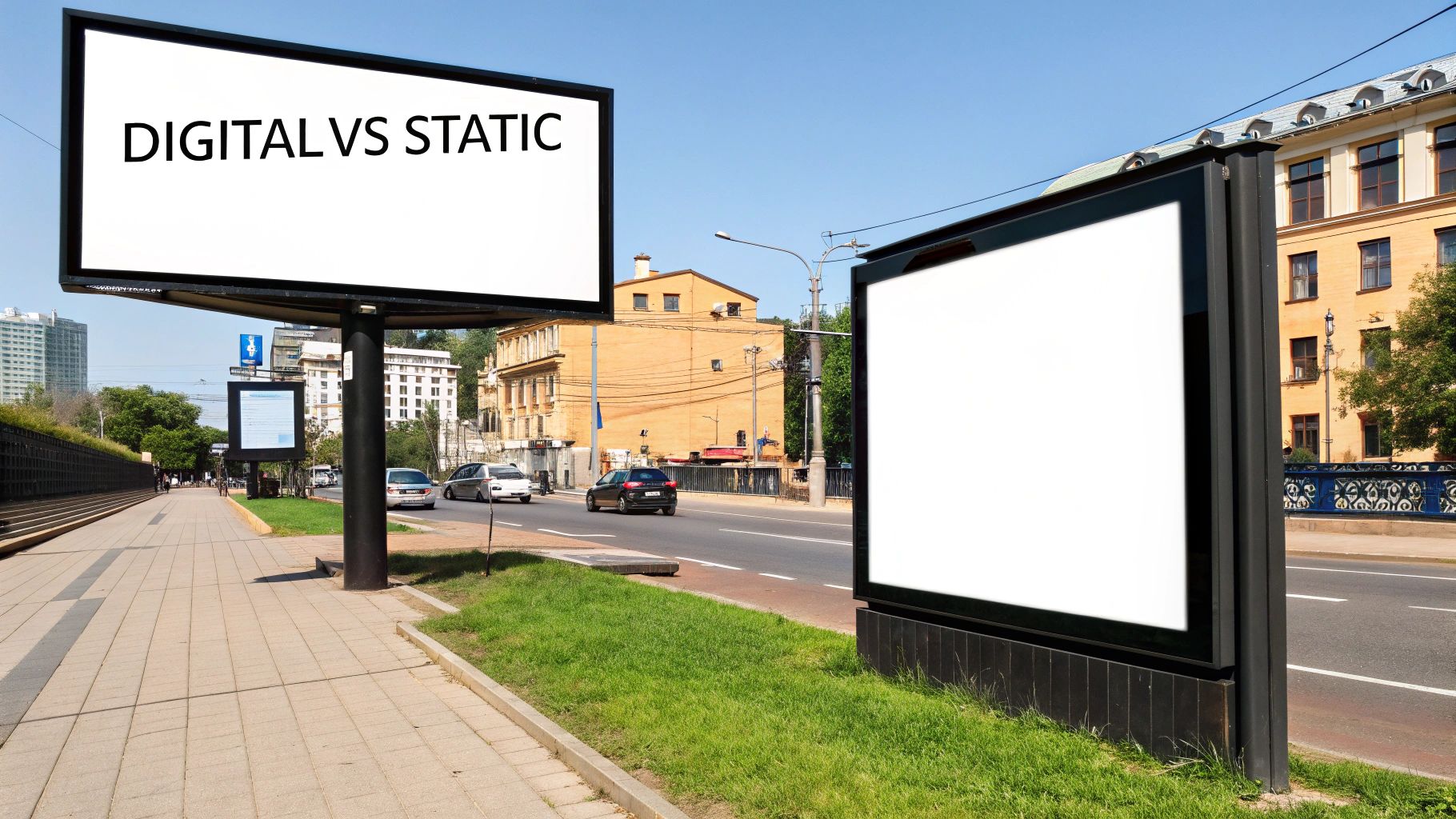
Once your goals are locked in, your next big fork in the road is the billboard format itself. Are you going with a classic static board or a modern digital screen? This decision ripples through everything—your campaign’s agility, creative options, and, of course, your budget.
Each type has its place. The right one for you comes down to what you’re trying to accomplish.
Traditional static billboards are the old guard for a reason. They're the massive, unchanging vinyl prints you see commanding attention on the highway. They give you a constant, 24/7 presence. Once it's up, it's up—delivering the same message to every single person who drives by for weeks or months.
Digital billboards, on the other hand, are all about motion and change. They are giant LED screens that cycle through a loop of different ads, typically giving your message a six- to eight-second slot. This brings a whole new level of adaptability to the table that a static board just can't touch.
The biggest win for a static billboard? Uninterrupted visibility. You own that piece of sky for the entire contract. There's no sharing, no waiting for your turn. That constant reinforcement is incredibly powerful for hammering home a brand name or a simple, memorable message.
They also tend to be lighter on the wallet in terms of monthly rental fees, which can make them a great starting point if you're working with a tighter budget. For a campaign built around long-term brand awareness or simple "Exit Now!" directions, a static board is often the most direct and cost-effective route.
The trade-off, however, is rigidity. Once that vinyl is printed and installed, your message is set in stone—or, well, vinyl. Any changes mean a whole new production and installation job, which costs both time and money.
This is where digital boards really shine. Their biggest strength is the ability to swap out creative almost instantly. This unlocks a whole world of strategic moves that a single, unchanging message could never pull off.
Think about the possibilities:
Digital gives you the power to be reactive and relevant. You're no longer just broadcasting a static image; you're participating in a dynamic conversation with your audience, tailored to the time of day, a local event, or even the weather.
While static boards have been the backbone of outdoor advertising for a century, digital is easily the fastest-growing part of the industry. The monthly cost might be higher, but the ability to rotate multiple advertisers and support programmatic ad buys makes them incredibly efficient.
For anyone looking to buy the actual structure, not just rent the space, getting familiar with the tech behind digital outdoor signage is non-negotiable for a modern investment.
To make the choice a little clearer, let's put them side-by-side.
| Feature | Static Billboards | Digital Billboards |
|---|---|---|
| Visibility | Constant, 24/7 presence | Rotates with other ads (e.g., 8-second slots) |
| Flexibility | Low (changes require new printing/installation) | High (content can be changed remotely and instantly) |
| Upfront Cost | Lower media rental, but includes print/install fees | Higher media rental, no print/install fees |
| Lead Time | Longer (design, print, ship, install) | Shorter (requires only a digital file) |
| Best For | Brand awareness, directional ads, long-term campaigns | Time-sensitive offers, multiple messages, A/B testing |
At the end of the day, it all comes back to your campaign goals. If you need to build lasting brand recall with a single, powerful message, the always-on nature of a static board is tough to beat. But if your strategy leans on speed, timeliness, and adapting on the fly, the extra cost for a digital billboard often pays for itself through sheer relevance and impact.
The old real estate mantra "location, location, location" has never been more true than in the world of billboards. A brilliant ad in the wrong place is just expensive scenery. True success isn’t just about finding a busy road; it’s about a sharp analysis of who is on that road and how they’re going to experience your message.
A billboard's power is all in the details: traffic flow, driver visibility, even the average speed of the cars zipping by. Think about it. An ad on a congested highway where traffic crawls during rush hour is a totally different opportunity than one on a rural road where drivers are flying past at 70 mph. The first one lets you get a bit more detailed, while the second demands a bold, simple message that can be understood in a flash.
Before you even think about signing a lease or pouring concrete, you need to become a student of the road. The good news is that billboard media owners have access to a ton of data to help you make a smart call. Don't just settle for the total number of cars. You need to dig deeper.
Ask them for a breakdown of traffic patterns by time of day. This is absolutely critical for digital billboards, where you might want to run specific ads during the morning commute versus the evening rush. You also need to get your hands on demographic data for the area. Are you trying to reach young professionals, families with kids, or a blue-collar workforce? Making sure this data aligns with your ideal customer is a non-negotiable first step.
When you're looking at a potential spot, obsess over these factors:
So, you’ve found the perfect, high-traffic spot with a clear line of sight. That’s only half the battle. A fantastic location is completely worthless if you can't legally build on it. Every single city, county, and state has its own tangled web of zoning laws, permit requirements, and restrictions that govern outdoor advertising.
Skipping this step is easily one of the most expensive mistakes you can make. It can lead to massive fines, ugly legal battles, and even an order to tear down a structure you just spent a fortune building.
Navigating local regulations isn't the sexy part of buying a billboard, but it's the most critical. Think of it as the foundation of your investment. A weak or non-compliant foundation will eventually cause the entire project to collapse, no matter how great the ad looks.
Your first call should be to the local planning or zoning department in the city or county where you want to place the billboard. They are the ultimate source of truth for the specific rules you'll need to play by.
While the nitty-gritty details will vary, most jurisdictions have rules covering a few key areas. You’ll need to get clear, definitive answers on these before you go any further.
1. Zoning Ordinances
Zoning laws dictate where billboards are even allowed to exist. Many areas flat-out ban them in residential zones or historic districts. You have to confirm that the land you're eyeing is zoned for commercial use that specifically permits outdoor advertising structures.
2. The Permitting Process
You will almost certainly need a permit to put up a new billboard. This isn't a simple form; it often involves submitting detailed plans, stamped engineering reports, and paying a hefty fee. Be prepared for this process to take anywhere from a few weeks to several months.
3. Size and Height Restrictions
Cities have very strict rules about how big and how tall a billboard can be. These regulations are there to maintain the look and feel of an area and, more importantly, to ensure public safety.
4. Lighting and Digital Display Rules
If you’re going digital, the rulebook gets even thicker. Many cities have ordinances about brightness levels to avoid blinding drivers, plus rules on how frequently the on-screen message can change. Some places might ban animated or flashing content entirely.
Getting a handle on these legal and logistical headaches from the very beginning will save you from a world of frustration and financial loss. It ensures that when you finally lock in that perfect spot, you can be confident your investment is secure, legal, and ready to start paying for itself.
Once you’ve zeroed in on the perfect location, it’s time to shift gears from strategist to deal-maker. This is the moment you reach out to the billboard provider—the company that owns the physical structure—and start turning your plan into a real, live campaign. The first contact is usually pretty simple, but the conversations that follow are where you’ll lock in the crucial details that define your campaign's success and final cost.
Your initial call will be to check the availability of your chosen spot and ask for their rate card. Here's a pro tip: don't ever take that first price as the final word. There are plenty of factors that can influence the cost, and there's almost always some wiggle room, especially if you’re willing to commit to a longer-term campaign. A six-month contract, for instance, is almost guaranteed to get you a better monthly rate than a short four-week run.
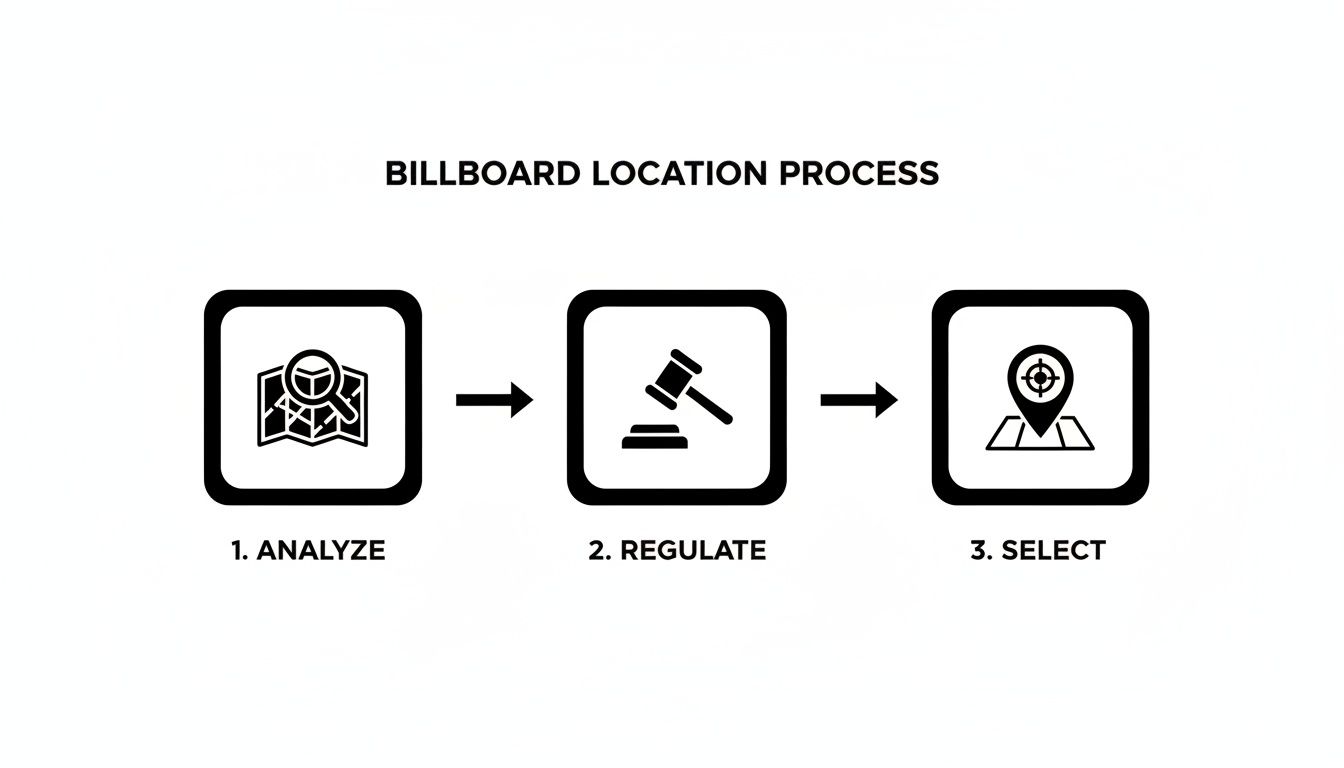
As this flowchart shows, a successful placement isn't luck; it's the result of thorough analysis and due diligence before you ever pick up the phone.
After you've settled on a price and a timeline, the provider will send over a contract. This is a legally binding document, so read it—and I mean really read it—before you sign. It’s easy to just skim for the price, but the fine print is where the important details live. Pay close attention to clauses covering payment terms, cancellation policies, and any rules about your ad content.
Your contract is the official rulebook for your campaign. It spells out not only what you'll pay but also the provider's responsibilities for maintenance, uptime (for digital boards), and what happens if your ad gets damaged. A solid contract is your best defense against expensive headaches later.
Make sure you find these key items in any agreement:
With the legal side sorted, the fun part begins: the creative. The billboard company will give you a "spec sheet" outlining the exact technical requirements for your design. This part is non-negotiable. If you submit artwork that doesn't meet their specs, you're looking at delays and, worse, a final product that looks unprofessional.
For a static billboard, your designer will be creating a massive, high-resolution file that gets printed on a huge sheet of vinyl. To ensure a crisp final product, it’s crucial to understand the nuances of banner PVC printing, from material choices to artwork setup. You’ll need to nail details like bleed, color profiles (CMYK), and file format (usually a high-res PDF or AI file).
Digital billboards are a different beast. They require a file built for screens—typically a JPEG or PNG set to a specific pixel dimension (like 1920×1080 pixels) and an RGB color profile. You can see just how sharp these displays can be in this example of a UHD LED billboard installation in San Antonio. That incredible clarity comes from hitting the precise technical specs.
Finally, you need to get a handle on the production timeline so your ad goes live right on schedule.
The process usually looks something like this:
Always, always build a little buffer into your timeline. Bad weather can delay a vinyl installation, and technology can have a bad day. By communicating clearly with your provider and understanding each step, you can set yourself up for a smooth launch and get your message in front of thousands of potential customers.
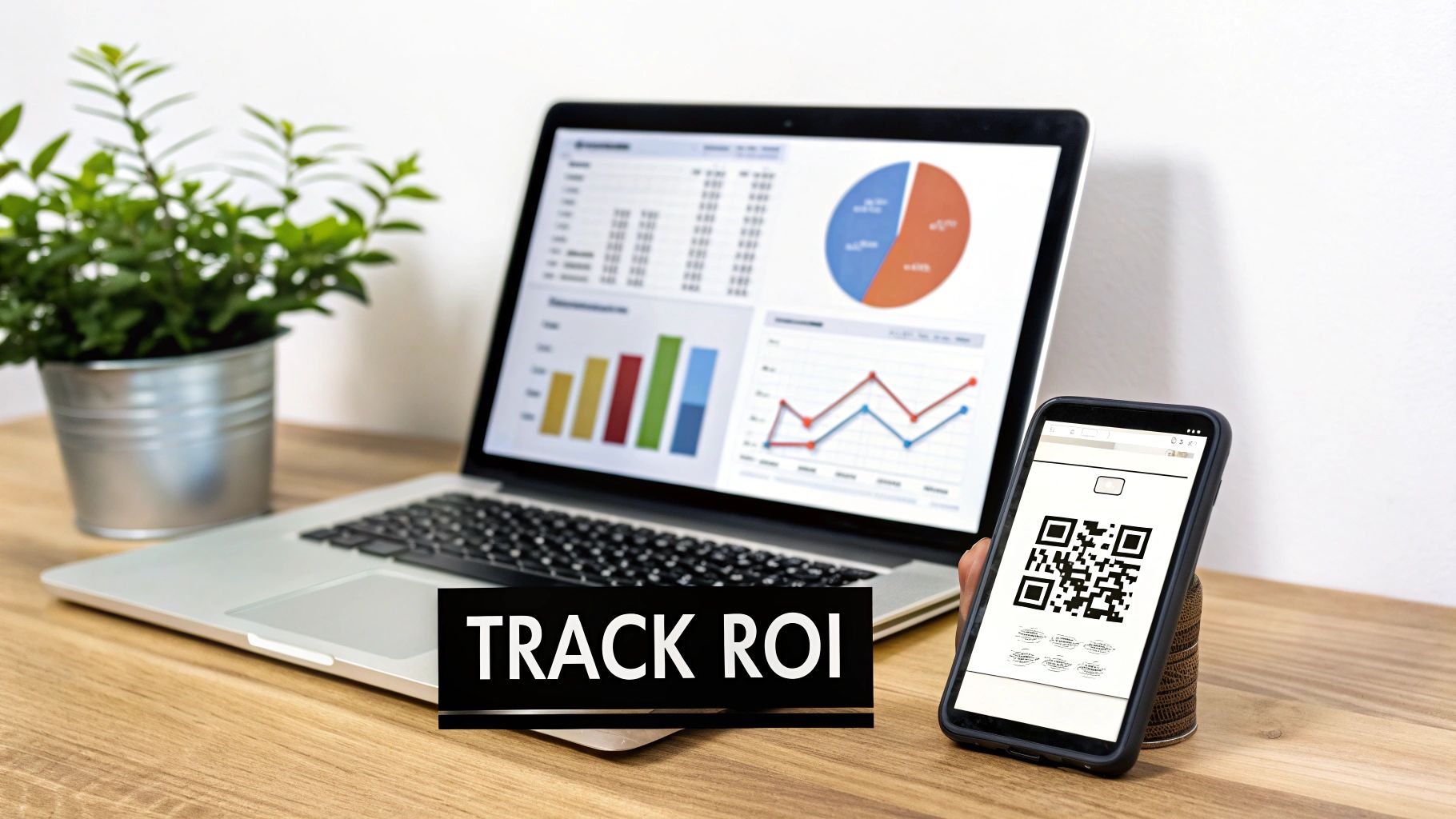
Putting up a billboard delivers a powerful sense of accomplishment, but that feeling fades fast if you can't actually prove it's working. Measuring the return on investment (ROI) for outdoor advertising can feel a bit abstract compared to clickable digital ads, but it’s far from impossible if you get creative.
The trick is to build a clear, traceable path from the billboard to a specific customer action. This is about more than just counting cars—it’s about implementing direct response mechanisms that connect real-world visibility to measurable digital results.
Your billboard design needs to do more than just build brand awareness; it has to give viewers a specific, trackable action to take. Fortunately, there are several effective tools you can use to bridge the gap between that physical ad and your analytics dashboard.
Here are a few proven methods I’ve seen work time and time again:
YourBrandDeals.com). Any traffic hitting that specific page can be directly chalked up to your billboard campaign.Measuring billboard ROI is an exercise in creativity. The goal is to make the offline-to-online jump as simple and enticing as possible. A short, memorable URL is almost always more effective than a complex QR code for drivers in motion.
Not every conversion will be direct, and that’s okay. A huge part of a billboard's value is its ability to lift brand visibility and recall in a specific area. Even if people don't use your special URL, the ad is still doing its job by planting a seed.
You can measure this "brand lift" by keeping an eye on other key indicators. Watch for a noticeable spike in branded web searches—people Googling your company name—from the cities or zip codes surrounding your billboard. At the same time, monitor social media for an uptick in mentions or people tagging photos of your ad. These signals provide strong evidence that your campaign is making an impact.
For those who buy a digital billboard, the data gets even richer. Most digital billboard providers offer detailed impression reports, showing how many times your ad was displayed and providing estimated audience figures based on traffic data. This gives you a clear sense of your ad's reach, helping you calculate a more precise cost per thousand impressions (CPM) and prove the campaign's value to stakeholders.
Even with the best-laid plans, a few questions always come up when you’re figuring out how to buy a billboard. It's totally normal. Getting these common queries sorted out from the start will give you the confidence to move forward and help you sidestep some easy-to-make mistakes.
This is always the first question, and the honest answer is: it’s all over the map. A static billboard on a sleepy country road might only set you back a few hundred dollars a month. But a premium digital screen overlooking a major city freeway? That could easily jump into the tens of thousands.
And don't forget the other costs. You'll need to budget for professional design work and, if you're going with a static board, the one-time fee for printing and installing the vinyl.
You bet, especially with digital billboards. The beauty of digital is its flexibility. You can run campaigns for just a few weeks or even a few days, which is perfect if you’re promoting an event or a flash sale.
Static billboards, on the other hand, usually require a longer commitment. Since there are real costs involved in printing and physically installing a huge vinyl ad, most billboard companies will ask for a minimum booking of at least four weeks.
The Bottom Line: If you need a short, fast campaign, digital is almost always the answer. Static boards are built for the long haul—think brand-building messages that can stay up for a while without getting stale.
Not unless you want to. Most of the big billboard companies have their own design teams that can whip something up for you, though it'll add to your final bill. If you've already got a great designer or an in-house creative team, you can just send over the final artwork.
Just be sure it perfectly matches the billboard company’s technical specs. We're talking size, file type, and resolution—get those right, and you'll end up with a crisp, professional-looking ad.
Ready to make a big impact with your own digital display? The experts at Smart LED Inc. can guide you through every step of the process, from choosing the right screen to professional installation. Explore our outdoor LED sign solutions today!
Picture this: you take the flash and spectacle of a Times Square billboard, slap it on the back of a truck, and send it wherever
A wall of TV screens is exactly what it sounds like: a big, impressive display made by tiling multiple TVs together so they act like

Picking the right displays for shows can feel like a high-stakes guessing game. Get it right, and you create an immersive world that captivates your
"*" indicates required fields