
Uncategorized
Digital Billboard Truck: Boost Your Campaign with Mobile Ads
Picture this: you take the flash and spectacle of a Times Square billboard, slap it on the back of a truck, and send it wherever
Think about your business's operating budget. Is there a leaky faucet somewhere, constantly dripping away your profits? For a surprising number of companies, that slow, steady drain is their outdated lighting system—a hidden expense that wastes money every single hour the lights are on.
That’s where modern, energy-efficient commercial lighting comes in. It’s not just about brighter bulbs; it’s about installing a smart valve that stops the financial leak for good and unlocks a whole new level of operational performance.
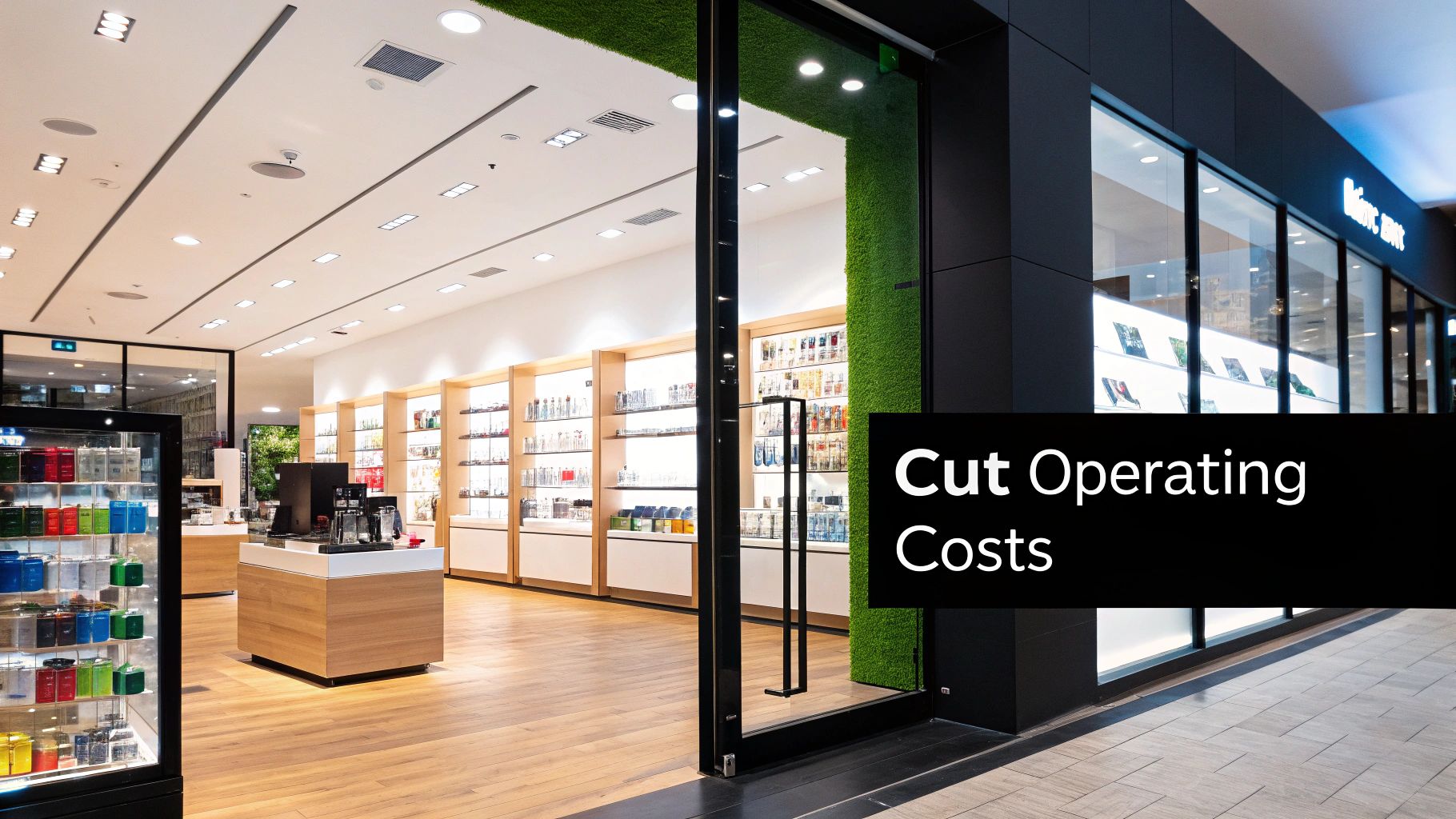
Upgrading your lighting is one of the smartest financial moves a business can make today. This isn't just another maintenance task to check off the list. It’s a strategic investment in your bottom line, the well-being of your employees, and the experience you create for your customers. You're turning a necessary utility expense into a high-performing asset.
The global trend tells the story. The market for industrial and commercial LED lighting, valued at USD 54.4 billion, is on track to hit a staggering USD 162.1 billion within a decade. Why? Businesses that make the switch are slashing their lighting-related energy consumption by up to 75%. That translates into immediate, substantial savings that show up on your very next utility bill.
While lower energy bills are a fantastic headline, the real power of modern lighting goes much deeper than just cost-cutting. A well-designed system can fundamentally change how your business feels and operates.
Here’s a quick breakdown of what a smart lighting upgrade can do for you.
| Benefit Category | Impact on Your Business |
|---|---|
| Operational Efficiency | Drastically lower energy bills and near-zero maintenance needs. |
| Workplace Productivity | Reduced eye strain and better focus lead to a safer, more productive team. |
| Customer Engagement | High-quality light makes products pop and creates a welcoming atmosphere. |
| Brand Image | Shows a commitment to sustainability and modern, forward-thinking practices. |
In short, a lighting upgrade delivers value across every part of your operation.
This shift elevates lighting from a passive, background utility to an active tool for business growth. You’re not just illuminating a space; you’re creating an environment that works harder for everyone in it.
The real magic happens when you pair great lights with smart controls. This is where you unlock the full potential of energy-efficient commercial lighting. Going beyond just LEDs and adding intelligent features like motion sensors is what truly amplifies your savings. Your system starts thinking for you, adapting to how your spaces are actually used.
A great first step is understanding selecting the right lighting motion sensor for different areas. By automating lighting in hallways, conference rooms, or stockrooms, you ensure you never waste a single watt illuminating an empty space.
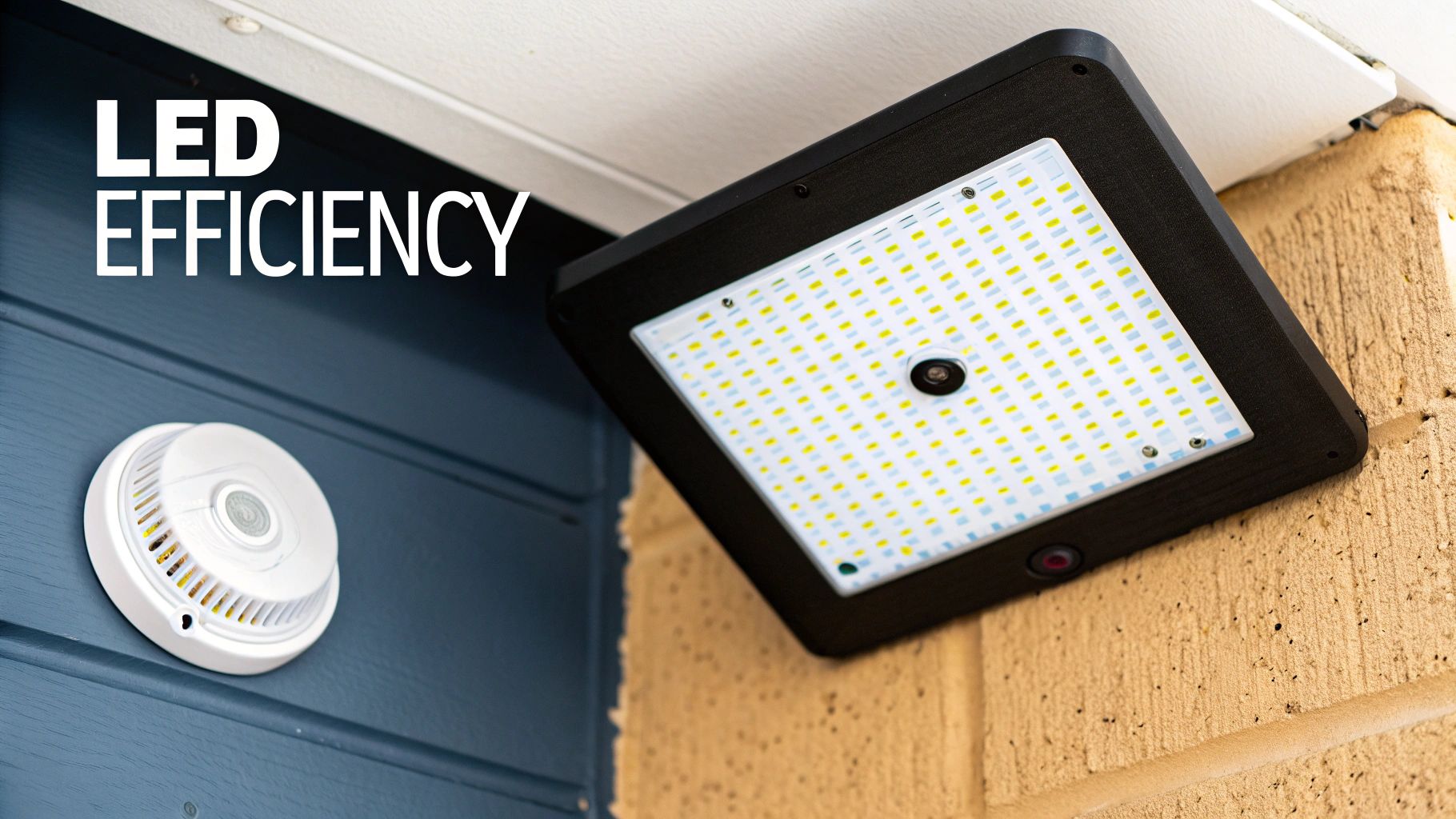
To really get what makes modern lighting so powerful, it helps to think of it as two separate but connected parts: the light source itself (the bulb) and the brain that tells it what to do (the controls).
Think back to old-school incandescent bulbs. They were like trying to make toast by boiling a massive pot of water—a huge amount of energy was wasted as heat just to get a little bit of light. That inefficiency was baked right into their design.
In stark contrast, LEDs (Light Emitting Diodes) are precision instruments. They convert electricity straight into light with almost no heat waste, which is why they’re unbelievably efficient. This one fundamental difference is the real engine behind the massive energy savings businesses see when they upgrade.
When you start shopping for the right energy efficient commercial lighting, you'll run into a few key technical terms. Getting a handle on them means you can choose fixtures that create the perfect atmosphere for your space, instead of just grabbing the brightest bulb off the shelf.
Let’s break down the big three:
These specs aren't just numbers on a box; they completely define the look, feel, and function of your environment. A cozy restaurant might go for low-Kelvin lighting to create an intimate mood, while a machine shop would demand high-Kelvin, high-lumen fixtures for absolute clarity and safety.
If LEDs are the hyper-efficient heart of the system, smart controls are the intelligent brain that takes your savings to a whole new level. These automated systems make sure your lights are only on when and where you need them, cutting out human error and wasted energy entirely.
The results are staggering. On their own, LEDs use up to 85% less electricity than old halogen bulbs and can last up to 25 times longer. But when you pair them with smart, IoT-integrated controls, you can slash your remaining energy use by another 30-50%. You can dig into more data on how office retrofits hit these numbers over at Spherical Insights.
Two of the most impactful types of controls are occupancy sensors and daylight harvesting.
Occupancy Sensors: These devices detect motion, instantly turning lights on when someone walks into a room and turning them off after it's been empty for a bit. They're a perfect fit for places with sporadic foot traffic, like restrooms, break rooms, and storage closets.
Daylight Harvesting: These clever sensors measure the amount of natural light pouring in through your windows. They then automatically dim the nearby artificial lights to keep the brightness perfectly consistent, banking huge energy savings without anyone even noticing.
Picture a warehouse aisle where the lights hang out at a low, energy-saving level. The second a forklift turns down the aisle, they ramp up to full brightness for safety and dim back down once it passes. Or think of an office where the lights near the windows automatically dim on a sunny afternoon. That’s the power of a truly intelligent energy efficient commercial lighting system at work.
Upgrading to energy-efficient commercial lighting stops being just a smart idea and becomes a rock-solid financial strategy the second you crunch the numbers. Figuring out your Return on Investment (ROI) isn’t some complex accounting trick; it’s about looking past the initial price tag and understanding the Total Cost of Ownership.
This simple shift in perspective changes the conversation from, "How much is this going to cost me?" to "How much is this going to save me?" The answer is almost always a pleasant surprise. It's a clear-cut calculation that shows you just how fast your investment pays for itself and starts putting money back in your pocket.
Your ROI is built on three major sources of savings that kick in the moment your new system goes live. Each one hits your bottom line directly, and together, their impact is massive.
Drastically Lower Energy Bills: This is the big one, and it’s immediate. High-efficiency LEDs use a tiny fraction of the power consumed by old-school tech like fluorescent or HID lamps. That translates directly to a smaller number on your monthly utility bill.
Near-Zero Maintenance Costs: Old bulbs are a constant headache. They burn out, they flicker, and they need to be replaced. LEDs, on the other hand, can last for 50,000 to 100,000 hours. Your maintenance crew can finally get off the lifts and ladders and focus on tasks that actually move the business forward.
Reduced HVAC Load: Here’s a benefit most people overlook. Traditional lights are basically tiny heaters, wasting a huge amount of energy as heat. All that heat has to be pumped out by your air conditioning, driving up cooling costs. Since LEDs run significantly cooler, they lighten the load on your HVAC system, creating a nice secondary stream of energy savings.
Let's break this down with a real-world example. Imagine a small retail shop with 50 ancient fluorescent fixtures, running 12 hours a day. The math is simpler than you'd think.
Example Scenario: Small Retail Store
A typical fluorescent tube might pull 80 watts. Its modern LED replacement? Just 30 watts. That’s a 50-watt saving per fixture. Multiply that by 50 fixtures, and you’re suddenly saving 2,500 watts every single hour.
Over a year, those savings balloon into thousands of dollars from lower energy use alone. When you add in the money you’re no longer spending on replacement bulbs and labor, the payback period for the entire project often shrinks to just one to three years.
Beyond the direct savings, there’s another huge factor that can slash your payback period: incentives. Utility companies and government agencies actually want you to upgrade to energy-efficient commercial lighting, and they’re willing to help you pay for it.
These financial perks can come in a few different forms:
Hunting down and applying for these programs can seem like a bit of work, but the financial reward is absolutely worth it. They can put your lighting project on the fast track to profitability. These savings can also free up capital for other impactful upgrades; you can even learn more about the cost of outdoor LED signs to further boost your business's visibility and modern appeal.
Once you’ve committed to upgrading to energy-efficient commercial lighting, the next big question is how to get it done. You're standing at a fork in the road with two main paths: retrofitting your existing fixtures or ripping them out and replacing them entirely.
There's no single right answer. The best choice depends entirely on the state of your building, your budget, and what you’re trying to achieve in the long run.
Think of a retrofit like swapping the engine in a classic car. You keep the familiar, sturdy frame—the fixture housing itself—but you gut the old, power-hungry parts inside. In their place go modern, high-performance guts like LED tubes or conversion kits. It's often faster, less disruptive, and easier on the initial budget.
A full replacement, on the other hand, is like trading that classic in for a brand-new electric vehicle. You get peak performance, all the latest smart features, and the absolute maximum long-term efficiency. It’s a bigger check to write upfront, but it pays dividends down the road and sets you up for the future.
A retrofit is often the perfect move when your existing fixture housings are still in good shape and can play nice with modern LED technology. This approach cuts down on waste and can be done quickly, making it a fantastic option for businesses that need a fast, budget-conscious upgrade without a lot of fuss.
A retrofit is probably your best bet if:
A lighting retrofit lets you capture 80% of the benefits of a full upgrade for just a fraction of the cost and time. It's the most direct route to seeing that utility bill drop.
Sometimes, just swapping out the bulbs isn't going to cut it. If your fixtures are old, falling apart, or were poorly placed to begin with, a full replacement is the smarter long-term play. Going this route gives you total control over the look, the performance, and the ability to bake in advanced smart controls from the start.
A full replacement is the clear winner when:
Deciding between an upgrade and a full overhaul comes down to balancing cost, time, and long-term goals. This table breaks down the key differences to help you see which path aligns better with your business needs.
| Consideration | Lighting Retrofit | New Installation |
|---|---|---|
| Upfront Cost | Lower initial investment. Uses existing fixture housings. | Higher initial investment. Requires all-new fixtures. |
| Installation Time | Faster and less disruptive. Often a simple "pop-and-swap." | More time-consuming and disruptive. Requires electrical work. |
| Performance | Significant improvement over old tech, but limited by the fixture. | Optimal performance, light distribution, and efficiency. |
| Longevity | Lifespan is tied to the new components (e.g., LED tubes). | Longest possible system lifespan with all-new components. |
| Control Integration | Limited options, often basic on/off or dimming. | Full integration with advanced sensors and smart controls. |
| Aesthetics | The look of the existing fixtures is retained. | Complete control over modern aesthetics and fixture design. |
| Best For | Budget-conscious projects, speed, and structurally sound fixtures. | Maximum efficiency, new construction, and total design control. |
Ultimately, a retrofit is a powerful, cost-effective step for many, while a new installation is the definitive solution for those seeking the absolute best in performance and future-readiness.
This decision tree gives you a visual for how things like your energy bills, maintenance headaches, and available rebates all feed into your ROI and which path to take.
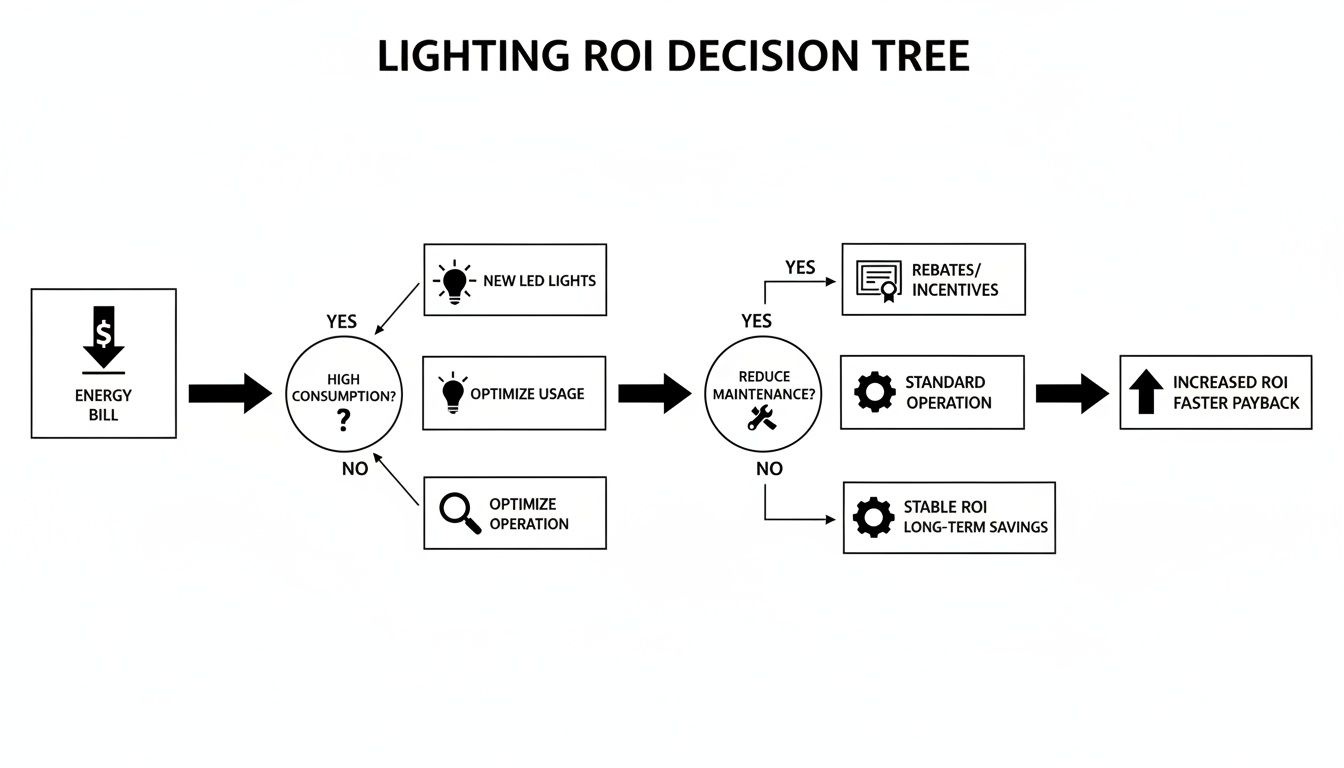
The key takeaway is this: the right choice always balances the upfront pain on your wallet with the long-term gain from lower energy bills and fewer maintenance calls. Take a hard look at your existing setup and be honest about your goals—that will light up the most profitable path forward for your business.
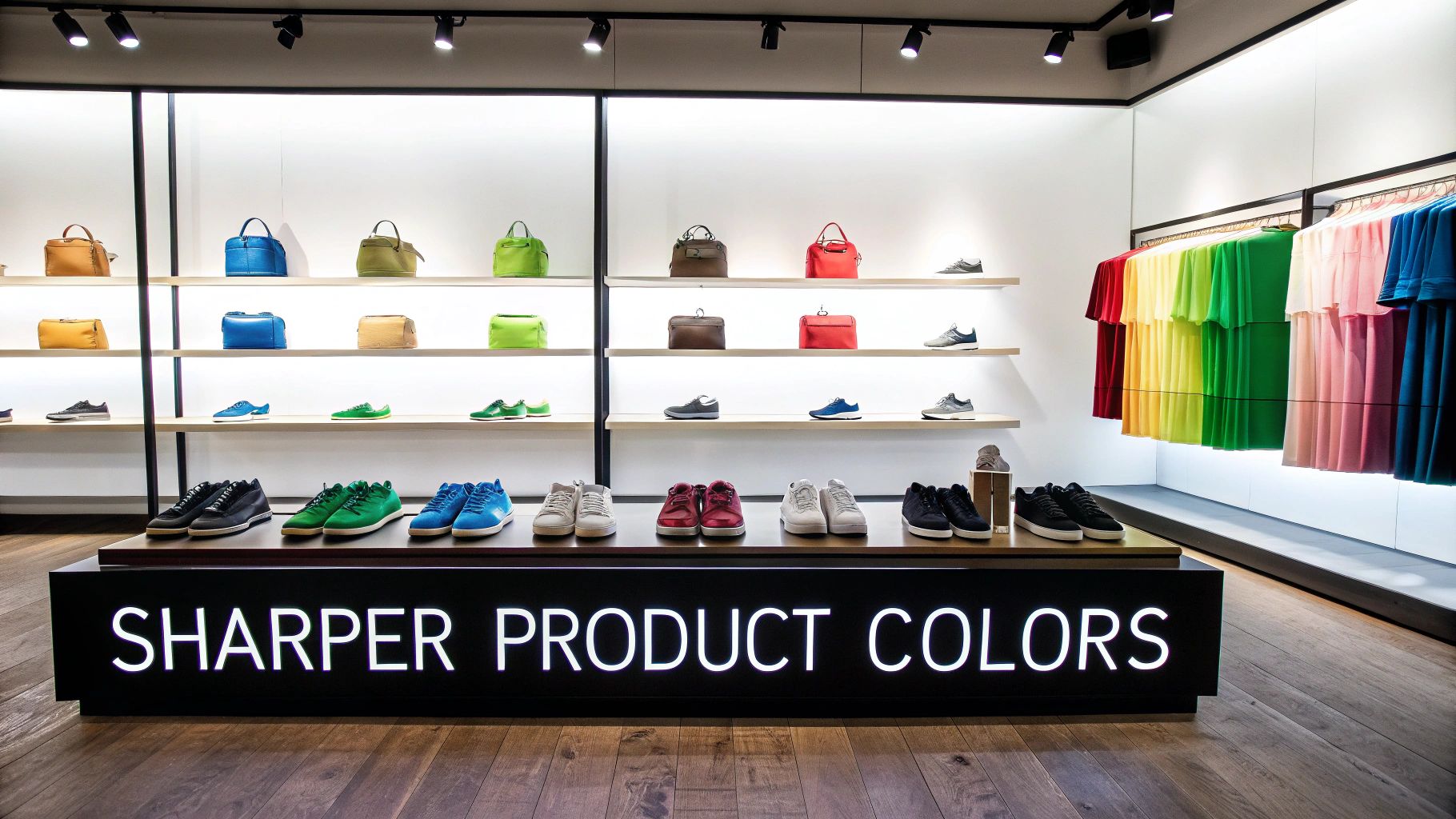
The theory is great, but seeing energy efficient commercial lighting in action is where the real value clicks. A smart lighting strategy doesn't just chip away at your utility bills; it fundamentally reshapes how a business operates, feels, and performs. So, let’s step away from the technical specs for a minute and look at three very different businesses that turned light into a serious competitive advantage.
Each story connects a specific lighting choice to a tangible business outcome. This is how you move beyond just flipping a switch and start engineering an environment for success.
Picture a high-end fashion boutique. Before their upgrade, the whole store was washed out by dull, cheap fluorescents. Those vibrant, expensive products looked lifeless. The rich reds of a designer handbag appeared muddy, and the crisp white of a tailored shirt had a yellowish, tired tint. Customers were walking because the products just didn't pop.
The owner decided to invest in a full LED replacement, specifically targeting fixtures with a high Color Rendering Index (CRI of 95+). The change was instant and dramatic.
This isn’t just about visibility. It proves that lighting is one of the most powerful sales tools you have.
Now, imagine a busy corporate office where the afternoon productivity slump is a daily reality. The old lighting was static and harsh, leading to employee eye strain and fatigue. It was a monotonous environment that did nothing to support the natural energy cycles of the people working there.
The facilities manager brought in a human-centric lighting system with tunable LEDs and smart controls. These fixtures could subtly shift their color temperature and intensity throughout the day, essentially mimicking the natural rhythm of sunlight.
The goal wasn't just to light the desks, but to create a work environment that was more in sync with the employees' internal clocks. This led to better focus, less fatigue, and a more energized team. The system even used daylight harvesting sensors, dimming lights near windows to cut energy waste without anyone noticing.
The results? Sure, they saved on energy, but the bigger win came from employee surveys showing higher satisfaction with the workspace. Managers even reported better alertness during those critical post-lunch hours.
Finally, let's head to a sprawling 24/7 logistics warehouse. Its old-school high-intensity discharge (HID) lamps took ages to warm up and cast a dim, uneven glow that created dangerous shadows in the aisles. This was a huge safety risk for forklift operators. On top of that, they were burning massive amounts of energy by keeping the entire facility lit at full blast, even in completely empty areas.
Their solution was a smart energy efficient commercial lighting system that paired powerful LED high bays with networked motion sensors in every single aisle. The impact was profound.
This is a perfect example of how smart controls deliver huge savings and critical safety improvements at the same time. It’s no surprise the market for these indoor applications is booming, expected to hold a 68.5% revenue share as more businesses swap out old tech. If you want to dive deeper into the data, you can explore the trend report from Research Nester.
These stories prove it: the right lighting is an investment that pays you back in ways that go far beyond the utility bill.
Making the switch to an energy efficient commercial lighting system is one of the most powerful moves you can make for your business. When you have the right strategy, it’s a surprisingly simple process that takes you from a smart idea to a tangible, money-saving asset. This game plan breaks the entire journey down into clear, manageable steps—a playbook to guide you from initial curiosity to a successful installation.
Think of it like planning a road trip. You wouldn't just jump in the car and start driving. You'd check the engine, map your route, and know exactly where you're headed. A lighting upgrade follows the same logic, ensuring you get where you want to go without any detours.
Before you can map out the future, you need a crystal-clear picture of the present. A lighting audit is your ground zero—a simple inventory of what you’ve got running right now. You don't need to be an engineer for this part. Just grab a notepad and walk your facility.
For each area (like the office, warehouse, or retail floor), jot down:
This initial walkthrough gives you a baseline. It helps you grasp the scale of the project and pinpoints the most urgent areas for improvement. This is the "You Are Here" marker on your project map.
With your audit done, it's time to define success. Every business has different priorities, and your goals will steer every single decision you make, from the tech you choose to the partner you hire. Are you chasing pure bottom-line savings, or are aesthetics and employee well-being just as important?
Figure out which of these outcomes matters most to you:
Knowing your "why" makes the "what" incredibly clear. It ensures your energy efficient commercial lighting project delivers the exact results your business needs most.
A successful lighting upgrade is rarely a solo mission. A great implementation partner is like a seasoned guide who’s been down this road a hundred times. They can help you navigate the tech options, sniff out valuable rebates, and make sure the installation is done right the first time.
Look for a company that actually listens to your goals, respects your budget, and has a proven track record. The technical side can get complicated, and a good partner will handle details like navigating the various lighting contactor wiring diagrams so you don't have to.
A strong partner does more than just sell you fixtures; they design a complete solution built around your goals, ensuring you squeeze every drop of value from your investment. For businesses looking to boost their curb appeal, this expertise also extends to high-impact additions like digital outdoor signage.
With your plan, goals, and partner locked in, the final step is the installation itself. A professional crew will work to keep disruptions to a minimum, often scheduling the work during off-hours or downtimes.
Your role here is simple: stay in the loop, ask questions, and make sure the finished product matches the plan. Once they flip the switch, you get to start enjoying the payoff immediately—from a brighter, safer space to a much friendlier utility bill.
Even with all the benefits laid out, it’s smart to have questions before you pull the trigger on a major lighting upgrade. This is a big decision, and you deserve straightforward, practical answers to feel confident about moving forward. We’ll cut through the technical jargon and tackle the most common questions business owners ask, addressing any final hesitations you might have.
This is one of the most common—and important—questions we get. Unlike old bulbs that suddenly pop and go dark, LEDs degrade very slowly over an incredibly long time. A typical commercial LED fixture is rated for a staggering 50,000 to 100,000 operating hours.
Let's put that into perspective:
This incredible longevity is what practically eliminates maintenance costs, freeing up your team's time and your budget for good.
For the most part, yes. Modern LED fixtures and retrofit kits are specifically designed to be compatible with standard commercial electrical systems. A qualified electrician can typically install new energy efficient commercial lighting without having to rip out and replace your building's existing wiring, which is a huge relief when it comes to keeping installation costs down.
That said, if your building is particularly old or has known wiring issues, your installation partner might recommend a quick electrical inspection just to make sure everything is safe and up to code before they begin.
Not at all. While the technology humming behind the scenes is advanced, the user experience is designed to be incredibly simple. Most systems are "set it and forget it," running on autopilot based on schedules, occupancy, or daylight levels that you establish during the initial setup.
Think of it like a smart thermostat for your lighting. You define the rules once—like dimming lights after 7 PM or turning them off in empty conference rooms—and the system takes it from there, delivering consistent energy savings without any daily effort from you or your team.
For the rare times you do need to make adjustments, it's usually done through a simple wall panel or a user-friendly mobile app.
Absolutely. While the initial investment for LEDs is higher than for old-school fluorescent or HID bulbs, the payback is fast and significant. The market itself confirms this. In fact, the industrial-commercial LED markets saw 40% growth in just three years as more and more businesses swapped out their outdated systems to capture massive energy savings. You can read more about these market shifts on Research Nester.
The return on investment isn't just about lower energy bills, either. It’s a powerful combination of factors:
Most businesses see a full payback on their investment within just one to three years. After that, all the savings go directly to your bottom line for a decade or more.
Ready to transform your business with a lighting solution that saves money, enhances your space, and puts an end to maintenance headaches? The experts at Smart LED Inc. can design a custom LED system tailored to your specific goals. From high-impact outdoor signs to brilliant indoor video walls, we provide factory-direct pricing and nationwide support to ensure your project is a stunning success. Calculate your ROI and explore your options with Smart LED Inc. today!
Picture this: you take the flash and spectacle of a Times Square billboard, slap it on the back of a truck, and send it wherever

A wall of TV screens is exactly what it sounds like: a big, impressive display made by tiling multiple TVs together so they act like

Picking the right displays for shows can feel like a high-stakes guessing game. Get it right, and you create an immersive world that captivates your
"*" indicates required fields