
Uncategorized
A Complete Guide to High School Football Scoreboards
A high school football scoreboard is so much more than a box that keeps score. It’s the heartbeat of the gameday experience. Today’s LED digital
Think of a digital sign board as the modern evolution of the classic static sign. It's the difference between hanging a single, printed photograph on a wall and mounting a high-definition screen that plays a vibrant, ever-changing video reel. This technology is all about grabbing attention and engaging people in ways that a simple printed poster never could.
Imagine trying to catch someone's eye with a paper flyer while they're scrolling through an endless feed of videos on their phone. It’s a tough sell. A digital sign board is designed to cut right through that noise. It isn’t just a screen; it's a dynamic canvas that lets you speak to your audience in real-time.
This completely changes how businesses and organizations connect with people. Instead of being locked into one printed message for weeks or months, you get the freedom to adapt on the fly. You can advertise a morning coffee special, switch to an afternoon meeting schedule, and then stream a live event in the evening—all on the same display, updated in seconds from anywhere.
The real magic of a digital sign board is right there in the name: it's dynamic. It doesn't just sit there—it actively works to pull viewers in. This delivers some serious advantages:
This shift from static to dynamic isn't some small trend; it's a full-blown market transformation. The global digital signage market, which covers all kinds of digital sign boards, hit a massive USD 28.8 billion in 2024. And it’s not slowing down, with projections showing it will soar to USD 45.9 billion by 2030. That growth is fueled by a huge demand for instant content and better, more affordable technology.
A traditional sign just tells people what you offer. A digital sign board shows them, starting a conversation that evolves right alongside your business and your customers' needs.
At its core, a digital sign board is a complete system. It's the hardware (the screen itself) working in perfect sync with the software (the content management system). That combination is what unlocks its potential.
To get a better feel for all the possibilities, you can explore the different display solutions out there. Whether you're thinking about a massive outdoor billboard, a sleek indoor video wall, or even a stunning home theater screen, you're really investing in a powerful communication platform. This guide will walk you through everything you need to know to pick the right one for your goals.
Picking the right digital sign board isn’t about chasing the latest tech—it's about understanding what you want to accomplish. You wouldn't use a megaphone in a library, right? The same logic applies here. The best display is always the one designed for a specific environment and a specific goal.
Not all digital signs are created equal. Each type is engineered to solve a unique problem. Are you trying to pull customers off a busy, sun-drenched street? Make a jaw-dropping first impression in your office lobby? Or create a truly cinematic escape in your own home? Thinking about your vision first is the secret to a smart investment. Let's walk through the four most common types to find the perfect fit for you.
Picture your storefront on a bright, sunny afternoon, competing with dozens of other businesses for attention. A standard indoor screen would be a washed-out, unreadable mess. This is exactly where a rugged outdoor LED sign comes in. Think of it as a powerful beacon for your business, built from the ground up for visibility and toughness.
These displays are engineered with ultra-high brightness levels that slice right through direct sunlight, keeping your message vibrant and clear from dawn till dusk. They’re also sealed in tough, weatherproof enclosures to shield the electronics from rain, dust, and whatever else Mother Nature throws at them. This makes them the go-to choice for any business looking to amp up its curb appeal and get more people through the door.
Now, take that storefront sign and scale it up—way up. Electronic billboards are the heavyweights of the digital sign world, designed for one thing: commanding mass attention from a serious distance. These are the colossal displays you see looming over highways or lighting up major city squares, delivering bold, unforgettable ads to thousands of people every single day.
Because the audience is often zooming by in a car, the content has to be simple, huge, and visually arresting. These signs prioritize immense scale and brightness over the pixel-perfect detail you'd need up close. They are built like tanks, engineered to withstand the elements for years of non-stop operation, making them a true cornerstone of modern advertising.
Once you step inside, the game changes completely. An indoor LED video wall isn't fighting the sun; it’s focused on creating a seamless, captivating visual experience that draws people in. Think of it as a living, digital mural that can turn a corporate lobby, concert stage, or retail space into something truly special.
Here, resolution is king. People are standing much closer, so a fine pixel pitch is absolutely essential to deliver a sharp, flawless image with no distracting gaps or visible dots. Brightness is carefully balanced for indoor lighting, and the real emphasis is on perfect color accuracy and creating a premium, high-tech atmosphere. These are incredible tools for brand storytelling and shaping an environment. To see how businesses are putting these displays to work, check out our guide on LED signs for businesses.
Finally, the digital sign board has found its way into luxury homes, offering a private movie experience that can blow commercial cinemas away. A home theater LED screen is the ultimate upgrade for film lovers who refuse to compromise on quality. Unlike their commercial cousins, these displays are meticulously calibrated for one thing: cinematic perfection.
The goal is pure, unadulterated immersion. These screens often feature the same DCI-P3 color gamut used by Hollywood studios, guaranteeing you see the film exactly as the director intended. They deliver mind-blowing contrast with inky, deep blacks and brilliant highlights that make every scene explode off the screen. It’s all about bringing that big-screen magic home.
Feeling a bit overwhelmed? Don't worry. This table gives you a quick rundown of the most common types of digital signs, what they're best for, and the key features that set them apart. It's a great starting point to help you zero in on the best fit for your project.
| Sign Board Type | Primary Environment | Best For | Key Feature Example |
|---|---|---|---|
| Outdoor LED Sign | Outdoors | Storefronts, local advertising, information | Extreme brightness (5,000+ nits) |
| Electronic Billboard | Outdoors | Highway advertising, mass communication | Massive scale and long-distance visibility |
| Indoor Video Wall | Indoors | Lobbies, stages, retail environments | Fine pixel pitch for high resolution |
| Home Theater Screen | Indoors | Dedicated home cinemas, luxury media rooms | DCI-P3 cinematic color accuracy |
Each of these technologies is brilliant in its own right—the trick is simply matching the right tool to the right job. By starting with your goal, you can confidently choose a display that won't just look good, but will deliver real results.
Diving into the world of a digital sign board can feel like learning a new language. You'll hear terms like pixel pitch, nits, and refresh rates thrown around, and it's easy to get lost in the jargon. But you don't need an engineering degree to make a smart choice.
Let's break down the five technical specs that truly define a display's performance. Once you get what they mean in a practical sense, you'll be able to read a spec sheet and know exactly what you're getting.
Imagine a classic newspaper photo. If you get really close, you can see it's made up of tiny dots. Pixel pitch is simply the distance from the center of one of those dots (in our case, an LED) to the center of the next one. It’s measured in millimeters (mm), and a smaller number means the LEDs are packed tighter together.
So, why does this matter? It's all about how far away your audience is.
Think of it this way: a lower pixel pitch number is what you need for close-up viewing, while a higher number works perfectly for signs meant to be seen from far away.
Brightness is arguably one of the most critical factors, especially for an outdoor digital sign board. It's measured in a unit called nits. The easiest way to think about nits is to compare them to the power of a flashlight.
A weak flashlight is fine for a dark room, but it’s completely useless on a sunny day. Digital displays work the same way. An indoor screen in a dimly lit office might only need 500–1,500 nits to look vibrant. An outdoor sign, however, has to compete with direct sunlight. To stay visible, it needs a much, much stronger "flashlight."
For a digital sign board to actually work outdoors, it needs a brightness level of at least 5,000 nits. Anything less will look washed out and unreadable on a sunny day, completely defeating the purpose of your investment.
This map shows how different digital sign boards are built for specific jobs, from storefronts and billboards to indoor displays.
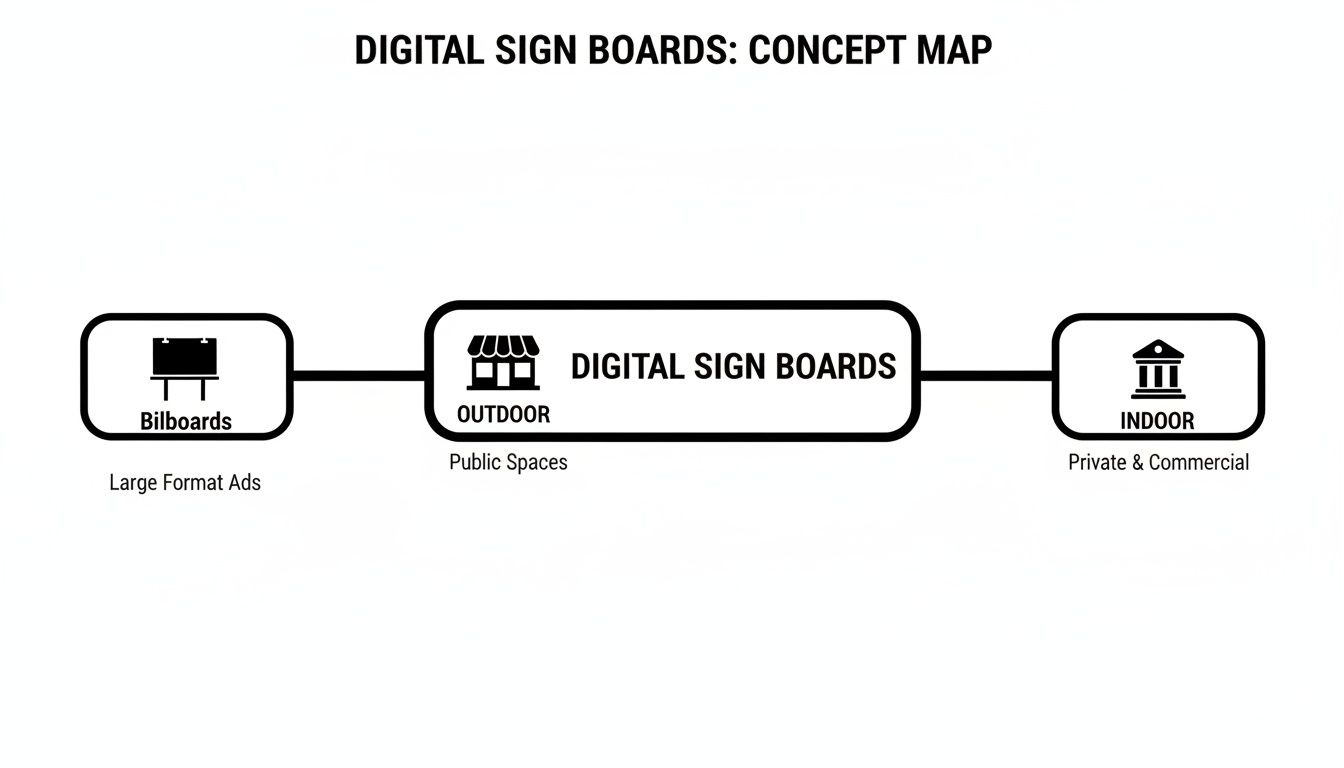
As you can see, the application dictates everything—from the brightness needed to the level of weatherproofing required.
What makes an image on a screen look rich and lifelike? A big part of it is the color gamut. Think of it as a box of crayons. A standard box might have 24 colors, which is fine for most things. But a professional artist’s set might have 120 colors, allowing for far more nuance, depth, and realism.
A wider color gamut means the display can reproduce more colors, making the visuals more vibrant and true-to-life. For a home theater screen aiming for cinematic quality, a wide gamut like DCI-P3 is a must-have to show a movie exactly as the director intended. For most commercial signs, a standard gamut is enough, but a wider one always makes your content pop.
You wouldn’t take a phone that isn't water-resistant out in a downpour, right? The same logic applies to an outdoor digital sign board, and its durability is measured by its IP Rating (Ingress Protection). An IP rating has two numbers.
A sign with an IP65 rating, for example, is fully protected from dust and can withstand water jets from any direction. This is the kind of industrial-grade armor an outdoor sign needs to survive years of rain, snow, and wind.
Ever watched a video on a cheap screen that looked choppy or stuttered? That’s often because of a low refresh rate. Refresh rate, measured in Hertz (Hz), tells you how many times per second the image on the screen is updated.
A higher refresh rate creates smoother, more fluid motion. A standard monitor might have a 60Hz refresh rate, but high-performance digital displays often boast 1,920Hz or even 3,840Hz. While your eye can't perceive every single frame update, a high refresh rate is critical for eliminating the flicker that causes eye strain. It also ensures the display looks perfect when recorded on camera—a must-have for live events, houses of worship, and broadcast studios.
Alright, you understand the tech specs, but how do you get from a great idea to a stunning digital sign up and running? This is where the rubber meets the road—where your vision becomes a physical reality. A successful project is all about careful planning, covering everything from the sign's physical placement to the software that brings your content to life.
This guide is your step-by-step roadmap to navigate the process, helping you sidestep common mistakes and ensure a smooth, successful launch.
First things first: you need to figure out the right size for your display. This is completely tied to how far away your audience will be. It’s just like buying a TV for your living room—you wouldn't stick a tiny screen in a massive space and expect it to have any impact. The goal is to pick a size that’s powerful and easy to read without either overwhelming the space or being too small to matter.
A simple rule of thumb can get you started. For every 10 feet of viewing distance, you need at least one inch of character height for text to be readable. So, if your sign needs to be seen from 50 feet away, your text should be at least five inches tall. That calculation directly informs the overall dimensions of the sign you’ll need to make sure your message connects, whether it's with pedestrians on the sidewalk or drivers on a busy street.
A digital sign is only as good as the content you put on it. That’s why a user-friendly Content Management System (CMS) is non-negotiable. Modern software lets you upload images, schedule video playlists, and manage everything from a computer or even your phone. You can have a breakfast menu running in the morning that automatically flips to a dinner menu in the evening without you lifting a finger.
This is also the perfect time to think about what you're actually going to display. To get compelling content up quickly, you might want to explore the best AI content creation tools that can help streamline the process. A clear content plan from day one ensures your new display is an engaging and effective tool from the moment it’s switched on.
Before anyone even thinks about turning a bolt, you have to dig into the local rules, especially for any outdoor signs. Many cities and counties have very specific zoning laws that dictate the size, placement, brightness, and even the type of content you can show on a digital sign board.
Navigating the permit process can be tricky and is one of the most common hurdles for new sign owners. Getting this wrong can lead to hefty fines or even an order to take the sign down.
Make a call to your local planning or zoning department early in the process. A professional installation partner will have experience in this and can often help guide you through the paperwork to make sure your project is fully compliant. If you're just starting to look, our experts can offer guidance on typical requirements for digital outdoor signage.
Every digital sign needs two things to run: a steady source of power and a solid data connection. For most commercial-grade displays, you can’t just plug it into a standard wall outlet. You'll almost certainly need a dedicated circuit installed by a licensed electrician to handle the power load safely.
You also need a way to get your content to the sign. This can be a hardwired Ethernet connection for maximum stability, a strong Wi-Fi signal, or even a cellular connection for signs in remote locations. Getting this infrastructure sorted out before installation day is key to avoiding delays and unexpected costs.
A quality LED display is built to last. Many are rated for 100,000 hours of operation—that’s over 11 years of running 24/7. But like any piece of tech, it needs some basic care to hit that mark. This usually just means keeping air vents clear of debris so it can cool properly and running occasional software updates.
Proper care is essential, especially since the market for these displays is growing so fast. In the U.S., the digital signage industry is projected to hit USD 9.07 billion in 2025 and is on track to reach USD 12.92 billion by 2030. That growth is fueled by businesses that understand the long-term value. Knowing what to expect for maintenance from the beginning will help you protect your investment for years.
Last but not least, never overlook the warranty and the support that comes with it. A reputable manufacturer will back their product with a solid warranty that covers parts and labor for several years. Think of it as your safety net.
Just as important is having a responsive support team you can actually talk to when you have questions or need to troubleshoot. This partnership is what ensures you get the most out of your digital sign board long after the installation is complete.
Let's get right to it—the question every buyer asks: is a digital sign board actually worth the money? The only way to get a real answer is to look past the sticker price and understand the entire financial picture, from the day it’s installed to the long-term value it brings your business.
A smart purchase starts with calculating the Total Cost of Ownership (TCO). Forget just the purchase price; TCO is a far better metric because it factors in every related expense over the display’s entire life. It’s like buying a car—the real cost isn't just what you pay at the dealership. It’s the fuel, insurance, and maintenance that follow. A digital sign is no different.
To get the full picture, you have to account for a few key components.
To budget like a pro, you need to think beyond the screen itself. Here’s what a realistic budget includes:
Tallying these up gives you a true sense of the investment. For a closer look at these numbers, our guide on outdoor LED sign costs breaks it down even further.
Once the costs are clear, we can get to the exciting part: the Return on Investment (ROI). A digital sign isn't just an expense; it’s an asset designed to make you money. How you measure that value, though, depends entirely on your goals.
For many, it's all about direct revenue. It's no surprise that retail applications lead the pack, projected to command about 24% of the digital signage market in 2025. Why? Because shops all over the world are using these signs for dynamic promotions and brand storytelling that static posters just can't touch. For them, vibrant, instantly updatable content directly boosts sales in a way old-fashioned print never could. You can find more insights on the growing digital signage market on coherentmarketinsights.com.
A digital sign board transforms a passive space into an active revenue stream. Whether through increased sales, new advertising income, or stronger brand engagement, it’s a tool that pays for itself.
So how does this actually play out in the real world? The payback period for a digital sign board can be surprisingly short when you have a clear game plan. These examples show how different businesses can see a powerful return.
| Business Type | Primary Goal | Key Metric for ROI | Example Payback Scenario |
|---|---|---|---|
| Retail Store | Increase Sales | Higher foot traffic and sales lift on promoted items | A sign costing $15,000 that boosts sales by just $1,500/month achieves payback in 10 months. |
| Event Venue | Generate Ad Revenue | Selling advertising slots to sponsors and partners | A $40,000 video wall that sells four ad slots at $1,000/month each pays for itself in 10 months. |
| Corporate Office | Improve Engagement | Better employee communication and brand perception | While harder to put a number on, improved morale and retention provide significant long-term financial value. |
As you can see, whether you're driving sales or selling ad space, the math often works out beautifully. The key is to define your goal upfront and track the metrics that matter most to your bottom line.
Of course. Here is the rewritten section, crafted to sound completely human-written, following the style of the provided examples.
Alright, we've covered the tech, the specs, and even the budget. But if you’re like most people, you probably still have a few practical questions bouncing around in your head. Buying a digital sign is a big decision, and you want to be absolutely sure you’ve got all the facts straight before you pull the trigger.
Let's cut through the noise and tackle the real-world questions we hear all the time. Think of this as the final checklist to make sure you're feeling 100% confident about your investment.
This is usually the first thing people ask, and for good reason. The answer? A long, long time. A well-built LED sign is a serious workhorse, designed for the long haul. Most quality displays are rated for an impressive 100,000 hours of use.
To put that into perspective, that’s over 11 straight years of running 24/7 before the sign is expected to reach half its original brightness. It doesn't just flicker out and die one day—it gracefully fades over more than a decade.
Now, a few things will influence that real-world lifespan:
Simple upkeep, like making sure the air vents are kept clear, goes a long way. We obsess over using top-tier components for this very reason—we want our displays to hit those numbers and then some, which is why we back them up with solid warranties.
Worried you’ll need a tech wizard on standby just to update a daily special? Not anymore. The days of clunky, headache-inducing software are firmly in the rearview mirror.
Modern digital signs are incredibly easy to manage. Most are controlled through a simple, web-based platform you can access from your laptop, tablet, or even your phone. It’s usually as simple as this:
This means you can be sitting at a coffee shop and change the content on a dozen signs across town. We’ll walk you through the whole process, but you'll be a pro in no time.
They might look like cousins, but indoor and outdoor signs are engineered for completely different worlds. It really boils down to three make-or-break distinctions.
Brightness: An outdoor sign has to battle the sun, and it needs some serious firepower to win—we’re talking 5,000 nits or more. An indoor sign, living in a world of controlled lighting, looks fantastic at just 500 to 1,500 nits. Put an indoor sign outside, and it would be completely washed out.
Durability: Outdoor signs are built like tanks. They have high IP ratings (like IP65) that certify they’re sealed tight against rain, dust, and whatever else Mother Nature throws at them. Indoor signs just don’t need that level of armor.
Pixel Pitch: Since you view outdoor signs from a distance, the LED bulbs can be spaced a bit further apart (a larger pixel pitch). For indoor signs, you’re up close and personal, so they need a much tighter pixel pitch to create that seamless, high-definition image without any distracting dots.
This one’s a big deal for both safety and performance. While some tiny, "plug-and-play" indoor displays are designed for DIY, virtually any commercial-grade sign—and every outdoor sign—needs a professional on the job.
Trying to hang a large sign yourself is a recipe for disaster. Here’s what the pros handle that you really don’t want to mess with:
Plus, for any outdoor project, a pro installer is your guide through the maze of local sign permits. Trust us on this: let the certified professionals handle it. It ensures your sign is safe, compliant, and looks its absolute best from day one.
Ready to bring your vision to life with a high-impact digital display? At Smart LED Inc., we make it easy. Use our online LED sign calculator to get a clear budget estimate, explore our gallery for inspiration, and contact our team for expert guidance on your project.
A high school football scoreboard is so much more than a box that keeps score. It’s the heartbeat of the gameday experience. Today’s LED digital

Before you even think about giant screens and earth-shaking subwoofers, let's talk about the single most important part of your home theater: the room itself.

Think of a digital sign board as the modern evolution of the classic static sign. It's the difference between hanging a single, printed photograph on
"*" indicates required fields