Uncategorized
Digital Billboard Truck: Boost Your Campaign with Mobile Ads
Picture this: you take the flash and spectacle of a Times Square billboard, slap it on the back of a truck, and send it wherever
Picture this: you take the flash and spectacle of a Times Square billboard, slap it on the back of a truck, and send it wherever you want. That, in a nutshell, is a digital billboard truck. It’s a game-changer for advertising, turning a static, roadside sign into a dynamic, mobile experience that takes your message directly to the people you want to reach.
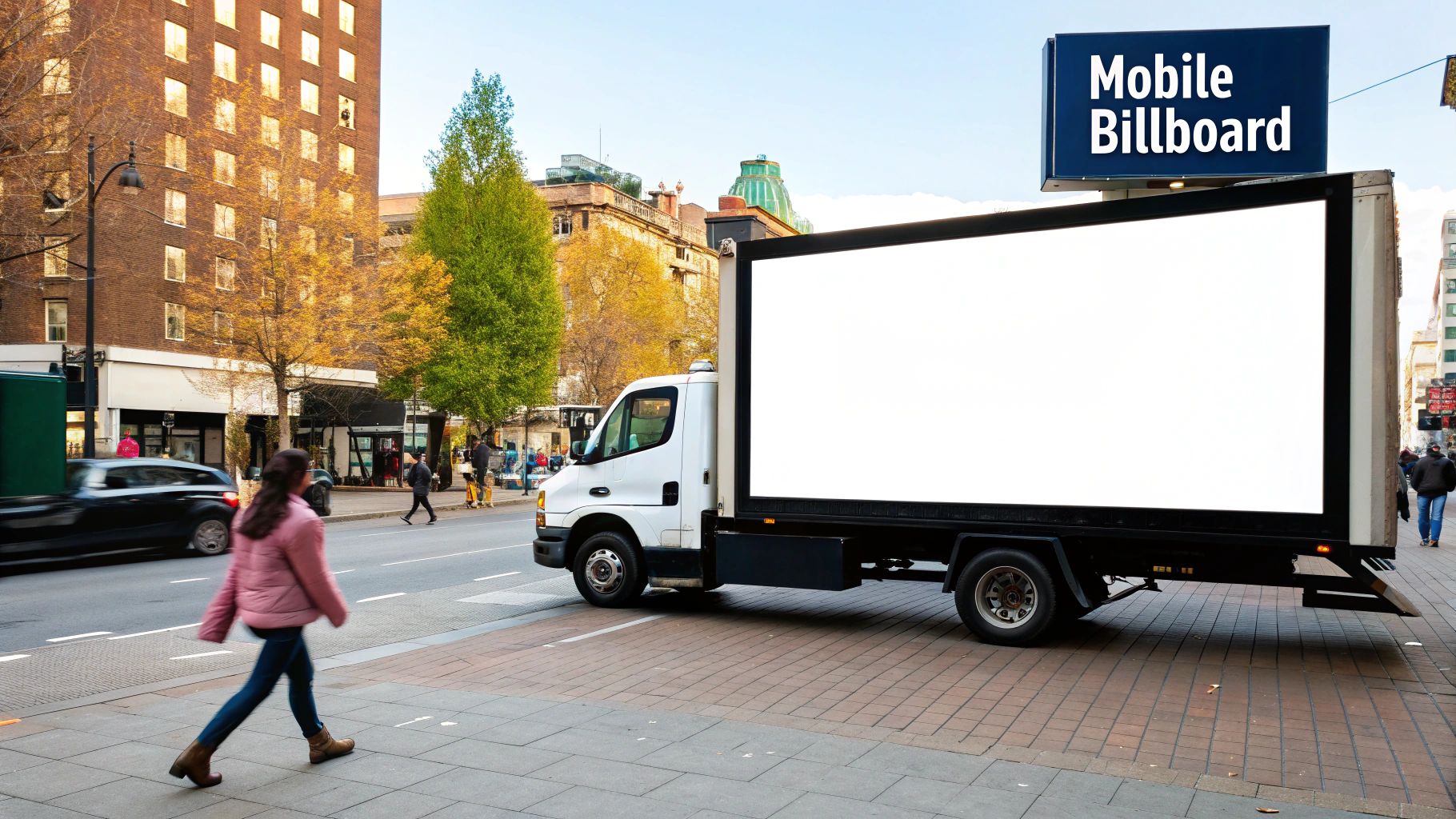
This isn’t just a big TV on wheels. A digital billboard truck is a fully self-contained advertising machine, built to go anywhere and everywhere. Think of it as your campaign’s mobile command center. While a traditional billboard is stuck in one spot hoping the right people drive by, these trucks actively hunt down your audience.
You can send them cruising through bustling downtown districts, station them outside a packed concert, or have them circle a convention center. This mobility gives you a level of control that’s almost unheard of in out-of-home advertising. It’s all about being in the right place at the right time, ensuring your ad spend delivers maximum impact.
To really get what makes these trucks tick, you need to look under the hood at the three key pieces of technology working together. Each one is critical for delivering a bright, seamless, and effective ad campaign on the move.
The magic happens when you combine these elements. You're essentially untethering high-definition digital advertising from a fixed spot, giving you the freedom to run hyper-targeted, location-based campaigns that were simply impossible before.
This move from a stationary sign to a mobile one is a fundamental shift in advertising thinking. Static ads are passive; they wait for an audience to come to them. A digital billboard truck is aggressive. It goes out and finds the audience, turning heads and making an impression wherever it goes.
This proactive approach unlocks incredible flexibility. Imagine a restaurant running a lunch special ad near office parks from 11 AM to 1 PM, then switching to a happy hour promotion in the entertainment district later that afternoon. This kind of granular control makes your ads more relevant and your budget work a whole lot smarter. It transforms advertising from a shot in the dark into a precise, tactical tool that moves with the pulse of the city.
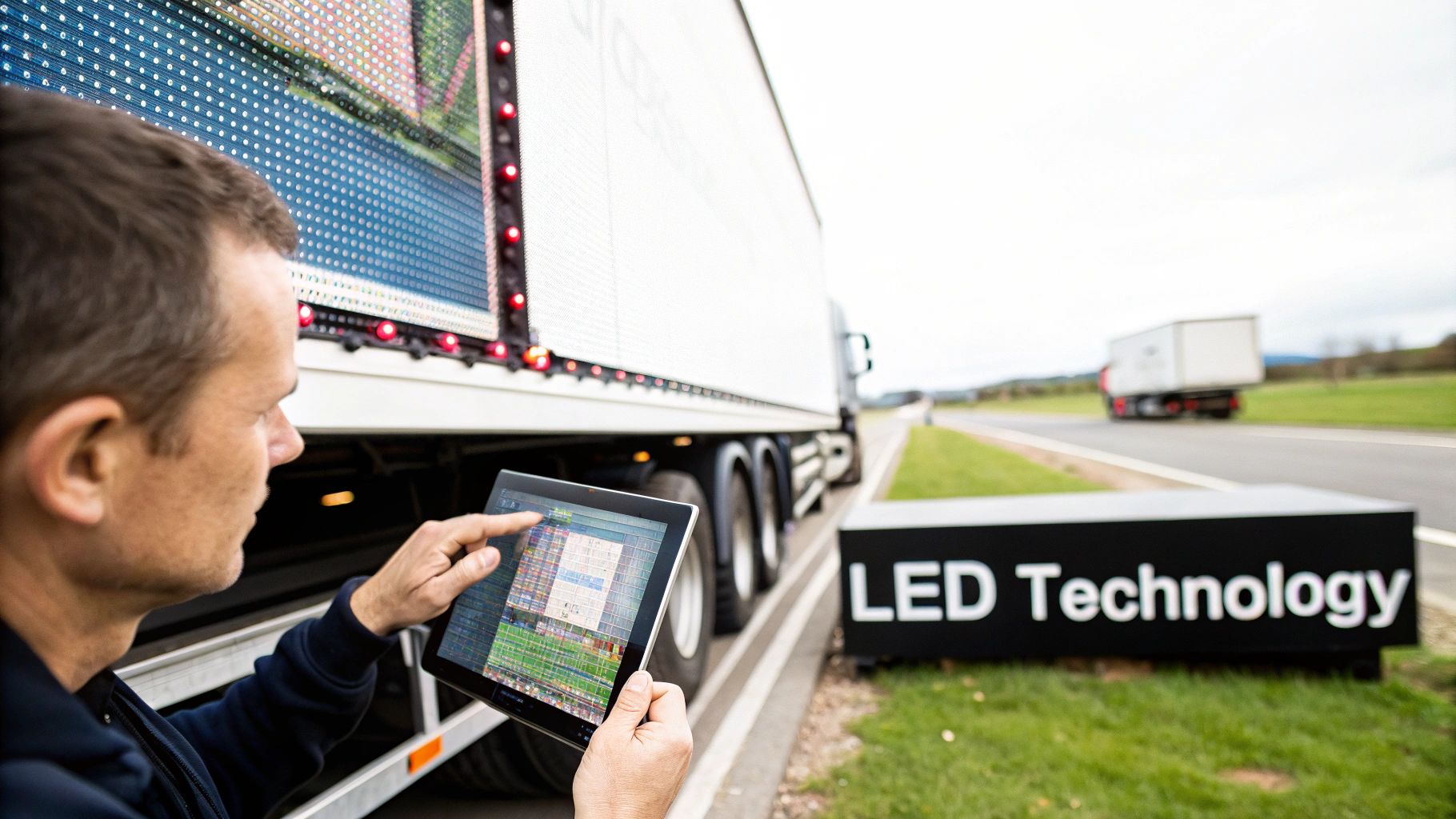
To really get why these trucks are so effective, you have to look past the "wow" factor and understand the technology that makes them advertising powerhouses. It’s a smart blend of hardware and software, all working together to get vibrant, dynamic messages in front of people on the move.
The star of the show, of course, is the brilliant LED screen itself.
But not all screens are created equal. Their performance boils down to a few key specs that determine whether your ad is a blurry mess or a crisp, captivating masterpiece that people can't ignore.
The visual punch of your campaign really comes down to three things: pixel pitch, brightness, and durability. Get a handle on these, and you'll know exactly what to look for when evaluating a digital billboard truck.
A stunning screen is worthless if it doesn't have power. These trucks have to be completely self-sufficient, ready to run for hours without ever needing to find an outlet. There are a couple of ways this is handled.
Traditional generators are the old-school, reliable workhorses, providing plenty of juice for long campaigns. But modern, high-capacity battery systems are quickly becoming the preferred option. They offer silent, emission-free power—a huge plus when you’re advertising in quiet neighborhoods, near hospitals, or at noise-sensitive events like a golf tournament.
These trucks are built on the same advanced LED technology that's driving the entire market forward. The broader LED billboard market, valued at USD 4.07 billion, is dominated by these efficient screens. Mobile trucks get the added benefit of higher resolutions and energy-sipping panels that keep operating costs down. With projections showing the sector hitting USD 6.95 billion by 2034, mobile units are set to play a huge part, especially as programmatic ad integrations make them even more engaging.
The final piece of the puzzle is the Content Management System (CMS). This is the brain of the whole operation. The CMS is what turns the truck from just a screen on wheels into an incredibly flexible marketing machine.
With a modern CMS, you can log into a simple web dashboard and take complete control. From anywhere, you can:
This is the kind of control that lets you stay relevant, adapt your strategy on the fly, and squeeze every last drop of value out of your campaign.
Let's be honest: is a billboard truck really that much better than a massive sign bolted to the side of a highway? The answer comes down to one key difference: passive exposure versus active engagement. A traditional ad has to wait for an audience to come to it. A mobile billboard goes out and finds one.
Think about it. Static billboards are powerful, but they’re stuck. Your message only hits the same people driving the same route day after day. A vehicle wrap gets you moving, but you’re locked into a single, unchanging graphic. The digital billboard truck is the best of both worlds—it brings dynamic, video-capable content and gives you the freedom to put it anywhere.
This blend completely changes the advertising game. You get better performance in the three areas that really matter: flexibility, audience engagement, and the return you get on your investment.
Imagine you're launching a new energy drink. A static billboard near a stadium is a decent play, but what if you could follow the hype all day long?
With a digital billboard truck, your campaign becomes a living, breathing part of the city's rhythm. You could kick off the morning by hitting the busiest commuter routes, slide over to a college campus to catch the lunch rush, and then claim a prime spot outside the stadium as fans pour in for the big game.
This kind of surgical precision is something fixed media just can't deliver. You can change your entire strategy on the fly based on:
This isn't just about driving around; it's about active targeting. You’re putting your message in front of the right people at the right moments, which means fewer wasted impressions and a much bigger impact for your budget.
Our brains are hardwired to notice two things: movement and light. A static ad, no matter how clever, eventually fades into the background. It becomes part of the scenery. A digital billboard truck, with its bright, changing visuals, simply can't be ignored.
You’re not just showing a static image—you can run full-motion video, slick animations, or a carousel of different promotions. That dynamism forces people to look up from their phones. It cuts through the noise and creates a message that people actually remember.
The data backs this up. While old-school signs are still out there, the value you get per impression from Digital Out-of-Home (DOOH) advertising is a staggering 6 to 7 times higher because it's so much more engaging. A single digital truck can rack up 5 to 10 times more daily impressions than a fixed board, hitting 50,000 to 200,000 views in just one day in a major city. You can dig into the numbers yourself in the full research about the U.S. OOH and DOOH market.
This isn't just about getting noticed; it’s about turning that attention into results, whether you’re trying to build brand awareness, generate leads, or get people in the door.
To really see the difference, it helps to line them up side-by-side. Each format has its place, but when it comes to modern, targeted advertising, the advantages of a mobile digital screen become crystal clear.
| Feature | Digital Billboard Truck | Static Billboard | Vehicle Wrap |
|---|---|---|---|
| Flexibility | Extremely High. Go anywhere, anytime. Change content instantly. | None. Fixed in one location. | High. Mobile, but the creative is permanent. |
| Targeting | Precision. Target specific events, times, and demographics. | Geographic. Reaches only who passes by. | General. Reaches a broad, untargeted audience. |
| Content | Dynamic. Video, animations, multiple ads, real-time updates. | Static. One single printed message. | Static. One single printed design. |
| Attention Grabbing | Very High. Bright, moving visuals cut through the noise. | Moderate. Can become part of the scenery. | Moderate. Effective but lacks dynamic appeal. |
| Cost-Per-Impression | Low to Moderate. Highly targeted, reducing wasted views. | Varies. Can be high in prime locations. | Low. Broad reach but many irrelevant impressions. |
| Campaign Speed | Instant. Upload new creative in minutes. | Slow. Requires printing and installation. | Slow. Requires design, print, and installation. |
In short, while static billboards and wraps have been the go-to for years, the digital billboard truck offers a level of control and dynamism that’s built for today’s fast-moving world.
At the end of the day, it all comes down to ROI. While the upfront cost of a mobile campaign might look different than leasing a static sign, the cost-per-impression is where the real story is told.
Let's walk through a quick scenario: a new retail store is planning its grand opening.
The mobile campaign might technically deliver fewer total impressions, but it reaches a far higher concentration of people who are actually likely to buy something. This focused approach gives you a lower effective cost for each relevant impression, which is how you drive a much stronger ROI. You're turning ad views into actual foot traffic.
By going where the customers are, a digital billboard truck ensures your advertising dollars are working smarter, not just harder.
Let's talk numbers. Investing in a digital billboard truck is all about getting results, and that means getting comfortable with the costs and, more importantly, how you'll measure your return. Moving past the initial sticker shock requires a clear-eyed look at what you’ll spend and how you'll track the wins.
Whether you're looking to buy, rent, or even retrofit a vehicle, the financial breakdown is your roadmap. The costs can swing pretty wildly depending on your approach. A brand-new, fully loaded truck is a serious capital expense, while renting gives you a much lower barrier to entry—perfect for a one-off event or just dipping your toes in the water.
To build a realistic budget, you need to account for both the upfront investment and the day-to-day operational costs. Getting these figures right is the foundation for calculating your ROI down the line.
Figuring out the ROI for a digital billboard truck isn't as straightforward as tracking clicks on a web ad, but it's far from impossible. Success is measured in impressions, brand lift, and direct actions from viewers—all of which are trackable if you plan ahead. The key is to define what a "win" looks like for your campaign before you even turn the key.
A great starting point is calculating your Cost Per Thousand Impressions (CPM). Let's say a day's rental costs $1,500 and your route generates an estimated 100,000 impressions (a totally realistic number for a busy city). Your CPM is just $15. That's often way more efficient than traditional media, especially when you’re zeroing in on a specific, high-value audience.
The real magic of a mobile digital campaign is its ability to drive real-world action. By plastering unique QR codes, dedicated landing pages, or special offer codes on the screen, you can directly trace website visits, lead submissions, and even in-store foot traffic right back to the truck.
This infographic gives a great snapshot of the performance advantages you can expect.
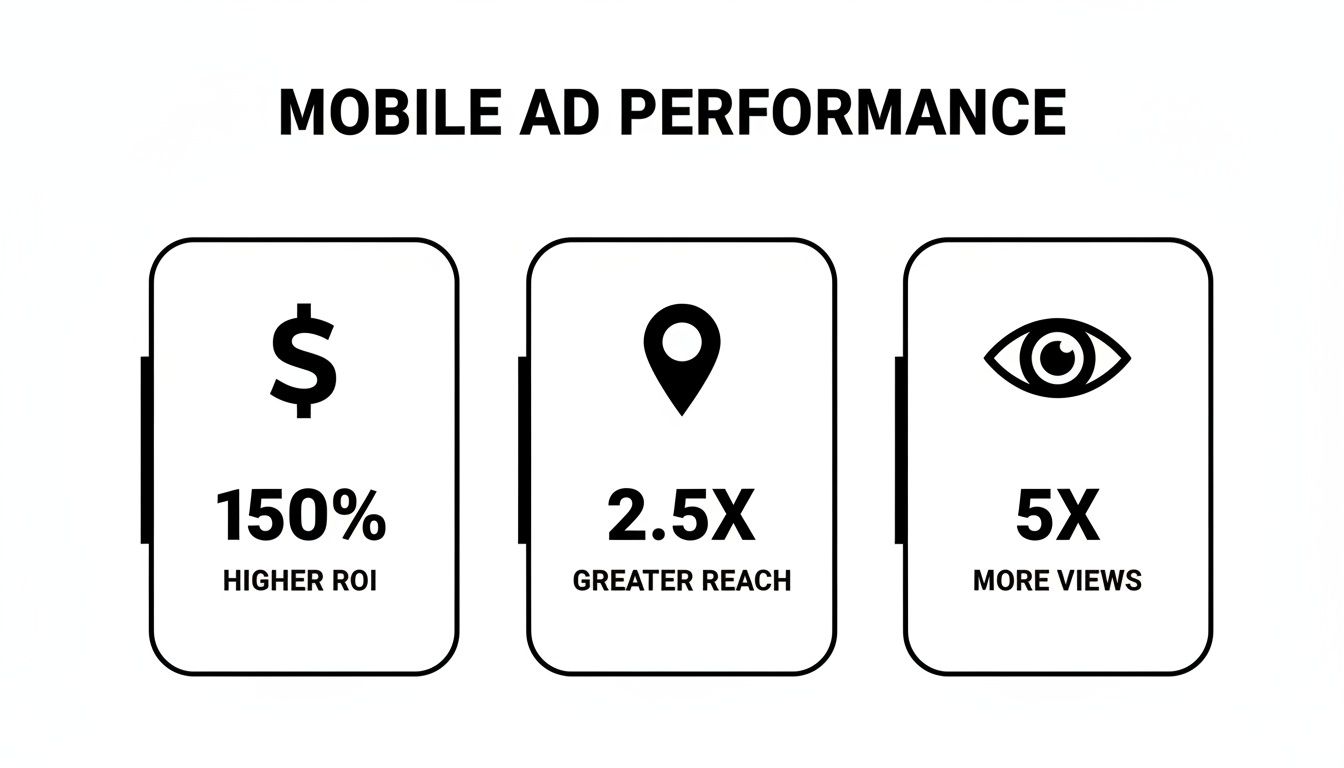
As you can see, the hyper-targeted nature of these trucks can translate into a much stronger ROI and a broader, more impactful reach than you might get elsewhere.
Before you even think about mapping out your first route, you have to untangle the web of local regulations. These rules are in place to manage everything from traffic flow to noise and public safety, and they can change dramatically from one town to the next. Ignoring them is a surefire way to get hit with hefty fines and have your campaign shut down.
Here are the key things you need to dig into:
Doing your homework upfront is your best defense. The easiest way to get clear, official guidance is by contacting the local city clerk's office or the department of transportation. For a deeper dive into how signage costs are calculated, you can also read about the outdoor LED sign cost to help inform your budget. Proper planning ensures your investment is not just effective, but fully compliant.
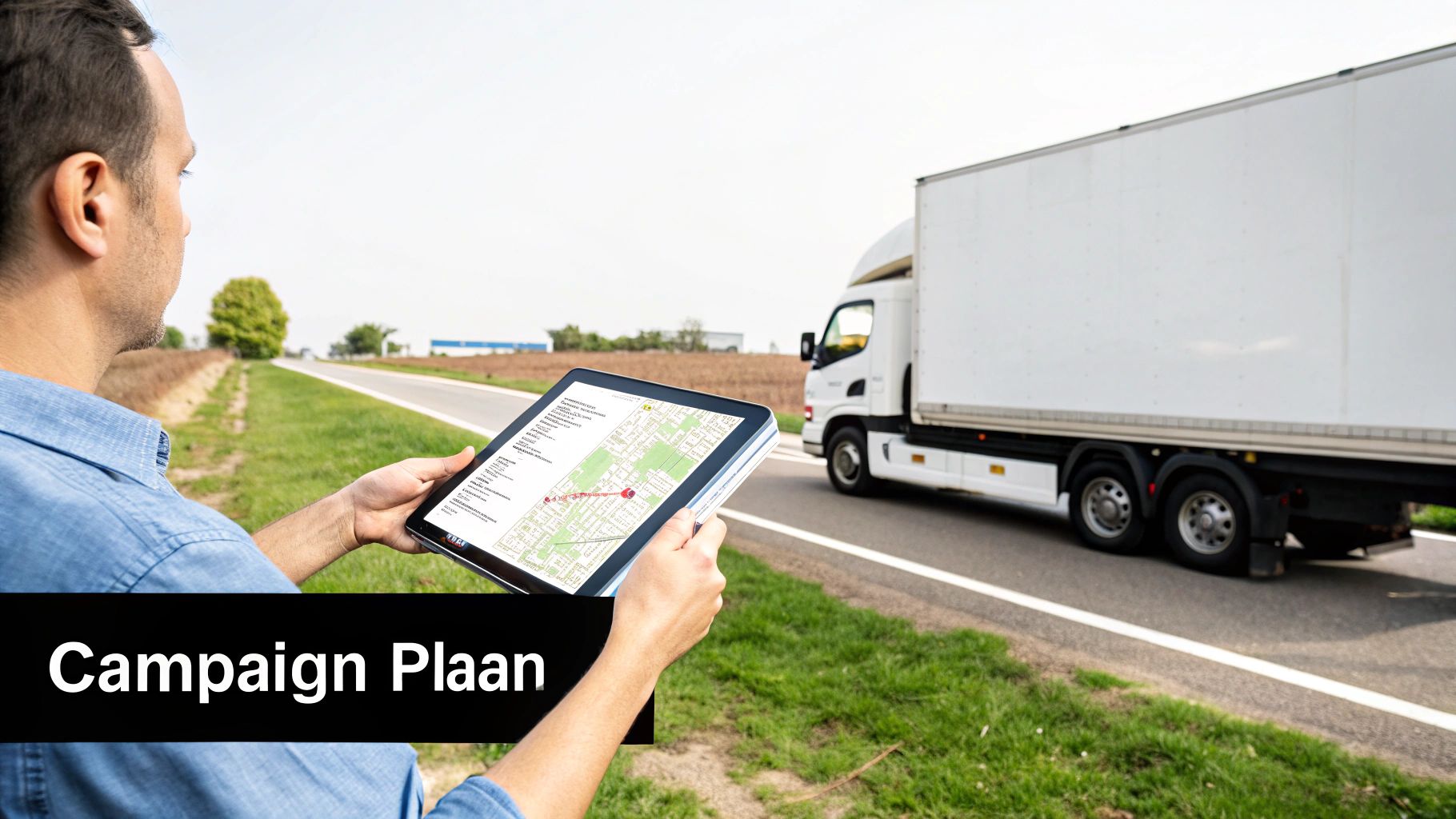
Getting your hands on a digital billboard truck is just the first step. The real magic happens when you pair that powerful tool with a smart, well-thought-out strategy. A high-impact campaign isn't just about a flashy ad; it's about nailing the creative, mapping the perfect route, and knowing how to track your results.
The best campaigns I've seen all start with a deep understanding of the medium itself. Your audience only has a few seconds to see and process your message as the truck drives by. That means you have to be crystal clear and straight to the point. Brevity is your best friend here.
Creative that works on a website or a social media feed is going to fall flat on a moving screen. You have to design for a quick glance. Think big, bold, and incredibly simple.
The core of any great mobile ad is a solid script. You can use a proven script for advertising to get high-converting messages put together quickly. Your goal is simple: make your ad impossible to ignore and easy to remember.
Once your creative is locked in, it's time to decide where and when to send the truck. This is where a digital billboard truck really flexes its muscles, giving you targeting precision that a fixed billboard could only dream of. Smart deployment is all about using data to put your message in front of the right eyeballs at the right time.
Digital billboard trucks are a huge part of what's driving growth in mobile advertising. The global market is expected to rocket from USD 42.6 billion to USD 112.52 billion by 2034. Some campaigns are reporting brand recall rates as high as 97%. This boom is all thanks to their ability to deliver scalable, cost-effective reach in crowded urban areas.
A go-to tactic is dayparting—running different ads at different times of the day to match what people are doing. For example, a coffee shop could run an ad for its morning brew special during the AM commute, then switch it up to a "buy one, get one" offer in the afternoon slump. For a deeper dive into how businesses use these visual tools, check out our guide on LED signs for businesses.
Before your first campaign hits the streets, run through this final checklist. It covers all the essentials from the creative side to deployment and tracking, ensuring you don't miss a thing.
By working through these points, you turn your digital billboard truck from just a moving screen into a strategic advertising machine that actually drives results.
Choosing a vendor for your digital billboard truck isn't just a one-off purchase; you're entering a long-term partnership. The quality of that partner will directly shape your campaign's success, your operational uptime, and ultimately, your return on investment.
Think of it like hiring a key team member. You need someone with a proven track record, reliable equipment, and the commitment to back you up long after you drive the truck off the lot. A great partner delivers a robust platform, not just a product.
The physical truck and screen are the foundation of your entire mobile advertising operation. This is not the place to cut corners. Skimping on quality here will inevitably lead to frustrating downtime and a constant drain of expensive repairs.
Start with the screen itself. The tech specs matter.
The most rugged truck on the planet is worthless without easy-to-use software and support you can count on. The content management system (CMS) is your command center—the tool you'll use every single day to upload ads, schedule campaigns, and make changes on the fly. It has to be intuitive.
Just as critical is what happens after the sale. A solid warranty covering the LED panels, power system, and other key components is a must. And you need to dig into their technical support process. When a problem pops up on the road, can you get a knowledgeable technician on the line quickly?
A reliable partner offers a complete ecosystem of support. They understand that your success depends on their product's performance and are structured to help you resolve issues quickly, minimizing any potential loss of revenue.
Thinking about the long-term health of your investment, it’s also wise to understand what comprehensive support looks like. Specialized on-road vehicle and truck fleet services can be a game-changer for maintaining efficiency and uptime, ensuring your assets are always ready to roll.
Finally, do your homework on the company’s reputation. A vendor worth their salt will be completely transparent about their experience and more than happy to show off their successes.
Ask to see a portfolio of past projects. Better yet, ask to speak with a few of their current clients to get firsthand feedback on their experience. That kind of insight is invaluable. You're looking for a partner with a history of successful deployments and one who offers clear, upfront pricing without a bunch of hidden fees. This due diligence ensures you're teaming up with a company that's genuinely invested in building a lasting, successful relationship.
Of course. Here is the rewritten section, crafted to sound like it was written by an experienced human expert, following the specific style and tone of your provided examples.
Jumping into the world of mobile digital advertising always brings up a few questions, especially if you're new to the game. Let's clear up some of the most common ones you'll run into when planning a campaign with a digital billboard truck.
The short answer is: it depends. You won't find a universal "yes" or "no" because the rules change dramatically from one city to the next. While most places allow them, you'll almost always have a specific set of local regulations to follow.
Think of it like this: running a campaign in Times Square has different rules than a quiet suburban town, and for good reason.
You'll typically find restrictions on:
Before you spend a dime, your first call should always be to the local city or county clerk's office. They'll give you the official rulebook.
Pinning down an exact price is tricky because it's all about context. Renting a truck for a massive festival in a major city is going to have a very different price tag than running a simple route on a Tuesday afternoon in a smaller market.
As a ballpark figure, you could be looking at a few hundred dollars for a quick, two-hour targeted run, or several thousand for a full-day brand takeover at a major event. Most companies offer packages, so renting for a full day or multiple days usually brings the hourly rate down.
The absolute golden rule here is simplicity and speed. You've got maybe three to five seconds to make an impression before the truck—or the person seeing it—is gone. Your message has to hit hard and fast.
The stuff that really connects uses bold, high-contrast visuals and massive fonts. Stick to a single, powerful headline and a killer image. Short, simple video clips or animations are fantastic for grabbing attention, but stay away from anything too complex. Rapid-fire cuts or detailed scenes just become a blur on the road.
Ready to take your message directly to your audience? Smart LED Inc. provides industry-leading digital billboard truck solutions built for high-impact, reliable performance. Get a quote today and start planning your next mobile campaign.
Picture this: you take the flash and spectacle of a Times Square billboard, slap it on the back of a truck, and send it wherever
A wall of TV screens is exactly what it sounds like: a big, impressive display made by tiling multiple TVs together so they act like

Picking the right displays for shows can feel like a high-stakes guessing game. Get it right, and you create an immersive world that captivates your
"*" indicates required fields