Uncategorized
Digital Billboard Truck: Boost Your Campaign with Mobile Ads
Picture this: you take the flash and spectacle of a Times Square billboard, slap it on the back of a truck, and send it wherever
The cost of an LED billboard can be anywhere from $30,000 for a smaller, simpler display to well over $500,000 for the massive, high-definition screens you see along the highway. That price gets you the hardware and covers the basic construction, but the final number really hinges on things like size, pixel clarity, and how complex the installation will be.
Making the jump into digital billboards is a big financial commitment, but it’s a lot less intimidating once you understand where the money goes. Instead of looking at it as one giant price tag, it helps to see the total cost as a combination of three key parts: the hardware, the installation, and the day-to-day operational expenses.
It’s a bit like buying a high-performance car. The sticker price is just the starting point; you also have to factor in getting it home, setting it up in your garage, and keeping it fueled up and running.
Getting your billboard from an idea to a fully functioning, revenue-generating sign happens in stages, and each one has its own set of costs that add up to the final investment.
This flowchart breaks down how the total cost is typically split between the hardware, installation, and what it takes to keep it running.
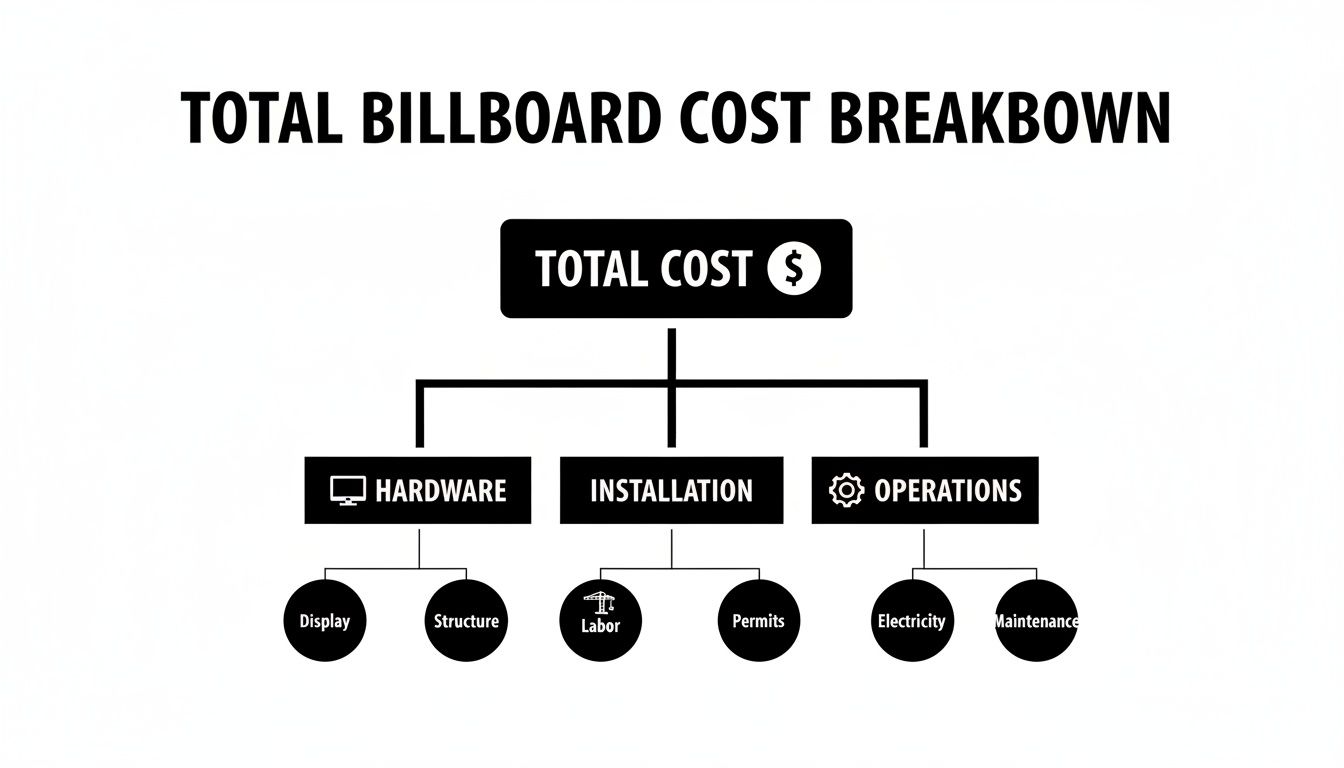
As you can see, buying the screen is just one piece of the puzzle. The setup and long-term running costs are a significant part of the overall financial picture.
To give you a clearer picture, here’s a high-level look at what you can expect to budget for the different parts of a typical LED billboard project.
| Cost Component | Low-End Estimate | High-End Estimate | Key Factors |
|---|---|---|---|
| LED Display Hardware | $30,000 | $200,000+ | Size, pixel pitch, brightness (nits), manufacturer |
| Steel Structure & Pole | $25,000 | $100,000+ | Height, sign weight, local engineering requirements |
| Foundation & Concrete | $10,000 | $40,000 | Soil conditions, footing size, local labor rates |
| Installation & Labor | $15,000 | $60,000 | Crane rental, crew size, site accessibility |
| Permits & Fees | $2,000 | $15,000+ | Municipality, zoning laws, inspection fees |
| Electrical & Connectivity | $5,000 | $20,000 | Distance to power source, internet setup |
| Software & Control System | $1,000 | $10,000 | Included with hardware or third-party subscription |
| Ongoing Operational Costs | $300 / month | $1,500+ / month | Electricity usage, software fees, maintenance |
Keep in mind these are ballpark figures. The final cost for your specific project will depend heavily on the variables listed, especially the sign's size and the complexities of your location.
A solid budget leaves no stone unturned. For instance, a small-to-mid-sized display might start in the $30,000 to $50,000 range for just the screen, but once you add the steel pole, foundation, and electrical work, a large roadside billboard can easily climb past $150,000.
To get the most out of your investment, it's also smart to look into proven strategies to reduce construction costs, as many of the same principles apply here.
When you first start looking into what an LED billboard costs, you'll notice something odd right away. Two signs that are the exact same size can have completely different price tags—and we're talking wildly different. It's not a typo. The real cost drivers are buried in the sign's technical DNA, kind of like how two cars that look identical on the outside can have vastly different engines under the hood.
Getting a handle on these core hardware components is the first real step to making a smart investment. It gives you the power to pick the right specs for your specific spot and your goals, making sure you don’t overpay for features you don't need or, even worse, cheap out on the ones that actually matter.
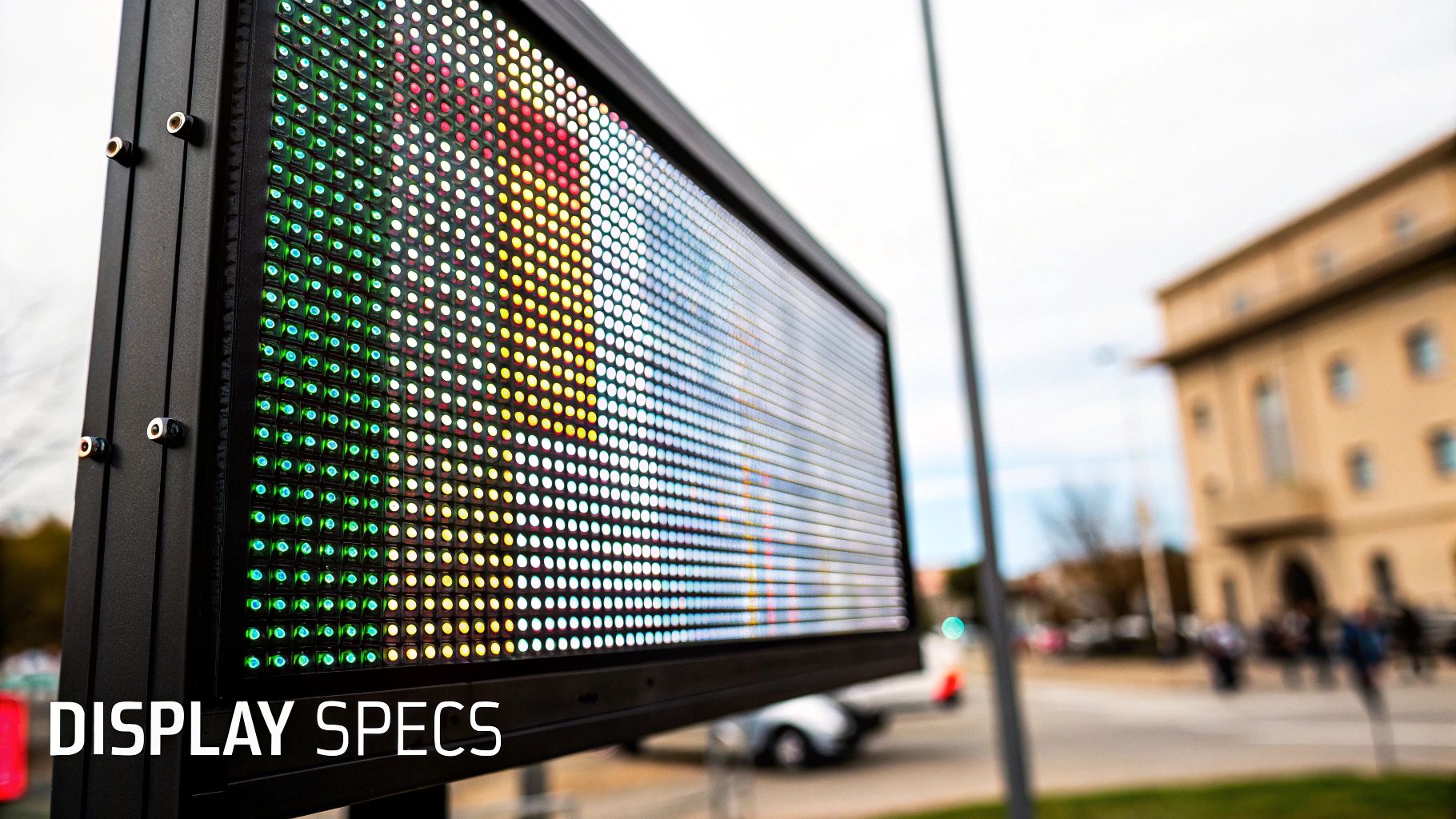
The single biggest factor that sways the price of an LED sign is its pixel pitch. The easiest way to think about pixel pitch is to compare it to the resolution on your TV at home. It’s simply the distance, measured in millimeters, from the center of one pixel to the center of the next.
A smaller pixel pitch number means the pixels are jammed closer together. This creates a much denser, higher-resolution image that looks sharp and crystal clear, even when you’re standing right up close.
Choosing the wrong pixel pitch is one of the most common—and expensive—mistakes people make. Putting a high-res 8mm sign on a highway is total overkill. A 16mm sign would look just as good to drivers, and you would have essentially doubled your hardware cost for zero real-world benefit.
Right after pixel pitch, the next big thing on the price list is brightness, which we measure in a unit called nits. Brightness isn't just about making your sign look pretty; it's about making it visible. An outdoor LED billboard has to be an absolute powerhouse to cut through and overpower direct sunlight.
An indoor display, say in a shopping mall, might only need 1,000 to 2,000 nits to look good. But an outdoor sign? That's a whole different ballgame.
Getting those higher nit ratings requires more powerful, higher-quality LEDs and beefier power supplies, which all adds to the final cost. Trying to save a few bucks by skimping on brightness is a classic rookie mistake that can make your billboard completely unreadable during the busiest daylight hours, defeating the whole purpose of having it.
The type of LED lighting up your sign also plays a huge part in its durability, performance, and price. You'll mainly run into two types of technology: DIP and SMD.
DIP (Dual In-line Package): This is the old-school workhorse. It uses three separate, individual LEDs (one red, one green, one blue) to form a single pixel. DIP signs are famous for being incredibly bright and tough as nails, which made them the traditional pick for harsh outdoor settings.
SMD (Surface-Mounted Device): This is the newer kid on the block. It bundles the red, green, and blue diodes into one tiny package that's mounted right onto the circuit board. This design allows for much smaller pixel pitches, wider viewing angles, and way better color blending, making it the standard for most high-resolution displays today.
While SMD tech used to be the more expensive option, huge leaps in manufacturing have made it incredibly competitive. For most situations now, it just delivers a better viewing experience. Getting this choice right is a key part of the puzzle, and you can dive deeper into the entire journey in our complete guide on how to buy an LED sign. It’s a great resource for getting into the nitty-gritty of picking the best tech for your project.
At the end of the day, the hardware's price tag is a direct reflection of what it can do. By understanding these core specs—pixel pitch, brightness, and LED type—you can look at quotes with confidence and pick a billboard that gives you the best bang for your buck, perfectly suited for your location.
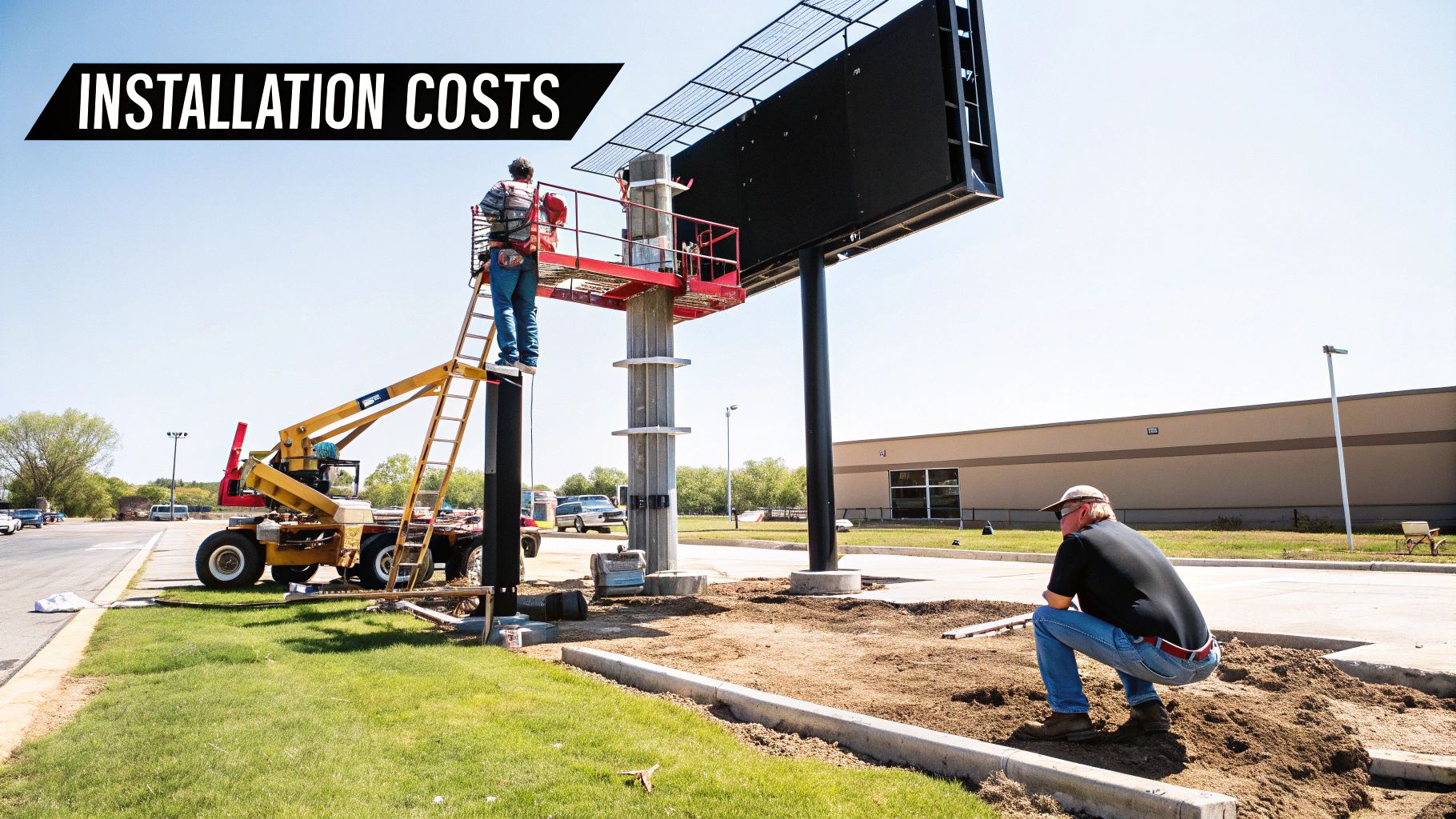
That bright, beautiful LED screen might be the star of the show, but it's only one piece of a much larger puzzle. Thinking you can just buy a display and hang it up is like buying a racecar engine without the car—it’s not going anywhere on its own. The real-world cost of an LED billboard can climb quickly when you start adding up the massive steel structure, complex site work, and layers of administrative red tape.
These are the "soft costs" where budgets often get thrown off course. A new owner might get a great deal on the display hardware, only to get hit with the sticker shock that the work to safely and legally install it can sometimes equal or even exceed the price of the screen itself. Planning for these from day one is the secret to a successful project.
Many first-time buyers focus entirely on the price of the screen. But as you can see, the hardware is often just the starting point. The table below breaks down how a typical budget is allocated between the display itself and all the critical support work.
| Cost Category | Typical Percentage of Total Budget | Examples |
|---|---|---|
| Hardware Costs | 40% – 60% | LED display modules, control systems, software |
| Structural & Site Costs | 30% – 50% | Steel monopole, concrete foundation, engineering fees |
| Installation & Labor | 10% – 20% | Crane rental, installation crew, electrical contractor |
| Permits & Fees | 5% – 10% | Zoning applications, building permits, inspections |
Notice how "soft costs" can easily account for half of the entire project budget. Underestimating them is the fastest way to derail your investment before it even gets off the ground.
An LED billboard is an enormous, heavy piece of equipment that has to stand up to high winds, brutal sun, and anything else nature throws at it. That demands some serious engineering, starting from the ground up.
First, you have the concrete foundation—a massive footing buried deep in the ground to anchor the whole thing. Just pouring this can run from $10,000 to $40,000, depending on the soil conditions and the sheer size of the sign it has to hold. Bad soil might mean you need deeper, more complex engineering, which will drive that price up.
Then comes the steel monopole or structure. This isn't just a simple pipe; it’s a custom-fabricated steel column precisely engineered to handle the billboard’s weight and wind load. The steel structure alone can range from $25,000 to over $100,000, based on its height and how heavy the LED display is. You absolutely cannot cut corners here—structural failure isn’t just costly, it’s catastrophic.
With the structural parts ready, the real work begins on-site, bringing its own set of big-ticket costs. This is where you need a skilled crew, heavy machinery, and perfect coordination.
The bottom line is that a complete outdoor billboard installation is a major construction project. For just the hardware, smaller signs might start in the $30,000–$50,000 range, but it's not uncommon for large, high-resolution screens to top $150,000 or even $500,000 once the steel, foundation, and electrical work are all factored in.
Finally, before a single shovel of dirt can be moved, you have to get through the bureaucratic maze of permits and licenses. This part is easy to overlook but can cause major delays and costs if you aren’t prepared.
You’ll need approvals from local planning and zoning boards, building permits for the structure, and electrical permits for the wiring. The fees for these can add anywhere from $2,000 to over $15,000 to your budget. In some areas, the rules are so complicated you may even need to hire a permit expediter or an attorney to get everything pushed through.
Forgetting to budget for these "soft costs" is a recipe for disaster. A truly comprehensive plan treats the installation, permits, and engineering with the same seriousness as the display itself. This ensures your digital outdoor signage project is built on a foundation that is not only solid but also fully legal and compliant.
Getting your new billboard purchased and installed is a huge milestone, but the race isn't over once it's shining brightly for all to see. An LED display is an active piece of technology—it's not a passive sign you can just set up and forget. To keep it profitable for years to come, you have to plan for the operational expenses that kick in the moment you flip the switch.
These recurring costs are a massive part of calculating the total cost of ownership (TCO). If you don't budget for them, a promising investment can quickly turn into a financial headache. Let's break down the main operational costs you'll need to factor in.
By far, the biggest and most consistent operational expense for any LED billboard is power. Your monthly electricity bill is directly tied to a few key variables, which means it’s a dynamic cost you can actually control to some extent.
Think of it like the fuel for your car—how much you spend depends on how hard you drive it.
A mid-sized digital billboard can easily tack on $300 to $800 per month to your power bill. For the really big, high-resolution displays, that number could climb past $1,500 per month.
Just like any other sophisticated piece of electronics, an LED billboard needs routine maintenance to perform at its best and hit its full 10- to 12-year lifespan. While today's displays are incredibly reliable, parts will eventually wear out and need to be replaced.
Smart owners set aside a maintenance budget from day one. This fund should be ready to cover the replacement of key components over the sign's life.
Smart billboard owners treat maintenance not as an unexpected problem but as a planned expense. Proactively budgeting for part replacements prevents downtime and protects the revenue stream your billboard generates.
Common components that will need attention down the line include:
Beyond just the hardware, these operating costs have a real impact on the lifetime cost of an LED billboard. When you add up electricity, maintenance, and content management, you could easily be looking at thousands—or even tens of thousands—of dollars per year. You can discover more insights about billboard advertising rates and ongoing expenses on smartledinc.com.
Your billboard needs a brain to tell it what to show, and that brain is the Content Management System (CMS). Some manufacturers might throw in basic software, but the more advanced cloud-based platforms that let you manage everything remotely usually require a subscription. These fees can run anywhere from $50 to several hundred dollars per month, depending on the features you need.
On top of that, your sign needs an internet connection to get those remote updates. This is usually handled with a cellular data plan, which adds another small monthly bill, just like a cell phone. These costs are essential for the convenience and efficiency of managing your content from anywhere in the world.
Once you've tallied up the upfront costs and figured out the ongoing expenses, we can get to the exciting part: turning that initial investment into a revenue-generating machine. An LED billboard isn't just an expense; it's a powerful asset that can start paying for itself faster than you might think. The trick is knowing how to monetize it properly.
This is where the world of Digital Out-of-Home (DOOH) advertising comes in. By selling ad space on your new display, you can build a steady, profitable income stream that just keeps flowing.
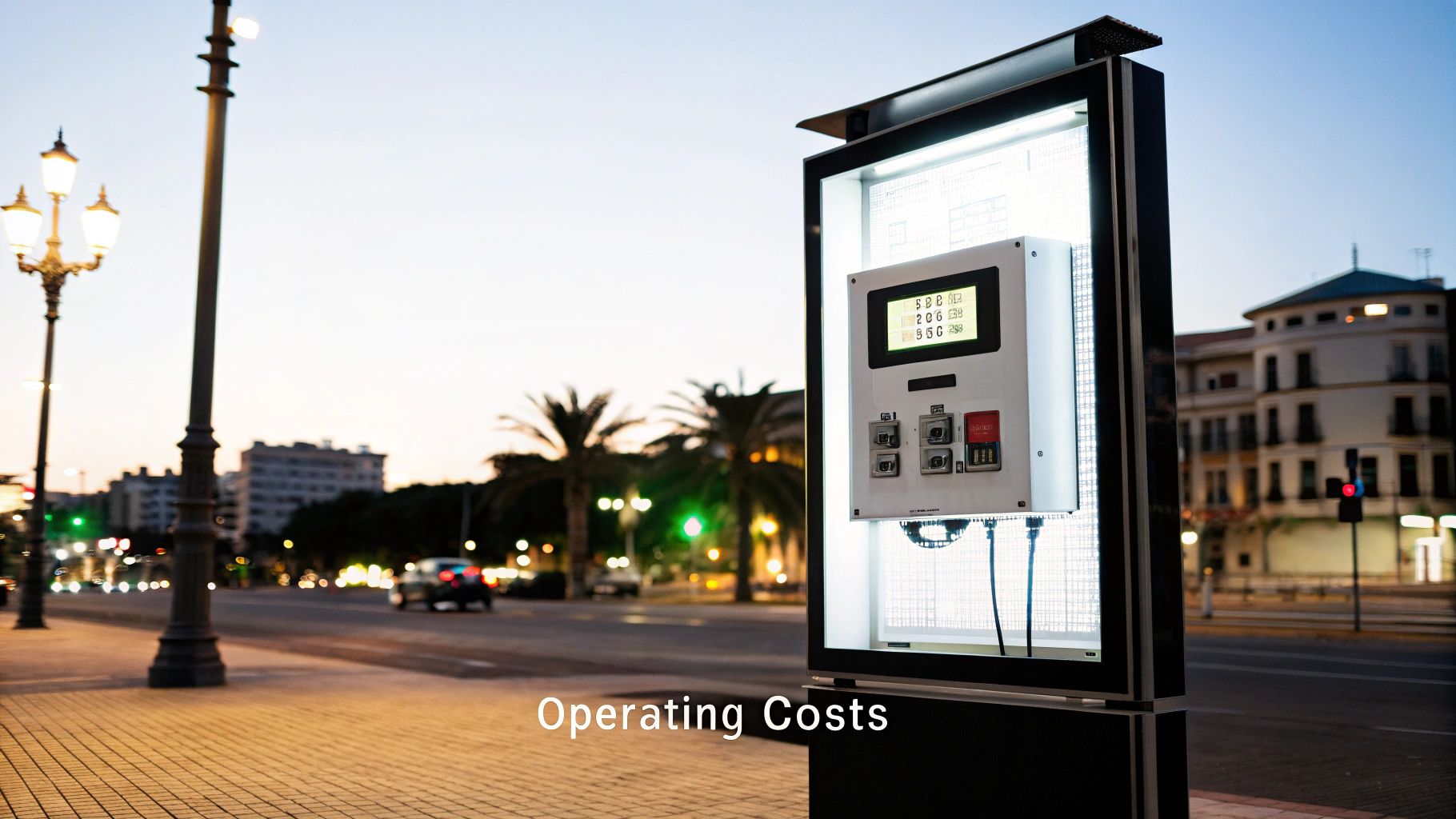
This digital display in a high-traffic urban area illustrates the prime real estate that modern LED signs can occupy, turning visibility into revenue.
Forget the old static signs that showed one ad for an entire month. A digital billboard is dynamic, rotating through a loop of different advertisements. Each advertiser buys a "slot" or a "flip" in that loop, which usually lasts anywhere from 6 to 10 seconds. This model lets you sell the exact same physical space to multiple advertisers at once, which dramatically multiplies your revenue potential.
Of course, the rates you can charge for these ad slots are all about location, location, location.
Ultimately, the price an advertiser is willing to pay is directly tied to the eyeballs you can deliver. More eyes on the screen means more value for every single ad slot.
So, what can you actually charge? Ad rates swing wildly depending on the market, but the numbers can be pretty substantial. For instance, monthly rental rates for a digital ad slot can go from $1,200 in smaller towns to over $15,000 in prime urban centers.
Doing the math, a single, well-placed billboard can generate anywhere from $14,400 to over $180,000 in annual advertising revenue.
The most successful billboard owners think like real estate investors. Your sign’s location is its most valuable attribute, directly dictating its income potential and how quickly you achieve a positive return on investment.
To squeeze every last drop of potential out of their signs, many owners are now plugging into programmatic advertising platforms. These are automated systems that connect your billboard to a huge network of advertisers, dynamically selling and scheduling ads to fill any unsold inventory. It’s a great way to ensure your screen is always making money and vacancies are kept to a minimum.
What if you’re a business owner and plan to use the billboard to advertise your own company? In this case, your return on investment isn't measured in ad sales, but in direct business growth. Instead of renting ad space from someone else, you own the whole platform.
The ROI here is calculated based on real-world results:
By owning the billboard, you get to cross off a recurring marketing expense and turn it into a one-time capital investment that promotes your business 24/7 for a decade or more. The cost of financing an LED sign can often be completely offset by the new business it drives, making it a powerful, self-sustaining marketing tool. You can learn more about how financing an LED sign can make this powerful asset more accessible.
Buying an LED billboard isn't just about the hardware. It's a strategic move into a market that's absolutely booming. The advertising world is quickly leaving static paper signs in the rearview mirror, and for good reason. They're jumping headfirst into the dynamic, data-driven power of digital screens.
This whole shift is being driven by advertisers who need more. They want to launch campaigns that are timely, targeted, and can change on a dime—something a printed sign could never do. Your investment puts you in the perfect spot to give them exactly what they're looking for.
The numbers don't lie. We're on a massive upward trend here. The global LED billboard market was pegged at around USD 3.4 billion in 2023. But here’s the kicker: it’s projected to more than double, hitting USD 7.3 billion by 2031.
That's a compound annual growth rate (CAGR) of about 10.3%, which signals a seriously healthy and expanding industry for years to come. This isn't some flash-in-the-pan trend; it's the future.
This kind of rapid growth should give you confidence that your asset won't just make you money day-to-day. It’s also set to appreciate in value as a critical piece of modern advertising infrastructure. To really get a feel for the opportunity, it helps to understand where these screens fit into broader Out-of-Home (OOH) advertising strategies.
When you buy an LED billboard, you’re securing your spot in a thriving, multi-billion dollar advertising landscape. Think of it as an investment in future-proof technology that’s perfectly aligned with where the entire media industry is headed.
As you get ready to make your move, keep those key cost factors we talked about front and center:
Finding the right balance between these elements is the final piece of the puzzle. It’s how you make sure your billboard isn’t just a sign on the side of the road, but a profitable, future-ready business asset.
You're likely getting down to the final details, and that's where the most practical questions come up. Let's tackle some of the most common ones we hear from prospective billboard owners.
You can expect a high-quality outdoor LED billboard to run for about 100,000 hours. In the real world, that translates to a solid 10-12 years of service before you'd even think about a major replacement.
Of course, this isn't set in stone. The quality of the components, the climate it's operating in, and how well you maintain it all play a huge role. While the brightness will naturally fade a bit over a decade, a well-cared-for board remains a powerful advertising asset, making that initial cost of an LED billboard a true long-term investment.
Yes, absolutely. You don't have to write a massive check upfront. Many manufacturers and specialized lenders have financing and leasing programs designed specifically for these assets. These options let you break down the initial investment into predictable monthly payments.
Here's the best part: for most owners, the ad revenue coming in from the billboard is more than enough to cover the monthly financing payment. This allows the asset to essentially pay for itself over time, turning what looks like a huge capital expense into a manageable, cash-flow-positive operational cost.
This is one of those "it depends" answers, but here's the breakdown. Some manufacturers will bundle a basic Content Management System (CMS) with the hardware purchase for no extra charge, which is great for getting started.
But if you want the real power—think cloud-based systems that let you schedule ads from anywhere, run advanced diagnostics, and tap into programmatic ad networks—you'll be looking at a subscription. These fees can be less than $100 a month for a simple setup or run up to several hundred dollars, depending on how many screens you're managing and the firepower of the platform.
Ready to see what the numbers look like for your project? The experts at Smart LED Inc. can walk you through the full cost and revenue potential. Or, get a personalized estimate right now with our free sign calculator. You can learn more at https://smartledinc.com.
Picture this: you take the flash and spectacle of a Times Square billboard, slap it on the back of a truck, and send it wherever
A wall of TV screens is exactly what it sounds like: a big, impressive display made by tiling multiple TVs together so they act like
Picking the right displays for shows can feel like a high-stakes guessing game. Get it right, and you create an immersive world that captivates your
"*" indicates required fields