
Uncategorized
Digital Billboard Truck: Boost Your Campaign with Mobile Ads
Picture this: you take the flash and spectacle of a Times Square billboard, slap it on the back of a truck, and send it wherever
Building a home theater is about creating an immersive escape, not just buying a big screen and some loud speakers. A truly great build starts with a solid plan that balances acoustics, visuals, and comfort. Get this right, and you’ll avoid the common and expensive mistakes that trip people up right from the start.
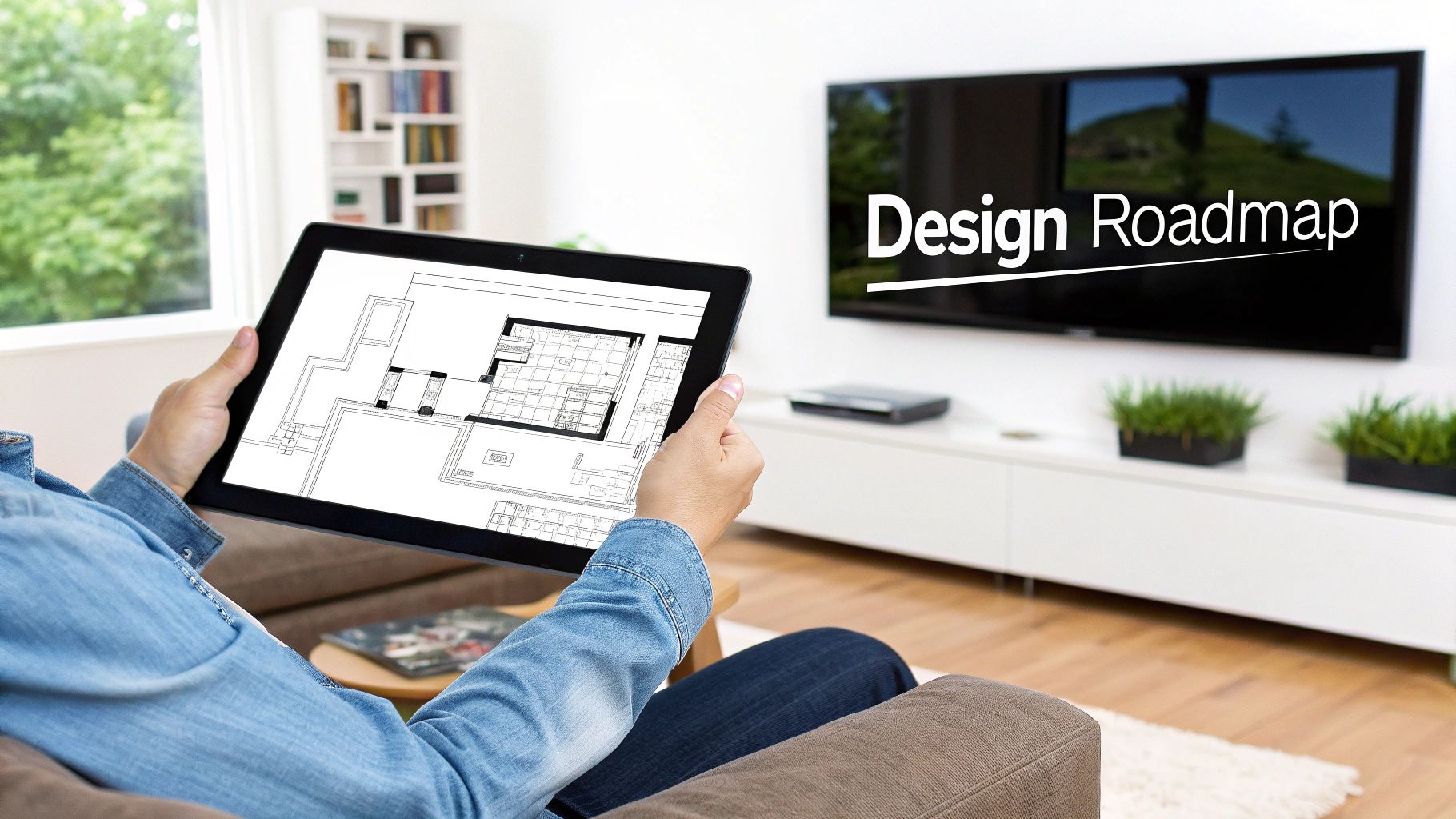
Creating a dedicated cinema space is more accessible than ever, but the secret to an amazing result isn't in the gear—it's in the initial planning. Before you even think about picking a single piece of equipment, you need a clear vision for the room itself. This roadmap is what stops you from overspending on hardware that just won't perform well in your specific environment.
The desire for premium, at-home entertainment has exploded, making home theaters a major trend for homeowners. The global market tells the story: it was valued at USD 12.36 billion in 2024 and is on track to hit USD 19.98 billion by 2030. This massive growth is being fueled by our appetite for high-quality streaming from services like Netflix and Disney+.
I’ve seen it time and time again: a truly great home theater balances a few critical elements. If you neglect one, it can easily undermine the others and lead to a disappointing experience. Your initial blueprint absolutely must address these core pillars:
Acoustics and Sound Isolation: This is a two-part puzzle. First, you have to manage how sound behaves inside the room (that's acoustic treatment). Second, you need to stop it from leaking out and disturbing the rest of the house (that's soundproofing).
Visual Performance: The display is the star of the show. The choice between a traditional projector and newer tech like direct-view LED walls comes down to your room's conditions, especially how much ambient light you're dealing with. For example, our indoor LED wall screen kits are designed to deliver jaw-dropping visuals even in brighter rooms where a projector would wash out.
Seating and Sightlines: Comfort is king for those movie marathons. More than that, proper seating placement ensures every single person has an unobstructed, perfect view of the screen. No bad seats in the house.
The technology is constantly getting better, giving us new ways to achieve cinematic perfection right at home. One of the most significant leaps forward is the rise of direct-view LED walls.
Unlike projectors, which can really struggle with any amount of ambient light, these displays produce a vibrant, completely seamless image. We're talking perfect black levels and color accuracy that can blow you away.
By thinking through the entire system—from the room's construction all the way to the final calibration—you set the stage for an experience that genuinely rivals a commercial cinema. The planning phase is where you make the decisions that matter most.
The room you choose is more than just four walls; it’s the single most important component of your home theater system. I've seen it time and time again: someone invests in a phenomenal set of speakers, only to have them sound muddy and incoherent in a room full of echoes. The most vibrant, high-contrast display will look washed out if you can't control the light.
Getting the room right is the foundation for everything that follows.
Think of your space as an instrument. Just like a guitar's body shapes its sound, your room's dimensions, surfaces, and layout will define the entire audio-visual experience. This isn't just a niche hobby anymore, either. It's a serious market reflecting a massive demand for quality at home. The global home theater system market is projected to jump from USD 11.42 billion in 2026 to USD 17.81 billion by 2031, a surge fueled by streaming and advanced audio like Dolby Atmos. You can dig into the numbers and drivers in this detailed report on the home theatre system market from Mordor Intelligence.
Before a single speaker gets installed, you need a game plan for sound. The goal here is to control reflections, not kill them entirely. A room that’s too “dead” feels unnatural and claustrophobic, but one with too much echo turns dialogue into a garbled mess and ruins the impact of sound effects.
Your main enemies? Hard, parallel surfaces. We're talking bare drywall, hardwood or tile floors, and large windows. Sound waves bounce back and forth between them, creating a chaotic mess of echoes and standing waves that can suck the life out of your bass or create annoying, buzzing hot spots.
Here are a few practical places to start:
A common mistake I see is confusing sound treatment with sound proofing. Acoustic treatment is all about managing sound inside the room for better quality. Soundproofing is about stopping sound from leaving the room, which is a much bigger job involving things like decoupled walls and solid-core doors.
Ambient light is the mortal enemy of a great picture, especially if you’re using a projector. It absolutely crushes black levels, washes out colors, and creates distracting reflections on the screen. For a truly cinematic image, non-negotiable, total light control is the only way.
To get there, you need a multi-layered strategy. Think about how to reduce glare on TV and then take it to the next level for your theater.
Finally, let's talk about the one thing most people completely forget: the electrical setup. Your high-end AV gear is incredibly sensitive to electrical "noise" and voltage fluctuations. Plugging a $5,000 receiver and a $10,000 projector into the same circuit as a mini-fridge or a vacuum cleaner is just asking for problems.
A dedicated electrical circuit for your home theater equipment is one of the smartest investments you can make. It delivers clean, stable power, protecting your components from surges and eliminating interference that shows up as an annoying hum in your audio or weird artifacts in your video.
Consider it essential insurance for your system’s performance and longevity.
The display is the soul of your home theater. It’s the focal point where every eye will be fixed, and honestly, it’s the decision that will most dramatically shape your viewing experience. For years, building a serious home theater meant one thing: choosing a projector. But that’s no longer the case. The real debate today is a fascinating head-to-head matchup: the classic high-end projector versus the modern direct-view LED video wall.
This isn't just about picking the biggest screen you can find. It’s a fundamental difference in how an image gets from the source to your eyes, and it impacts everything from watching a movie on a sunny afternoon to catching the subtlest details in a dark, moody scene. Your choice here really defines the visual character of your entire room.
When you get these two technologies into a real home, you have to look past the spec sheets and talk about how they actually perform day-to-day. Here's the bottom line: a projector's performance is always relative to its environment, while an LED wall's performance is absolute.
Think about it this way: a projector works by reflecting light off a screen. That means its image is immediately vulnerable to any other light in the room, which can crush black levels and wash out colors in an instant. An LED wall, on the other hand, is a direct-view display—it creates its own light. This makes it incredibly resilient in rooms with ambient light, delivering a punchy, vibrant image even if you don't have perfect blackout conditions.
The core difference is simple: a projector fights against the room's light, while an LED wall overpowers it. For a multi-purpose media room that isn't a dedicated, pitch-black cave, this gives LED a significant real-world advantage in usability and picture quality.
This is just one piece of the puzzle, of course. Building a truly great theater means thinking through how your room's acoustics, lighting, and power infrastructure all work together.
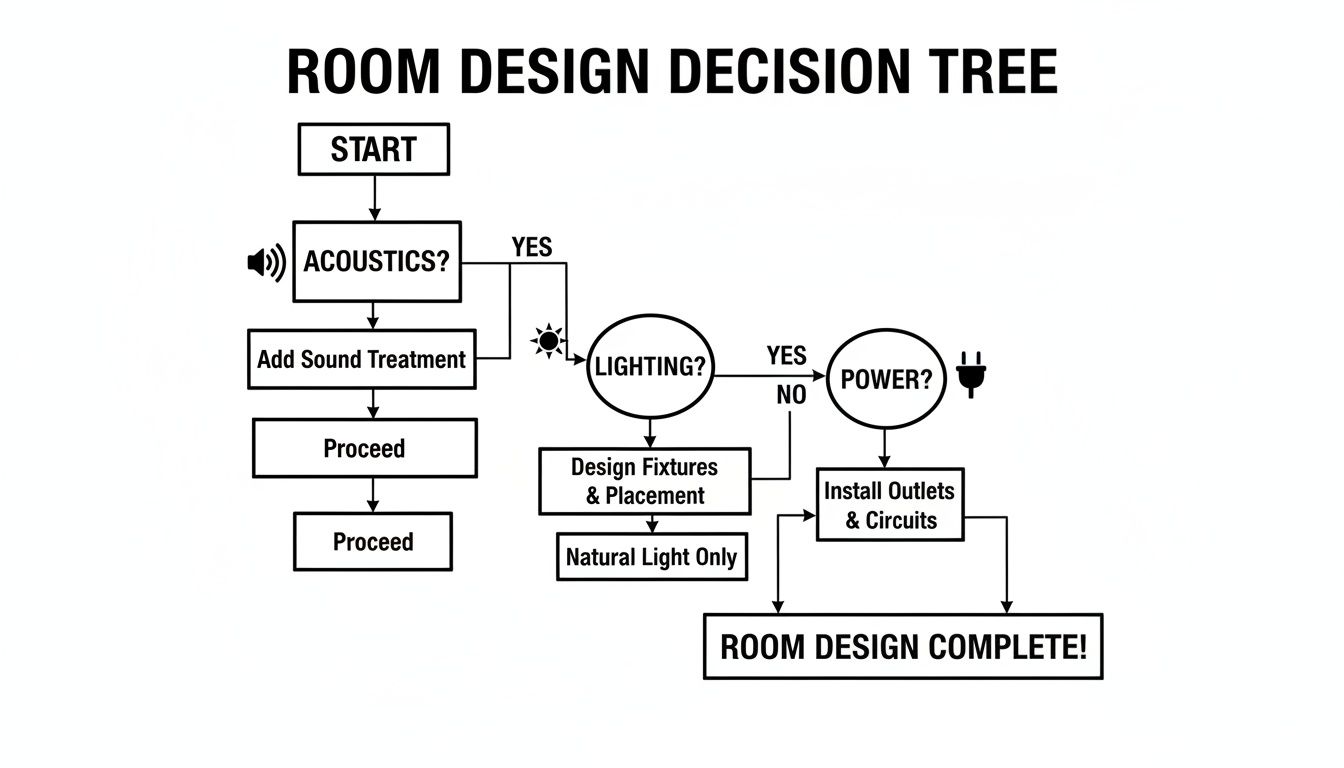
As you can see, these foundational choices are all interconnected. Getting the electrical planning and lighting control right from the start is critical to getting the most out of your display, regardless of which technology you choose.
To make this choice clearer, let's break down how these two technologies stack up on the metrics that truly matter when you’re settled in for movie night.
| Feature | Direct-View LED Wall (e.g., Smart LED Inc.) | High-End 4K Projector |
|---|---|---|
| Brightness | Extremely high, easily overcoming ambient light. | Good, but performance degrades quickly with any room light. |
| Black Levels | Absolute black. Pixels turn off completely for perfect contrast. | Dark gray. Relies on blocking light, limited by room darkness. |
| Color Gamut | Can cover over 95% of DCI-P3 for cinematic color. | Also targets DCI-P3, but perceived color is washed out by light. |
| Viewing Experience | Perfectly seamless canvas with no bezels or screen texture. | Image is projected onto a screen, which may have texture. |
| Longevity | 80,000-100,000 hours with consistent performance. | 2,000-4,000 hours for a lamp, which degrades over time. |
| Ideal Room | Any room, from dedicated theaters to bright living rooms. | Dedicated, light-controlled "bat cave" theaters. |
Ultimately, the table shows two different philosophies. A projector setup is designed to create a cinematic experience under very specific, controlled conditions. An LED wall is engineered to deliver that same reference-quality experience under a much wider range of real-world conditions.
Let's dig a little deeper into what those numbers in the table actually mean for your movie-watching.
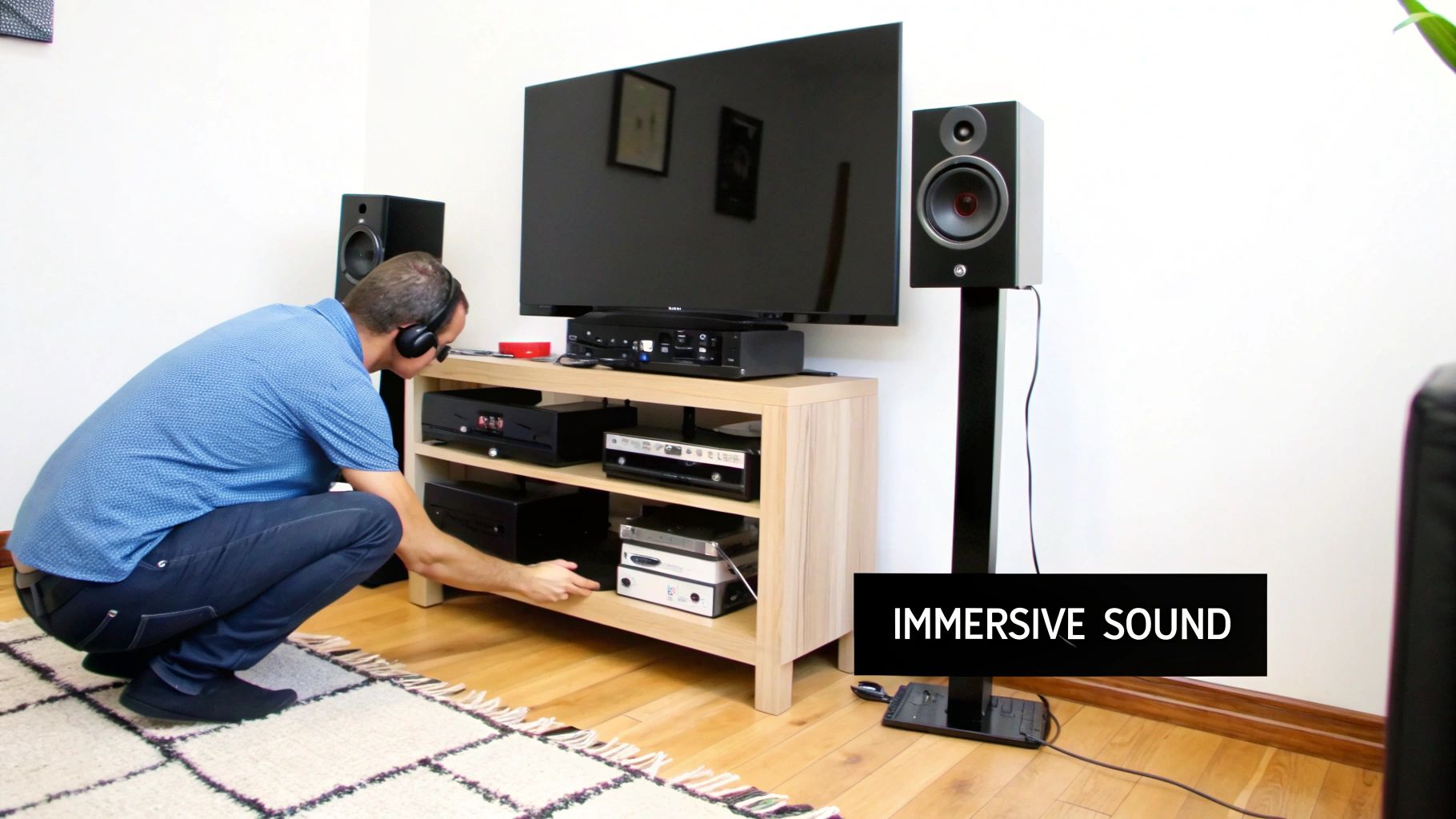
A breathtaking picture is only half the story. While that massive screen pulls your eyes in, it’s the sound that truly immerses you in the action. It’s the difference between watching a movie and experiencing it—feeling the rumble of an explosion in your chest or hearing the subtle rustle of leaves just over your shoulder.
Getting the audio right is where you transform a room with a big screen into a genuine home cinema. It can seem daunting with all the different formats, specs, and speaker types out there. But really, it all comes down to building a cohesive system where every part works in harmony to deliver sound that’s clear, dynamic, and spatially convincing.
First, let's get the terminology straight. You're going to see two names everywhere: Dolby Atmos and DTS:X. These aren't just logos on a box; they represent a massive leap from old-school surround sound to what we call "object-based" audio.
Instead of mixing sound for a fixed number of channels (left, right, center, etc.), object-based audio treats individual sounds—like a buzzing fly or a ricocheting bullet—as distinct "objects." Sound designers can then place and move these objects anywhere in a 3D space, creating an unbelievably realistic soundscape.
Thankfully, you don't have to pick a side. Practically every modern AV receiver can handle both, so you’re covered no matter what you watch.
The whole point of object-based audio is to shatter the limits of fixed channels. When a helicopter flies overhead on screen, you don't just hear a generic "top" speaker fire up. You hear the sound object move seamlessly across the ceiling, creating a totally convincing illusion of flight.
This kind of audio tech used to be exclusive to high-end commercial theaters, but its accessibility has fueled a massive boom in home cinema. The market, valued at USD 12.31 billion in 2023, is on track to hit USD 30.98 billion by 2032. We're seeing a huge trend here, with 35% more households installing 3D sound systems since 2018. It's clear that immersive audio is no longer just a niche luxury. Read more about the growth drivers in the home theater market.
If your home theater has a heart, it's the Audio/Video Receiver (AVR). This box is the command center. It takes in all your sources (Apple TV, Xbox, Blu-ray player), decodes the audio and video, shoots the picture to your display, and sends power to every single one of your speakers. Choosing the right AVR is absolutely critical.
Here’s what to zero in on:
With the AVR sorted, it's time for the fun part: picking the speakers that will actually make the sound. The single most important rule here is timbre-matching your front soundstage. This means your front left, right, and center speakers should all come from the same brand and product line to ensure a seamless sonic signature as sound pans across the screen.
Here’s a look at the cast of characters you’ll need:
Think about it: with one touch, the lights dim, the screen drops into place, and the projector and receiver spring to life. That’s not just convenience; it's showmanship. It elevates the entire experience, transforming the simple act of watching a movie into a true cinematic event.
Let's be honest, a rat's nest of cables behind your equipment rack is more than just ugly—it’s a recipe for signal interference and a troubleshooter's worst nightmare. A well-thought-out wiring plan, ideally executed while the walls are open, is the single best investment you can make for long-term reliability and a clean finish.
The golden rule? Run more cable than you think you’ll ever need. It is vastly cheaper and easier to pull extra runs now than to tear open drywall later.
The invisible infrastructure supporting your smart controls is crucial for system reliability. A practical explainer on home automation and wiring can provide a deeper understanding of how these systems work together to create a seamless user experience.
Nothing shatters the cinematic illusion faster than fumbling with five different remotes. Consolidating everything into a single, intuitive interface is absolutely non-negotiable for a modern home theater. This is where smart control systems work their magic, translating a whole sequence of complex commands into one simple action.
The goal is to create "scenes" or "macros" that do the heavy lifting for you. For example, a "Movie Night" button could trigger a cascade of events: the lights smoothly fade to 10%, the projector powers on, the AV receiver clicks to the right input, and your movie player cues up.
There are a few solid paths to unified control, and the right one for you really comes down to your budget and how complex your system is.
| Control Type | Best For | Key Benefits |
|---|---|---|
| Universal Remote | Simpler setups | Cost-effective, tactile buttons, combines multiple remotes into one. |
| Smart Home Hub | Integrated homes | Controls lighting, shades, and AV; enables voice commands. |
| Dedicated Control System | High-end custom theaters | Ultimate customization, professional programming, rock-solid reliability. |
For most home theater builds, a smart home hub from a company like Control4 or Savant hits the perfect balance of power and usability. They give you a slick, centralized app for your phone or a dedicated touchscreen, enabling the kind of one-touch automation that makes your theater feel both luxurious and completely effortless to use.
Alright, the room is built, the gear is in place, and all the messy wires are tucked away. It’s tempting to grab the remote and call it a day, but you're not quite at the finish line. The final, and arguably most important, step is still ahead: calibration.
This is the secret sauce. Calibration is what turns a pile of expensive components into a truly cohesive, jaw-dropping cinema experience. Without it, even the most high-end equipment can sound muddy or look completely unnatural. Think of it as the last 10% of the work that unlocks 100% of the performance you paid for.
Every room has its own personality—a unique acoustic fingerprint shaped by its dimensions, furniture, and surfaces. This "room sound" can wreak havoc on your audio, creating boomy bass in one spot and lifeless dialogue in another.
Thankfully, your AV receiver comes armed with some powerful room correction software to fight back. You'll almost certainly run into one of two systems: Audyssey or Dirac Live.
The process itself is pretty simple, though it does require a bit of patience. You plug a small microphone (it should be in the box with your receiver) into the front of the unit and place it right where your head would be in your favorite seat. From there, the system will blast a series of whooshing and popping test tones through each speaker.
Here’s a pro tip: don’t just take one measurement from the "money seat" and call it good. That's a classic rookie mistake. Follow the on-screen prompts and move the mic to several positions around your main seating area. This gives the software a much richer acoustic map to work with, resulting in a system that sounds incredible for everyone, not just one person.
Just like your audio, your projector or TV needs to be tuned. The out-of-the-box settings are almost universally terrible. They're cranked up to look flashy and over-the-top in a brightly lit big-box store, but in a dark theater, they just look wrong.
The good news is that a few quick tweaks in your display's menu can make a night-and-day difference.
First thing's first: find the "Cinema" or "Filmmaker Mode" picture preset. This one change alone gets you about 90% of the way to an accurate, natural-looking image. From there, you can fine-tune the big four:
These DIY adjustments will give you a massive improvement over the factory settings. But if you want to see exactly what the director saw in the editing suite, nothing beats hiring a professional ISF-certified calibrator. They use specialized light meters and software to achieve near-perfect color accuracy, squeezing every last drop of performance out of your display.
Even the best-laid plans run into questions. It’s just part of the process. Over the years, we’ve heard just about everything, but a few questions pop up time and time again. Let's tackle some of the big ones so you can move forward with confidence.
This is, without a doubt, the number one point of confusion we see, and getting it right is absolutely critical for a great-sounding room. They are two completely different things that work together.
Soundproofing is all about isolation. Think of it as building a box to keep sound in. This is a construction-level job, involving things like decoupled walls (using resilient channels or clips), heavy solid-core doors, and meticulously sealing every single air gap. The goal is to stop that thundering bass from waking up the kids or bothering your neighbors.
Acoustic Treatment is all about sound quality inside the box. This is where you tame the room itself by strategically placing things like absorption panels, diffusers, and bass traps to manage echoes, reverb, and standing waves. This is what gives you that crisp, clear, and immersive audio you're after.
You really do need both. Soundproofing contains the roar, while acoustic treatment refines the listening experience.
Sound control isn't something you tack on at the end—it's foundational. The most effective strategies are baked into the design from day one, layering mass, decoupling structures, and absorbing sound within wall cavities. A properly designed room shell is the secret to getting both killer isolation and pristine in-room audio.
The answer here depends entirely on your room size and how you plan to use it. The biggest mistake we see is people trying to cram in as many seats as physics will allow. Don't do it. Overcrowding will ruin the sightlines and acoustics for just about everyone.
For most dedicated theaters, a single row of three or four high-quality recliners is the sweet spot. This setup gives the primary viewers the absolute best, uncompromised experience. If you know you'll be hosting larger movie nights, a second, elevated row on a custom-built riser is the way to go.
While a dedicated, blacked-out room will always represent the pinnacle of the home theater experience, it's definitely not the only way to get amazing results. With the right tech, you can build an incredible media space right in a multi-purpose living or family room.
This is where a direct-view LED video wall completely changes the game, leaving traditional projectors in the dust. Its sheer brightness and perfect black levels can slice right through ambient light, delivering a stunning, vibrant, and cinematic image even with the windows open on a sunny afternoon.
Ready to design a visual experience that defies compromise? The experts at Smart LED Inc. can help you choose the perfect LED video wall solution that brings cinematic magic to any room in your home. Learn more at smartledinc.com.
Picture this: you take the flash and spectacle of a Times Square billboard, slap it on the back of a truck, and send it wherever

A wall of TV screens is exactly what it sounds like: a big, impressive display made by tiling multiple TVs together so they act like

Picking the right displays for shows can feel like a high-stakes guessing game. Get it right, and you create an immersive world that captivates your
"*" indicates required fields