
Uncategorized
Digital Billboard Truck: Boost Your Campaign with Mobile Ads
Picture this: you take the flash and spectacle of a Times Square billboard, slap it on the back of a truck, and send it wherever

Before you even think about speakers or screens, the success of your home theater hinges on a solid plan. It’s not just about picking a spare room; it’s about understanding its unique quirks and designing a layout that pulls you right into the action, both visually and sonically.
This foundational stage—assessing the room, mapping the layout, and killing unwanted light—is what turns a simple space into a truly cinematic escape.
More and more people are craving that premium, big-screen experience at home, and it shows. The global home theater market was valued at a whopping USD 12.36 billion in 2024 and is expected to climb to USD 19.98 billion by 2030. That's a huge shift in how we think about home entertainment. People are investing seriously in getting it right.
This initial planning phase is absolutely critical. It ensures every dollar you spend on gear actually pays off with an incredible, immersive experience.
Every room has its own personality. The ideal home theater is a blank canvas, but most of us are starting with an existing room, and that's perfectly fine. First thing's first: grab a tape measure.
Get the room’s length, width, and height. A quick tip from experience: rectangular rooms are your friend. They handle sound much better than square rooms, which can create nasty audio dead spots and echoes.
Jot down where all the doors and windows are. Don't forget weird architectural features like pillars or alcoves—they'll all affect where you can put your screen, seats, and speakers. Also, take a hard look at the surfaces. Hardwood floors, big windows, and bare drywall are sound-bouncers, which can muddy up the audio and create distracting echoes.
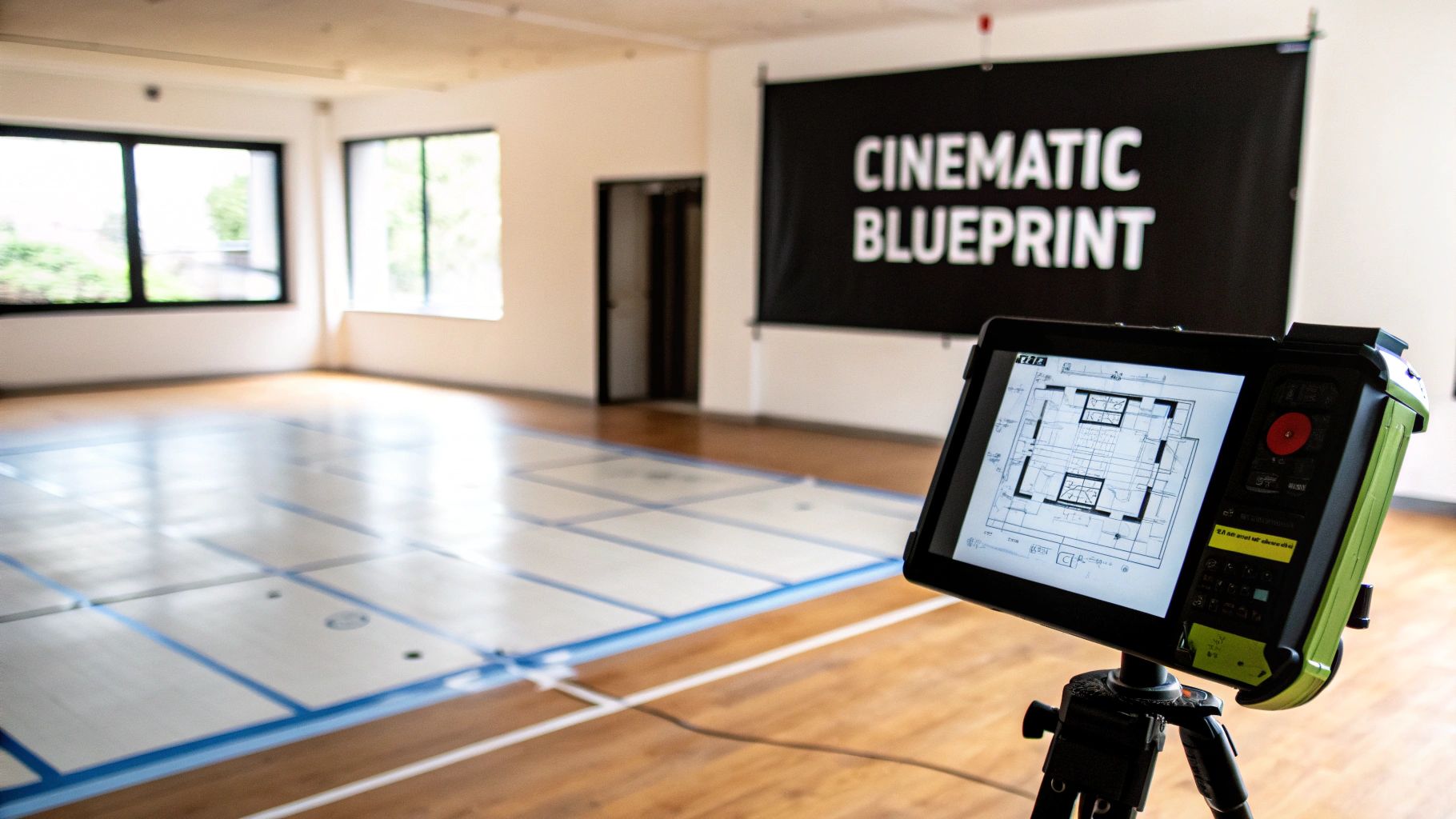
Got your room’s stats? Great. Now it's time to sketch out a layout. The absolute heart of your setup is the relationship between your screen and your seating. Nailing this down is priority one. A great starting point is calculating the best placement for your sofa and television.
Your goal is simple: make sure every seat has a great view without causing neck strain.
This simple three-step process—room selection, layout, and light control—is the bedrock of any amazing home theater.
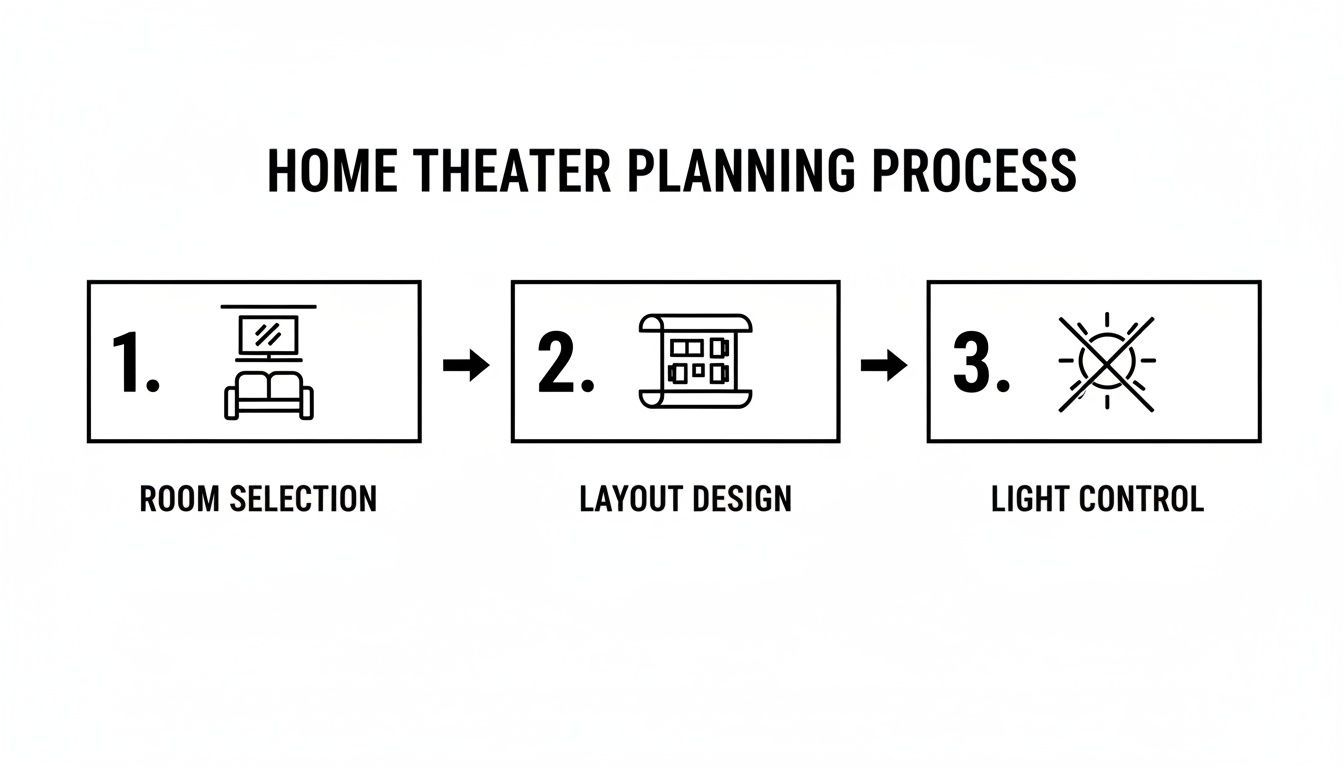
Get these fundamentals right, and you're well on your way.
Sunlight is the mortal enemy of a great picture. Any stray light from windows, hallways, or even reflections off a white wall will wash out your screen, killing the contrast and making colors look faded. This is a massive issue for projectors, which just can't compete with bright light.
The aim is to create a "light-controlled" room. This doesn't mean you need a pitch-black cave 24/7, but you must have the power to kill the lights when it's showtime.
Here are a few ways to win the war against light:
While projectors are notoriously sensitive to light, modern displays have come a long way. A purpose-built LED video wall for sale can pump out incredible brightness and contrast, making it a fantastic choice for rooms where you can't get perfect darkness.
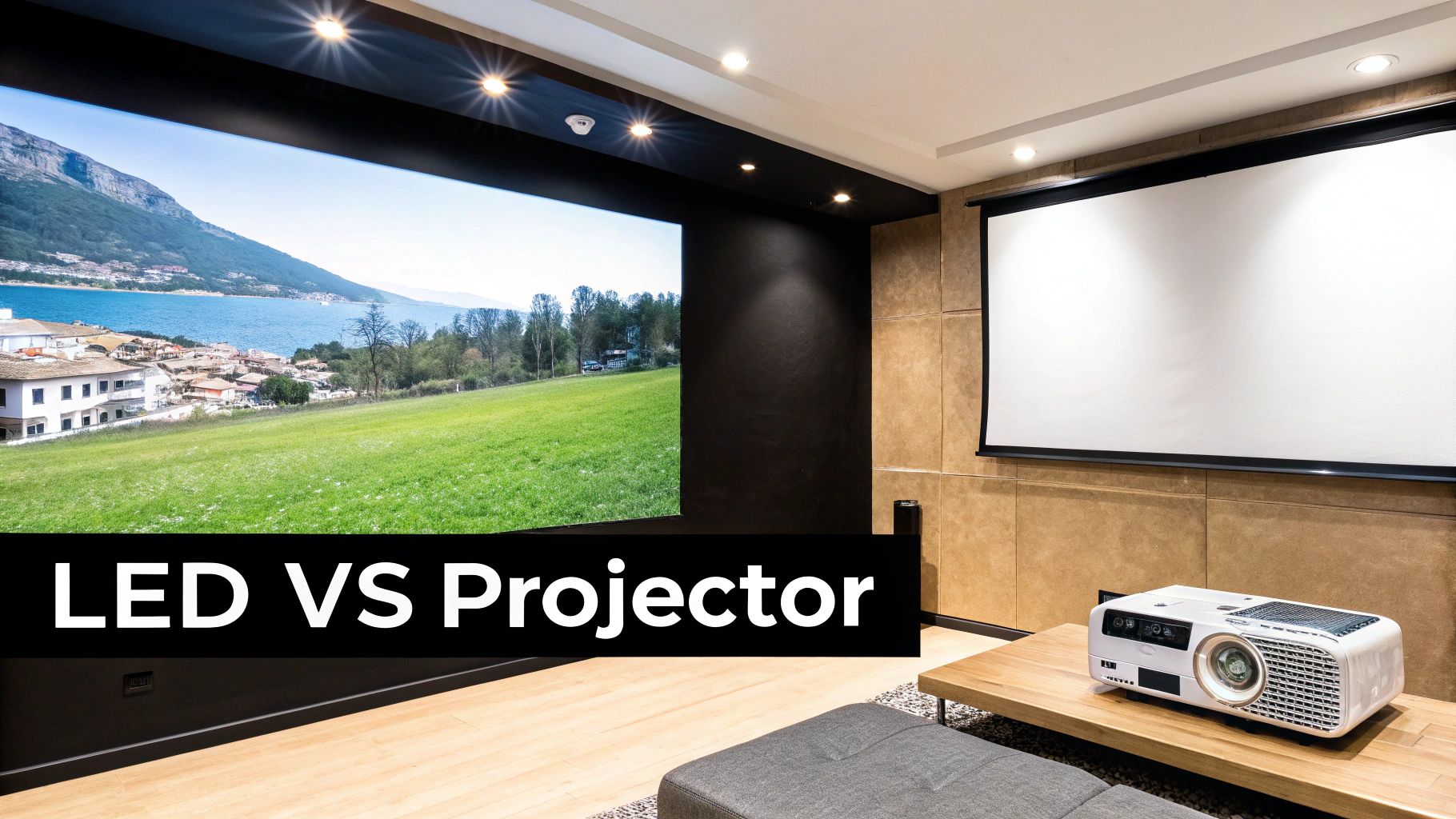
Alright, you've mapped out the room. Now for the fun part—picking the screen. This is the heart and soul of your theater, the visual anchor for every movie night, big game, and gaming session. For decades, projectors were the undisputed kings of the big screen, but a seriously powerful new player has stepped into the ring: the direct-view LED video wall.
This choice goes way beyond just screen size. We're talking about how the picture holds up when someone opens the door, its performance years down the line, and the raw, immersive experience it delivers. While projectors can throw up a massive image, they have some baked-in limitations that a modern LED screen just doesn't.
For years, if you wanted a screen bigger than 100 inches, a projector was pretty much your only move. A good 4K projector can look stunningly sharp and cinematic, but here's the catch: its performance is completely at the mercy of the room. It works by throwing light across a room onto a screen, which means any other light is its mortal enemy.
Even a sliver of light from the hallway can wash out the picture, crushing your contrast and turning deep blacks into murky grays. To get that punchy, vibrant image projectors are famous for, you need a pitch-black, cave-like environment. No compromises.
On top of that, projectors have some real-world quirks that the spec sheets don't always advertise:
Direct-view LED video walls are a total paradigm shift. Instead of projecting light onto a screen, these displays are the light source. Built from perfectly seamless modular panels, they create one massive, cohesive screen that generates an incredibly bright and dynamic image all on its own. This is a game-changer.
Because an LED wall makes its own light, it couldn't care less about a little ambient light in the room. You can enjoy a brilliant, high-contrast HDR image with the lights dimmed for guests, making it ideal for multi-purpose media rooms where a dark cave isn't always practical. The brightness and contrast are just on another planet compared to projection.
The magic of an LED video wall is its ability to hit perfect, inky blacks and blindingly bright highlights at the same time. This creates a level of dynamic range that makes HDR content look exactly how the director wanted you to see it—something even the best projectors can only dream of.
This is the same tech that lights up Times Square, but refined and perfected for your home. You can see how this technology is being adapted for stunning residential installs with these Smart LED indoor LED wall panels. The result is a true "wall of picture," where the image seems to float in the room with no bezel or frame to break the illusion.
When you build a home theater, you're investing in an experience. Let's put these two technologies head-to-head on the features that truly matter for a premium viewing experience.
| Feature | LED Video Wall (e.g., Smart LED Inc.) | High-End 4K Projector |
|---|---|---|
| Brightness & Contrast | Exceptional, with true blacks and searing HDR highlights. Performs well even in rooms with some ambient light. | Good, but highly dependent on a completely dark room. Contrast suffers significantly with any stray light. |
| Color Performance | Can achieve wider color gamuts like DCI-P3 for incredibly rich, accurate colors that pop off the screen. | Very good color, but brightness limitations can affect the perceived vibrancy and saturation. |
| Lifespan & Reliability | Extremely long lifespan (up to 100,000 hours) with consistent performance and no color or brightness degradation. | Bulb life is limited (2,000-5,000 hours for lamp-based models) and performance degrades over time. |
| Installation & Form | Creates a completely seamless, bezel-free image. Requires professional installation for perfect alignment. | Requires careful positioning, screen mounting, and calibration. The projector itself takes up space. |
| Operational Noise | Completely silent operation as there are no fans or moving parts in the screen itself. | Fan noise can be audible, especially during quiet movie moments, depending on the model and placement. |
At the end of the day, while a projector is still a solid choice for a dedicated, blacked-out theater room on a specific budget, an LED video wall offers a more powerful, versatile, and future-proof foundation for your system. The unrivaled brightness, contrast, and longevity make it the clear winner for anyone looking to build the ultimate home theater without compromise.
A stunning visual centerpiece is only half the story. To truly build a home theater that rivals a commercial cinema, the audio has to be just as captivating. A well-designed soundstage doesn't just let you hear the movie; it places you directly inside it.
We're talking about creating a three-dimensional bubble of sound that's so convincing, you'll forget you're on your couch.
This is where your audio components and your room’s natural acoustics come together. It's less about buying the most expensive gear and more about creating a symbiotic relationship between your equipment and the space itself. When you get it right, every line of dialogue is crystal clear, and every explosion feels like it's shaking the room.
The foundation of modern cinema sound is object-based audio, with Dolby Atmos leading the charge. This isn't your old-school 5.1 or 7.1 surround sound that just assigns audio to specific speakers. Dolby Atmos treats sounds as individual "objects," which lets sound engineers place and move effects anywhere in a 3D space with unbelievable precision.
Think of it this way: in a standard 7.1 system, a helicopter flying overhead is faked by sending audio to your surround speakers. In an Atmos system, that helicopter is a distinct sound object that can be moved with pinpoint accuracy over your head, creating a far more realistic and immersive effect.
So, how do you get that overhead sound? An Atmos setup adds height channels to a traditional layout. There are two main ways to do this:
A fantastic and common Atmos configuration is 7.1.4. This means seven traditional surround speakers, one subwoofer, and four height channels. A setup like this creates a complete dome of sound that wraps around you.
Your Audio-Video (AV) receiver is the central hub of your home theater. It's the traffic cop that takes in all your video and audio sources, decodes the complex sound formats, and sends the right amount of power to each speaker. Choosing the right one is absolutely crucial.
Don't just look at the wattage numbers. You need to make sure the receiver can process the formats you want (like Dolby Atmos and DTS:X) and has enough channels to power all your speakers. For a 7.1.4 system, you'll need a receiver capable of powering 11 channels.
Pro Tip: Look for a receiver with high-quality room correction software, like Audyssey or Dirac Live. This tech uses a microphone to analyze your room's unique acoustic quirks and automatically adjusts each speaker's output to compensate. It’s a game-changer for delivering a much more balanced and accurate sound.
This is the part so many people overlook, but it's arguably the single most important element in achieving great sound. You can have the best speakers in the world, but if your room has poor acoustics, the sound will be a muddy, echoing mess. Sound waves from your speakers bounce off hard surfaces like drywall, windows, and bare floors, creating chaos.
The goal here is to manage these reflections. To truly craft an immersive soundstage, the choice of flooring is paramount. Materials that absorb sound, like a low pile carpet for better acoustics, can significantly reduce echo and improve audio clarity.
Beyond flooring, two key tools will completely transform your room's sound:
By strategically placing these treatments, you're not just decorating; you're fine-tuning the room itself, making it an integral part of your high-performance audio system. This is the real secret to achieving that clean, professional sound you hear in a proper cinema.
You could have the most incredible audio and visual gear money can buy, but if the room itself is uncomfortable or full of distractions, the magic is lost. Once you’ve dialed in your screen and sound, it's time to perfect the atmosphere. This is the crucial step where you transform a room full of great tech into a genuine cinematic escape.
So often, seating and lighting are treated as afterthoughts, but they are absolutely essential. Getting these two elements right makes all the difference, ensuring total comfort for marathon movie nights and crafting a mood that pulls you deep into the story. A truly exceptional home theater build gives just as much attention to the human experience as it does to the technical specs.
The right seating is about so much more than just being comfortable—it's about sightlines and acoustics. Every single seat in the house needs an unobstructed view of the screen, and its placement directly impacts how each person hears the surround sound mix. A poorly planned layout can easily ruin the experience for half your guests.
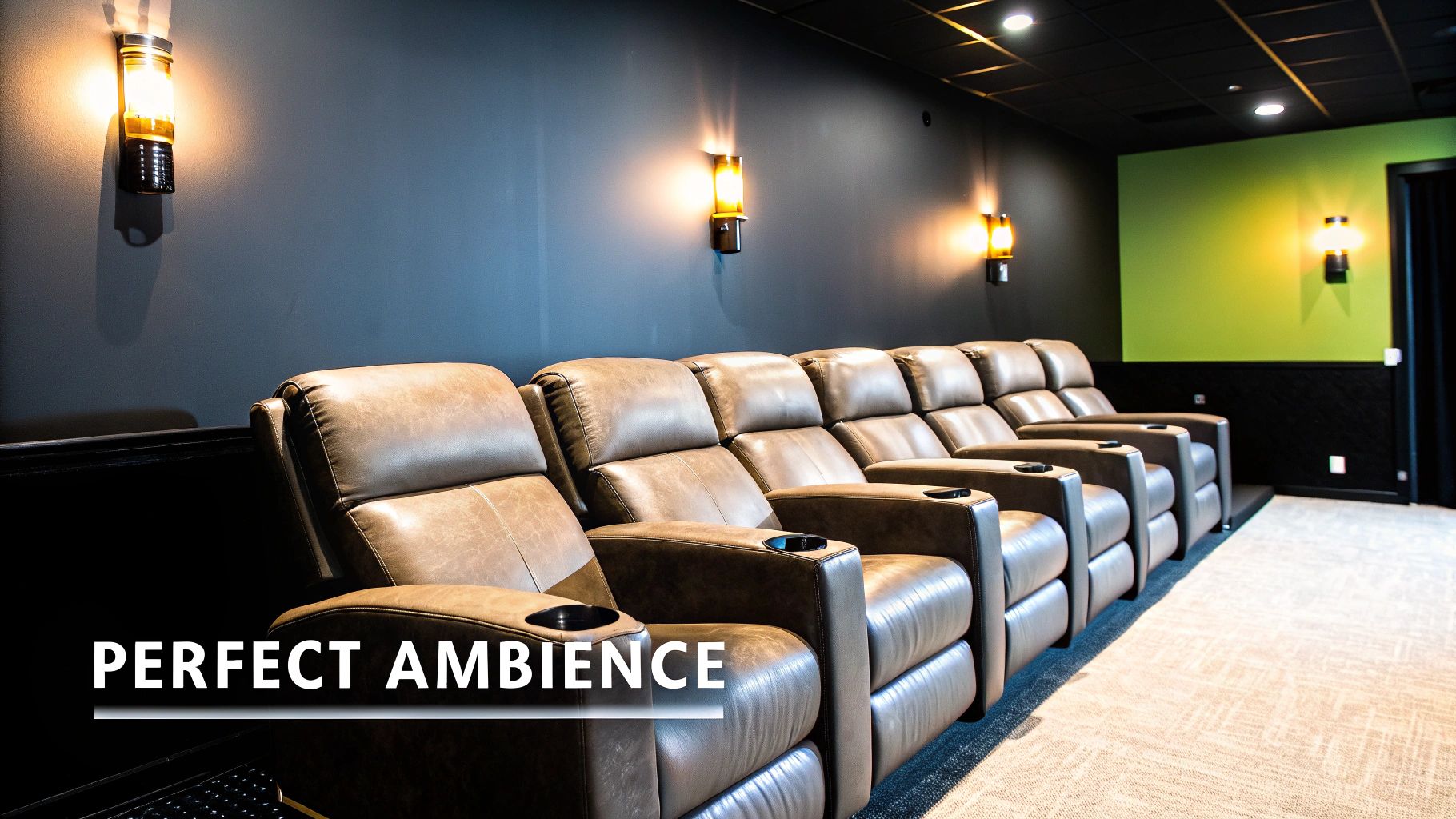
First things first, what kind of seating are you going for? Dedicated theater recliners, complete with cup holders and plush upholstery, are the classic choice. They scream "cinema" and offer incredible individual comfort. On the other hand, if your space doubles as a multi-purpose media room, a big, cozy sectional sofa might be a more practical fit, creating a more social and relaxed viewing environment.
Once you know the style, placement becomes everything.
The real goal here is to make the "sweet spot" as massive as possible. You want every single viewer to get the full impact of both the stunning visuals and the carefully calibrated soundstage you've worked so hard to create.
Lighting is one of your most powerful tools for setting a mood, but it’s also one of the biggest culprits for screen glare and distractions. The secret is to think in layers. By using multiple light sources that you can control independently, you can create the perfect ambiance for any situation.
Forget that one harsh, central overhead light. A proper home theater lighting plan uses several different types of fixtures to nail both function and style. Your number one priority is to eliminate any light that shines directly on the screen or into the viewers' eyes.
Here’s how you can build a layered lighting strategy:
The final touch is to tie all of this into a single smart lighting system. The ability to hit one button on a remote or say a voice command to dim the sconces, kill the main lights, and bring up the accents is what elevates a media room from good to truly great. It’s that effortless, custom-tailored feeling that completes the entire experience.
The breathtaking visuals and heart-pounding audio are the stars of the show, but let's be honest: the real magic of a high-end home theater is how effortlessly it all works. The unseen infrastructure—the wiring, power, and control systems—is what separates a pile of expensive components from a truly seamless cinematic experience.
This is the part that allows you to dim the lights, fire up the screen, and start the movie with a single touch. It’s about creating an intuitive, reliable setup where the technology just disappears, letting you get lost in the film instead of fumbling with a half-dozen remotes. This is the final layer that completes your mission to build a home theater that feels both professional and personal.
A visible mess of cables is the quickest way to ruin the clean, immersive aesthetic you've worked so hard to create. You absolutely have to plan your wiring strategy from the very beginning to get that polished, professional look where all the connections are neatly tucked away.
Before you even think about drywall, consider running conduits. These plastic or metal tubes get installed within your walls and provide a clean pathway for all your low-voltage cables, like HDMI and speaker wire. This not only hides them completely but also makes it a thousand times easier to upgrade cables in the future without tearing open your walls again.
Think about the entire signal path for every single component:
Your home theater equipment represents a significant investment, and it's also incredibly sensitive to the electrical chaos happening in your home. Plugging thousands of dollars of gear into a standard wall outlet that shares a circuit with your vacuum cleaner is just asking for trouble.
A dedicated electrical circuit for your home theater is non-negotiable. This means running a new, separate line directly from your home's main breaker panel to your equipment rack. This simple step isolates your sensitive electronics from the "electrical noise" generated by other appliances, which can absolutely degrade your audio and video performance.
A dedicated circuit isn’t just about performance; it’s about protection. It ensures your system has consistent, clean power, preventing issues like dimming lights during loud scenes and protecting your gear from potentially damaging power surges.
Beyond the dedicated circuit, a high-quality power conditioner or surge protector is your final line of defense. This device filters the incoming power, smooths out voltage irregularities, and provides robust protection against catastrophic surges. It’s the peace of mind you need when you've invested so much in your setup.
The final piece of the puzzle is bringing all your different components under one simple, unified control system. The goal is to banish that coffee table clutter of remotes and create a true one-touch experience.
Universal remotes have come a long way. Modern smart remotes from brands like Logitech Harmony or Control4 can be programmed to execute complex commands, or "macros." For example, a single "Movie" button can turn on your display, power up your AV receiver, select the correct inputs, and dim your smart lights all at once.
This is the kind of integration that makes a home theater feel truly luxurious and easy enough for everyone in the family to use. Exploring options like the various smart indoor LED wall screen kits available can often reveal built-in compatibility with these major control systems, which simplifies the whole process.
And if you want to take it one step further, smart home platforms like Amazon Alexa or Google Assistant can add another layer of convenience. Imagine starting movie night with a simple voice command. This cohesive control is what turns a good setup into a truly amazing one.
Building a home theater is an incredible journey, but it's one that often starts with a lot of questions. We get it. From figuring out the right room dimensions and setting a realistic budget to the nitty-gritty of acoustics and installation, getting good answers upfront is the key to avoiding costly mistakes later on.
Let's walk through some of the most common questions we hear from people just like you who are ready to build their dream cinema. Sorting these out first will give you a solid foundation for your project, ensuring every decision you make aligns with your vision.
There's no single "perfect" size, but a good rule of thumb is to start with a room that's at least 15 feet long and 10 feet wide. This gives you enough breathing room for comfortable seating and proper viewing distances for a truly cinematic screen.
Interestingly, rectangular rooms are almost always better than square ones. Square rooms can be an acoustic nightmare, creating weird sound reflections that muddy the audio. The goal is to have enough length to sit at the right distance from the screen and enough width to get proper separation between your front speakers. That separation is what creates that wide, immersive soundstage that pulls you into the action.
The good news? Modern displays like LED video walls give you way more flexibility. Their incredible brightness and scalability mean they look fantastic in all sorts of room sizes and lighting conditions, something projectors often struggle with.
This is the big one, isn't it? Home theater budgets can swing wildly, from a few thousand dollars for a great starter setup to well into the six figures for a cost-is-no-object experience. It all comes down to what you want to achieve.
As a general guideline, a balanced budget looks something like this: allocate about 40% for your display, 30% for audio and acoustics, 15% for seating and comfort, and the remaining 15% for wiring, control, and professional installation.
I love the DIY spirit, but installing a home theater LED video wall is a completely different beast than hanging a TV. This is one job you absolutely want to leave to the professionals.
These displays are built from multiple, precision-engineered panels that have to be aligned perfectly to create that seamless, single-canvas image. Any tiny misalignment, and the illusion is shattered.
A professional installer has the specialized tools, training, and experience to handle the complex mounting, power grid, and signal wiring. Most importantly, they perform the final, critical calibration to ensure the color and brightness are perfectly uniform across every single panel. That final step is what makes your investment truly shine.
In a word: absolutely. If you want a true, immersive cinema experience, you can't skip acoustic treatment.
Think about it—your typical room is full of hard, flat surfaces. Drywall, windows, and hardwood floors act like mirrors for sound waves, bouncing them all over the place. This creates echo and reverb that muddies dialogue and makes your surround sound feel chaotic and imprecise.
Acoustic panels are engineered to absorb those reflections, especially at the "first reflection points" on your side walls and ceiling. Just adding a few panels can make a night-and-day difference, clarifying dialogue and making sound effects pop with pinpoint accuracy. Add some bass traps in the corners to tame boomy, uncontrolled bass, and you've suddenly unlocked the true potential of your speakers.
Acoustic treatment isn't an optional accessory; it's what lets your expensive audio gear perform the way it was designed to.
Ready to explore the ultimate visual foundation for your home theater? The team at Smart LED Inc. can help you design a stunning, seamless LED video wall tailored to your exact space and vision. Get a personalized consultation today and see what’s possible.
Picture this: you take the flash and spectacle of a Times Square billboard, slap it on the back of a truck, and send it wherever
A wall of TV screens is exactly what it sounds like: a big, impressive display made by tiling multiple TVs together so they act like

Picking the right displays for shows can feel like a high-stakes guessing game. Get it right, and you create an immersive world that captivates your
"*" indicates required fields