
Uncategorized
Digital Billboard Truck: Boost Your Campaign with Mobile Ads
Picture this: you take the flash and spectacle of a Times Square billboard, slap it on the back of a truck, and send it wherever
Forget everything you know about big TVs. A video wall display isn't just one giant screen—it's more like a digital mosaic, built from multiple individual displays that are perfectly synchronized to work as one.
The result? A single, massive, and seamless visual canvas that commands attention in a way no ordinary screen ever could.
At its core, a video wall is a system of multiple displays—often called "tiles" or "panels"—arranged together in a grid. These tiles are connected to a central processor that intelligently slices a single image or video across the entire canvas, making it all look like one cohesive picture.
Think of it like building a mural with small, square tiles. Each tile is just one piece of the puzzle, but when you put them all together, they create a stunning, large-scale image. A video wall works on the same principle, but its tiles are dynamic, living screens. This modular approach is its secret weapon, giving you a level of creative flexibility and scale that a single large-format display just can't touch.
The stunning visuals you see on these digital canvases are brought to life by two primary technologies, each with its own unique strengths.
Let's quickly compare the two to see where they shine.
| Technology Type | Best For | Key Advantage |
|---|---|---|
| LCD | Indoor environments with close viewing, like control rooms and corporate boardrooms. | Ultra-sharp detail and cost-effectiveness for high-resolution needs. |
| LED | Large-scale, seamless applications like billboards, concert stages, and retail. | Completely bezel-free design creates a truly continuous and immersive visual canvas. |
At the end of the day, LCDs are fantastic for clarity up close, while LEDs are the undisputed champions for creating massive, seamless, and jaw-dropping visual experiences.
The real value of a video wall display isn't just its size; it's about its power as a communication tool. These systems don't just show content—they create atmospheres, tell brand stories, and deliver information with an authority that static signs can only dream of.
The real magic of this technology is its power to completely transform a physical space. It’s the difference between showing a picture and creating an entire world.
This isn't just a niche trend; it's a rapidly growing market. The global video wall market was valued at a whopping USD 10.23 billion in 2024 and is on track to hit USD 11.71 billion in 2025. With a projected compound annual growth rate of 11.7% through 2030, the demand is exploding.
If you're curious about what's fueling this growth, you can dive into the full market analysis of video wall growth drivers on GrandViewResearch.com. It’s clear that sectors like retail, transportation, and entertainment have realized that making a bold visual statement isn't just a nice-to-have—it's essential for success.
Picking the right technology for your video wall is the single most important decision you’ll make. It’s a choice that will define everything—performance, appearance, and your budget. This isn't just about picking a screen; it's about matching the tech's core strengths to your vision and the environment it will live in.
The debate boils down to two incredible but very different technologies: Light Emitting Diode (LED) and Liquid Crystal Display (LCD).
Think of it like this: an LCD video wall is a grid of perfectly aligned, high-definition windows. The ultra-thin lines between each window—the bezels—are there, but they’re so small they’re almost unnoticeable. This makes them a fantastic choice for controlled indoor spaces where every tiny detail matters, like a corporate boardroom or a mission-critical control room.
Now, imagine an LED video wall as a single, seamless tapestry woven from pure light. No lines, no gaps—just one continuous, stunningly vibrant image. Because they create their own light, LEDs can outshine direct sunlight, making them the undisputed champion for massive outdoor billboards, bright retail stores, and jaw-dropping event stages.
The most obvious difference you'll see between an LCD and an LED wall is the bezel. LCD panels are individual monitors pieced together, and no matter how thin manufacturers make the borders, a faint grid will always exist where the screens meet. Modern "narrow bezel" tech has shrunk these lines to just a few millimeters, but up close, they're still visible.
In contrast, direct-view LED technology is seamless by design. The display is built from smaller modules that click together perfectly, allowing the image to flow from one edge to the next without a single break. This creates a completely uninterrupted canvas, which is non-negotiable for applications where even the slightest visual distraction is a deal-breaker.
If your goal is a single, massive, uninterrupted image that feels like one cohesive screen, LED is the only technology that delivers a truly seamless experience.
Where your video wall will live is a huge factor. An indoor office with controlled lighting has completely different needs than an outdoor stadium or a sun-drenched airport terminal. This is where brightness, measured in nits, becomes the ultimate tie-breaker.
If your display has to compete with bright ambient light or the sun itself, the high-nit power of an LED video wall isn't a feature—it's a necessity.
To make things even simpler, this decision tree can walk you through the key questions. It's all about seamlessness, lighting, and your need for indoor detail.
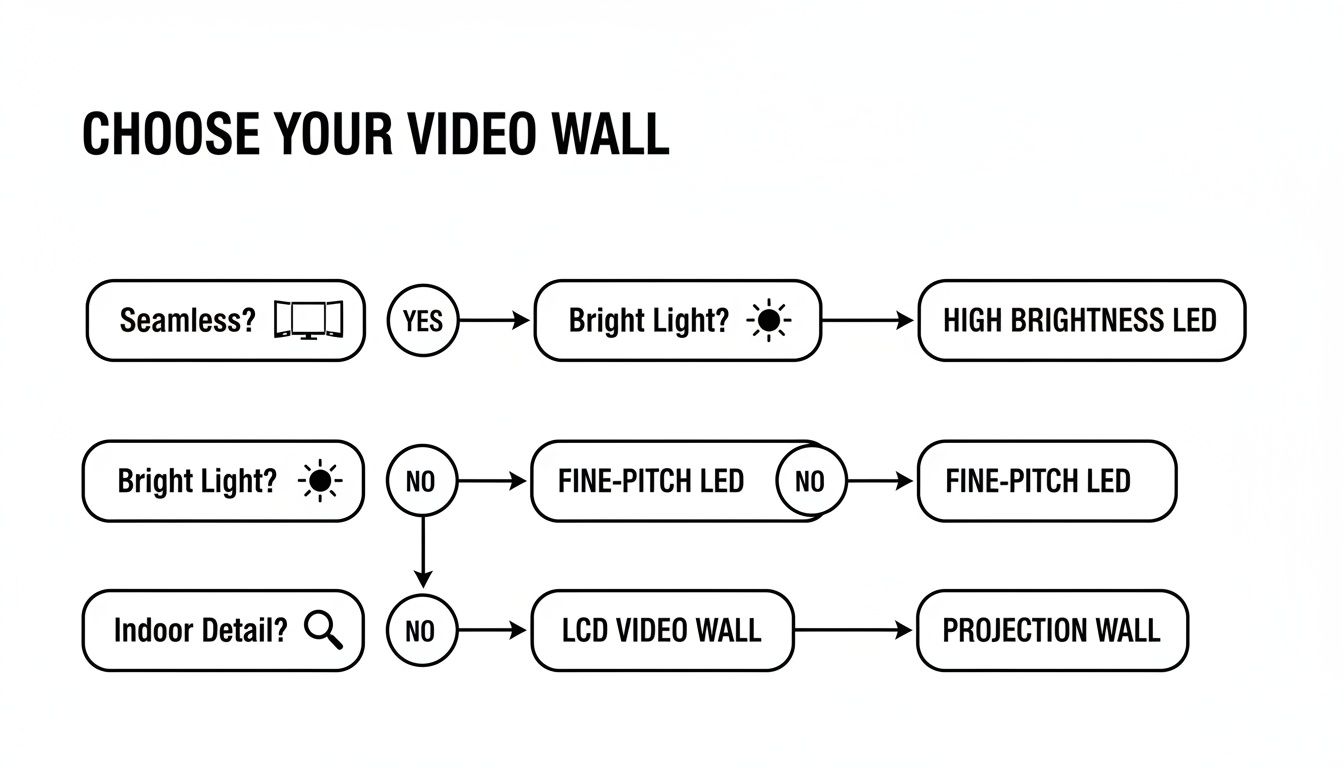
As you can see, if a completely seamless image is your top priority or if the display will be fighting bright light, the path leads straight to LED.
Ultimately, it comes down to what matters most for your project. If you're on a tighter budget and need ultra-high resolution for close-up viewing in a controlled indoor space, an LCD video wall is a powerful and cost-effective choice. You’ll get incredible detail right where it counts.
However, if your vision demands an immersive, totally seamless experience, or if your display has to perform flawlessly in a bright environment, an LED video wall is the clear winner. Its modular design, unbeatable brightness, and bezel-free surface offer a level of creative freedom and visual punch that LCDs simply can’t match.
Stepping into the world of video wall displays can feel a bit like learning a new language. You're hit with a barrage of acronyms, numbers, and technical jargon on every spec sheet. But here's the secret: understanding a few key terms is all it takes to go from confused to confident and find the perfect screen for your vision.
Let's break down what actually matters so you know exactly what you're buying.
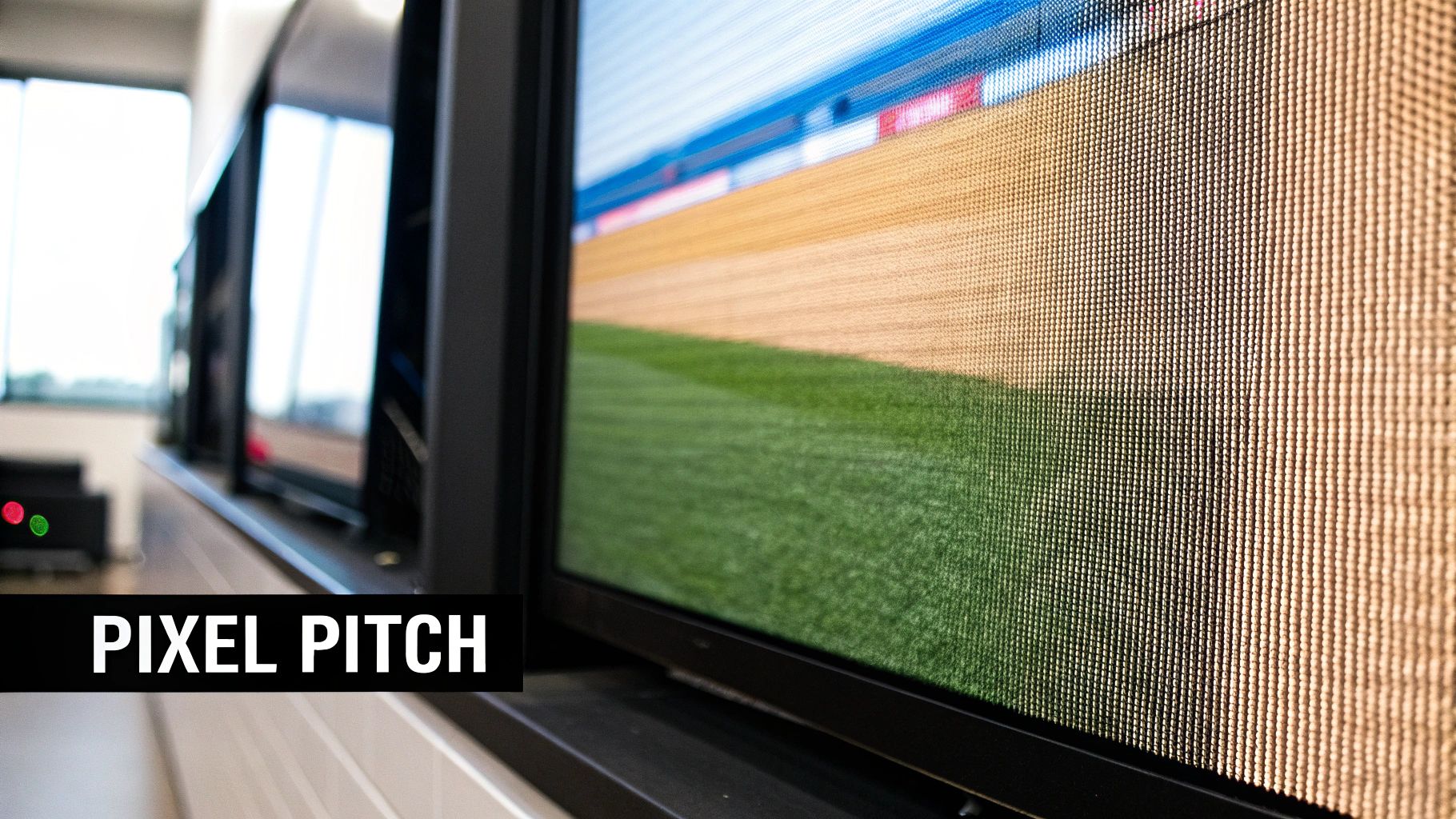
If there's one spec to understand, it's pixel pitch. All it means is the distance, in millimeters, from the center of one pixel to the center of the next one. The smaller the number, the closer the pixels are packed together, which creates a denser and more detailed image.
Think of it like the thread count on high-end sheets. From across the room, any fabric looks solid. But get right up close, and you can see the individual threads. A tighter weave—or a smaller pixel pitch—gives you a much sharper, smoother image when you're viewing it from nearby.
The right pixel pitch for your project boils down to one simple question: how far away will people be standing? A massive screen in a stadium can get away with a larger pixel pitch because, from hundreds of feet away, the human eye can't resolve that fine detail anyway.
But for a display in a retail store where customers are just a few feet away, a small pixel pitch is a must-have. Without it, the image looks blocky and "pixelated," completely shattering the immersive experience you're trying to create. It's this need for close-up clarity that has made indoor LED video walls so popular in shops, corporate lobbies, and event venues.
This boom in adoption has driven some serious market growth. The LED video walls market saw strong momentum in 2024 and is on track for healthy expansion all the way through 2034.
Key Takeaway: The perfect pixel pitch is a trade-off between viewing distance and budget. The closer your audience, the smaller (and yes, more expensive) your pixel pitch needs to be to deliver that crisp, clean image.
Getting this right ensures your investment makes the impact you intended. You can get a better feel for this by checking out the different types of LED signs for businesses to see how pixel pitch plays out in the real world.
Beyond pixel pitch, a few other numbers on that spec sheet make a huge difference in visual performance. These specs all work together to define how vivid, clear, and smooth your content will look.
To make things easier, here's a quick cheat sheet breaking down the most important video wall specifications.
| Specification | What It Means | Why It Matters |
|---|---|---|
| Brightness (Nits) | How much light the screen emits. 1 nit is about the brightness of one candle. | Crucial for visibility. An indoor screen might only need 500-800 nits, but an outdoor sign battling direct sunlight needs 5,000+ nits to not look washed out. |
| Resolution | The total number of pixels on the screen, like 1920×1080 (Full HD) or 3840×2160 (4K). | This determines the overall detail and clarity of the image. More pixels mean a sharper picture, which is essential for displaying complex graphics or fine text. |
| Refresh Rate (Hz) | How many times per second the screen updates the image. | Higher is better for motion. 60Hz is fine for static images, but for fast-action sports or video, you'll want 120Hz or more to avoid motion blur and get that buttery-smooth look. |
| Color Gamut | The range of colors the display can reproduce. | A wider gamut (like DCI-P3 or Rec. 2020) means richer, more vibrant, and more accurate colors. This is vital for brand consistency and creating lifelike visuals. |
These specs don't work in isolation—they're all part of a larger system. The ultimate performance of your video wall is completely tied to the underlying robust network infrastructure that feeds it content. A stunning 4K, 120Hz display is useless without a powerful backbone to deliver the data seamlessly.
By getting a handle on these core specs, you can look at any video wall and know exactly how it will perform in your space.
Okay, we’ve covered the tech specs—the nuts and bolts of what makes a video wall tick. But let's be honest, the real magic happens when you see them out in the wild, solving problems and creating experiences you can't forget. This is where we move from theory to reality. These aren't just giant screens; they are powerful tools that completely reshape how we interact with a space.
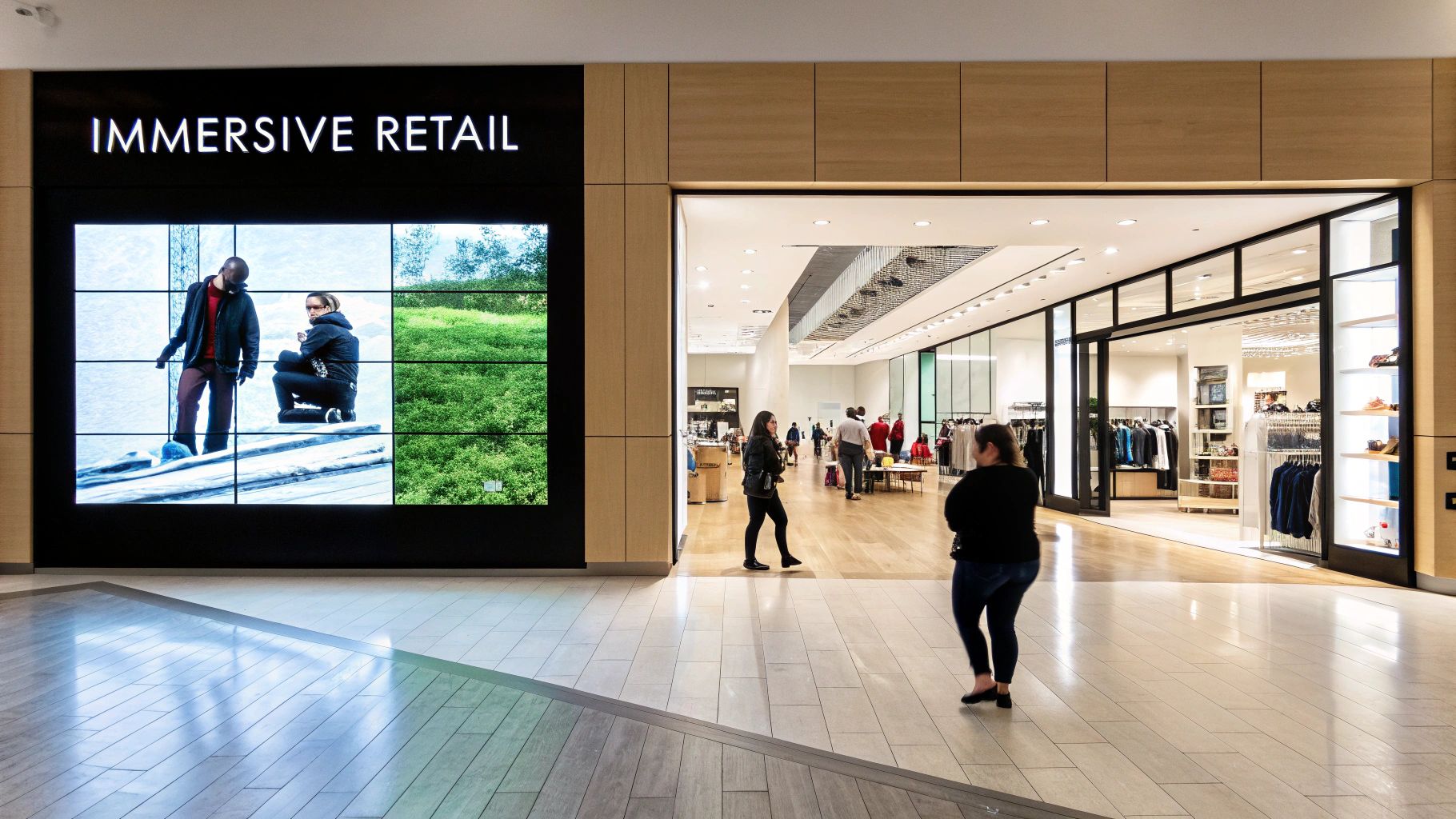
A video wall turns a passive, blank wall into an active asset. It grabs attention, communicates with undeniable authority, and elevates the entire purpose of a location, whether it’s a packed retail store or a high-stakes command center.
In the hyper-competitive world of retail, a video wall isn't just a feature; it's a showstopper. Picture a flagship clothing store where the entire back wall is a floor-to-ceiling LED canvas. It’s not just cycling through static ads—it’s live-streaming a runway show from Paris, building an atmosphere of high fashion and exclusivity that literally stops people in their tracks.
This kind of dynamic content does more than just decorate. It builds a brand world. It can shift with the seasons, spotlight new arrivals, and tell a story that makes a product feel like a must-have experience. The same idea applies to large-scale advertising, but on an even bigger stage.
A well-placed video wall transforms advertising from a passive message into an environmental feature. It becomes part of the architecture, engaging audiences in a way traditional billboards simply cannot.
This is especially true for outdoor signs. The sheer brightness of modern LED technology allows for massive, brilliant displays that are impossible to ignore, even in direct sunlight. These platforms have become absolutely essential for anyone serious about making an impact with digital outdoor signage.
The modern boardroom is no longer just a place for meetings; it’s a data-fueled decision center. In this setting, a high-resolution video wall completely outclasses a traditional projector. It turns dense spreadsheets and complex charts into a clear, compelling story that everyone in the room can actually see and grasp.
Think about a quarterly review where the finance team is presenting market trends. On a massive, seamless screen, they can display multiple data streams at once—stock performance, regional sales figures, competitor analysis—all perfectly crisp and visible from every seat. A dry presentation is suddenly an interactive, collaborative session where insights are sparked in real time.
This application really shines a light on several key benefits:
In environments where every second counts, information is everything. We're talking about a city’s traffic management center, a utility’s network operations hub, or a public safety dispatch. In these high-stakes settings, operators need to monitor dozens of live video feeds and data streams at the same time.
A video wall is the perfect solution: a single, unified command center. It provides a huge digital canvas where operators can see the big picture at a glance while still being able to zoom in on specific incidents. The incredible reliability and long operational hours of commercial-grade displays mean they can run 24/7 without a hiccup.
From concert stages to hotel lobbies, video walls are all about creating an atmosphere and amplifying the experience. At a music festival, they become breathtaking backdrops that sync with the performance, creating an immersive sensory overload for thousands.
In a hotel, a beautifully integrated video wall can display stunning digital art or provide useful guest information, elevating the experience from the moment someone walks in. When planning for public spaces like these, understanding broader hospitality technology trends can help shape a video wall strategy that truly connects with people.
When you're thinking about a video wall, it's easy to get fixated on the initial price tag. But that's only part of the story. A truly smart investment looks beyond the day-one cost to understand the Total Cost of Ownership (TCO), which gives you a far more realistic picture of what you're signing up for.
Think of it like buying a car. The sticker price is just where the conversation starts. You still have to factor in insurance, gas, and regular maintenance to know what it really costs to own. A video wall is exactly the same. The TCO covers not just the display panels, but all the other critical pieces that keep it running beautifully for years to come.
Beyond the screen itself, your budget needs to account for a few key items. Each one is essential to the performance and longevity of your video wall.
The market already shows clear trends. Indoor LED video walls are expected to hold a 56.32% revenue share in 2025, driven by huge demand in retail, airports, and corporate lobbies. At the same time, outdoor installations are poised for the fastest growth, which just goes to show how many new uses people are finding for this tech. You can see more insights about the LED video wall market growth on GlobalNewsWire.com.
The real value of a video wall isn't just a number on a spreadsheet—it's about the impact it creates. When you shift your thinking from pure cost to Return on Investment (ROI), the purchase becomes a strategic asset instead of just another expense. While direct revenue is one way to measure success, many of the most powerful returns aren't measured in dollars.
A video wall is an investment in experience. Its success is measured not just in dollars, but in attention captured, perceptions shaped, and operations improved.
Figuring out your ROI means looking at both the tangible and the intangible wins. For a deeper dive into the numbers, this guide on the cost of outdoor LED signs is a great resource for understanding how different factors play into the final price.
To track your own success, start monitoring a few key performance indicators:
By defining what success looks like for your goals, you can clearly show just how much value your video wall brings to the table.
You’ve explored the technology, compared the specs, and envisioned the possibilities. Now, as you get closer to making a decision, the practical questions start bubbling up. This is where the rubber meets the road.
Let’s tackle some of the most common questions we hear from clients during the final planning stages. Getting clear, straightforward answers will give you the confidence to move forward.
This is one of the first questions any smart buyer asks: "How long is this thing actually going to last?" The good news is that commercial-grade video walls are built like tanks, engineered for endurance far beyond any consumer TV. But the true lifespan really depends on the technology you choose and how you use it.
Commercial LCD panels are typically rated for 50,000 to 60,000 hours of operation. To put that into perspective, that’s more than five straight years of running 24/7. LED displays take it to another level, with many models boasting an impressive 100,000-hour rating.
It's crucial to understand what "lifespan" really means here. This rating doesn't mark the day the screen goes black. Instead, it’s the point when the display is expected to reach half of its original brightness.
Key Takeaway: A video wall's rated lifespan isn't an expiration date; it's a milestone on its journey to half-brightness. With a little care, its operational life can stretch well beyond these estimates, delivering value for years to come.
You can easily extend the life of your display with a few simple best practices:
While the DIY spirit is admirable, video wall installation is a job for certified professionals. Period. This isn't like mounting a TV in your living room; it's a highly specialized task that demands precision engineering to make sure every single panel aligns perfectly for a seamless, jaw-dropping final look.
A botched installation can cause a cascade of problems, from distracting grid lines between misaligned panels to electrical issues that can fry your expensive hardware. And perhaps the biggest risk? Going the DIY route will almost certainly void your warranty, leaving you completely on the hook if something goes wrong.
Maintenance, on the other hand, is a different story.
No matter the tech, a solid maintenance plan should always include routine software updates and professional color calibration to keep the visuals looking uniform and vibrant across the entire canvas.
Those stunning, dynamic visuals you see on a video wall are brought to life by a tag team of specialized hardware and user-friendly software.
The hardware piece of the puzzle is the video wall controller (or processor). Think of it as the brain of the entire operation. This powerful device takes all your inputs—a video file, a live TV feed, a complex data dashboard—and intelligently slices the image up, sending the exact right piece to each individual screen in the wall.
On the software side, you have the Content Management System (CMS). This is your command center, the platform where you become the director of your digital canvas. A good CMS lets you:
Modern CMS platforms are often cloud-based and built with intuitive, drag-and-drop interfaces, so your team doesn't need an IT degree to manage even the most complex display. Choosing the right CMS is every bit as important as picking the right screen.
This is a really common point of confusion, but they are fundamentally different beasts. While both give you a big picture, they're built on entirely different philosophies.
A Large Format Display (LFD) is a single, massive screen—basically a giant TV. They're a simple, all-in-one solution that works great for standard sizes like 85 or 98 inches.
A video wall display, on the other hand, is a modular system. It's built by tiling multiple smaller screens together to create a display of virtually any size, shape, or configuration you can dream up. This modularity is its superpower.
Here’s a quick rundown of the key differences:
| Feature | Large Format Display (LFD) | Video Wall Display |
|---|---|---|
| Construction | A single, monolithic screen. | Multiple panels tiled together. |
| Scalability | Limited to standard manufactured sizes. | Nearly infinite scalability in size and shape. |
| Brightness | Good for indoor use. | Superior brightness, especially with LED for outdoor use. |
| Creativity | Limited to a standard rectangular shape. | Can be configured in curves, columns, or abstract patterns. |
| Seamlessness | Perfectly seamless (one screen). | LED is seamless; LCD has thin bezels. |
An LFD is a great choice for a standard, no-fuss large screen. But if you're after unparalleled scale, show-stopping visual impact, and true creative freedom, a video wall is in a league of its own.
Ready to transform your space with a high-impact visual solution? The team at Smart LED Inc. provides factory-direct pricing on everything from immersive indoor video walls to powerful outdoor digital signs. Explore our solutions and get a quote today at smartledinc.com.
Picture this: you take the flash and spectacle of a Times Square billboard, slap it on the back of a truck, and send it wherever
A wall of TV screens is exactly what it sounds like: a big, impressive display made by tiling multiple TVs together so they act like

Picking the right displays for shows can feel like a high-stakes guessing game. Get it right, and you create an immersive world that captivates your
"*" indicates required fields

We have sent a 6-digit verification code to your email. Please enter it below to continue.