
Uncategorized
Digital Billboard Truck: Boost Your Campaign with Mobile Ads
Picture this: you take the flash and spectacle of a Times Square billboard, slap it on the back of a truck, and send it wherever
Measuring your advertising effectiveness is all about figuring out if your campaigns are actually making you money. It means looking past the flashy numbers like likes and impressions and digging into the data that shows your ad spend is a smart investment, not just another line item on the expense report.
We're talking about tracking core metrics like Return on Ad Spend (ROAS) and Customer Acquisition Cost (CAC) to see if your efforts are driving real, tangible business results.
Running ads without a solid measurement plan is like driving blindfolded. You're spending money, but you have no real idea if you're getting any closer to your goals. A data-driven approach is essential for justifying your budget and building a foundation for sustainable growth. It helps you shift from just 'spending' on ads to strategically 'investing' in outcomes you can actually track and improve upon.

This isn't just a hunch; the market backs it up. The global advertising effectiveness and ROI measurement market was valued at $4.6 billion in 2025 and is on track to hit an incredible $16.4 billion by 2034. That's not just growth—that's a clear signal that brands are getting serious about precise measurement.
Even better, top-performing advertisers have already seen their median profit ROI jump from 1.9:1 to 2.5:1 between 2017 and 2024. That’s a 32% improvement in just seven years, proving that what gets measured truly gets managed. You can dig into more of these numbers in this advertising effectiveness market report.
It's easy to get caught up in vanity metrics. Impressions, clicks, and social media likes can feel great, but they don't actually tell you if your ads are profitable. Real measurement focuses on the outcomes that directly impact your bottom line.
This guide is designed to help you cut through the noise of data overload and confusing attribution reports. We’ll get back to the basics and focus on the bedrock of any successful measurement strategy, including:
Getting a handle on these core metrics gives you the power to confidently answer the one question every stakeholder asks: "Are our ads actually working?" This clarity is what allows you to optimize campaigns, slash wasteful spending, and double down on what truly moves the needle.
Smart measurement isn't just for your digital campaigns. You can—and should—track the impact of your physical advertising, too. Think about the powerful messages you can display on LED signs for businesses.
Even something as traditional as a sign can be measured. By using unique QR codes, dedicated landing pages, or special in-store promotions mentioned only on the sign, you can directly attribute foot traffic and sales back to your outdoor advertising. This kind of holistic view ensures every single dollar in your marketing budget is held accountable.
You can't measure what you don't track. It's a simple truth, but one that gets overlooked all the time. Before you even touch a ROAS calculation or start debating attribution models, you have to build a reliable data ecosystem.
Think of it as laying the foundation for a house. If you get it wrong, everything you build on top of it will be unstable. This is your playbook for creating a clean, trustworthy source of truth from the ground up, making sure every dollar you spend is accounted for.
The first order of business is instrumentation—getting the right tracking tools in place. It's the wiring behind the walls. Without it, nothing works. Your main goal here is to accurately capture every important user interaction across all your digital properties.
This all starts with two absolute must-haves: tracking pixels and UTM parameters.
Tracking Pixels (Tags): These are little snippets of code you place on your website. You've heard of the Meta Pixel and the Google Ads tag—these are your workhorses. They track conversions, help you build powerful retargeting audiences, and let the ad platforms optimize for the outcomes you actually want. Pro tip: Always install these using Google Tag Manager. It keeps everything organized in one place and saves you from constantly bugging your developers to edit the site's code.
UTM Parameters: These are just simple tags you add to the end of your URLs, but their impact is massive. They tell your analytics platform exactly where your traffic is coming from. A consistent UTM strategy is the only thing that separates a click from a specific Facebook ad and a random click from an organic social post.
Without disciplined UTMs, your analytics reports will be a swamp of "direct" or "referral" traffic. You'll be flying blind, unable to give credit where it's due. Get this right from day one, and you’ll have crystal-clear data on what’s actually driving results.
Once your tracking is solid, it's time to define what "success" actually means for each channel. KPIs are not one-size-fits-all. The metrics that matter for a top-of-funnel awareness campaign are completely different from those for a bottom-of-funnel sales campaign.
For social media ads trying to build brand awareness, you'll be watching Reach and Video View-Through Rate. But for search ads designed to capture someone actively looking to buy, you’ll obsess over Click-Through Rate (CTR) and Cost Per Acquisition (CPA).
Key Takeaway: The single biggest mistake marketers make is applying bottom-of-funnel metrics (like sales) to top-of-funnel campaigns (like brand awareness). Match your KPIs to the campaign's objective to get a true reading of its performance.
This isn't just a minor issue; it's a huge industry-wide problem. Even with endless data, a shocking 86% of in-house marketers admit they can't effectively determine channel impact. A recent report on marketers' measurement struggles found that their top priorities are proving incremental ROI (67.4%) and tying marketing metrics to real business outcomes (66.3%). It all points back to the urgent need for a solid measurement foundation.
To help you get started, here's a breakdown of the most critical KPIs to watch across different channels, broken down by their role in the marketing funnel. This isn't an exhaustive list, but it's the core of what you should be tracking to get a clear picture of performance.
| Channel | Top-of-Funnel KPIs (Awareness) | Mid-Funnel KPIs (Consideration) | Bottom-of-Funnel KPIs (Conversion) |
|---|---|---|---|
| Social Media | Impressions, Reach, Video Views | Link Clicks, Engagement Rate, Landing Page Views | Conversions, CPA, ROAS |
| Search (PPC) | Impression Share, Impressions | CTR, Quality Score, Ad Engagement | Conversions, Conversion Rate, ROAS |
| Display Ads | Impressions, Reach, Viewability | Clicks, Website Visits | View-Through Conversions, CPA |
| Video (e.g., YouTube) | Views, View-Through Rate (VTR) | Clicks to Website, Subscribers Gained | Conversions, Sign-ups, ROAS |
| DOOH / LED Signage | Estimated Impressions, Foot Traffic | QR Code Scans, Website Visits (Geo-Lift) | Promo Code Redemptions, In-Store Sales Lift |
Focusing on the right KPIs for each stage of the journey ensures you're not judging a fish by its ability to climb a tree. It gives you an accurate, holistic view of how all your channels are working together to drive growth.
So, what about channels that don't have a "click"? I'm talking about things like Digital Out-of-Home (DOOH) and LED signage. The good news is that modern methods allow us to bring data-driven measurement into the physical world.
If you're investing in high-impact visual displays, you can absolutely still track their performance. Here are a few smart ways to do it:
Unique QR Codes: Put a QR code on your display that sends people to a specific landing page already tagged with UTMs. This creates a direct, trackable link between seeing your physical sign and taking a digital action.
Exclusive Promo Codes: Create a special discount code that's only available on the sign. When customers use that code to buy something online or in-store, you can directly attribute that sale back to your outdoor ad.
Geo-Fenced Lift Analysis: This is a bit more advanced, but incredibly powerful. You measure the increase in website traffic, app downloads, or even physical foot traffic from the specific geographic area where your sign is located. By comparing this to a similar "control" area without a sign, you can calculate the "lift" your ad generated.
Of course, any ROI calculation needs to factor in the initial investment. To better inform your budget and performance expectations, it helps to understand what goes into the outdoor LED sign cost. By combining these creative tracking tactics, you can hold even your physical advertising accountable for driving real, tangible results.
Attribution. It’s the part of advertising measurement that often feels like a puzzle, but it’s really just about giving credit where it's due. Think of it like reviewing the game tape after a big win. Was it the first pass, the final shot, or the assist in the middle that truly sealed the deal? The answer shapes your entire game plan for the next match.
https://www.youtube.com/embed/_orJeaD_Kms
In advertising, your attribution model is how you decide which touchpoints get the credit for a sale or lead. The model you pick has a huge impact on how you see your campaign's performance, influencing everything from where you put your budget to the ads you create. Get it wrong, and you might accidentally cut funding for a channel that’s quietly doing the heavy lifting at the start of your customer's journey.
The world of attribution is full of different approaches, each telling a slightly different story about your customer’s path. More and more, brands are moving to attribution modeling to get a complete picture of how all their digital campaigns work together. Most organizations land on one of a few common models, like giving all the credit to the first ad someone saw, the last one they clicked, or spreading it out more evenly. You can find more great insights into how attribution impacts marketing effectiveness on hbs.edu.
Let's break down the go-to models with some real-world context:
First-Touch Attribution: This one gives 100% of the credit to the very first ad a customer ever clicked or saw. It’s straightforward and shines a light on what’s bringing new people into your orbit.
Last-Touch Attribution: The polar opposite. Here, all the credit goes to the final interaction right before a conversion. It’s the default in tons of platforms because it’s simple and easy to track.
Linear Attribution: The diplomat of the group. This model splits credit equally across every single touchpoint. It’s built on the idea that every interaction played some part.
Time-Decay Attribution: This model is a bit more nuanced. It gives more credit to the touchpoints that happened closer to the conversion. An ad seen yesterday gets more credit than one seen two weeks ago.
The biggest trap in attribution is the "one-size-fits-all" mindset. A last-touch model might be perfect for a flash sale campaign where urgency is key, but it would completely undervalue the brand-building work of a video ad seen weeks earlier.
To help you decide which KPIs to focus on based on your core business objective, use this decision tree to guide your thinking.
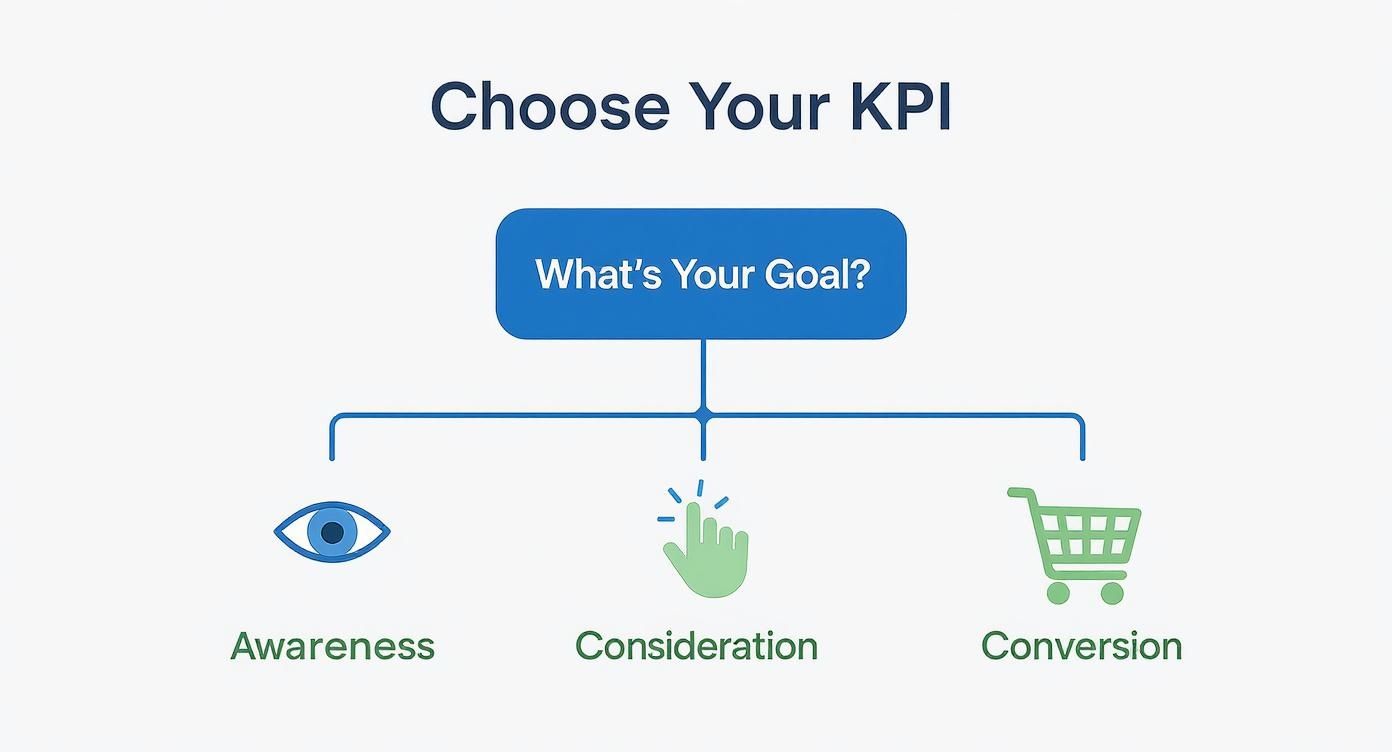
This flowchart helps you draw a straight line from your high-level goals—like building awareness, driving consideration, or closing deals—to the specific metrics that will actually tell you if you're succeeding.
Before we dive into choosing a model, it helps to see them side-by-side. Each one has its strengths and weaknesses, and the best choice really depends on what you're trying to achieve.
| Attribution Model | How It Works | Best For | Potential Pitfall |
|---|---|---|---|
| First-Touch | Assigns 100% of the conversion credit to the first touchpoint. | Top-of-funnel campaigns where the goal is brand awareness or lead generation. | Overlooks the impact of all mid- and bottom-funnel marketing efforts. |
| Last-Touch | Assigns 100% of the conversion credit to the last touchpoint. | Short sales cycles and campaigns focused on immediate conversions (e.g., flash sales). | Ignores the initial interactions that introduced the customer to the brand. |
| Linear | Distributes credit equally across all touchpoints in the journey. | Long consideration cycles where every interaction is considered valuable. | Can undervalue key touchpoints by treating all interactions as equally important. |
| Time-Decay | Gives more credit to touchpoints closer in time to the conversion. | Businesses with shorter consideration phases where recent ads have more influence. | Can devalue early-stage, brand-building activities that happened long ago. |
Ultimately, the table shows there's no single "best" model. The right one for you is the one that most accurately reflects your customer's journey and gives you actionable insights to grow your business.
There's no silver bullet here. The right model comes down to your business, how long your sales cycle is, and what your campaign goals are. The key is to pick the model that best mirrors how your customers actually behave.
Take a B2B SaaS company with a six-month sales cycle. A First-Touch model could be incredibly valuable for them. It would highlight which marketing channels are successfully filling the top of their funnel, even if those leads take months to become customers. A Last-Touch model in that same scenario would give all the credit to the final demo call, completely ignoring the blog post and webinar that started the whole conversation.
On the flip side, an e-commerce store running a weekend promotion for a new sneaker drop might find Last-Touch attribution is all they need. The customer journey is short and sweet. Knowing which final ad—like that Instagram retargeting ad—pushed the customer over the finish line is the most important insight. A Time-Decay model could also work well here, giving the most credit to the recent, urgent marketing messages.
Many of the big platforms, like Google and Meta, are starting to move beyond these rigid, rules-based models. They're embracing Data-Driven Attribution (DDA). This approach uses machine learning to analyze all the different conversion paths and assigns credit based on how each touchpoint actually influenced the outcome.
Instead of following a fixed rule, a data-driven model might learn that for your specific business, an initial search ad followed by a YouTube video view is a knockout combination, and it will assign credit accordingly. It’s a smarter, more flexible way to measure your advertising because it adapts to real customer behavior instead of trying to force it into a predefined box.
Look, metrics like ROAS and CPA are great. They're the bread and butter of performance marketing, telling you what’s happening with your campaigns. They show a clear line between ad spend and revenue, which is a solid starting point.
But they don't answer the million-dollar question: are your ads actually creating new business, or are you just paying to get in front of people who would have bought from you anyway?
To get past simple correlation, you first have to nail the basics of how to calculate return on ad spend. Once you have that down, you can start digging deeper to find the true, causal impact of your ads. Proving this causality—what we call incrementality—is the real endgame of advertising measurement.

This is where you have to put on your scientist hat and run some experiments. By setting up controlled tests, you can finally measure the actual "lift" your campaigns are generating—the sales that simply wouldn't have happened without your ads.
Before you start testing entire campaigns, you need to make sure your individual ads are pulling their weight. This is where A/B testing (or split testing) comes in. It's a straightforward but incredibly powerful way to squeeze more performance out of your creative.
The process is simple: create two or more versions of an ad, changing just one thing—the headline, the image, the call-to-action (CTA), or the ad copy. Then, you show these different versions to similar audiences and see which one performs better for your goal, whether that's Click-Through Rate (CTR) or Conversion Rate.
A Quick Example: A/B Testing Ad Copy
Let's say you're an e-commerce brand selling running shoes. You want to test two different angles in your ad copy:
You run both ads for a week with the same budget, targeting, and image. At the end, you find that Ad B got a 25% higher CTR and a 10% lower CPA. Now you have hard data telling you that benefit-driven messaging resonates more with your audience, and you can confidently roll that style out across your campaigns.
A/B testing isn't a "set it and forget it" task. It's an ongoing cycle of learning and tweaking. Consistently testing your creative is one of the highest-impact things you can do to improve overall ad effectiveness.
While A/B tests help you fine-tune your ads, they don't prove that your entire campaign is incremental. For that, we need bigger, more robust experiments. For businesses with a physical or regional presence, one of the most practical methods is the geo-experiment, also called a geo-lift test.
The idea is to split your market into distinct geographical areas:
During the campaign, you measure the difference in sales, website traffic, or another key metric between the two groups. That difference is your incremental lift. The key here is to make sure your test and control markets are as similar as possible in terms of population, past sales trends, and seasonality. Otherwise, your results will be skewed.
A holdout test follows the same logic as a geo-experiment but at the user level, which is perfect for digital campaigns. Here, you intentionally "hold back" a small portion of your target audience, creating a control group that doesn't see your ads.
For example, you could run a retargeting campaign targeting 90% of everyone who visited your website in the last 30 days. The other 10% becomes your holdout group.
At the end of the campaign, you compare the conversion rate of the group that saw the ads to the group that didn't. If the exposed group converted at 5% and the holdout group converted at 2%, you can confidently say your ads drove a 3% incremental lift. This proves a huge chunk of your conversions happened specifically because of your ads.
Not every ad is meant to drive an immediate sale. Brand-building campaigns are all about influencing perception, awareness, and purchase intent over the long haul. These upper-funnel effects are invisible to standard conversion tracking but are absolutely essential for sustainable growth.
This is where brand lift studies shine. These studies use surveys to measure how your ads are changing what people think about your brand. Big platforms like Google, Meta, and YouTube have these tools built right in.
Here's how they work. They survey two groups of people:
The surveys ask questions to measure things like ad recall ("Do you remember seeing an ad for Brand X?"), brand awareness ("Which of these running shoe brands have you heard of?"), and purchase intent ("How likely are you to consider buying from Brand X?"). The difference in answers between the two groups shows you the actual lift your campaign created, finally giving you a real number to attach to your brand-building efforts.
All the data in the world is useless if it just sits in a spreadsheet. The real magic happens when you turn those numbers into a compelling story—one that helps your team make better, faster decisions. This is where a well-designed dashboard comes into play. It transforms raw data into an actionable narrative your team will actually want to use.

An effective dashboard isn’t just about cramming a bunch of metrics onto a screen; it’s about providing clarity at a glance. It should immediately answer your team's most pressing questions and highlight opportunities without needing a data science degree to interpret.
The whole point is to move from simply collecting data to taking data-driven action. Think of your dashboard as the command center for your advertising—guiding strategy and proving the value of your work to the entire organization.
How you present your data matters just as much as the data itself. Different charts tell different stories, and picking the right one can be the difference between a confusing report and a powerful insight. Matching your visualization to your data type is a fundamental best practice.
By thoughtfully selecting your charts, you create a visual language that makes even complex performance data instantly understandable.
Let’s be honest: not everyone in your organization needs the same level of detail. A CEO wants the 30,000-foot view, while a channel specialist needs to get into the weeds. A tiered reporting system ensures everyone gets the info they need without being overwhelmed.
Your dashboard shouldn't be a one-size-fits-all document. Tailor it to your audience. Leadership needs the "what," and specialists need the "why." This approach makes the data relevant and actionable for every stakeholder.
A smart, tiered structure might look something like this:
This approach ensures that your hard work measuring performance serves the entire business, from the C-suite right down to the front lines.
With your structure planned out, you need the right tool to bring it to life. There are several powerful platforms that can connect to your data sources and help you build stunning, interactive dashboards. The best choice really depends on your budget, technical resources, and existing tech stack.
Here’s a quick rundown of the most popular options:
| Tool | Key Strengths | Best For |
|---|---|---|
| Looker Studio (formerly Google Data Studio) | It's free, pretty easy to use, and integrates seamlessly with Google products (Analytics, Ads, Sheets). | Startups and small to medium-sized businesses, especially those already deep in the Google ecosystem. |
| Tableau | Extremely powerful visualization capabilities. It's highly customizable and can handle seriously complex data sets. | Larger enterprises with dedicated data analysts who need to do deep-dive analysis and create sophisticated visuals. |
| Microsoft Power BI | Strong integration with the Microsoft world (Excel, Azure) and has robust data modeling features. | Organizations that already run on Microsoft products for their day-to-day business operations. |
Regardless of which tool you land on, the principle is the same: create a single source of truth that is clear, accessible, and drives action. If you're looking for inspiration on how to make your data pop, check out some of these business intelligence dashboard examples to see what's possible.
Even with a solid framework, measuring how well your ads are actually working can get tricky. You'll inevitably run into challenges, especially with channels that don't fit neatly into a digital tracking box or when you’re trying to prove the long-term value of brand building.
Let's tackle some of the most common questions marketers ask.
This is a big one. Channels like TV, radio, or even your big, bright outdoor LED sign require a different toolkit than digital ads. You can't just look for a click, so you have to get creative and build a bridge from the physical world to the digital one.
Think of it as creating trackable actions. For example:
YourBrand.com/TV works great.If you want to get more advanced, look into Marketing Mix Modeling (MMM). This is a statistical approach that crunches historical sales and marketing data to figure out how much each channel—including your offline efforts—contributed to the bottom line. It’s perfect for understanding how your TV spend, for instance, impacts overall sales trends over time.
Everyone asks this, and the honest-to-goodness answer is: it depends. A "good" Return on Ad Spend (ROAS) can vary wildly depending on your industry, your profit margins, and what you’re trying to achieve.
You'll often hear a 4:1 ratio thrown around as a benchmark—meaning you generate $4 in revenue for every $1 you spend. But that’s just a general guideline. A high-volume, low-margin e-commerce business might need a 10:1 ROAS just to stay profitable, while a high-margin software company could be thrilled with a 2:1 ROAS.
The most important thing is to measure ROAS against your own break-even point and profitability targets, not some generic industry average. Knowing your numbers is what really matters for sustainable growth.
The formula itself is straightforward: ROAS = (Revenue from Ad Campaign / Cost of Ad Campaign). The real key to an accurate calculation is having precise conversion value tracking set up in your analytics. Without it, you’re just flying blind.
Brand-building is a long game. The goal isn’t an immediate click or sale but to build awareness and positive sentiment that pays off for years to come. Because of this, you can't measure it with the same metrics you'd use for a direct-response campaign.
You need to shift your focus to upper-funnel indicators. The most direct way to do this is with brand lift studies, which use surveys to measure changes in key metrics like:
Beyond formal studies, you can also track some incredibly valuable proxy metrics. Keep an eye on increases in branded search volume (more people Googling your company name), a jump in direct website traffic, and growth in social media followers or engagement. These signals are strong indicators that your advertising is successfully building valuable brand equity.
At Smart LED Inc., we believe in the power of high-impact visual advertising that gets noticed. Our factory-direct outdoor LED signs and indoor video walls are engineered to help you capture attention and drive real business results you can measure. Ready to make your message unmissable? Explore our display solutions.
Picture this: you take the flash and spectacle of a Times Square billboard, slap it on the back of a truck, and send it wherever

A wall of TV screens is exactly what it sounds like: a big, impressive display made by tiling multiple TVs together so they act like

Picking the right displays for shows can feel like a high-stakes guessing game. Get it right, and you create an immersive world that captivates your
"*" indicates required fields

We have sent a 6-digit verification code to your email. Please enter it below to continue.