
Uncategorized
Digital Billboard Truck: Boost Your Campaign with Mobile Ads
Picture this: you take the flash and spectacle of a Times Square billboard, slap it on the back of a truck, and send it wherever
Let's get right to it: video wall pricing isn't some simple number you can pull off a shelf. The reality is, you could be looking at anything from $2,500 for a small, basic setup to well over $100,000 for a massive, ultra-high-resolution display. Why such a huge gap? Because the final cost is a blend of hardware, software, and crucial services that all come together to create the final product.
This guide is here to break down that vast range, showing you exactly what goes into the final number.
Figuring out the cost of a video wall isn't about finding a single sticker price. It's more like spec'ing out a custom-built car. You have the base model, sure, but the engine you choose, the interior finishes, and the performance package are what really define the final investment. It’s the same exact principle here—every choice you make adds up to the final cost and, more importantly, the overall value you get.
Think of this section as your financial roadmap. We're moving past the simple question of "how much does it cost?" and digging into the far more useful question: "what am I actually paying for?"
The demand for stunning, dynamic visual experiences is exploding. The global video wall market hit roughly USD 6.9 billion in 2023 and is on track to nearly double by 2032. This isn't just a tech trend; it's a fundamental shift in how businesses in retail, corporate offices, and entertainment engage with their audiences. If you want to dive deeper, you can explore the latest data intelligence reports on market growth.
All this growth means you have more options than ever, which makes understanding the cost breakdown even more critical. Your project's purpose is the single biggest driver of its price tag. For example:
To give you a real-world starting point, let's look at how these factors play out in different scenarios. We'll get into the nitty-gritty of specific use cases later, but the table below gives a great high-level overview of what an all-inclusive project might cost.
A video wall is a strategic asset, not just an expense. A clear understanding of pricing is the first step to unlocking its full value for your organization, whether through increased sales, stronger brand perception, or improved communication.
The following table offers a snapshot of what you can expect to invest based on some common applications. Use it as a benchmark to frame your own needs as we prepare to break down every component in the sections to come.
Here’s a quick reference table to give you a ballpark idea of what a complete, installed video wall project might cost for different use cases.
| Application Type | Typical Size (Approx.) | Estimated Cost Range (All-Inclusive) |
|---|---|---|
| Indoor Retail Store | 8 ft x 5 ft | $15,000 – $35,000 |
| Corporate Lobby | 12 ft x 7 ft | $30,000 – $70,000 |
| Control Room (24/7) | 16 ft x 9 ft | $60,000 – $120,000+ |
| Outdoor Storefront | 10 ft x 6 ft | $40,000 – $85,000 |
Remember, these are just estimates. The final price tag will always depend on the specific technology, complexity, and services required for your unique project.
The physical components of your display are, without a doubt, the biggest line items on your quote. Think of it like building a high-performance computer—the quality of each part, from the individual pixels on the screen to the processor running the show, directly impacts both performance and the final price tag.
Getting a handle on these core hardware elements is the key to making a smart investment.
Let's break down the essential hardware so you can see exactly how different choices add up. This is the kind of knowledge that will help you ask the right questions and feel confident when you're looking at proposals.
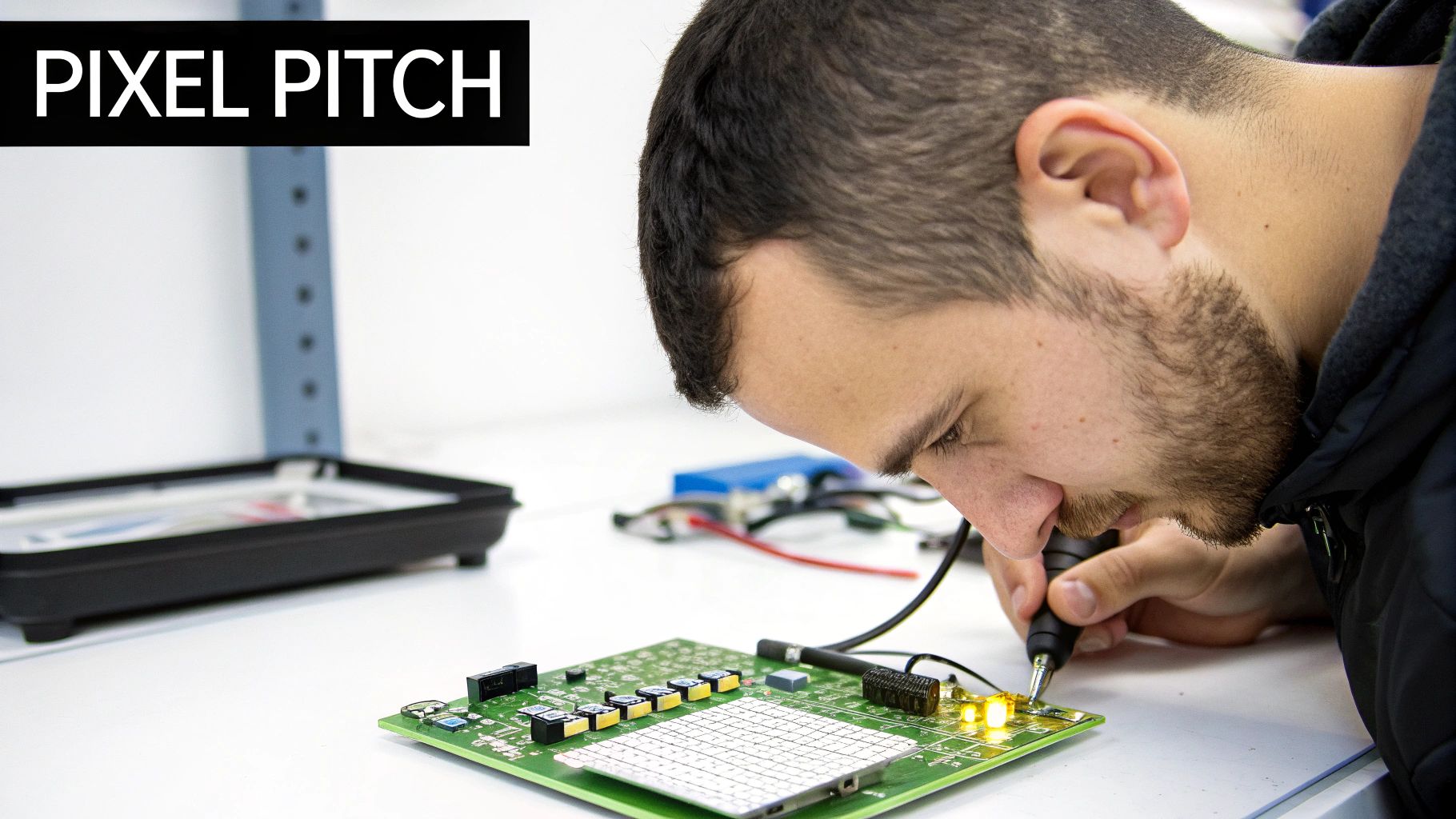
The single most significant factor in a video wall’s cost is its pixel pitch.
Imagine it like the thread count in luxury sheets: a lower number means the threads (or in our case, pixels) are packed closer together, creating a smoother, more detailed image. A smaller pixel pitch is absolutely essential for up-close viewing, like in a corporate lobby, but it comes at a premium because you're cramming more technology into the same physical space.
For instance, a display with a 1.9mm pixel pitch looks incredibly sharp from just a few feet away. It's perfect for those indoor applications where viewers are right on top of the screen. But a 6mm pitch display might look just as stunning from 50 feet away on a roadside billboard—and it will cost a whole lot less.
Choosing the right pixel pitch for your viewing distance is the most effective way to manage your budget without ruining the viewer's experience. You might be interested in our guide to the FX2 2.5mm LED video wall, which hits a sweet spot between amazing clarity and cost.
The rule of thumb is simple: The closer your audience, the smaller (and more expensive) your pixel pitch needs to be. Overspending on a super-fine pitch for a distant viewing application is like buying a 4K TV for a room where you can only sit 30 feet away—you’re paying for detail you can't see.
Your video wall isn't one giant screen. It’s actually built from smaller LED modules that are housed in larger frames called cabinets. The quality of these components is what determines the display's durability, visual consistency, and how easy it is to maintain down the road.
These hardware components are the engine driving the industry's massive growth. Market analyses show the global video walls market is projected to surge from USD 10.24 billion in 2025 to USD 27.8 billion by 2035. And the hardware segment—these very modules and cabinets—consistently holds the biggest market share. It just goes to show that component quality is truly the backbone of video wall pricing.
Finally, every video wall needs a control system. This is the "brain" that processes the video signal and tells each and every pixel what to do. The system is usually made up of a video processor, sending cards, and receiving cards.
While it’s less visible than the screen itself, skimping here is a huge mistake. A cheap control system can lead to poor image quality, annoying glitches, or just a frustrating user experience for your team.
High-quality processors offer much better image scaling, more accurate color processing, and can handle more complex content sources. The refresh rate, often handled by the receiving cards, is another critical spec. A standard 1920Hz refresh rate is fine for many uses, but if you're in broadcast or plan on live streaming, you’ll need a higher rate of 3840Hz or more to avoid that awful flicker you see on camera. It’s a crucial detail that directly impacts your video wall's final cost.
So you've got a quote for the video wall itself, but let's be real—that's just the tip of the iceberg. The final video wall pricing is about so much more than the screen. There’s a whole ecosystem of essential services and logistical costs that are easy to miss but are absolutely make-or-break for a successful project. These aren’t just "add-ons"; they're the foundational work that ensures your investment looks incredible, runs without a hitch, and actually lasts.
If you ignore these costs, you're setting yourself up for surprise bills and some serious headaches. To get the real financial picture, you have to look beyond the hardware and understand everything it takes to bring your vision to life—from the steel holding it up to the final pixel-perfect calibration.
First up: how is this thing actually going to be supported? The structure holding your display is a huge part of the cost, and it can range from a simple bracket to a completely custom-engineered frame. The difference in price is significant.
Installing a video wall isn't a handyman job; it's a highly specialized skill. The cost here really depends on the complexity of the project and the conditions at your site. A simple ground-supported setup in a wide-open room is going to cost way less than a multi-story installation that needs scissor lifts, scaffolding, and a specialized rigging crew.
It's also crucial to remember the electrical work behind the wall. For a good breakdown of understanding installation costs and hidden fees, this guide on EV charger installations offers some great parallels for planning this kind of project.
The installation isn't just about hanging panels. It involves precise alignment, electrical work, and data cabling. A rushed or inexperienced installation is the number one cause of premature hardware failure and poor visual performance.
LED panels and their mounting hardware are heavy, bulky, and surprisingly delicate. Just getting all those components from the factory to your front door is a real cost, and it’s one people often underestimate. Shipping expenses are all about total weight, dimensions, and distance.
Because we ship directly from our factory, we can often consolidate everything to keep these costs as low as possible. But if you need it there yesterday or your site is in a remote location, you can expect the freight budget to go up. This is especially true for huge projects where the total shipping weight can easily hit several tons. For a deeper dive into how logistics impact pricing in a similar context, check out our guide on outdoor LED sign cost.
Okay, the wall is up. Now what? Two final steps are non-negotiable if you want to protect your investment: professional calibration and an ongoing maintenance plan.
Talking theory is one thing, but the best way to really get a handle on video wall pricing is to see how all these pieces fit together on an actual project. Every job is different, with its own unique goals, environment, and audience. Walking through a few common scenarios shows you exactly how specific priorities directly impact the final price tag.
Let's move from theory to practice. We'll break down several detailed examples, digging into the specific requirements and estimated costs for each one. This will give you a much more tangible sense of what you can expect to invest for different applications and help you benchmark your own project.
The image below drives home a key point: the total cost is always more than just the screen. Essential services like mounting, installation, and shipping are what turn a pile of boxes into a successful, functioning asset.
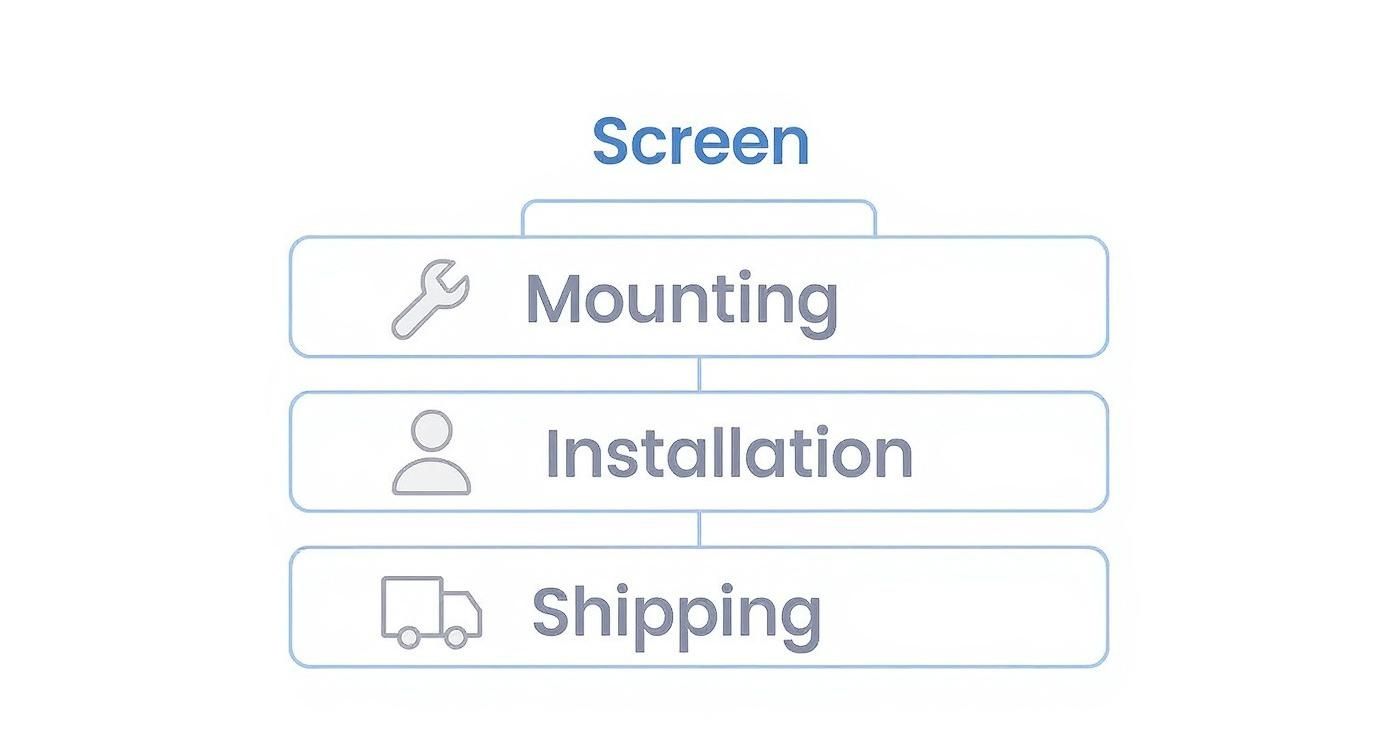
Think of it like this: the display hardware is the engine, but the supporting services are the chassis, wheels, and transmission that actually get you on the road.
A boutique retailer wants to grab the attention of shoppers in a busy district. The plan is to install a bright, 10-foot by 6-foot LED video wall right next to their main entrance, running eye-catching ads that pop, even in direct sunlight.
Here, the budget is dictated by the need to battle the elements and the sun.
Estimated Total Project Cost: $45,000 – $80,000
That price range reflects the premium you pay for high-brightness, outdoor-rated hardware and the specialized installation needed for a safe, long-lasting setup.
A high-flying tech firm is looking to make a statement in its headquarters lobby with a stunning, high-resolution video wall. The screen will be 12 feet by 7 feet, displaying slick branded content and welcome messages. For this project, aesthetics and a flawless, seamless image are everything.
The biggest cost driver here is getting that pixel-perfect image for up-close viewing.
Estimated Total Project Cost: $50,000 – $95,000
The higher cost per square foot comes almost entirely from the fine pixel pitch technology. You're packing millions more tiny LEDs into the same physical space, and that advanced engineering comes at a premium.
A major logistics company is building a new 24/7 command center and needs a massive 16-foot by 9-foot video wall at its heart. The screen will display a constant stream of real-time tracking data, video feeds, and system alerts. The top priorities? Rock-solid reliability, longevity, and perfect clarity.
For an application like this, redundancy and long-term performance are what drive the budget.
Estimated Total Project Cost: $80,000 – $150,000+
This is a serious investment, but it's what's required to meet the intense demands of a 24/7 operational environment. This kind of rapid adoption in critical sectors is a huge reason why the LED video walls market was valued at an incredible USD 24.37 billion in 2024. If you're interested in the data, you can explore more research on the growing LED video wall market trends.
Figuring out a real-world budget from all the moving parts of a video wall project can feel like a huge task, but it doesn't have to be. With a clear process, you can move from a rough guess to a solid financial plan. We’ll walk you through the steps, helping you ask the right questions and use the right tools to build an accurate budget from the ground up.
Our goal is to give you the confidence to plan your investment without getting blindsided by surprise costs down the road.
Before you can get a meaningful quote, you have to nail down the core details of your project. Answering these questions first gives any reputable provider the basic info they need to give you an accurate price. It’s like telling an architect your lot size and how many bedrooms you want before they start drawing up plans for a house.
Kick things off by defining these key details:
Once you have your basics covered, it’s time to get a quote. One of the best ways to keep your video wall pricing in check is by working directly with the manufacturer. When you buy from Smart LED Inc., you're buying factory-direct. That means you skip the markups tacked on by third-party distributors and resellers.
This direct relationship doesn’t just save you money; it also gives you a direct line to expert engineers who can help you fine-tune your specs. They'll make sure you aren’t overspending on features you don't need or, just as importantly, underspending on a component that’s critical for your specific use case.
For an immediate, data-driven starting point, an online calculator is an incredible tool. These let you plug in your project details—like size, pixel pitch, and where you'll use it—to generate a preliminary cost estimate right away.
Here’s a quick look at what our LED sign calculator looks like as you input your project’s information.
This tool instantly turns your requirements into a ballpark figure. It helps you grasp the financial scope of your project before you even pick up the phone to talk to a sales rep.
An online calculator is your first reality check. It provides a solid baseline that grounds your expectations and helps you prepare for more detailed, formal quotes. It’s the perfect first step in the budgeting process.
To streamline your financial planning and ensure comprehensive coverage, consider how you might utilize a robust cost estimation calculator to account for all aspects of your video wall project. Combining these tools with your answers to the essential questions will give you the most accurate and reliable budget possible.
Making a big investment like a video wall is about more than just finding the lowest price tag. It's about being strategic. You want to make smart choices that deliver real, long-term value. Once you understand what really drives the cost, you can start to fine-tune your project to fit your budget without sacrificing the "wow" factor you're after.
It all starts with matching the tech to your actual needs. The single biggest way to get the most for your money is to pick the right pixel pitch for your main viewing distance. The most common mistake we see is people overspending on an ultra-fine pitch screen that’s only ever going to be seen from 30 feet away. It’s like buying a race car engine just to drive in city traffic—you’re paying for power you’ll never get to use.
Once you've nailed down the upfront cost, the conversation shifts to its long-term worth. A video wall isn't just a piece of equipment; it's a strategic asset. How you measure its return on investment (ROI) really depends on what you're trying to achieve.
For businesses focused on advertising or direct sales, the ROI is often tangible and quick. Dynamic, eye-catching content on a high-visibility screen can directly sway buying decisions and pull people in off the street. In fact, studies have shown digital signage can boost average sales by nearly 30%. To see this in action, check out some powerful examples of digital outdoor signage and the impact they make.
In a corporate environment, the ROI looks a little different, but it’s just as crucial. Here, it’s all about enhancing brand perception and making a killer first impression that screams professionalism and innovation. A stunning lobby display becomes a landmark, reinforcing company culture and even improving how you communicate with your team.
A video wall is a powerful communication tool. For advertisers, it’s a direct line to increased revenue. For organizations, it's an investment in brand identity, employee engagement, and creating an unforgettable visitor experience.
Even with a perfectly optimized budget, a video wall is a significant purchase. The good news is, flexible financing options can make this technology much more accessible. Spreading the cost over time with a lease or financing plan frees up your capital for other business needs while letting you reap the rewards of your new display right away. This approach turns a large one-time expense into a predictable monthly operating cost, making it easier to budget for and prove a positive ROI from day one.
Ultimately, getting a firm grip on video wall pricing is the first step to unlocking its incredible value. By making informed choices, you ensure your display isn’t just a beautiful screen, but a hardworking asset that pays for itself many times over.
When you're diving into the world of video walls, a lot of questions about cost naturally come up. Let's clear up some of the most common ones we hear from buyers, so you can move forward with confidence.
You can expect an outdoor video wall to run 30-50% more than an indoor screen of the same size and resolution. That price jump is all about making the display tough enough to survive the elements.
Think of it this way: an outdoor screen has to be "ruggedized." This means two key things:
Installation is a major line item, and you should budget for it to be somewhere between 15-30% of your total project cost. A straightforward job, like mounting a screen on a flat, easily accessible wall, will keep you on the lower end of that range.
However, if your project is more complex—say, it requires custom rigging to suspend the screen from a ceiling or involves working in a tricky-to-reach spot—the cost will climb. Those jobs demand specialized labor, equipment like lifts, and simply more time on-site.
Here's a piece of advice we always give: installation is not the place to cut corners. A shoddy installation can cause hardware to fail early, void your warranties, and even create safety hazards. Trying to save a little upfront can end up costing you a fortune down the road.
Absolutely. This is one of the smartest ways to manage your video wall's price tag. As long as the pixel pitch is right for your audience's typical viewing distance, you can get a huge amount of value.
For instance, shifting from a very fine 1.9mm pitch to a 2.9mm pitch can slash your hardware costs by 25-40%. The trick is to avoid paying for super-high resolution that your viewers won't even be able to perceive from where they're standing.
Ready to turn your vision into a stunning visual reality? The experts at Smart LED Inc. are here to help you design the perfect video wall for your space and budget. Explore our solutions and get a factory-direct quote at https://smartledinc.com.
Picture this: you take the flash and spectacle of a Times Square billboard, slap it on the back of a truck, and send it wherever
A wall of TV screens is exactly what it sounds like: a big, impressive display made by tiling multiple TVs together so they act like

Picking the right displays for shows can feel like a high-stakes guessing game. Get it right, and you create an immersive world that captivates your
"*" indicates required fields

We have sent a 6-digit verification code to your email. Please enter it below to continue.