Wie man die Gewinne, die Sie erzielen von online Spielautomaten maximiert Die Regeln des Casino-Betriebs und Bedingungen für Online-Spielautomaten. Der Zweck dieser Regeln ist es,

Let's cut right to it. When you're asking about the cost of a Jumbotron, the answer is a pretty wide spectrum—you could be looking at anywhere from $15,000 for a smaller indoor screen to well over $1,000,000 for the kind of colossal display you see in a pro sports stadium.
For most businesses, schools, or churches, the sweet spot usually lands somewhere between $50,000 and $500,000. But that's just a number. The real story is in what makes up that cost, because this isn't just a purchase; it's a major investment.
Trying to pin down the cost of a Jumbotron is a lot like pricing out a new truck. The base model has a sticker price, sure, but once you start adding the bigger engine, the off-road package, and the high-end sound system, that final number changes—a lot. Your Jumbotron is the exact same deal.
The final price tag is a blend of the screen itself, the software that runs it, the steel that holds it up, and the team that puts it all together.
To give you a real-world starting point for your budget, we've put together a breakdown of typical all-in project costs. This isn't just the price of the screen in a box; it's a reflection of the total investment to get a show-stopping display up and running.
The Big Picture: Remember, the screen is just one piece of the puzzle. A complete quote will always include the mounting structure, control system, installation, and shipping. These are all critical parts of the final cost.
Think of this table as a quick reference map. It’ll help you see where your project might fall and start to understand what drives those costs as we dig into the details.
| Application Type | Typical Screen Size (Sq. Meters) | Estimated Cost Range (Hardware & Installation) |
|---|---|---|
| Small Retail / Bar | 5 – 15 sq. m | $15,000 – $45,000 |
| House of Worship | 15 – 30 sq. m | $40,000 – $95,000 |
| High School Stadium | 30 – 50 sq. m | $90,000 – $180,000 |
| Small College Arena | 50 – 80 sq. m | $150,000 – $400,000 |
| Pro Sports / Venue | 100+ sq. m | $500,000 – $1,000,000+ |
These ranges give you a much more realistic financial snapshot than a simple guess, bridging the gap until you can get a detailed quote tailored to your exact needs.
Figuring out what a Jumbotron costs isn't as simple as picking a model from a catalog. The final number on your quote is a blend of several key factors, each playing a big part in the total investment. If you understand these components, you can make a much smarter decision and ensure you’re only paying for what your venue actually needs.
Think of it like spec'ing out a new truck. The base model has a price, but the real cost comes from choosing the engine, the drivetrain, the cab size, and all the interior upgrades. A Jumbotron is exactly the same—every technical choice adds to the bottom line.
This map gives you a bird's-eye view of how costs scale, from smaller setups for local venues all the way to massive displays for professional stadiums.
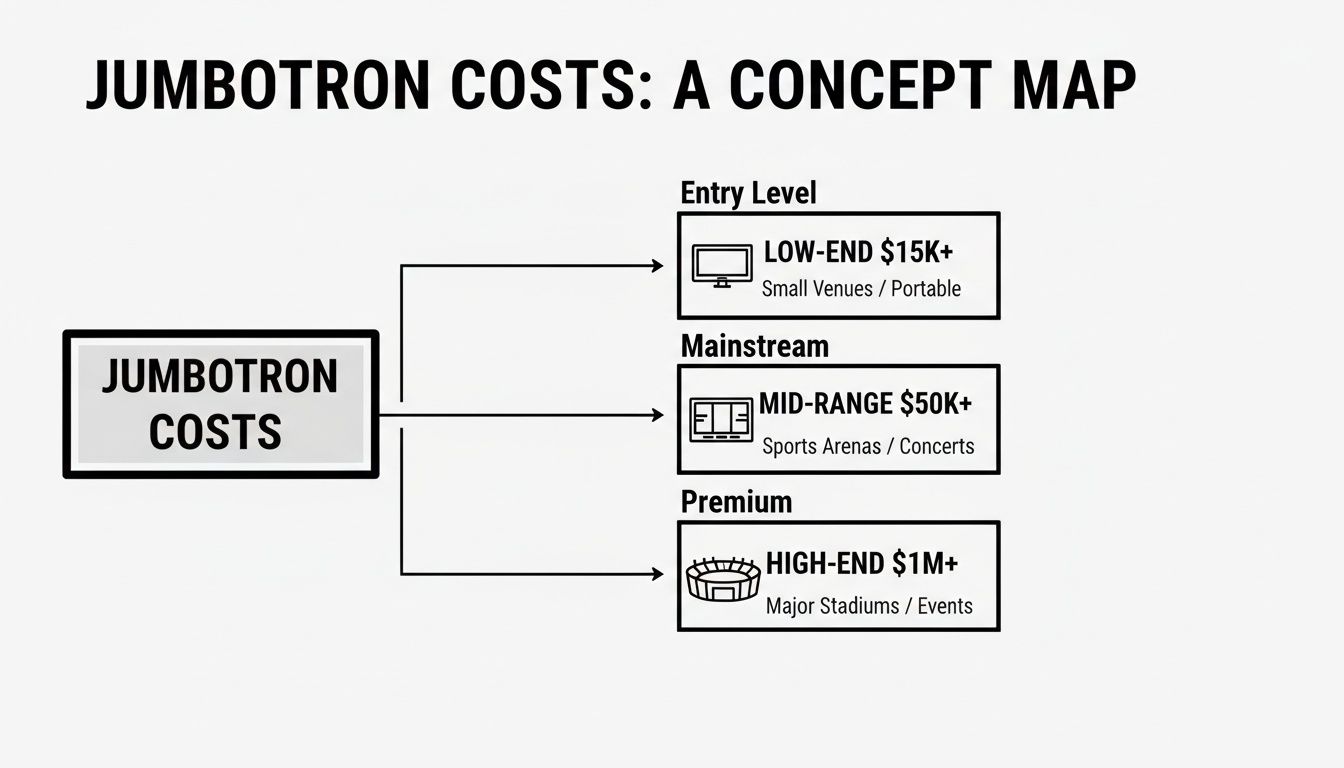
As you can see, the jump from a standard commercial display to a premium stadium screen is huge. That's not just about size; it's about the technology required to deliver a flawless experience in a massive space. Let's break down exactly what causes those price jumps.
This one’s a no-brainer. Bigger screens cost more. It’s the most direct factor influencing the price because a larger display requires more LED modules, more steel for the frame, and a much beefier support structure. The math is simple: as the square footage goes up, so does the price tag.
But hold on—bigger isn't always better. The right strategy isn't just to buy the largest screen you can squeeze into the budget. The perfect size depends entirely on your venue and how far away your audience will be. Too small, and it's useless. Too big, and you’ve just wasted a ton of money.
This might be the single most critical spec you’ll choose, impacting both image quality and your final cost. Pixel pitch is simply the distance, measured in millimeters, between the center of one tiny LED pixel and the center of the one next to it. A smaller number means the pixels are packed tighter, giving you a sharper, higher-resolution image.
It’s like the thread count in a set of luxury sheets. A higher thread count feels smoother and more premium. In the same way, a tight pixel pitch (like a P2.5) creates a crisp, seamless picture that looks incredible up close. A wider pitch (like a P10) is perfect for viewers who are far away, like fans in the upper deck of a stadium.
The catch? It’s all about cost. A finer pixel pitch can easily double the price of a screen of the exact same physical size because it requires exponentially more individual LEDs. The key is to find the sweet spot that balances your budget with your audience's viewing distance.
Where you plan to install the screen changes everything. An outdoor Jumbotron is engineered completely differently from an indoor one, and that engineering has a major impact on the cost.
Because of that extra durability and high-brightness tech, an outdoor screen will always be more expensive than an indoor screen of the same size and pixel pitch. Our guide on outdoor LED sign cost digs into this a lot deeper.
The brightness of an LED screen is measured in nits. For an indoor screen in a controlled environment, 500-1,000 nits is usually plenty. But take that screen outside on a sunny afternoon, and it’ll look completely washed out.
For any outdoor Jumbotron, you need to look for a brightness of at least 5,000 nits. The real high-performance models push 7,000 nits or even more to ensure the picture is vibrant and clear no matter the weather. Achieving that level of brightness requires more powerful LEDs and stronger power supplies, which adds to the total cost.
The screen itself is just one piece of the puzzle. You also have to think about how it will be held up and how you'll send content to it.
Finally, there are a few logistical expenses that are easy to forget when you’re budgeting but can add up quickly. Just like understanding hourly rates and potential hidden fees for a moving company, being aware of these Jumbotron-related costs from the start will save you from sticker shock later.
These "soft costs" are non-negotiable:
A good quote will always include these items. When all is said and done, research shows that pixel pitch and screen size account for about 60% of a Jumbotron's price. For example, opting for a fine-resolution P2.5 screen can easily double the cost compared to a P10 screen of the same dimensions. Different variables come into play depending on the project, but these are the foundational factors that build your final price.
It's one thing to talk about pixel pitch and brightness in theory, but it’s another thing entirely to see how those factors come together on a real-world project. To really wrap your head around what a Jumbotron costs, let's stop talking hypothetically and look at how these numbers play out in the wild.
We'll walk through three completely different scenarios—each with its own venue, goals, and budget. These examples will connect the dots between screen size, resolution, and the nitty-gritty of installation to show you how a final price tag takes shape. By the end, you'll have a much better feel for where your own project might land.
Picture a bustling restaurant right on a busy street corner. The owner wants to catch the eye of every car and pedestrian that goes by, flashing daily specials, happy hour deals, and weekend events. An outdoor digital sign is the perfect tool for the job.
The goal here isn't cinematic video—it's about bold, bright, can't-miss text and graphics that are easy to read from a distance.
Let's break down what an investment like this looks like:
| Cost Component | Estimated Price | Description |
|---|---|---|
| LED Screen Panels (10m²) | $11,000 | P10 outdoor-rated, high-brightness modules. |
| Steel Structure & Mounting | $4,500 | Custom fabrication and installation for facade mount. |
| Control System & Software | $1,000 | Basic system for scheduling content. |
| Installation & Labor | $2,500 | Includes electrical hookup and screen assembly. |
| Total Estimated Project Cost | ~$19,000 | An all-in price for a powerful local advertising tool. |
This is a perfect example of how a smaller business can get in on the digital signage action for a totally manageable price, directly boosting sales and street-level visibility.
Now, let's step inside a thriving community church looking to take its worship services to the next level. The leadership wants to create a more immersive and engaging atmosphere, showing song lyrics, sermon points, and live video of the speakers on stage.
Here, image quality is everything. The congregation is sitting pretty close to the screen, so a high-resolution display is an absolute must for a professional, easy-to-read experience.
For any indoor space where your audience is up close, investing in a finer pixel pitch is non-negotiable. It's the difference between a pixelated, amateur-looking screen and a smooth, broadcast-quality image that pulls people in.
A more ambitious project like this naturally comes with a bigger price tag, reflecting its scale and technical demands.
| Cost Component | Estimated Price | Description |
|---|---|---|
| LED Screen Panels (30m²) | $72,000 | High-resolution P2.5 indoor modules. |
| Custom Mounting Frame | $8,000 | Engineered structure for stage integration. |
| Video Processor & Control | $4,000 | Advanced system for live video switching. |
| Installation & Calibration | $6,000 | Precision installation and color tuning. |
| Total Estimated Project Cost | ~$90,000 | A significant, but truly transformative, investment in the worship experience. |
Finally, let's head out to the football field. A local high school is ready to ditch its old, static scoreboard for a real Jumbotron. The athletic director wants something that can show instant replays, run ads for local sponsors, and get the crowd fired up on Friday nights—a true college-level game-day experience.
This screen has to be huge, ridiculously bright, and built like a tank to survive years of sun, rain, and snow.
This kind of project is a major capital improvement, and the costs reflect the scale and complexity of the build.
| Cost Component | Estimated Price | Description |
|---|---|---|
| LED Screen Panels (50m²) | $100,000 | P8 outdoor-rated, IP65 weatherproof modules. |
| Structural Steel & Footings | $25,000 | Freestanding scoreboard engineering and construction. |
| Scoreboard Control System | $8,000 | Integrated software for scores, stats, and video. |
| Installation & Crane Rental | $17,000 | Complex logistics and heavy equipment operation. |
| Total Estimated Project Cost | ~$150,000 | A landmark upgrade that will supercharge school spirit and open up brand new revenue streams. |
Picking out the perfect Jumbotron is only half the battle. How you decide to pay for it is just as critical to your long-term success. The initial price tag can look pretty intimidating, which is why getting a handle on your options—buying, renting, or leasing—is so important.
Each path comes with its own set of pros and cons. The best choice really boils down to your specific goals, your budget, and how you plan on using the screen day in and day out. This isn't just a line item in your budget; it's a strategic decision that can mean the difference between a sustainable, revenue-generating asset and a massive logistical headache. Let's break down the three main routes to help you figure out which one fits your financial reality.
Buying your Jumbotron is the most direct route and, in many cases, offers the best long-term value. When you buy it, you own it. It's your asset, free and clear, ready for you to control, customize, and monetize however you see fit.
This is the ideal path for permanent installations where the screen will be a cornerstone of your venue for years. For businesses, schools, or churches with a long-term vision, purchasing delivers some major wins:
The obvious catch? The huge upfront cost. It’s a significant capital investment that simply isn’t feasible for every organization.
Renting a Jumbotron brings incredible flexibility to the table without the commitment of ownership. This option is practically tailor-made for specific, short-term events where you need to make a massive impact for just a day, a weekend, or a week. Think music festivals, corporate conferences, major sporting events, or even big private parties.
Renting shines when buying is completely impractical. The high daily or weekly costs mean it’s not a sustainable option for permanent use, but for those one-off events, it’s a brilliant solution. A mobile Jumbotron on a trailer, for example, can be set up in minutes and delivers a professional, high-impact display with almost no fuss.
Key Takeaway: Renting is your go-to for temporary needs. It gives you access to top-tier technology and professional support for a specific event without tying up capital in an asset you don’t need year-round.
Leasing strikes a powerful balance between the all-in commitment of purchasing and the short-term nature of renting. It lets you get the exact Jumbotron you need with predictable, manageable monthly payments instead of one massive upfront hit. This keeps your capital free for other critical business operations while still giving you access to the latest tech.
This is a fantastic strategy for organizations that need a permanent screen but want to protect their cash flow. Many lease agreements also roll in maintenance packages and offer options to upgrade the technology at the end of the term, so you’re never stuck with an outdated screen. Some even include a buyout option, giving you a clear path to eventual ownership.
Navigating the world of financing can be complex, but you can learn more about financing an LED sign to see how these programs are structured.
To help you see the differences side-by-side, we’ve put together a simple comparison. Thinking through these factors should help clarify which model aligns best with your financial strategy and operational needs.
| Factor | Purchasing | Renting | Leasing |
|---|---|---|---|
| Upfront Cost | Highest | Lowest (for short term) | Low / None |
| Ownership | Full ownership | None | Path to ownership |
| Best For | Permanent installations | Short-term events | Long-term use with cash flow |
| Flexibility | Low | Highest | Moderate |
| Long-Term ROI | Highest | N/A | Good |
Ultimately, there’s no single "right" answer—just the one that best supports your goals. A major sports stadium needs to own its scoreboard. A festival organizer should definitely rent. And a growing business might find that leasing is the smartest way to invest in its future without breaking the bank.
The price tag on a Jumbotron is just the beginning of the story. To really get a handle on how much a Jumbotron costs, you need to think about the Total Cost of Ownership (TCO)—everything from the electricity it sips to the maintenance it will need over its 100,000-hour operational lifespan.
The good news? Modern LED technology has made this long-term picture much more manageable. Today’s screens are incredibly energy-efficient, which means your monthly utility bills won't give you a heart attack. That efficiency also puts less stress on the internal parts, leading to fewer repairs and a longer, more reliable life.
Here’s where things get interesting. If you're only focused on the cost, you’re missing the point. A Jumbotron isn't just an expense; it’s a revenue-generating machine. The real conversation isn't about what you spend, but what it can earn you. This is your Return on Investment (ROI), and for most businesses, the screen pays for itself faster than you’d think.
A well-placed Jumbotron turns a boring wall or a quiet corner of a field into a money-maker. It’s a dynamic platform for advertising, sponsorships, and promoting your own sales.
The power of a Jumbotron as an investment is undeniable. Think about this: a mid-sized 50-100 square meter outdoor screen gives you ten times the visibility of an old-school static billboard. That kind of visual punch can drive enough new business to see a full ROI in under two years. To see what these displays are all about, check out our breakdown of digital outdoor signage.
Sure, the costs for massive, high-end stadium screens have gone up, with some installations easily hitting $280,000 to $420,000 for just the hardware. But that investment is quickly justified by the incredible advertising revenue and fan engagement they deliver.
The Bottom Line: A Jumbotron is an investment in growth. It’s a tool built to grab attention, get your message out, and—most importantly—drive revenue. When you see how much income it can generate, the initial price starts to feel less like an expense and more like a smart business move.
Ultimately, the right screen doesn't cost you money; it makes you money. By focusing on the ROI, you can confidently invest in a powerful asset that will pay dividends for years.
Trying to pin down the cost of a Jumbotron can feel like you're chasing a moving target. But getting a quote that actually fits your project doesn't have to be a headache. The secret? It's all about coming to the conversation prepared.
When you approach a supplier with clear, specific details, you shift the dynamic. You're no longer just asking for a vague price range; you're building a concrete plan. This simple step saves everyone time and, more importantly, ensures the quotes you get back are accurate, comparable, and built around what you really need.
Before you ever pick up the phone or draft that first email, take a few minutes to gather some key information. Think of it as creating a blueprint for your project. This little bit of prep work is the single most effective way to streamline the entire process and get a real answer to the question: how much does a Jumbotron cost for my specific needs?
Here’s what you need to figure out:
Expert Tip: Walk into a conversation with a supplier armed with these four pieces of information, and you'll immediately elevate the discussion. It shows you've done your homework and are serious about finding the right fit, which always leads to a much more detailed and trustworthy quote.
With your checklist complete, you’re ready to talk business. Now, you can confidently explain not just what you want, but why you need it. It’s the difference between a vague request and a clear vision.
For instance, instead of just saying, "I need a big screen," you can now say, "I'm looking for a 40-square-meter outdoor screen, probably a P8 pixel pitch, for our high school football field. The main bleachers are about 100 feet away from the proposed location."
See the difference? That level of detail is everything. A good supplier can hear that and immediately start recommending the right product, flag any potential structural challenges, and build a quote that reflects the true, total scope of your project. This simple framework closes the gap between just browsing and actually building something incredible.
Of course. Here is the rewritten section, crafted to sound like it was written by an experienced human expert.
As you get closer to finalizing your plans, a few key questions always seem to come up. It's totally normal. Getting straight answers now helps you avoid any nasty surprises later and truly understand the long-term value you're getting.
Let's walk through some of the most common things people ask about the total cost and life of a Jumbotron. Think of these as the final puzzle pieces that connect the initial purchase to long-term ownership.
Modern LED screens are absolute workhorses. A well-made Jumbotron is engineered for a lifespan of around 100,000 hours of operation.
To put that into perspective, if you ran the screen 12 hours a day, every single day, it would last for more than 22 years. This isn't just a short-term expense; it's a solid capital investment that pays dividends for decades.
This is one of the best parts—ongoing maintenance is surprisingly minimal. Thanks to huge leaps in LED technology, your main recurring cost will be electricity, and even that is kept in check by today's energy-efficient designs.
Most of the time, "maintenance" just means routine check-ups. If a small part of the screen ever goes out, you don't have to panic. The screens are built from many individual modules, so you just swap out the one faulty panel. It’s a quick, easy, and affordable fix.
Key Insight: The modular design of Jumbotrons is their greatest strength for long-term ownership. It contains costs by allowing for targeted, inexpensive repairs instead of massive overhauls, protecting your initial investment for years.
This decision really boils down to one thing: do you need flexibility or permanence?
Yes and no. It’s a bit of a trick question. You can’t change the pixel pitch—the physical distance between LEDs—on the panels you already own. That's baked into the hardware.
But here’s the good news: because the whole system is modular, you can upgrade down the road. You would simply replace the existing LED cabinets with new ones that have a finer pixel pitch. This lets you boost your screen to a higher resolution using the same support structure, giving you a cost-effective path to keep your display looking sharp as technology evolves.
Once you have a clear understanding of the factors influencing price, the next crucial step is to request a detailed quote.
Ready to bring your vision to life with a stunning LED display? The team at Smart LED Inc. offers factory-direct pricing on a huge range of indoor and outdoor screens, backed by expert support from design to installation. https://smartledinc.com
Wie man die Gewinne, die Sie erzielen von online Spielautomaten maximiert Die Regeln des Casino-Betriebs und Bedingungen für Online-Spielautomaten. Der Zweck dieser Regeln ist es,
If you have a pet dog that supplies you with emotional assistance, you might be interested in getting an Emotional Support Animal (ESA) letter. This
Wie man Ihre Gewinne maximiert bei Online-Spielautomaten maximiert Spielautomaten online haben Regeln und Bedingungen programmiert denen von Casinos integriert werden. Diese Regeln sind so konzipiert
"*" indicates required fields
We have sent a 6-digit verification code to your email. Please enter it below to continue.