Recognizing What Is an ESA Letter
In recent times, the value of psychological support animals (ESAs) has acquired substantial interest, specifically amongst people grappling with mental health issues. An ESA can
Ever wonder how a bare stage transforms into a breathtaking, immersive world? The magic behind that transformation is often a stage LED screen. These aren't just giant TVs; they've become sophisticated storytelling tools that can turn any event into a truly unforgettable experience.
Think of a stage LED screen like a high-tech mosaic. It's built from many smaller, individual LED panels that link together seamlessly. This modular design is the secret sauce, allowing for incredible creative freedom—you can build a screen of almost any size or shape you can imagine.
This flexibility is why LED screens have become the visual anchor for so many events. Whether it's a massive outdoor concert or an intimate corporate keynote, these displays are the key to grabbing an audience's attention and holding it. They do more than just show a close-up of the speaker; they're now a core part of the artistic vision and branding message.
Not too long ago, stage visuals were pretty basic—think static banners or fuzzy projections. LED technology completely rewrote the rules. Now, with the ability to show crystal-clear video, complex animations, and live-streamed content, the screen is just as crucial as the sound system or lighting rig.
This shift gives event producers a powerful new toolkit to:
The real power of a stage LED screen is its ability to turn a physical space into an emotional one. It's the bridge that connects the performer on stage to every single person in the crowd, no matter how far back they are.
So, how does it work? At its most basic, an LED screen is made of thousands of tiny light-emitting diodes (LEDs). These are grouped into clusters to form individual pixels, and those pixels combine to create the image you see. The quality, brightness, and overall clarity of that image all come down to how well those tiny components are engineered.
This is where a partner like Smart LED Inc. comes in, providing a complete visual solution that covers everything from the initial design to the final installation.
To get a broader sense of how event visuals are created, it’s helpful to see how various types of digital screens are chosen for different jobs. This knowledge helps you appreciate how a simple panel becomes a key part of a jaw-dropping spectacle. Ultimately, these displays are unlocking a whole new level of creativity and connection for live events.
Diving into the technical specs for stage LED screens can feel like trying to read a foreign language. But getting a handle on these key terms is what separates a decent event from an unforgettable one, because they directly shape what your audience sees and feels.
Let's break down the jargon into practical, real-world concepts. Think of these specs less like intimidating technical hurdles and more like dials on a control board—each one lets you fine-tune your visual presentation for maximum impact.
The first and arguably most important spec to understand is pixel pitch. I like to compare it to the thread count in a sheet. Pixel pitch is simply the distance, in millimeters, from the center of one tiny LED light (a pixel) to the center of the one next to it. The smaller the number, the closer the pixels are packed together.
This density is what creates a sharp, seamless image, which is absolutely critical when your audience is up close. For an indoor corporate event where the front row is just a few feet from the stage, you'll want a fine pixel pitch—something like a 2.5mm screen. This ensures text and detailed graphics look crisp and clear, not like a blocky, pixelated mess. On the other hand, for a massive outdoor festival where people are watching from hundreds of feet away, you can get away with a much larger pitch and still deliver a great visual experience.
Here's a handy rule of thumb I've used for years: the "1mm per meter" rule. If your closest audience member will be about 3 meters (roughly 10 feet) away, a 3mm pixel pitch screen is a perfect match for a smooth, high-resolution image.
This isn't just about cramming pixels together; it's about engineering an experience that's immersive, flexible, and dynamic.
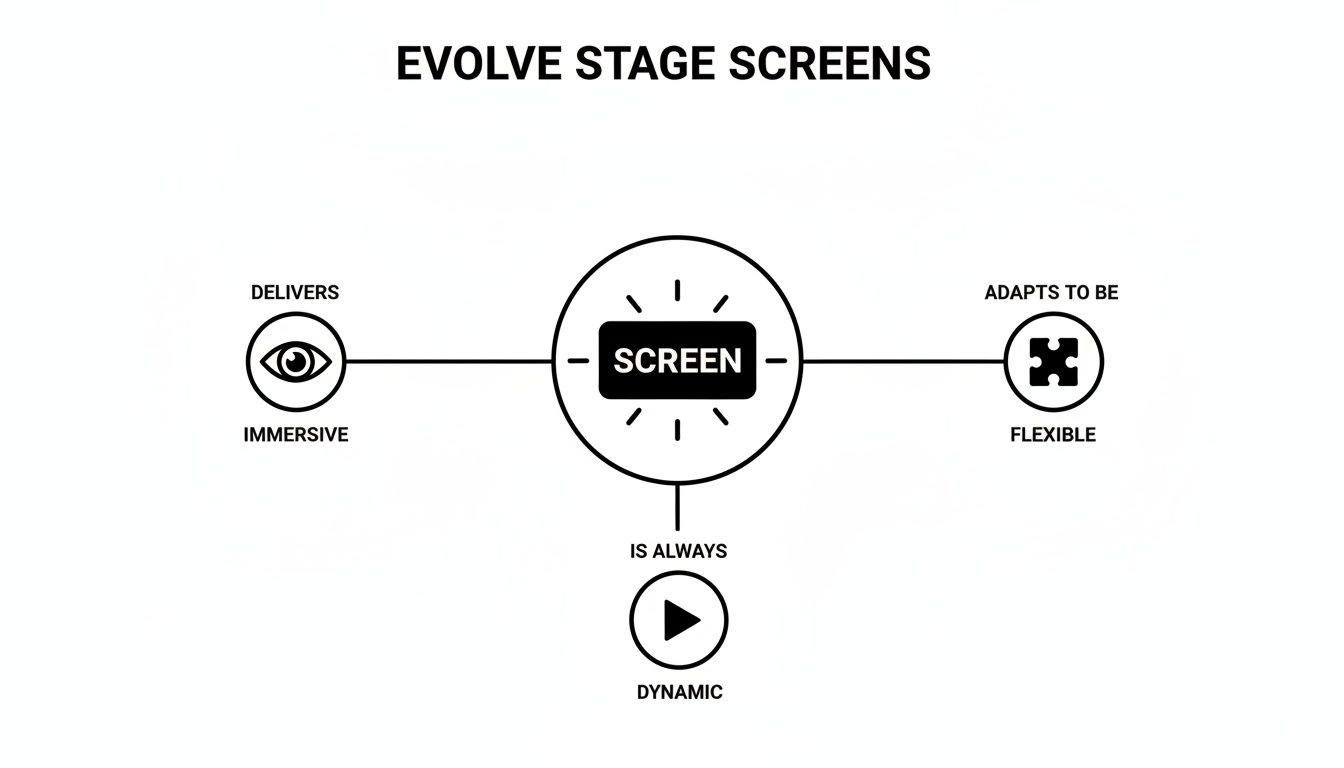
As you can see, these three qualities are the direct result of getting the technical details right. That deeply immersive feeling? It comes from a fine pixel pitch that makes the image feel real. We build our products around this principle, and you can see it in action when you look at product lines like the Smart LED Inc. FX2 2.5mm LED video wall at https://smartledinc.com/smart-led-inc-introduces-fx2-2-5mm-led-video-wall-product-lines/, which are designed from the ground up to deliver that high-impact clarity.
To make these terms even clearer, here's a quick cheat sheet that connects the dots between the technical name, what it actually does, and why it matters for your stage.
| Specification | What It Measures | Why It Matters for Your Stage |
|---|---|---|
| Pixel Pitch (mm) | The distance between individual pixels. | A smaller number means a sharper, higher-resolution image, which is crucial for close viewing distances. |
| Brightness (Nits) | The screen's light output. | Ensures your content is visible, whether in a dark theater or under the bright sun at an outdoor festival. |
| Refresh Rate (Hz) | How many times per second the image is redrawn. | A high refresh rate prevents flickering on camera, making it essential for any event that will be filmed or broadcast. |
| Color Depth (Bits) | The range of colors the screen can display. | Higher bit depth creates smoother color gradients and more accurate, lifelike images. |
Getting these specs right is the foundation of a stunning visual show. Each one plays a critical role in bringing your vision to life.
An LED screen's brightness is measured in a unit called nits. To give you a sense of scale, one nit is about the same amount of light produced by a single candle. That might not sound like much, but today's LED screens can get incredibly bright.
For an indoor venue like a church or a theater with controlled lighting, a screen with 800 to 1,500 nits is usually more than enough to look vibrant. But if you're taking your event outdoors, you're in a completely different ballgame—you're fighting the sun. To stay visible on a bright, sunny day, an outdoor screen needs some serious power, often 5,000 nits or more.
Getting this wrong can ruin an event. An indoor screen that's too bright will literally hurt your audience's eyes. And an outdoor screen that isn't bright enough will look faded and washed out, making it completely useless.
Have you ever tried to take a video of a screen with your phone, only to see ugly, flickering lines scrolling across it? That's a low refresh rate in action. Measured in Hertz (Hz), the refresh rate is simply how many times per second the screen redraws the entire image.
If there's any chance your event will be filmed or broadcast, a high refresh rate of 3,840 Hz or higher is non-negotiable. It's the only way to guarantee a smooth, stable, and flicker-free image on camera. A lower rate might look perfectly fine to the naked eye, but it can make your event look amateurish on video.
Finally, color depth determines the sheer number of colors the screen can reproduce. Measured in bits, a higher bit depth means smoother gradients and more accurate colors. This is what makes sure a company's logo is the exact right shade of blue or that a video of a sunset looks breathtakingly real. An 8-bit screen can display 16.7 million colors (which sounds like a lot), but a 10-bit screen can display over a billion, which completely eliminates "color banding" and creates a far more lifelike picture.
Understanding how light and color are controlled is key to creating an experience, a concept that's also at the heart of technologies like LED dance floor lighting solutions. By getting a handle on these core specs, you're no longer just buying a screen—you're making a strategic investment in the perfect visual outcome.
Picking the perfect stage LED screen isn't about chasing the biggest, brightest, or most expensive panel on the market. The right choice is the one that fits your specific world. To get there, you need to think through three key pillars: your venue, your audience, and your content.
Each of these elements pulls the technical requirements in a different direction. Think about it—a massive, rugged screen for an outdoor music festival has a completely different job to do than a high-definition backdrop for a corporate ballroom. One needs insane brightness and weatherproofing, while the other demands flawless resolution to make text and fine details pop.
Getting this right means you don't waste money on specs you'll never use, or worse, cut the wrong corner and end up with a screen that just doesn't deliver. It’s all about matching the tech to the job to make sure every dollar you spend creates a real impact. It’s this need for tailored solutions that’s fueling incredible growth in the industry.
In fact, the global market for stage LED screens is expected to hit roughly USD 20.74 billion by 2033, and it's climbing fast. This just goes to show how vital great visual displays have become for live events of all kinds. You can dig into the numbers and see the stage LED screens market dynamics for yourself.
One of the most critical specs you'll look at is pixel pitch. This is what determines the screen's sharpness. Thankfully, there's a simple rule of thumb that works wonders: 1mm of pixel pitch for every meter of viewing distance.
Here’s what that looks like in the real world:
Following this guideline is the secret to making sure your investment looks incredible from every single seat. It keeps you from overpaying for a super-high resolution nobody can appreciate from the back row, or choosing a pitch that looks blocky and pixelated to those up front.
What you put on the screen is just as important as where you put the screen itself. The tech needed to show a static company logo is a world away from what's required for a fast-paced video feed.
Let's break it down by content type:
At the end of the day, the right stage LED screen is a strategic tool. By taking the time to weigh your venue, audience, and content, you can make a choice that truly elevates your event. Here at Smart LED Inc., we work as your partner, walking you through these decisions to make sure you invest wisely and get the visual knockout you're looking for.
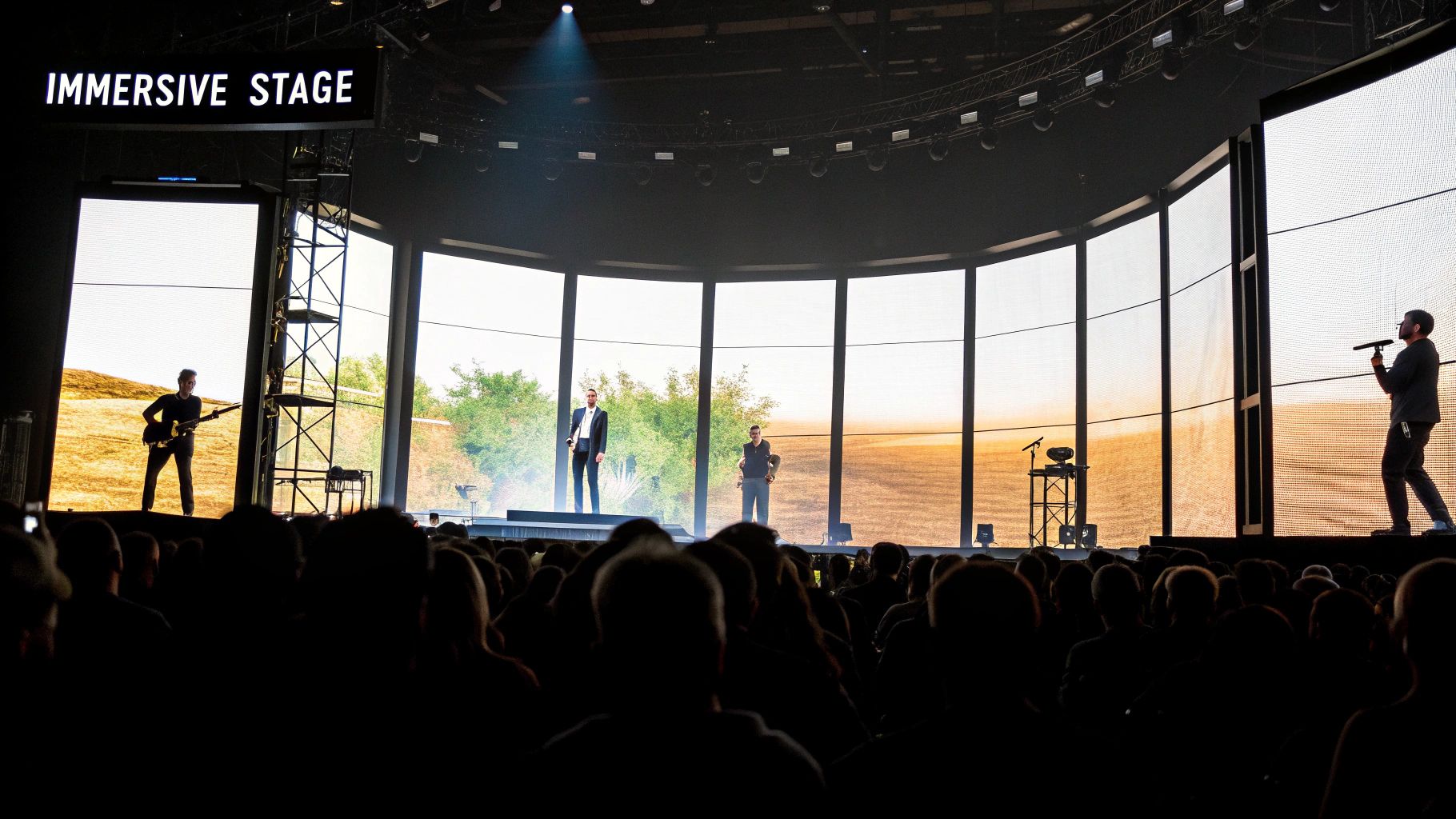
Knowing the tech specs is one thing, but seeing what these screens can do is where the real magic happens. Stage LED screens aren't just big TVs. They are powerful tools for reshaping an environment, telling a story, and forging a genuine emotional connection with an audience. Their real strength lies in their chameleon-like ability to serve completely different needs depending on the venue.
Let's look at how these dynamic displays are making a huge impact in three very different worlds.
At a modern concert, the stage is no longer just a platform—it's a portal. This is where stage LED screens truly come alive, using breathtaking scale and mind-bending configurations to create visual spectacles that are impossible to forget. Artists have moved beyond static props and now use LED technology to build entire universes around them.
The most innovative tours are pushing the creative boundaries in exciting ways:
For a performer, the right LED screen becomes a storytelling partner. It breathes with the music, amplifies the emotion of a song, and transforms a performance into a multi-sensory journey that sticks with you long after the lights go up.
In the corporate world, making a sharp, lasting impression is everything. Stage LED screens have become essential for turning a standard presentation into a high-impact brand experience. They provide a polished, professional, and incredibly powerful way to communicate key messages without saying a word.
A high-resolution LED wall can completely elevate the tone of a corporate event by:
These displays are a huge part of the event industry. The global LED display market hit USD 8.96 billion in 2023, and indoor applications—think corporate events—make up 45% of that revenue. You can dig into the numbers yourself in this LED display market research report to see what's driving the growth.
For houses of worship, stage LED screens are used to deepen the connection with their congregations. Here, the goal isn't spectacle but clarity, participation, and creating a shared spiritual experience. The technology simply makes the service more accessible and engaging for every single person in the room.
In this setting, the screens fulfill several crucial roles:
To get a better sense of how these displays can work in an indoor setting, take a look at our guide to Smart LED indoor LED wall panels. Whether it's a concert stage or a corporate boardroom, the right LED screen can transform any space into a truly dynamic environment.
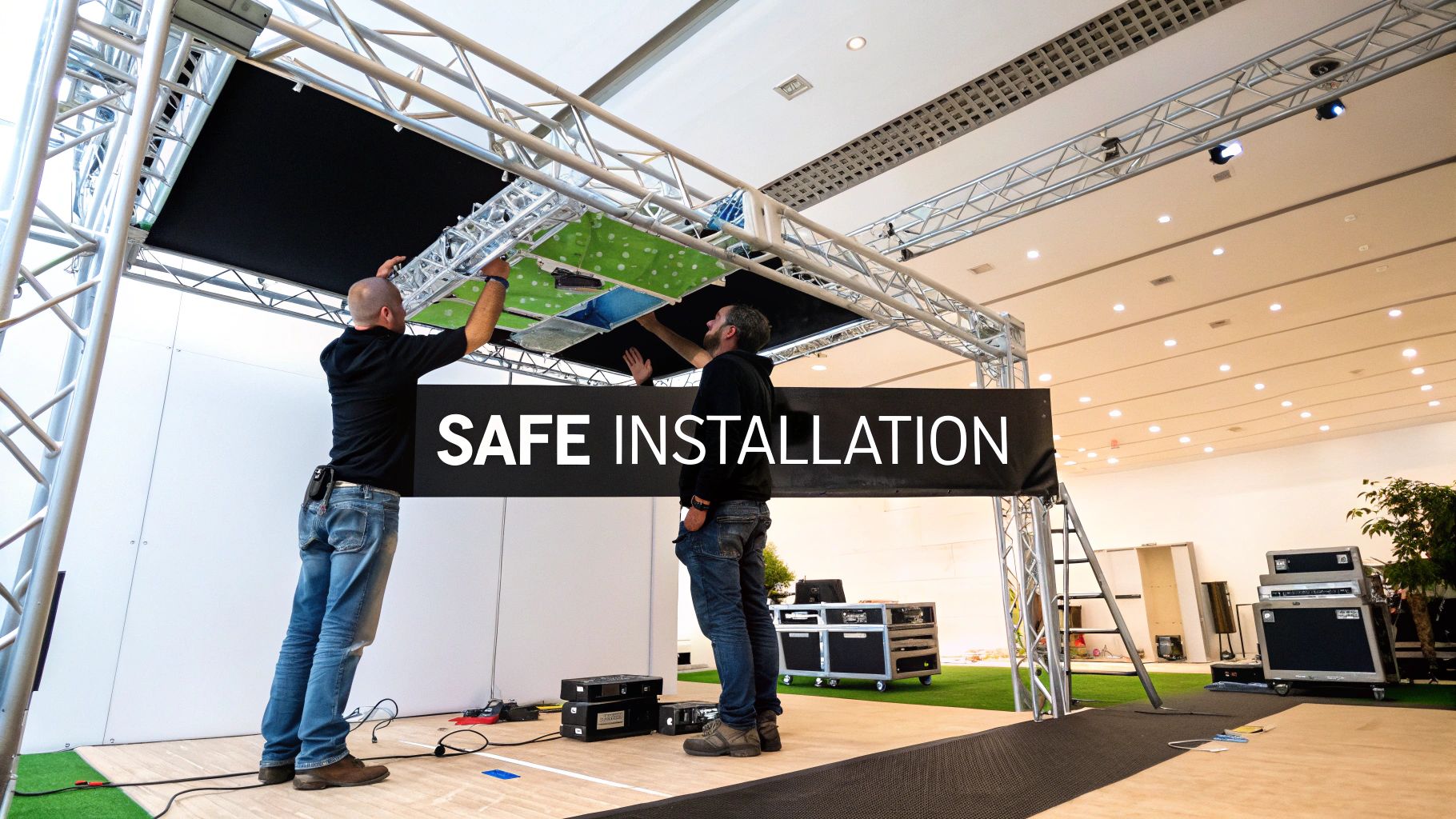
Getting a professional stage LED screen is a serious investment in your event's visual impact. To make sure that investment pays off for years to come, you need a solid plan for installation and maintenance right from the start. Getting the setup right is about more than just aesthetics—it's about safety, stability, and making your screen last.
The first big question is how you’re going to put the screen together. There are two main ways to do it, and each one fits different venues and event styles. Let’s break them down so you can plan your space and budget accordingly.
Choosing between stacking or flying your screen is a foundational decision. It directly affects your labor costs, what kind of structural support you'll need, and the final look of your stage design.
Ground Stacking: This is typically the more straightforward and faster method. You simply build the screen from the ground up, panel by panel, on a solid, level base or a low-profile truss. It's a fantastic option for indoor events, smaller stages, or any venue where you don't have rigging points in the ceiling.
Flying (Hanging): For that sleek, professional look you see at major concerts, "flying" the screen is the way to go. This involves hanging the entire display from rigging points in the ceiling or from a large truss arch. This method frees up precious floor space on your stage but requires a professional structural engineer to verify that the support points can safely handle the load.
No matter which method you choose, a structural assessment by a qualified pro is non-negotiable. The total weight of hundreds of LED panels adds up fast, and cutting corners on safety can lead to disaster. This step is all about protecting your venue, your crew, and your audience.
Peace of mind comes from knowing your display is not only visually spectacular but also structurally sound. A professional installation handles the complex load calculations and safety checks, allowing you to focus on creating an amazing show.
Once your screen is up and running, consistent care is what will help it reach its full lifespan, which can often be more than 80,000 hours of use. Staying on top of maintenance helps stop small problems from turning into expensive failures and keeps your display looking bright and sharp.
Think of it like owning a high-performance car—you wouldn’t just ignore the oil changes and hope for the best. A few simple, routine checks can make a huge difference in the life and quality of your LED screen.
Here are a few essential maintenance habits to get into:
For screens set up outside, it's also vital to check that all weather seals and protective casings are in good shape. Our expertise goes beyond indoor stages; you can see what it takes to build durable displays for the elements in our guide on digital outdoor signage. Smart LED Inc.'s nationwide support ensures you have expert help from day one, covering everything from design and installation to the ongoing life of your screen.
Diving into the world of stage LED screens always brings up some practical questions. Once you get past the basic technology, you start wondering about the real-world stuff: costs, how long they last, and what it's like to use one day-to-day. We get it. This section cuts straight to the chase, answering the most common questions we hear from event planners, venue owners, and church leaders just like you.
Our goal here is to pull back the curtain on the whole process. We want you to have the confidence and the knowledge to make a smart investment—one that pays off with incredible visuals and real value for your organization.
This is usually the first question on everyone's mind, and the honest answer is: it depends. The price of a stage LED screen can vary wildly because you're not just buying a product off a shelf; you're commissioning a custom visual centerpiece. The final cost really comes down to the tech you choose for your specific needs.
A few key things drive the price:
A small, high-res screen for a church sanctuary will have a completely different price than a massive, curved video wall for a concert tour. Because we at Smart LED Inc. are factory-direct, we cut out the middleman markups that often inflate the cost. The best way to get a real number is to chat with our team; we can give you a precise quote based on your venue, your goals, and your budget.
A well-made LED screen is a serious long-term investment, not just a piece of gear you'll replace in a couple of years. These displays are built tough, typically rated for 80,000 to 100,000 hours of use. To put that into perspective, that’s easily over a decade of reliable service, even if you’re running it constantly.
Of course, the actual lifespan you get depends on a few things. How often you use it, the environment it’s in (a climate-controlled theater vs. an outdoor festival stage), and how well you keep up with maintenance all play a role in getting the most out of your screen.
Over many years, individual LED diodes will slowly and gradually dim, but quality engineering ensures this happens at an incredibly slow, uniform rate across the entire screen. This is what guarantees your display will look vibrant and consistent for years to come.
At Smart LED Inc., we're sticklers for using top-tier components and manufacturing processes. We build our screens to meet and exceed those industry standards, ensuring you get a great return on your investment through years of dependable, brilliant performance.
Think of your LED screen as a giant, incredibly dynamic digital canvas. Its versatility is its superpower. Modern systems are built to handle just about any kind of digital content you can throw at them, giving your creative team a massive playground.
Everything is managed through a video processor and control software. This setup is the brain of the operation, letting your team switch between different video sources, create cool picture-in-picture layouts, and run the whole visual experience without a hitch.
You can display pretty much anything, including:
The systems from Smart LED Inc. are designed to play nicely with all the standard video sources and software out there. This makes it easy for your team to plug the screen right into their existing workflow, whether they're running a simple corporate presentation or a complex live show.
At a glance, they might look similar, but indoor and outdoor LED screens are two completely different beasts, engineered for two completely different worlds. The two main things that set them apart are brightness and weatherproofing.
An outdoor screen is in a constant battle with the sun. To win, it needs to be intensely bright—we're talking 5,000 nits or more. An indoor screen, sitting in a controlled lighting environment, only needs about 800-1,500 nits to look fantastic.
Beyond that, outdoor screens are built like tanks to handle whatever Mother Nature throws at them. They have an IP (Ingress Protection) rating, which is a formal grade of how well they resist dust and water. They’re made with rugged parts, UV-resistant coatings, and specialized cooling systems. Indoor screens don't need that heavy-duty protection, so they are instead optimized with finer pixel pitches for sharp, up-close viewing. Smart LED Inc. builds specialized solutions for both applications, so you can be sure you're getting the right tool for the job.
Ready to see what an LED display can do for your stage? The experts at Smart LED Inc. are here to walk you through every step, from the first sketch to the final installation. Our factory-direct model means you get top-tier quality without the inflated price tag.
Explore our high-impact LED screen solutions at smartledinc.com
In recent times, the value of psychological support animals (ESAs) has acquired substantial interest, specifically amongst people grappling with mental health issues. An ESA can
Mastercard is just one of one of the most commonly accepted settlement approaches worldwide, and it’s no Curacao Online Casino Spiele surprise that several on-line
There are many ways to play the Bier Haus slot machine. Based on the paylines, this slot machine can give up to 243 ways to
"*" indicates required fields

We have sent a 6-digit verification code to your email. Please enter it below to continue.