Spinbit Casino: Reading the Fine Print Before You Spin
Online casinos are good at making chance look orderly. A bright lobby, tidy game categories and a spin button that seems to have excellent posture
So, you're wondering how much a digital sign costs. The short answer? It can be anything from a few thousand dollars for a small sign you might see inside a store, all the way up to $100,000 or more for a massive outdoor billboard.
Think of it like buying a car. The sticker price for the base model is just the starting point. The final cost really depends on the performance, features, and all the extras you add on.
Let's cut to the chase. You need a number, but the truth is, there's no single price tag. This guide is built to give you a real-world feel for what to expect, from smaller indoor displays to those huge signs you see on the side of the highway.
The sign itself—the hardware—is just one piece of the puzzle. It’s crucial to understand this from the get-go to avoid surprise costs later on. Knowing this also shows why working directly with a manufacturer like Smart LED Inc. can save you a ton of money by cutting out the middlemen who mark up the price.
One thing is for sure: you're not alone in looking for a digital sign. The demand for this technology is exploding. The global digital signage market was valued at USD 28.83 billion in 2024 and is expected to hit USD 45.94 billion by 2030—that's a growth rate of 8.1% every year.
This boom is happening for a reason. Businesses, especially in retail, are using digital displays to grab attention and compete with the online giants. You can dig deeper into these trends over at Grandview Research.
Our goal here is to give you a solid starting point before we get into the nitty-gritty details that will shape your final quote. Once you get a handle on the basics, you'll be able to plan your project with confidence.
To help you set a realistic budget, here's a quick look at what you can generally expect to pay for just the hardware.
This table gives you a ballpark idea for different types of signs. Keep in mind, these are starting points and don't include things like installation, software, or ongoing maintenance.
| Sign Type | Typical Size Range | Estimated Price Range (Hardware Only) |
|---|---|---|
| Small Indoor Display | 2' x 4' | $2,500 – $6,000 |
| Medium Outdoor Sign | 4' x 8' | $12,000 – $25,000 |
| Large Monument Sign | 6' x 12' | $25,000 – $50,000 |
| Roadside Billboard | 14' x 48' | $90,000 – $200,000+ |
As you can see, the price jumps significantly when you move outdoors or go bigger. An outdoor sign needs to be tough enough to handle the weather and bright enough to be seen in direct sunlight, and those features add to the final cost.
When you look at a digital sign, you're not just seeing a screen; you're seeing a complex collection of tiny lights working in perfect harmony. The specific qualities of those lights and the box they live in are, by far, the biggest drivers of the final digital sign prices. While things like software and installation are definitely part of the equation, the physical hardware is where the bulk of your initial investment will go.
Think of it like buying a high-performance sports car. The engine is what really dictates the price and what the car can do on the road. It's the same with an LED display. The core components are what determine its cost and capabilities. These aren't just obscure technical details; they're the fundamental choices that affect everything from how sharp your image is to whether your sign can survive a brutal thunderstorm. Getting a handle on these factors is the first real step to building an accurate budget.
Recent market analysis backs this up, showing hardware is easily the most significant chunk of the cost. As of 2025, the hardware component captured the largest revenue share at a massive 56.60%. This means the physical display equipment itself makes up most of what customers spend. While video walls are the most common product out there, exciting technologies like transparent LED screens are coming on strong as premium, fast-growing options. You can see a full breakdown of these market trends on Precedence Research.
One of the most critical—and often misunderstood—factors in this whole discussion is pixel pitch. In simple terms, this is just the distance, measured in millimeters, from the center of one tiny LED light to the center of the one next to it.
Imagine a photograph made of dots. If the dots are spread far apart (that's a high pixel pitch), the image looks blocky and undefined, especially when you're standing close. But if you pack those dots tightly together (a low pixel pitch), the image snaps into focus, becoming sharp, clear, and full of detail. A sign with a 6mm pixel pitch has way more LEDs packed into the same space than a 10mm sign, which gives you a higher resolution but also comes with a higher cost.
Key Takeaway: A lower pixel pitch number means a sharper, more detailed image, which is perfect for closer viewing distances. Just remember, that increased LED density also means a higher price tag.
For a massive billboard that people see from hundreds of feet away on the highway, a higher pixel pitch is perfectly fine and saves a lot of money. But for a storefront sign where your customers are just a few feet away, a lower pixel pitch is an absolute must for a professional, high-quality look.
Where your sign will live dramatically changes how it needs to be built and, you guessed it, its price. An outdoor sign is a completely different beast from an indoor one, engineered from the ground up to handle a whole different set of challenges.
Brightness (Nits): An indoor sign just has to compete with the lights in a room. An outdoor sign, on the other hand, has to go head-to-head with direct, bright sunlight and win. This brightness is measured in nits, and outdoor displays need a powerful rating of 5,000 nits or more, making them significantly more robust and expensive.
Durability (IP Rating): Outdoor signs have to be built like a tank. They need to be ready for anything mother nature throws at them—rain, snow, dust, and extreme temperatures. This ruggedness is measured by an IP (Ingress Protection) rating. A high IP rating, like IP65, ensures the sign is completely sealed against the elements, a feature that adds to its manufacturing complexity and cost.
Finally, the physical size and the overall resolution of the sign work together to lock in the final hardware cost. It’s a pretty straightforward idea: a bigger sign needs more materials. That means more LEDs, a larger cabinet, and more power supplies, all of which drive up the price.
But size is only half the story. A very large sign with a low resolution (a high pixel pitch) might actually cost less than a smaller sign that's packed with a super high, 4K-level resolution (a low pixel pitch). The real key is to match the sign's size and resolution to its intended viewing distance and what you want to achieve with it. By understanding how all these hardware pieces connect, you can make smarter decisions that work for both your budget and your business goals. For a deeper dive into how these factors apply to different settings, check out our guide on LED signs for businesses.
One of the biggest mistakes you can make when budgeting for a digital sign is thinking the screen's sticker price is the final bill. It’s a classic rookie error. The real investment—the true digital sign price—is tied up in the total cost of ownership, which includes a whole host of expenses that pop up long after you've picked out the perfect display.
If you ignore these so-called "hidden" costs, you're setting yourself up for project delays, blown budgets, and a whole lot of frustration. To get your numbers right, you have to look past the hardware and account for everything it takes to get that sign up, running, and pulling in customers for years to come.
This graphic breaks down the big three hardware factors that set the initial price tag for the sign itself.
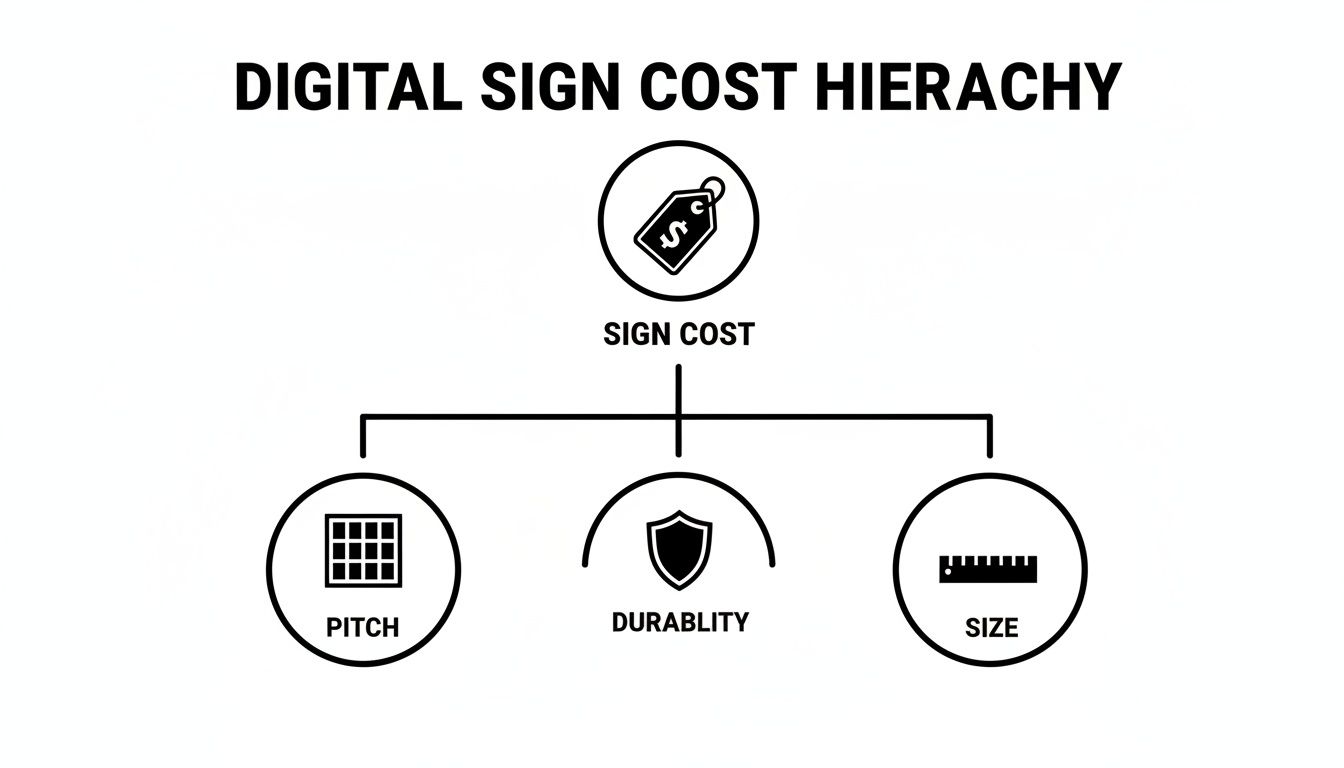
While pixel pitch, durability, and size anchor the sign's base cost, the real budget-busters are often the installation, software, and ongoing upkeep. These are the things that add up.
The complexity of your installation can completely change the financial picture. Mounting a small indoor screen on a wall? That’s a relatively simple job, maybe just a few hundred bucks. But putting up a massive outdoor pylon sign? That’s a full-blown construction project.
This kind of large-scale installation is a different beast entirely and often requires:
A complex outdoor sign installation can easily tack on $5,000 to $20,000 or more to your total project cost. That number can swing wildly depending on the sign's size, where you're putting it, and local labor rates.
On top of all that, you can't just stick a sign wherever you feel like it. You have to navigate a maze of local zoning laws and pull the right permits. This process alone can add weeks, or even months, to your timeline, not to mention all the administrative fees that come with it.
Your fancy new digital sign is really only as smart as the software that powers it. This is what lets you create content, schedule your ads, and manage everything that shows up on screen. Some basic, bare-bones software might be thrown in for free, but the powerful, user-friendly systems almost always come with a subscription fee.
Don't skimp here. Investing in a quality control system is what turns your sign from a passive screen into an active, money-making marketing tool. There's a reason the digital signage software market was valued at USD 11.7 billion in 2025 and is on track to hit USD 13.2 billion by 2026—businesses know that powerful, integrated solutions are worth paying for.
And it's not just about the sign's operating system. You also need to think about the operational costs of interactive digital content, like QR code platforms. Factoring these in from the start ensures you can maximize your sign's potential without getting hit with unexpected recurring charges down the road.
Finally, you have to think long-term. Just like any other piece of technology, digital signs need maintenance. We're talking routine cleaning, software updates, and the occasional component repair.
A solid warranty is your best defense against surprise repair bills. It can cover parts and sometimes even on-site labor for a set period. Yes, a better warranty might bump up the upfront price a little, but the peace of mind it buys is invaluable. It can easily save you thousands in the long run.
Price ranges and technical specs are one thing, but nothing makes the numbers click quite like seeing them in action. To really get a feel for how digital sign prices come together, we need to move from theory to reality. Walking through a few common projects helps connect the dots between a business’s goals and the final number on the invoice.
This is where you can see exactly how pixel pitch, installation headaches, and software choices all shape the total investment. Seeing these pieces come together in a real-world context makes it much easier to picture your own project and budget with confidence. Let's break down a couple of typical scenarios.
Picture a small, local clothing boutique on a bustling downtown street. The owner has one simple goal: grab the attention of pedestrians and pull more foot traffic through the door. They want to showcase crisp images of new arrivals, announce flash sales, and promote seasonal events right where people can see them.
The perfect fit here is a single-sided, full-color outdoor LED sign, maybe 4 feet by 8 feet, mounted flush against the building's facade. Because shoppers will be just a few feet away on the sidewalk, a tight pixel pitch of 6mm is a must-have for those sharp, detailed visuals.
Here’s how the costs for a project like this might stack up:
By looking at these components, the boutique owner can see exactly where every dollar of their investment is going.
Now, let's think about a community church on a main road with steady traffic. Their old, static letter board is faded, and someone has to trudge outside to change the message in the rain and snow. They want to upgrade to a modern digital marquee to post service times, share inspirational messages, and promote community events like bake sales or youth group meetings.
For them, the ideal setup is a double-sided monument sign, around 5 feet by 10 feet, with a digital display that doesn't need to be ultra-high-resolution. Since people will be driving by at 35-45 mph, a 10mm or 12mm pixel pitch is more than enough to get the message across and is far more cost-effective.
Project Insight: Viewing distance is everything when choosing a pixel pitch. A sign meant for drivers doesn't need the same pixel density as one for pedestrians right in front of it. This is one of the biggest opportunities to save money without losing impact.
The scope of this project is much more involved:
This example really highlights how a larger physical structure and a more complex installation can drive up the total cost, even when the LED display itself has a more budget-friendly resolution.
Putting these two scenarios side-by-side reveals how different needs create very different price points. Here's a detailed look at the itemized costs for these digital signage projects, illustrating how various components contribute to the total investment.
| Project Type | Hardware Cost | Installation And Permitting | Software And Control System | Total Estimated Cost |
|---|---|---|---|---|
| Retail Boutique (4'x8', 6mm) | ~$14,000 | ~$3,500 | ~$1,500 | ~$19,000 |
| Church Marquee (5'x10', 10mm) | ~$22,000 | ~$9,000 | ~$1,500 | ~$32,500 |
These examples turn abstract pricing into something you can really work with. You can start to see how your own goals—whether it’s attracting up-close shoppers or broadcasting messages to passing traffic—will directly influence the specs and, ultimately, the final cost of your digital sign.
When you're thinking about a digital sign, it's easy to get stuck on the price tag. But that's the wrong way to look at it. The real conversation isn't about cost—it's about value. You're not just buying a sign; you're making a powerful investment in your business's future.
The only question that truly matters is how much return that investment will bring you over time. This is your return on investment (ROI), and it's the ultimate measure of a sign's worth. A well-placed, eye-catching digital display can drive sales, boost foot traffic, and even open up new revenue streams if you decide to sell ad space.
The proof is in the numbers. The digital signage market has exploded, growing from USD 19.78 billion in 2018 to an estimated USD 28.83 billion in 2024. Why the massive growth? Because businesses everywhere are seeing firsthand how these signs transform customer engagement and create smarter, more dynamic spaces. You can dig deeper into this market expansion at Fortune Business Insights.
Figuring out your sign's payback period is probably simpler than you think. It really just comes down to one thing: how long will it take for the new business generated by the sign to completely cover its initial cost?
Let's break it down with a straightforward example. Say a new outdoor sign costs you $20,000 for the whole package—sign, installation, everything. If that sign brings in just $100 in extra revenue each day, it will pay for itself in only 200 days. That's less than seven months to a full return.
To map out your own potential ROI, start tracking these key metrics:
Even with a crystal-clear path to a strong ROI, coming up with the cash for a high-quality digital sign can be a big ask. We get it. The good news is, you don't have to pay for it all at once. Financing and leasing options are designed to make this technology accessible for any business.
Key Insight: Financing lets you spread the cost over several years, turning a large one-time expense into a small, predictable monthly payment. Often, this means the sign starts paying for itself—and then some—from the very first month it's switched on.
This mindset of weighing upfront costs against long-term value is crucial. It applies to many business investments. For an interesting parallel, check out this guide on Ceramic Coating Vs PPF Cost: A Complete Financial Guide. The logic of comparing an initial outlay against ongoing benefits is exactly how you should approach your new sign.
Exploring different payment structures is just smart business. We've put together a guide on financing an LED sign that walks you through the specifics. By using these options, you can get a powerful marketing asset working for you now and let it pay for itself with all the new revenue it helps bring in.

Alright, you've done the research and have a feel for the landscape. Now for the exciting part: moving from ideas on a page to a real, tangible plan for your business. After exploring all the factors that go into digital sign prices, it's time to get a number that’s actually built for your project.
A generic price list can only get you so far. A custom quote is where your vision starts to take shape, complete with a clear budget and a solid path forward.
This isn't about getting roped into a high-pressure sales call. We believe in making this step simple and transparent. The goal is to give you a solid, data-backed estimate quickly, so you can make an informed decision without any of the usual guesswork. It’s all about turning your specific needs into a real starting point for a conversation.
The fastest way to get a personalized price is to start with our online calculator. Think of it as a tool that demystifies the whole quoting process. It walks you through the key variables that will shape your final cost, giving you immediate insight into what your investment might look like.
It's designed to be your first practical step. We'll just ask for a few key details about your project:
With just that simple input, our system has what it needs to generate a realistic baseline estimate. No fluff, just a clear starting point.
You don't need to be a tech expert to get a good estimate. A well-designed calculator translates your business goals—like reaching drivers on a busy street or catching the eye of shoppers on the sidewalk—into the technical specs required to make it happen.
Once you have that initial estimate in hand, the next step is a quick chat with one of our project consultants. This is your chance to really dial in the details and make sure the final quote covers everything from A to Z. The more prepared you are, the more productive this call will be.
Before you connect, try to have this information ready:
Getting this sorted out beforehand allows our team to give you the best possible recommendations right out of the gate. To see how these factors impact your specific digital sign prices, the best next step is to fill out our custom LED sign request. We'll get you a detailed, no-obligation quote tailored completely to your vision.
Of course. Here is the rewritten section, crafted to sound like an experienced human expert in the LED sign industry.
When you're thinking about a digital sign, the initial price tag is just the start of the conversation. It's the long-term costs and real-world value that truly matter. Let's tackle some of the most common questions that pop up when businesses start crunching the numbers.
Think of this as getting straight answers beyond the hardware quote. We're talking about the practical, day-to-day realities of owning a sign—the kind of insights you need to make a truly confident investment.
This really boils down to how you decide to pay for it. If you purchase the sign outright, your only recurring costs are pretty minimal: electricity and maybe a software subscription. For an average outdoor sign, you can expect your electricity bill to go up by about $30 to $100 per month. This can swing a bit based on the sign's size, how bright you run it, and what your local utility company charges.
The other route is financing. Many businesses choose this option to turn a large one-time capital expense into a predictable monthly operating cost. Your payment bundles the hardware, and often the installation and software, into one fixed amount, making it much easier to budget for.
Without a doubt. For a small business, a digital sign is one of the hardest-working marketing tools you can own. It's your 24/7 salesperson, sitting right outside your door, broadcasting sales, new arrivals, and your brand’s personality to every person who drives by.
There's a well-known rule of thumb in our industry: a good digital sign can boost a business's sales by anywhere from 15% to 150%. It drives foot traffic and builds top-of-mind awareness in your community. You'd be surprised how quickly the sign can pay for itself.
Yes, and this is where a lot of people get tripped up. Focusing only on the price of the screen itself is a classic mistake. The true digital sign prices have to include a few other critical components we've talked about:
Ready to see what a high-impact sign could look like for your business? At Smart LED Inc., we offer factory-direct pricing that cuts out the middlemen and the markups. Get a free, no-obligation quote tailored to your exact needs by visiting https://smartledinc.com.
Online casinos are good at making chance look orderly. A bright lobby, tidy game categories and a spin button that seems to have excellent posture
A good online casino experience is built from small decisions: checking the terms before claiming a promotion, choosing games that suit your budget, and knowing
Online casino gaming can be entertaining when it is approached with care, realistic expectations and a clear understanding of how games work. Australian players researching
"*" indicates required fields

We have sent a 6-digit verification code to your email. Please enter it below to continue.