Think of a video display wall as a giant, seamless digital canvas. It's not just one screen, but a whole system of smaller, interconnected displays that work together to create a single, massive, high-impact image. This is the kind of technology that can completely transform a space, whether it's a bustling retail store or a high-stakes command center. They’re less like TVs and more like powerful storytelling platforms built to grab an audience and deliver information on a grand scale.
What Are Video Display Walls and Why Do They Matter
Ever seen a mosaic, where thousands of tiny tiles combine to create one breathtaking picture? A modern video wall works on a very similar principle. The difference is that its "tiles" are dynamic, glowing pixels. Each individual screen or panel is a piece of a much larger puzzle, and when they all come together, they create a unified visual experience that no single television could ever hope to match. This technology doesn't just display content; it creates an immersive environment.
This ability to craft large-scale, dynamic visuals is exactly why video display walls have become such an essential tool for communication. They demand attention in a way static posters or smaller screens just can't. A business can use one to make an unforgettable first impression in their lobby, a university can pull students right into a lecture, or a retailer can showcase their products with true cinematic flair.
The Growing Demand for Immersive Visuals
It’s no surprise that the market for these impressive displays is blowing up. Businesses in just about every sector are realizing their power to capture attention and get a message across with real impact. This isn't just a fleeting trend; it’s a fundamental shift in how organizations communicate with the world.
The global video wall market was valued at USD 2.0 billion and is projected to skyrocket to USD 7.98 billion by 2032, fueled by a robust CAGR of 9.76%. This surge highlights a massive demand for immersive, large-format displays that deliver visuals far beyond what traditional screens can achieve.
This incredible growth just hammers home the point: in a world oversaturated with information, bigger and bolder visuals are what cut through the noise. Video walls are no longer a niche luxury—they're a strategic asset. You can dig deeper into this market expansion and find more detailed stats in the full research from Verified Market Research.
More Than Just a Big Screen
It's easy to look at a video wall and think of it as just an oversized monitor, but that's missing the bigger picture. It’s actually a complete system with several key components working in perfect harmony:
Display Panels: These are the building blocks of the wall itself. They usually come in two main flavors: LED or LCD technology.
Video Processor: This is the "brain" of the operation. It takes one or more video sources and intelligently splits the image across all the individual screens so it looks like one cohesive picture.
Mounting System: You can't just stick these on a wall. A specialized structure is needed to hold the panels together, ensuring perfect alignment and creating that seamless look.
Content Management System (CMS): This is the software that puts you in the driver's seat, allowing you to control, schedule, and update all the content that appears on the wall.
Getting a handle on these elements is the first step toward really appreciating the power and versatility of a video display wall. They aren't just about showing a picture; they are about creating an experience.
Choosing the Right Technology: LED vs. LCD
When you're ready to invest in a video wall, one of the first big decisions you'll face is the technology behind the screen. It really comes down to two main players: LED (Light Emitting Diode) and LCD (Liquid Crystal Display).
This isn't about which one is "better" in a vacuum. Instead, it’s about what’s right for your specific space and what you want to achieve. Think of it like choosing between a massive, rugged off-road truck and a sleek, high-performance sports car. Both are amazing machines, but you wouldn't take the sports car mudding, and you wouldn't enter the truck in a Formula 1 race. The environment and the goal dictate the right choice.
LED technology is the undisputed champion for big, bright, and completely seamless displays. Picture a massive, vibrant screen at an outdoor concert or a jaw-dropping digital backdrop in a TV studio. That’s LED's home turf. Because LED displays are built from individual modules that fit together without any borders (or "bezels"), they create one continuous, uninterrupted canvas. Even better, each pixel makes its own light, letting them get incredibly bright—bright enough to look stunning even in direct sunlight.
On the other hand, an LCD video wall is built by arranging multiple commercial-grade, ultra-thin-bezel screens together into a grid. While you can still see very faint lines where the panels meet, modern LCDs deliver incredible sharpness and pinpoint color accuracy. This makes them a fantastic and often more budget-friendly choice for controlled indoor settings like corporate boardrooms, retail stores, or command centers where people are closer to the screen.
LED vs. LCD Video Walls at a Glance
To make the best call, it helps to see these two powerhouses side-by-side. The perfect fit for your video wall really hinges on where you'll use it and how you want it to perform.
Controlled indoor lighting (boardrooms, control rooms, retail)
Seamlessness
100% seamless. No gaps or lines between panels.
Ultra-thin bezels create nearly seamless look, but lines are visible up close.
Brightness
Extremely high. Easily cuts through direct sunlight.
Good for indoors, but can struggle in very bright ambient light.
Size & Shape
Limitless. Can be built to any size or creative shape (curves, corners).
Limited to standard rectangular grid configurations.
Initial Cost
Higher upfront investment, especially for high-resolution indoor models.
Lower upfront cost, making it more accessible for smaller budgets.
Lifespan
Generally longer, often 100,000+ hours.
Typically around 50,000-60,000 hours.
Viewing Distance
Best for medium-to-long distances. Closer viewing requires finer pixel pitch.
Excellent for up-close viewing due to high pixel density.
Ultimately, this table shows there's no single "winner." The right technology is the one that aligns with your space, audience, and budget.
Making the Right Choice for Your Goal
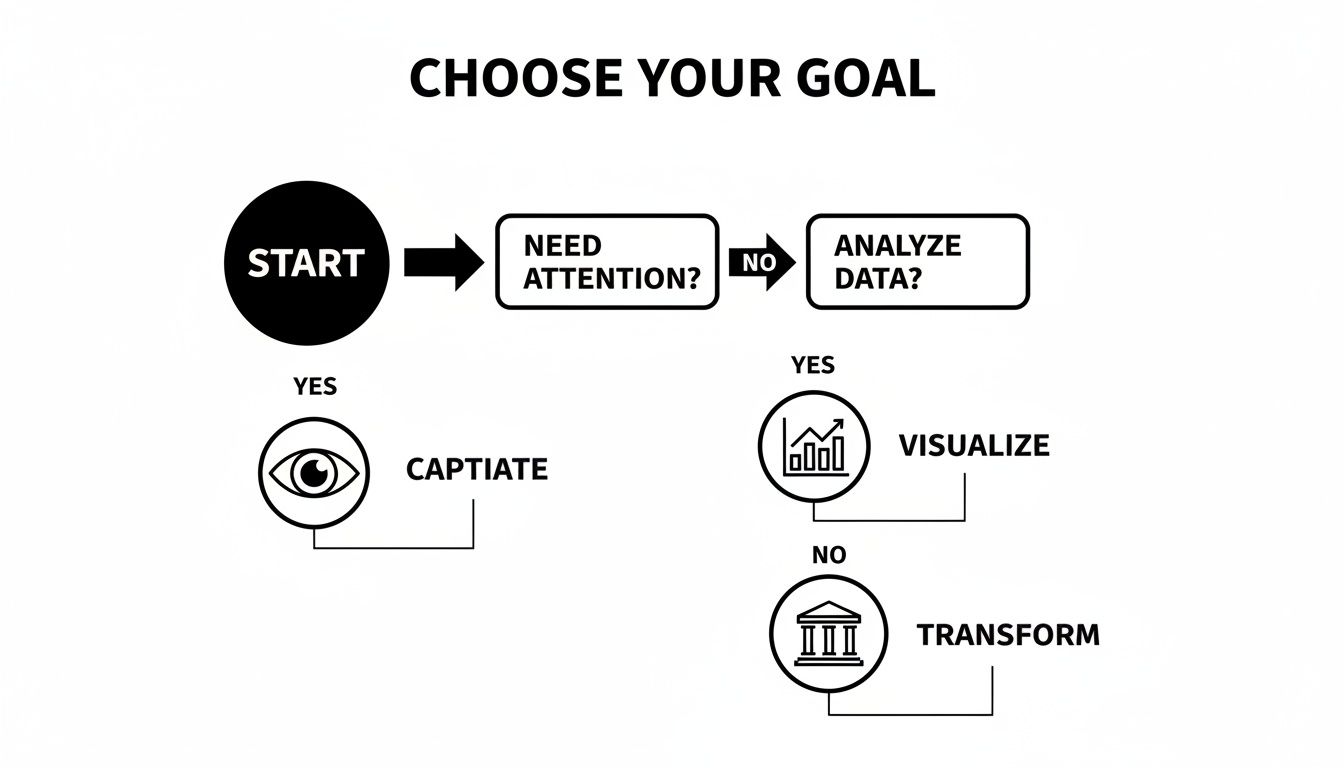
So, how do you decide? It all comes back to your primary goal. Are you trying to grab the attention of a huge crowd from far away? Do you need to show incredibly detailed data to a team in a meeting room? Or are you looking to completely transform a space with digital art?
This flowchart helps simplify the decision-making process.
A Practical Guide to Video Display Walls 4
As you can see, if your mission is to captivate and create a high-impact "wow" factor, especially at a distance or outdoors, LED is the clear winner. If you’re focused on visualizing fine-detail data up close or transforming an indoor space on a tighter budget, LCD is an excellent, powerful option.
For many of today's premier indoor projects that demand that flawless, high-end look without any seams, our Smart LED indoor LED wall panels are designed to deliver exactly that—bridging the gap between breathtaking performance and practical value. Making sure your tech choice lines up with your vision is the first step toward a successful project.
Understanding the Specs That Actually Matter
Let's be honest—technical spec sheets for video display walls can look like a foreign language. They're crammed with acronyms and numbers that don't mean much on their own. But here’s the good news: you only need to get a handle on a few key details to really understand how your display will look and perform for your audience.
Instead of getting lost in the weeds, we’re going to focus on the three pillars that truly define a video wall’s visual quality: Pixel Pitch, Resolution, and Brightness.
Think of these specs as the core ingredients in a recipe. Get them right, and the final result will be spectacular. Get them wrong, and the whole experience can fall flat, no matter how much you’ve invested. Knowing what they mean empowers you to see past the sales jargon and make a smart decision based on real-world performance.
Pixel Pitch: The Secret to a Seamless Image
Imagine a high-quality fabric. The tighter the weave and the closer the threads, the smoother and more detailed it looks up close. Pixel pitch is pretty much the digital version of that. It's the physical distance, measured in millimeters, from the center of one pixel to the center of the next.
A smaller pixel pitch number (like 1.5mm) means the pixels are packed tightly together, creating a high-density canvas perfect for sharp, crisp images—even when you’re standing just a few feet away. On the other hand, a larger number (like 6mm) means the pixels are farther apart, which is totally fine for a massive outdoor billboard that people will only see from across a highway.
The main takeaway here is that pixel pitch directly dictates the optimal viewing distance.
Fine Pitch (under 3mm): This is ideal for indoor spots where your audience is close, like corporate boardrooms, retail displays, and control rooms. It guarantees a smooth, non-pixelated image.
Standard Pitch (3mm – 6mm): A versatile choice for stages, large lobbies, and houses of worship where viewers are a bit farther back.
Wide Pitch (over 6mm): Built for the long haul. Think outdoor billboards and stadium screens, where the space between pixels becomes invisible from far away.
Choosing the right pixel pitch isn't about getting the smallest number possible—it's about matching the display's density to your audience's perspective. An unnecessarily fine pitch for a distant screen is an overinvestment, while a wide pitch for close viewing will look blocky and unprofessional.
For projects that need that perfect balance of clarity and value for indoor spaces, options like the Smart LED Inc. FX2 2.5mm product line are a great place to start. That pitch is a popular sweet spot for a ton of different applications.
Resolution: The Big Picture
While pixel pitch describes the density of the pixels, resolution tells you the total number of pixels on the entire video display wall. You’re probably already familiar with terms like Full HD (1920×1080 pixels) or 4K (3840×2160 pixels). A higher resolution simply means more pixels, which gives you more detail and greater overall clarity.
It’s crucial to see how pixel pitch and physical size work together to create the final resolution. You could have a massive outdoor sign with a wide pixel pitch and a smaller indoor screen with a fine pixel pitch, and both could somehow have the same 4K resolution. The indoor screen gets there with density, while the outdoor screen gets there with sheer size. Your goal is just to make sure the final resolution is high enough to make your content look sharp on the finished wall.
Brightness: Making Your Content Shine
Finally, let’s talk about brightness, which is measured in a unit called nits. The brightness level you need is determined entirely by where the display is going. The wrong brightness can make your expensive video wall nearly useless.
Indoor (500 – 1,200 nits): For controlled environments like offices or retail stores, this range is more than enough to produce a vibrant image without blinding people.
Semi-Outdoor (1,500 – 2,500 nits): Think of a bright, sunlit atrium or a storefront window. You need extra power to compete with all that ambient sunlight.
Full Outdoor (5,000+ nits): For displays sitting in direct sunlight, maximum brightness is non-negotiable. This is the only way your content will stay visible and impactful on a super sunny day.
When you’re thinking about the physical connections for your video wall, it’s also smart to look into the right network cabling infrastructure. The right cables ensure data gets delivered reliably to keep that perfect image on screen. By mastering these three core specs, you can confidently choose a video display wall that will not only look amazing but also perform flawlessly right where you need it.
Real World Applications of Video Display Walls
It's one thing to talk about specs and hardware, but the real magic of video display walls comes alive when you see how they solve problems and get results in the wild. These aren't just big screens; they are powerful tools that completely reshape environments, tell unforgettable stories, and grab people's attention across a ton of different industries. From the high-energy floor of a retail store to the silent intensity of a mission-critical control center, these displays are proving their worth every single day.
A Practical Guide to Video Display Walls 5
Let's dive into how these versatile platforms are being used to create incredible experiences and deliver real, functional advantages in the places that matter.
Retail Revolution and Brand Experiences
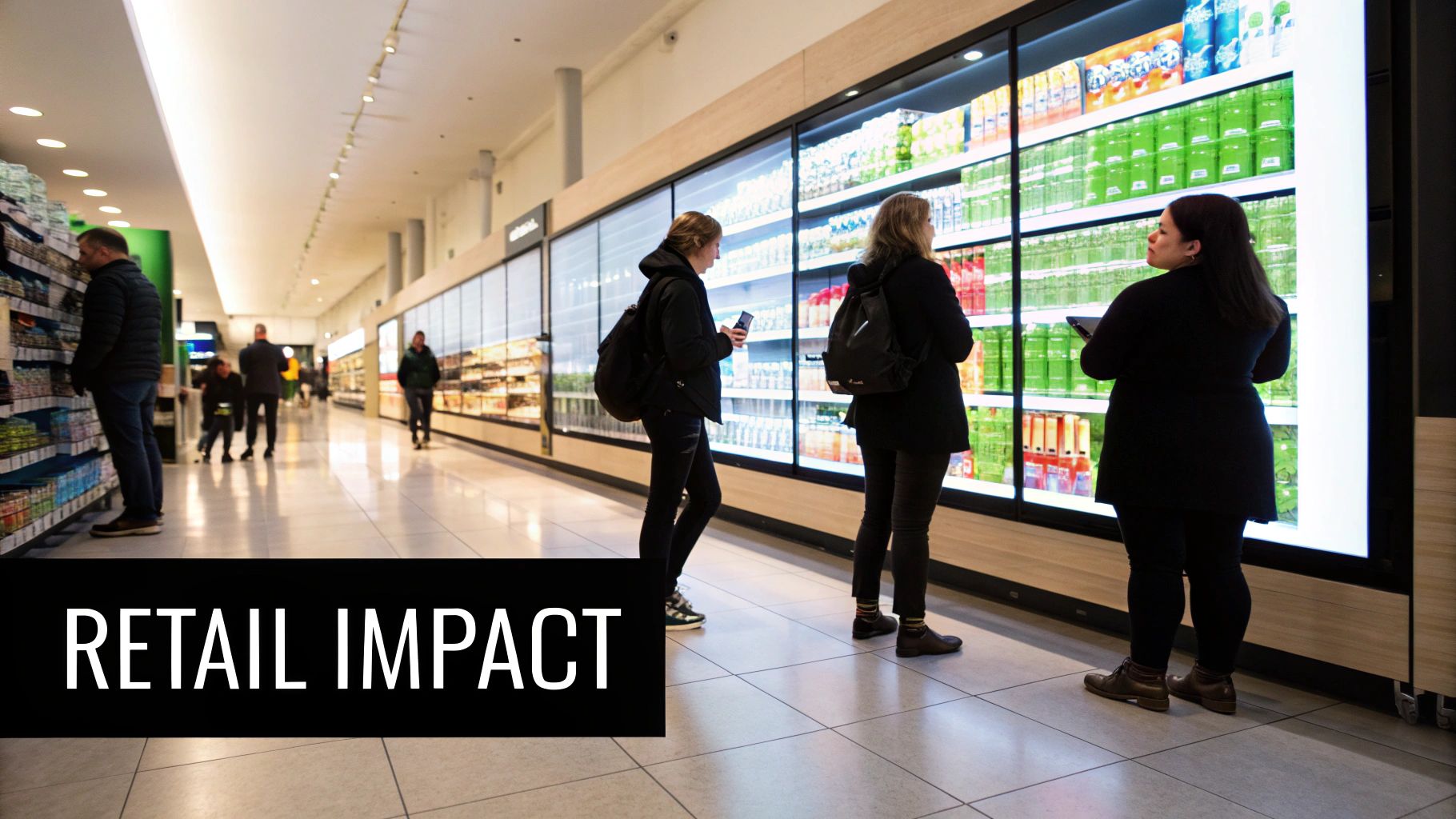
In the cutthroat world of retail, getting a customer to stop and look is half the battle. Video display walls are the ultimate attention-grabbers, pulling shoppers in from the street and creating an immersive vibe inside the store. They can turn a simple product demo into a cinematic experience or make a store's back wall a living, breathing canvas for your brand story.
Forget about static posters that people stop noticing after a day. With a video wall, retailers can:
Showcase products in motion: A fashion brand can stream a live runway show, while an electronics store can put a new gadget through its paces in glorious high-definition.
Create seasonal ambiance: That same display can shift from a cozy winter wonderland in December to a sun-drenched beach in July, keeping the store feeling fresh and exciting all year long.
Promote limited-time offers: You can launch flash sales and special deals instantly, creating a buzz of urgency that gets people buying right then and there.
This isn't just about looking cool—it's about creating a dynamic shopping experience that directly influences buying decisions at the point of sale.
Corporate Lobbies and Modern Workplaces
Think of your corporate lobby as the first handshake you offer to clients, partners, and future employees. A video display wall makes that first impression count. It’s an immediate signal that your company is modern, innovative, and serious about its brand.
But it's more than just a "wow" factor. These displays are workhorses for communication. They can broadcast company news, welcome important guests by name, or highlight community initiatives and core values. Suddenly, a boring waiting area becomes a space that tells your company's story.
By making a smart investment in a prominent visual centerpiece, a company can effectively immerse every visitor and employee in its brand story from the moment they walk through the door.
Mission-Critical Control Rooms
In places where decisions have to be made in a split second, there is no room for confusion. Command and control centers—for security, utilities, or logistics—depend on video display walls to pull dozens of complex data feeds into one unified, visual command center. Operators can watch live video, track assets on interactive maps, and analyze real-time data all at once, on a single canvas.
This cohesive, big-picture view helps teams spot problems, identify trends, and coordinate a response with a speed and efficiency that’s impossible when juggling a bunch of small, separate monitors. Seeing everything in one place is a true game-changer for situational awareness and smart decision-making.
Public Venues and Outdoor Advertising
The power of video display walls doesn't stop at the front door. Outdoor applications, especially in advertising and public information, are exploding. Tough, weatherproof LED technology has made it possible to build brilliant, durable digital billboards and event screens that captivate audiences 24/7. In fact, research shows outdoor displays now hold the largest revenue share in the video wall market, with a projected growth rate of 11.7% CAGR, driven by the rise of digital-out-of-home (DOOH) advertising. These eye-catching screens are popping up in high-traffic areas where constant visibility is key. You can discover more insights about video wall growth at Grand View Research and see the full market analysis.
How to Plan Your Investment and Measure ROI
A video display wall is a serious investment, so you need a smart financial plan before you jump in. The sticker price is just the beginning. To get a real sense of the numbers, you need to think in terms of Total Cost of Ownership (TCO), which gives you the complete financial picture over the life of your display.
Your TCO isn't just about the screen. It covers everything from professional installation and content management software (CMS) to potential service agreements down the road. Factoring these things in from the start helps you avoid nasty surprises and keeps the project from going over budget.
Breaking Down the Budget
The final price tag on a video wall can swing wildly depending on the tech you choose and where you're putting it. An outdoor LED screen built to take a beating from the weather will have a completely different cost than an indoor LCD wall for a corporate boardroom. For anyone looking at durable displays for public spaces, understanding the costs of digital outdoor signage is a great place to start.
Here are the main things that will shape your total investment:
Hardware Costs: This is the biggest chunk of your budget. It’s driven by the size of the wall, your choice between LED and LCD, and the pixel pitch you need for clear viewing.
Installation Fees: How complex is the install site? Do you need custom mounts? Labor costs? All of these play a big role.
Software and Processors: You need a powerful video processor and a good CMS to make your content look great and manage it easily. These come with their own price tags.
Ongoing Expenses: Don’t forget about the electric bill—this is where energy-efficient LEDs really shine. Optional maintenance contracts are also worth considering to protect your investment for the long haul.
Calculating Your Return on Investment
Once you’ve got a handle on the costs, it’s time to talk about the good part: the Return on Investment (ROI). The ROI for a video wall isn't always about hard cash. It often comes from powerful, intangible benefits that quietly drive your business forward.
For some, the ROI is simple. A retailer can literally watch foot traffic increase or see a direct sales lift on products advertised on the screen. In fact, studies show that dynamic digital signage can boost sales by nearly 30% by giving customers the info they need to make a confident purchase.
But for many organizations, the real gold is in the metrics you can't easily count. Think about elevated brand perception, seamless internal communications, or creating a genuine emotional connection with your audience. These are the powerful returns that keep paying you back for years.
Let’s look at how a video wall creates value in different situations:
Direct Revenue Generation: A stadium or concert venue can sell ad space on its screens, opening up a brand-new and highly profitable revenue stream.
Increased Brand Awareness: Research has shown that dynamic digital displays can lift brand awareness by as much as 48%. That makes you far more memorable to potential customers.
Cost Avoidance: Digital screens wipe out the endless cycle of printing, shipping, and installing static signs. Over time, this can slash your traditional marketing spend by up to 50%.
By figuring out which key performance indicators matter most to your business—whether it’s more sales, better brand recall, or just saving money—you can build a rock-solid case for the investment. This isn't just about buying a cool piece of tech; it's about making a strategic move that delivers real, measurable results.
Bringing Your Vision to Life with Content and Strategy
A stunning video display wall is an incredible piece of hardware, but its true power is only unlocked by the content you put on it. Think of the wall as a world-class orchestra and your content strategy as its conductor.
Without a clear plan and the right tools, even the most impressive display will fall flat, failing to deliver the impact you invested in. The long-term success of your video wall really begins the moment the installation is complete.
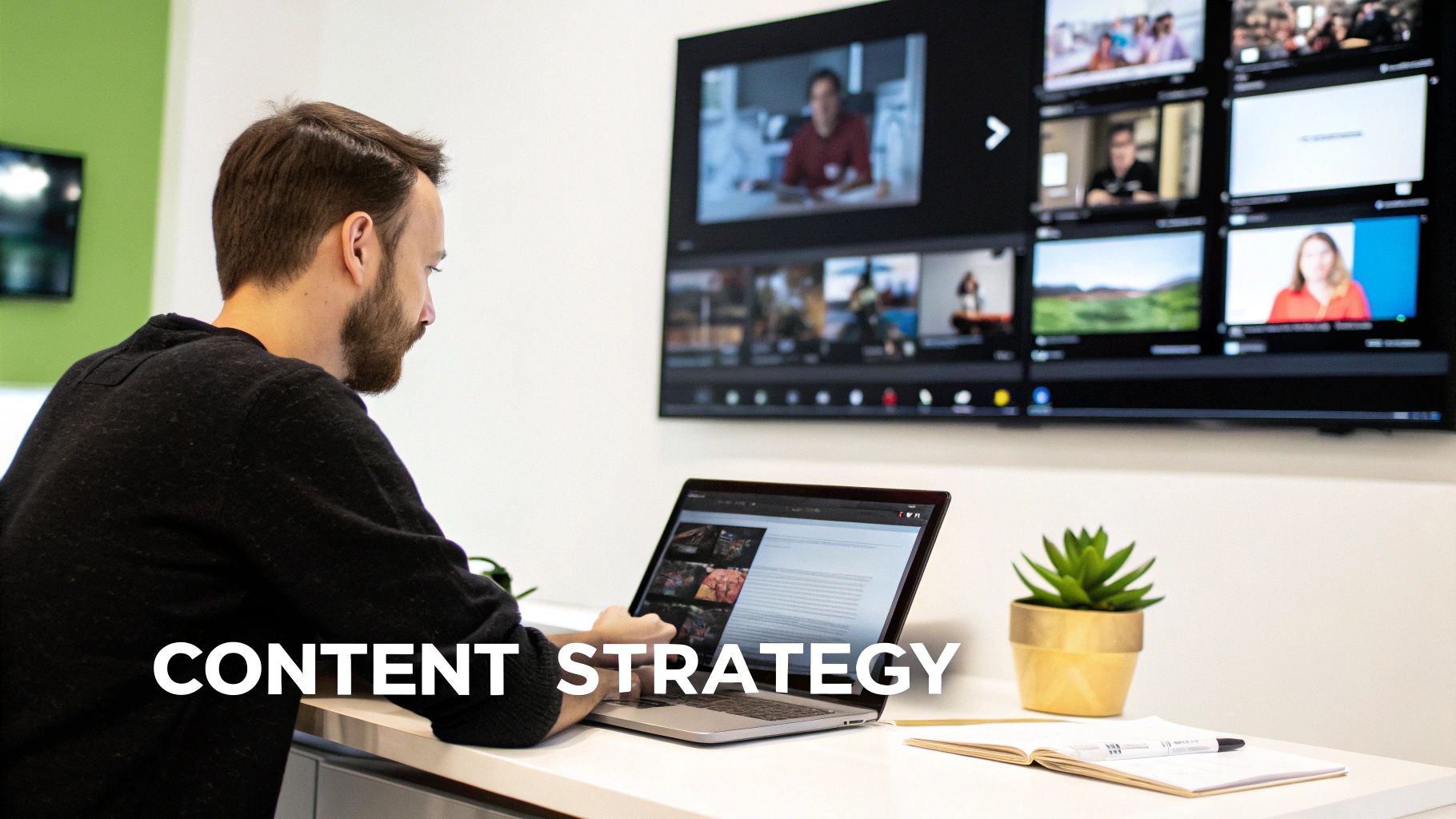
This is where a Content Management System (CMS) becomes the most important part of your toolkit. A user-friendly CMS is the central hub for your entire visual operation, letting you schedule, update, and manage everything on your screen with total ease. It’s the difference between a dynamic, engaging asset and an expensive, static picture frame.
A Practical Guide to Video Display Walls 6
Choosing a Powerful Content Management System
Not all CMS platforms are created equal. When you're looking at options, you need features that give you both flexibility and control, making sure your team can manage the display efficiently without needing a degree in computer science. A good system empowers creativity, it doesn't limit it.
Key features to look for include:
Remote Access: The ability to update content from anywhere, at any time, using a web browser is an absolute game-changer. This means no more running to the physical location just to make a small change.
Intuitive Scheduling: A solid scheduler lets you plan your content weeks or even months ahead. You can program promotions to launch at a specific time or have welcome messages appear automatically for scheduled visitors.
Multi-Zone Layouts: This is a killer feature. It lets you slice your video wall into multiple sections, each showing different content at the same time. You could run a live video feed, a scrolling news ticker, and a static brand logo—all at once.
A great CMS transforms your video wall from a single screen into a multi-faceted communication platform. It allows you to tailor messages with precision, ensuring the right information reaches the right audience at exactly the right moment.
Building a Sustainable Content Pipeline
Okay, so you have your technology and CMS ready to go. The final, crucial piece of the puzzle is figuring out what you’re actually going to show. Once you've chosen your technology and planned your investment, the next crucial step is defining the content that will bring your video display wall to life. Explore various aspects of effective video content creation strategies to ensure your visuals are compelling.
A screen showing the same old thing quickly becomes invisible. To keep people watching, you need a steady stream of fresh, relevant content. This doesn't mean you need a Hollywood-level production team on standby.
A successful content pipeline balances high-impact "hero" content with simpler, easily updated visuals.
Consider a mix of formats to keep your display dynamic and interesting:
Brand Storytelling Videos: Professionally produced videos that show off your company’s mission, values, or key products.
Real-Time Information Feeds: Live data like news headlines, weather updates, social media feeds, or stock tickers.
Promotional Graphics: Eye-catching visuals for upcoming sales, events, or special announcements.
User-Generated Content: Showing off positive customer reviews or social media posts is a fantastic way to build community and trust.
By strategically planning your content and choosing a powerful CMS, your video wall will evolve from a simple hardware purchase into a lasting, dynamic asset that continuously delivers value.
Got Questions About Video Display Walls? We’ve Got Answers.
Jumping into the world of video display walls is exciting, but it naturally comes with a few questions. We hear them all the time. To help you feel confident about your project, here are some straightforward answers to the most common queries we get.
How Long Do These Things Actually Last?
This is one of the first things everyone wants to know, and for good reason! The lifespan of a video wall really comes down to the technology inside and how you use it.
A quality commercial-grade LED wall is a true workhorse, often rated for an impressive 80,000 to 100,000 hours of use before its brightness dips to half of its original output. That’s more than a decade of round-the-clock performance.
LCD walls, on the other hand, typically have a shorter lifespan, usually in the ballpark of 50,000 to 60,000 hours. But with either tech, a little TLC—like proper maintenance, sensible brightness levels, and a stable environment—can go a long way in stretching that investment for years to come.
What's the Real Difference Between Pixel Pitch and Resolution?
This is a fantastic question, and it gets right to the heart of what makes a display look great. The easiest way to think about it is that pixel pitch is about the physical build of the screen, while resolution is about the digital image it shows.
Pixel Pitch: This is simply the physical distance (in millimeters) from the center of one pixel to the center of the next. A smaller number, like 1.9mm, means the pixels are packed in super tight. This creates a really sharp, seamless image that looks amazing even when you're standing right in front of it.
Resolution: This is the total count of pixels that make up the entire screen, like 1920×1080 for Full HD. A huge wall with a wider pixel pitch can have the same resolution as a smaller screen with a fine pixel pitch. One gets there with sheer size, the other with density.
The bottom line? You need the right pixel pitch for how far away your audience will be, and the right resolution for the content you want to show. They’re a team, working together to create that final "wow" moment.
Can I Show Different Things on Different Parts of the Wall?
Absolutely! And honestly, this is where the magic really happens. With a good Content Management System (CMS) and a video wall processor, you can slice and dice your screen into multiple zones, turning one massive canvas into several independent displays.
This flexibility is a game-changer for so many businesses. A corporate lobby, for instance, could run a live news ticker in one corner, a welcome message in another, and a stunning brand video in the main section—all at the same time. In a control room, operators can keep an eye on a dozen live camera feeds, data dashboards, and alerts on one unified video wall. It’s this ability to do it all at once that makes the technology so incredibly powerful.
Ready to transform your space with a visual solution that commands attention? The experts at Smart LED Inc. can help you design and build the perfect indoor or outdoor video display wall for your goals and budget. Explore our solutions and get a quote today at https://smartledinc.com.
Casinoly hat sich als populäre Online-Glücksspielplattform etabliert und bietet Spielern eine umfangreiche Auswahl an Casino-Spielen sowie verlockende Bonusprogramme. In diesem detaillierten Überblick 2024 untersuchen wir