Understanding The Expense of a Pettable ESA Letter
In today’s hectic globe, Emotional Support Pets (ESAs) play a crucial duty in giving convenience and friendship to people struggling with emotional or emotional problems.
Trying to pin down the cost of a digital sign can feel a bit like asking, "How much does a car cost?" The answer is always, "Well, it depends." A simple screen for your lobby won't carry the same price tag as a massive, weatherproof pylon sign built to grab attention from a busy highway.
You could be looking at anywhere from $4,000 for a small indoor display to well over $70,000 for a large-scale outdoor installation. The final number comes down to a blend of size, resolution, and whether it’s built to live inside or brave the elements.
But the sticker price is just the beginning. Just like a car has ongoing costs for fuel, insurance, and maintenance, a digital sign has other factors that make up its total cost of ownership. We’re talking about installation, software to run your content, and the creative work to make your messages pop.
To get our bearings, let's look at some typical starting points. Think of these figures as a quick-reference map before we dig into the details that can move the price up or down.
Remember, these are ballpark estimates. The goal here is to give you a realistic starting point for your budget talks, not a final, set-in-stone quote.
To give you a clearer picture of what to expect, we've broken down some common sign types and their typical price ranges. This should help you frame your initial budget and understand where your project might land.
This table offers a quick glance at what you can generally expect to invest, broken down by common sign types and their typical uses.
| Sign Type | Common Use Case | Estimated Price Range (Per Square Foot) | Key Price Factors |
|---|---|---|---|
| Indoor Video Wall | Corporate lobbies, event stages, retail stores | $800 – $2,500+ | Fine pixel pitch (for close viewing), seamless panel integration, screen size. |
| Outdoor Monument Sign | Storefronts, schools, churches, business parks | $1,500 – $3,500 | High brightness (for sunlight), weatherproofing (IP rating), resolution. |
| Outdoor Pylon/Pole Sign | Shopping centers, gas stations, roadside businesses | $1,200 – $3,000 | Structural engineering, extreme weather durability, size, and height. |
| LED Home Theater | High-end home cinemas, media rooms | $900 – $2,000 | Ultra-high definition, DCI-P3 color, screen size, and audio integration. |
As you can see, the application drives the price. A high-resolution indoor wall meant for up-close viewing has different technical demands—and costs—than a rugged outdoor sign engineered to be seen from a distance and withstand a hurricane. Next, we'll dive into exactly why these prices vary so much.
Ever wonder why two digital signs that look the same size can have wildly different price tags? It’s a lot like cars. A high-performance sports car costs way more than a standard sedan, right? The engine, the materials, the tech under the hood—that’s what dictates performance and price. It's the exact same story with LED signs. The hardware and software packed inside are what really drive the final cost.
Getting a handle on these components helps you move past a simple price-to-price comparison and start thinking about true value. You aren't just buying a screen; you're investing in a specific level of performance, toughness, and capability. The lion's share of the digital signs prices you'll see quoted comes down to the physical guts of the display.
This mind map boils it down to three core areas: size, technology, and where you plan to use it.
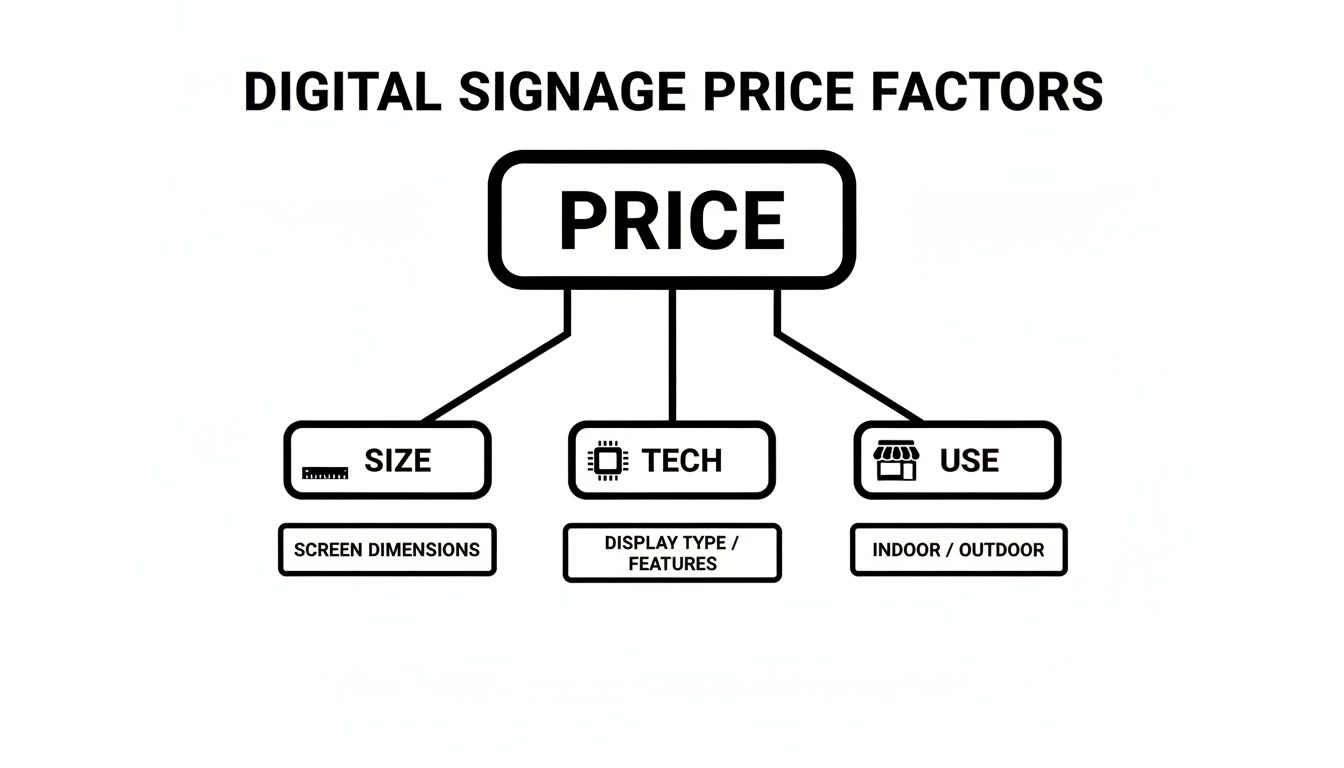
As you can see, these three pillars are all connected. But the technology inside the display? That’s almost always the biggest variable swinging the final cost one way or the other.
Hardware is, without a doubt, the single biggest piece of the cost puzzle. The numbers back this up: hardware accounts for roughly 56.6% of total digital signage revenue. This tells you that the physical display is where most of the investment goes. Huge displays and custom video walls are a big part of this spend, setting the price benchmarks for the whole industry.
Let's unpack the hardware elements that matter most.
1. Pixel Pitch: The Key to Clarity
Pixel pitch is simply the distance between the tiny LEDs on your sign, measured in millimeters. Think of it as the sign's resolution.
A finer pixel pitch requires way more LED diodes per square foot, making it one of the biggest cost drivers. For example, choosing a 6mm pitch sign over a 10mm pitch can nearly double the number of LEDs—and the price tag along with it.
2. Brightness: Measured in Nits
Brightness, measured in nits, is all about how visible your sign is, especially in the glaring sun. A sign that isn't bright enough will look completely washed out and unreadable on a sunny day. It's a waste of money.
Achieving a higher nit rating requires more powerful LEDs and beefier power supplies, which directly bumps up the cost. This is a critical factor, especially when you dig into outdoor LED sign costs in more detail.
3. Durability and Weatherproofing
An outdoor sign has to be a fortress. It's built to take everything nature can throw at it—rain, snow, heat, dust. That rugged construction adds to the price, but it’s completely non-negotiable if you want your investment to last.
Key features to look for include:
If the hardware is the body, the software is the brain. The Content Management System (CMS) is the command center you'll use to schedule, upload, and manage everything that shows up on your screen. And yes, the sophistication of this software can definitely influence the price.
Basic software for a single, standalone sign is often thrown in for free. But if your needs are more complex, your investment will go up.
These more powerful software solutions usually come with a one-time license fee or an ongoing subscription, adding another layer to your total cost. Once you understand both the hardware and software drivers, you can make a much smarter decision that perfectly balances your budget with your goals.
When you start budgeting for a new digital sign, it’s all too easy to fixate on the sticker price of the screen itself. But treating the hardware as the only major expense is a classic misstep, one that often leads to surprise bills and a busted budget down the road. The true cost goes far beyond the display—it’s a full package deal that includes the crucial services needed to bring your sign to life and keep it humming.
Think of it like buying a high-performance engine for a custom car. The engine is the star of the show, but you still have to pay for the chassis to hold it, the expert mechanic to install it, and the fuel to make it roar. The same logic applies to digital signs prices; the display is just one piece of a much larger, more comprehensive investment.
To build a budget that holds up in the real world, you need to think in terms of Total Cost of Ownership (TCO). This covers everything from the moment you sign the dotted line to years of successful operation, including installation, permits, content, and upkeep.
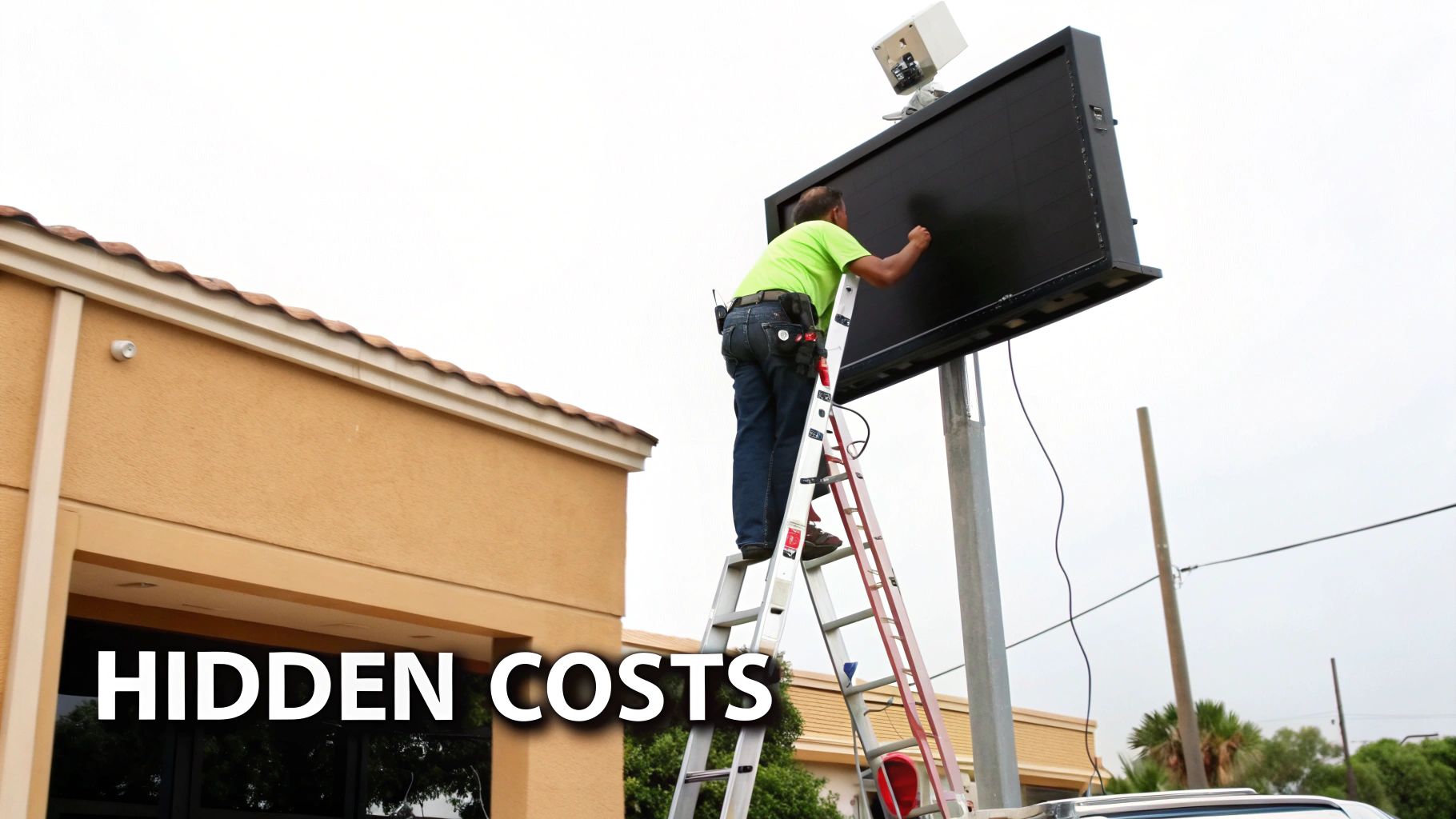
Before your sign even flickers to life, there are a handful of critical services you'll need to pay for. These aren't optional add-ons; they are non-negotiable steps to get your sign installed safely, legally, and effectively. Skipping these can stop your project dead in its tracks.
1. Professional Installation
This is a major line item, often adding 15-30% of the hardware price to your total. And for good reason—this is a specialized job that involves way more than just hanging a screen on a wall.
2. Permits and Zoning Compliance
This is the hidden hurdle that trips up so many first-time buyers. You can't just put up a digital sign wherever you feel like it. Nearly every town and city has strict rules governing sign size, height, brightness levels, and even how often the message on your sign is allowed to change.
Navigating the permit process can be a bureaucratic nightmare. It often involves submitting detailed engineering plans, showing up at zoning board meetings, and paying fees that vary wildly from one place to the next. A sign company with experience in your specific area is worth its weight in gold here.
Forget to secure the right permits, and you could be facing hefty fines or, even worse, an order to tear down the very sign you just paid to install. This step is absolutely critical.
Once your sign is up and running, the investment continues. These ongoing costs are what will keep your sign a powerful communication tool for years to come, preventing it from becoming an expensive, blank fixture on the side of your building.
1. Maintenance and Support Plans
Modern LED signs are built like tanks, with incredible lifespans of 50,000 to 100,000 hours, but they aren’t indestructible. A good maintenance plan is your insurance policy, giving you peace of mind and protecting your investment.
These plans typically cover things like:
2. Content Creation and Management
A digital sign is only as good as the content you put on it. A screen that’s blank, broken, or showing the same tired message from six months ago is a massive wasted opportunity. You need a plan for creating a steady stream of fresh, engaging content.
Think about these potential costs:
The key is to view these "hidden costs" not as expenses, but as investments. Proper installation ensures your sign is safe and built to last. Permits keep you on the right side of the law. And fantastic content is what ultimately drives the return on your entire investment. Budgeting for these from day one is the secret to a smooth project and long-term success.
Just like with any major purchase, where you buy your digital sign can affect the final price tag as much as the sign's size or pixel pitch. You've really got two main paths to go down: buying from a factory-direct manufacturer or working with a local reseller. Figuring out the pros and cons of each is crucial for stretching your budget and getting the right long-term support.
Let's use an analogy. Think about buying produce. You could go to a high-end specialty grocery store where everything is perfectly arranged and the service is convenient, but you know you're paying a premium. Or, you could go straight to the farm, cut out the middleman, and get a better deal along with a direct connection to the source. Digital signs are a lot like that.
A local reseller or a systems integrator is the "specialty grocery store" in this scenario. They buy signs from different manufacturers and then sell them to businesses like yours, often bundling the hardware with installation and other local services. It’s an appealing model because you get a single point of contact for the whole project.
But that convenience comes at a price. Resellers have to add their own markup to the hardware to cover their overhead and turn a profit. This layered pricing means you're not just paying for the sign itself; you're also paying for the reseller's rent, payroll, and marketing. While their local know-how can be valuable, the impact on the final digital signs prices can be huge, often adding a hefty percentage on top of the manufacturer’s cost.
Buying factory-direct is like going straight to the farm. This model cuts out the intermediary, letting you purchase your sign directly from the folks who actually designed and built it. The most obvious win here is the cost savings—by slicing away the reseller's markup, you get a whole lot more sign for your money.
But this direct relationship is about more than just a better price. It gives you a clear line of communication to the people who know the product inside and out.
The real power of the factory-direct model is cutting out the inefficiency. You get a better price by avoiding markups and faster, more accurate support by talking directly with the people who made the technology.
So, which way should you go? It really boils down to your priorities. If you need a completely hands-off, all-in-one local package and you're willing to pay a premium for that white-glove service, a reseller could be a good fit.
However, for most businesses focused on getting the best possible value and long-term technical reliability, the factory-direct model is almost always the smarter financial move. It puts you in the driver's seat, allowing you to make a more informed decision while making sure your investment goes as far as it can. For a deeper dive into the buying process, our guide on how to buy an LED sign offers some great additional insights.
As you explore your options, a key step is to request a general digital sign quote from both types of suppliers. Putting a quote from a reseller next to one from a factory-direct source will quickly illuminate the price differences and make it crystal clear which approach aligns best with your budget and project goals.
Let’s be honest: seeing the initial price for a quality digital sign can be a bit of a shock. But looking at it as just an upfront cost is missing the entire point. A dynamic LED display isn't an expense line item; it's a powerful engine for growing your business.
The real key is to shift your mindset from the price tag to the long-term return on investment (ROI). This simple change transforms the entire conversation from, "How much does it cost?" to, "What can this sign earn for us?"
It's a perspective shared by businesses worldwide. The global digital signage market hit roughly USD 20.12 billion in 2019 and is on track to reach USD 35.62 billion by 2026. That kind of steady growth doesn’t happen by accident. It shows that businesses are seeing real, tangible returns and are continuing to invest in high-impact displays.
What's driving this? A sign's incredible ability to influence customer behavior right at the point of decision. Studies have found that dynamic digital signage can boost average purchase values by as much as 29.5%. By grabbing attention with timely, relevant messages, these signs do more than just advertise—they actively make you money.
Before you can figure out your potential return, you need a solid idea of your initial investment. This is where an online LED sign calculator becomes one of your best friends. It lets you move past generic price ranges and get a customized estimate based on what you actually need.
Think of it as a starting point for your project budget.
A good calculator will let you input key details like the sign's dimensions, resolution (pixel pitch), and the typical viewing distance. Punching in those numbers will generate a reliable starting budget to work from.
Let's walk through a real-world example to see how the numbers play out. Imagine a local retail shop invests $25,000 in a brand-new outdoor LED sign.
The Goal: Get more people in the door and boost sales of a specific high-margin product line.
The Strategy:
The Results (After Just 6 Months):
In this scenario, the sign didn't just pay for itself in under half a year—it generated an extra $11,000 in pure profit. That's the power of moving from a cost-based mindset to an investment-based one. Of course, a truly profitable investment should also account for end-of-life management; it's always smart to consider the long-term value and benefits of e-waste recycling.
To build a strong business case, you need precise numbers. Sending out a generic request for "digital signs prices" is only going to get you a vague, unhelpful estimate. The more detail you give a vendor, the more accurate your quote will be.
Providing specific, well-thought-out information in your quote request does two things: it ensures you get a precise price, and it shows you're a serious buyer. This often leads to better service and more attention from suppliers.
Use the checklist below to gather the essential information your vendor will need. For a deeper dive into what makes outdoor signage effective, check out our complete guide on digital outdoor signage.
To help you get the most accurate quote possible, we've put together a checklist of the information every quality sign vendor will need from you. Being prepared with these details will make the whole process smoother and faster.
| Information Category | Details to Provide | Why It's Important for Pricing |
|---|---|---|
| Project Basics | Your business name, physical location, and desired installation date. | Helps the vendor check local regulations and understand your project timeline. |
| Sign Specifications | The sign's dimensions (height x width) and whether it's single or double-sided. | The physical size is the biggest single factor driving the hardware cost. |
| Viewing Environment | Average viewing distance, traffic speed, and sun exposure (direct or indirect). | This determines the required pixel pitch (resolution) and brightness (nits). |
| Installation Details | Is this a new installation or a replacement? What kind of structure (pole, monument)? | Defines how complex—and costly—the installation work will be. |
| Content & Software | How you plan to manage content; if you need to control a network of signs. | This lays out the software requirements and any potential licensing fees. |
Gathering this information upfront will show any vendor that you've done your homework and are ready to have a productive conversation about your project.
As you get closer to pulling the trigger on your digital sign project, it's totally normal for some very specific questions about money to pop up. This is where the rubber meets the road. We're going to tackle the most common (and practical) concerns we hear from buyers every day, giving you straight, clear answers to help you lock in your budget with confidence.
Think of this as the last piece of the puzzle. Getting these details ironed out is what separates a good investment from a great one.
This is the big one, the question everyone asks first. The honest answer? It varies—a lot. The final price tag for an outdoor LED sign really boils down to three key things: its physical size, its resolution (what we call pixel pitch), and how bright it needs to be.
For a local business that wants to make a splash, a sharp little monument sign out front might land somewhere between $5,000 and $15,000. These are fantastic for grabbing the attention of people driving or walking by. On the flip side, a massive pylon sign for a shopping center or a business right off a busy highway could run anywhere from $20,000 to over $70,000.
What drives that huge price difference? Two main things:
And don't forget to budget for a professional installation. That typically adds another 15% to 30% on top of the hardware cost.
You'd think so, right? But surprisingly, not always. If you compare them square foot for square foot, a high-resolution indoor video wall can easily cost more than a standard outdoor sign. It all comes down to viewing distance and the tech needed to deliver a perfect picture.
People stand just a few feet away from indoor displays. To look sharp and seamless up close, those screens need an incredibly fine pixel pitch. That density of LEDs is a lot more complex and expensive to manufacture. It's like comparing a jumbotron to a high-end 8K television—the technology for that up-close detail comes at a premium.
While an indoor wall doesn't need the heavy-duty weatherproofing or intense brightness of its outdoor cousin, its price is pushed up by the sheer number of pixels packed into every square inch. A huge, lower-resolution outdoor billboard can easily have a lower cost per square foot than a smaller, ultra-HD indoor video wall.
So, you might save on the rugged, weatherproof housing, but you'll likely invest that money (and then some) into the pixel density needed for a stunning close-up experience.
The initial purchase is the main event, but there are a few running costs to factor into your long-term budget. The good news is that modern LED tech has made these costs very manageable.
Here’s a quick breakdown of what to plan for:
Where you buy your sign is a huge decision. It impacts not just the price but your entire experience for years to come. Going with a factory-direct supplier instead of a local reseller or third-party vendor gives you some serious advantages.
The most obvious benefit is cost savings. When you cut out the middleman, you're not paying their markup. That money goes directly into better components and technology for your sign, not into another company's pocket. It's the simplest way to get more bang for your buck.
But it’s not just about the price. A direct line to the manufacturer means you get far better support.
Working directly with the factory streamlines everything, from the first conversation to long-term support, ensuring you get a better product and a better experience for a lower cost.
Ready to bring your vision to life with a high-impact display? At Smart LED Inc., we are the factory-direct source for premium indoor and outdoor LED signs. We eliminate the middleman to give you the best possible price and direct access to our team of experts.
Explore our custom LED sign solutions and get a direct quote today!
In today’s hectic globe, Emotional Support Pets (ESAs) play a crucial duty in giving convenience and friendship to people struggling with emotional or emotional problems.
When it pertains to on the internet gaming, one of one of the most vital factors to take into consideration is the settlement technique. Security,
Free Casino Games Slots There are a variety of ways you can play free online casino slots. You can test your luck on a variety
"*" indicates required fields
We have sent a 6-digit verification code to your email. Please enter it below to continue.