Casino Site Bank Settlement Methods: A Comprehensive Guide
Welcome to our helpful guide on gambling establishment financial institution repayment approaches. In this article, we will certainly discover the various repayment options offered to
Think of your business's storefront. Is it working for you around the clock? Outdoor LED sign lights can turn that static facade into your most effective, hardest-working salesperson—one that never sleeps. It's about so much more than just lighting things up; it's about grabbing attention, pulling people in off the street, and building a brand that people remember long after they've passed by.
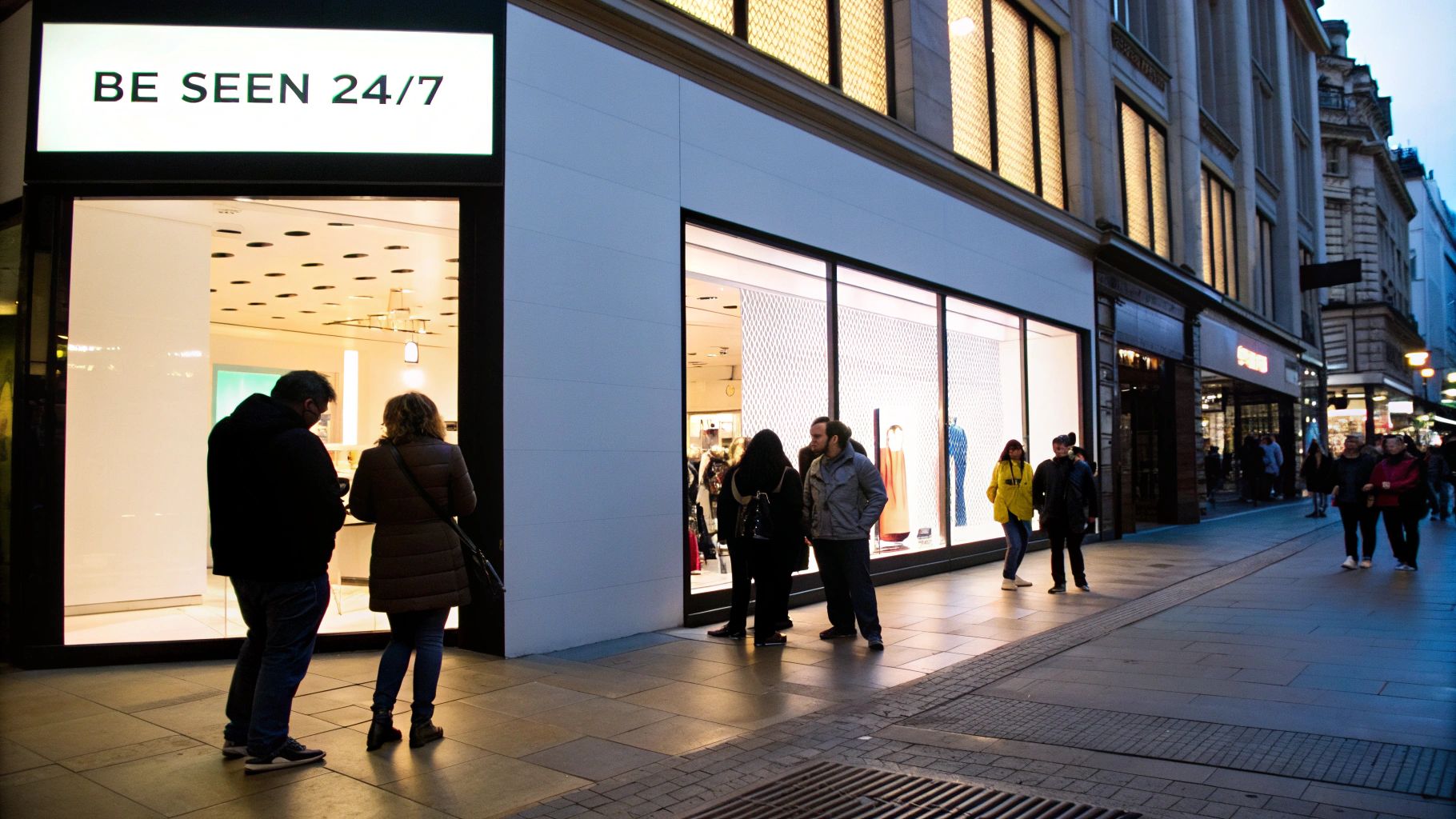
Picture a typical busy street. One business has a traditional sign that just sort of… blends in. It's there, but nobody really sees it. A few doors down, a competitor has a vibrant, glowing message that cuts through the noise, impossible to ignore even in the middle of the day. That's the power of modern LED sign lighting.
We've come a long way from the simple backlit boxes of the past. Today’s signs are high-impact visual platforms, capable of showing off crisp text, slick graphics, and even full-motion video. They become a constant, tireless advocate for your brand, working 24/7 to announce a sale, share key info, or just build that all-important name recognition.
In a market overflowing with options, getting seen is half the battle. A solid LED sign hands you a serious competitive advantage, turning your physical location into a local landmark. And this isn't just for the big-box stores anymore. This technology is now a go-to tool for main-street shops, restaurants, and local service providers who want to stand out.
The numbers don't lie. The outdoor LED display market is expected to explode from USD 11.3 billion in 2025 to a staggering USD 29.2 billion by 2035. This isn't a fleeting trend; it’s a fundamental shift in how businesses advertise. This guide will give you a clear roadmap to choosing the right sign, getting it installed, and making sure you get a fantastic return on that investment.
By commanding attention, an LED sign fundamentally changes how customers see and interact with your business. It’s not just about being seen; it's about being remembered.
Putting money into an outdoor LED sign is a direct investment in your ability to talk to potential customers. It gives you the power to update your message in an instant—reacting to a sunny day with an ice cream special or promoting a flash sale without the cost or delay of printing physical banners.
The benefits kick in almost immediately:
By exploring the different types of LED signs for businesses, you can find the perfect fit for your specific goals and budget. We’ll walk you through every critical step, from the nitty-gritty tech specs to installation and upkeep.
Diving into the technical side of outdoor LED sign lighting can feel like you're trying to learn a new language. You'll hear terms like "nits," "pitch," and "Kelvin" thrown around, but what do they actually mean for your business on the street? Let's break down these key specs with some simple, real-world analogies so you can look at any sign and know exactly what you're getting.
Think of these specifications as your sign's DNA—they dictate its performance, how it looks from the road, and whether it can stand up to Mother Nature. Getting a handle on them is the first step to choosing a sign that not only looks incredible but also works perfectly for your specific location and goals.
Pixel pitch is hands-down one of the most critical factors for your sign's clarity. It’s simply the distance, measured in millimeters, from the center of one LED cluster (or pixel) to the center of the one next to it.
It’s just like a high-definition TV. The pixels are crammed so tightly together that your brain sees a smooth, flawless picture. Now, contrast that with an old stadium jumbotron where you could practically count the individual light bulbs from your seat. That’s the exact difference pixel pitch makes.
Choosing the right pitch is all about balancing viewing distance with your budget. A sign meant for foot traffic needs that tight, crisp pitch, while one designed to grab the attention of drivers hundreds of feet away can get the job done with a larger one.
Before we go further, let's pull these key specs into a quick-reference table. This will help you see how everything fits together at a glance.
| Specification | What It Measures | Why It Matters for Outdoor Signs |
|---|---|---|
| Pixel Pitch (mm) | The distance between the center of adjacent LEDs. | A smaller number means higher resolution and a sharper image up close. A larger number is fine for long-distance viewing. |
| Brightness (Nits) | The raw light output of the sign. | Your sign needs enough "power" to overcome direct sunlight. Too low, and it will look washed out and unreadable during the day. |
| Color Temp (K) | The "warmth" or "coolness" of the white light. | A cooler, bluish-white (like daylight) makes colors pop and ensures your branding looks vibrant and accurate. |
| IP Rating | How well the sign is sealed against dust and water. | This is your sign's weatherproofing. IP65 is the standard, protecting it from dust and rain. |
| IK Rating | The sign's resistance to physical impacts. | This is its armor against vandalism or accidental damage from debris. A higher number means it's tougher. |
Think of this table as your cheat sheet. When you're comparing different signs, these are the five numbers that will tell you almost everything you need to know about its real-world performance.
Ever wondered how an LED sign stays so vibrant and readable under the full glare of the sun? The secret is brightness, and we measure it in a unit called nits.
Think of nits as the horsepower behind a car's headlights. On a dark country road, even dim lights work. But to slice through dense fog or the blinding lights of oncoming traffic, you need some serious high-beam power. For an outdoor sign, the sun is that fog.
A typical indoor TV or your computer monitor puts out about 250 to 500 nits. To even be visible in daylight, a respectable outdoor LED sign needs to start at 5,000 nits, while the real powerhouses hit 8,000 to 10,000 nits to truly dominate in the brightest conditions.
If the nit rating is too low, your sign will look pale, washed-out, and unreadable during the day—completely defeating the point of having it. Always check the nits to make sure your message will shine through, rain or shine.
Color temperature is all about the look and feel of the white light your sign produces. It’s measured in Kelvin (K) and is what makes light feel either "warm" and cozy or "cool" and energetic.
You see this every day with light bulbs at home. A low Kelvin value (around 2700K) gives off that warm, yellowish glow of an old-school incandescent bulb. Go to the other end of the spectrum (6500K and up), and you get a crisp, bluish-white light that feels like natural daylight—clean, modern, and sharp.
Most outdoor LED signs operate in the 6500K to 9500K range. This cooler temperature is intentional; it guarantees maximum visibility and makes all the other colors in your graphics appear more vivid and true-to-life. It’s absolutely essential for displaying brand logos and images with perfect accuracy.
An outdoor sign lives a tough life. It’s constantly bombarded with rain, dust, heat, and even the occasional stray rock. That’s where IP and IK ratings come in—they are the official report card for your sign's toughness.
IP Rating (Ingress Protection): Think of this as a weatherproof, high-tech case for your sign's electronics. The rating is made of two numbers:
For any serious outdoor LED sign, an IP65 rating is the non-negotiable industry standard. It tells you the sign is sealed against fine dust and can easily stand up to a heavy downpour.
IK Rating (Impact Protection): This is your sign’s helmet. It measures how much physical impact the casing can take before something breaks. An IK08 rating, for example, can resist an impact equal to dropping a 1.7kg (3.75 lbs) object from 300mm (about 1 foot). A higher IK rating means better protection against everything from vandalism to flying debris in a storm.
Picking the right outdoor LED sign isn't a one-size-fits-all kind of deal. The best choice hangs entirely on what you’re trying to accomplish. Are you just posting store hours, or are you looking to run stunning, high-definition videos of your new product line? Matching the technology to your mission is the secret to a smart investment.
Let's walk through the main types of LED signs, starting with the simplest text-based displays and moving up to the dynamic video boards that stop traffic. Think of it like buying a vehicle: you wouldn't get a sports car to haul lumber, and you shouldn't get a video board if all you need to do is post gas prices.
The most straightforward and reliable option is the monochromatic sign. This workhorse displays LEDs of a single color—usually red or amber, since they cut through the clutter and are easiest to see from a distance. Their power is in their simplicity and raw clarity.
Monochromatic signs get right to the point. They’re built to deliver essential information with maximum readability and impact, no fuss involved.
Because they’re designed for one job, they are incredibly durable and cost-effective. They get the message across without the expense or complexity of more advanced displays.
A step up the ladder brings us to tri-color signs. These displays use a combination of red, green, and amber LEDs. By mixing and matching, they can create a limited color palette that adds a new dimension to your messages.
While they can’t show you a full-color photograph, tri-color signs are a fantastic middle ground. They let you use basic graphics, color-code your text, and display simple logos, making your content far more engaging than a single-color sign ever could. Just imagine highlighting a "SALE" message in bright amber to make it leap off the screen.
By combining different colored LEDs, tri-color signs can create more visual hierarchy. This helps guide the viewer's eye to the most important part of your message, increasing its effectiveness.
This extra bit of flair makes them a versatile choice for businesses that want to do more than just text but don't quite need the full firepower of a video screen.
At the very top of the food chain are full-color LED signs, what most people think of as digital billboards or video displays. These are the signs that truly mesmerize an audience. Using a blend of red, green, and blue (RGB) LEDs, they can reproduce over 16 million colors, which means they can display absolutely anything—from crisp, static images and vibrant logos to fluid, high-definition video.
This is where your marketing creativity can finally run wild.
These signs are, without a doubt, the most powerful communication tools you can put on your storefront, turning it into a dynamic digital canvas. They are a significant investment, but their power to grab attention and drive sales delivers a return that’s hard to match. This kind of high-impact advertising is a key reason North America is the biggest market for outdoor LED displays, with U.S. outdoor installations growing at a 12.1% CAGR. You can check out more insights on this exploding market from Market Research Future.
Of course, not every sign solution needs to be a digital screen. Sometimes, the goal is just to make a traditional, static sign shine. For that, specialized outdoor LED sign lights offer a modern, hyper-efficient alternative to old-school floodlights.
Deciding between a new digital display and simply upgrading your lighting comes down to your content strategy. If your message is static and unchanging, a lighting upgrade is a brilliant, cost-effective move. But if you need to change your message daily, weekly, or even hourly, a full-color digital sign is the superior long-term investment.
So you've picked out the perfect LED sign. Now comes the part that makes it all real: installation. Getting your new sign up and running is about more than just finding a spot and plugging it in. A solid installation is a careful dance between physical mounting, clean power, and, critically, local rules and regulations.
Nailing these details from day one is the secret to a sign that runs safely, shines brightly for years, and doesn't turn into a costly headache. Think of it like the foundation of a house—get it right, and your investment is secure. A sloppy setup with poor mounting or shaky wiring is just asking for trouble.
Before you even think about drilling holes, you need to be sure you have the right type of sign for your message. This flowchart breaks down the decision-making process based on what you want to display.
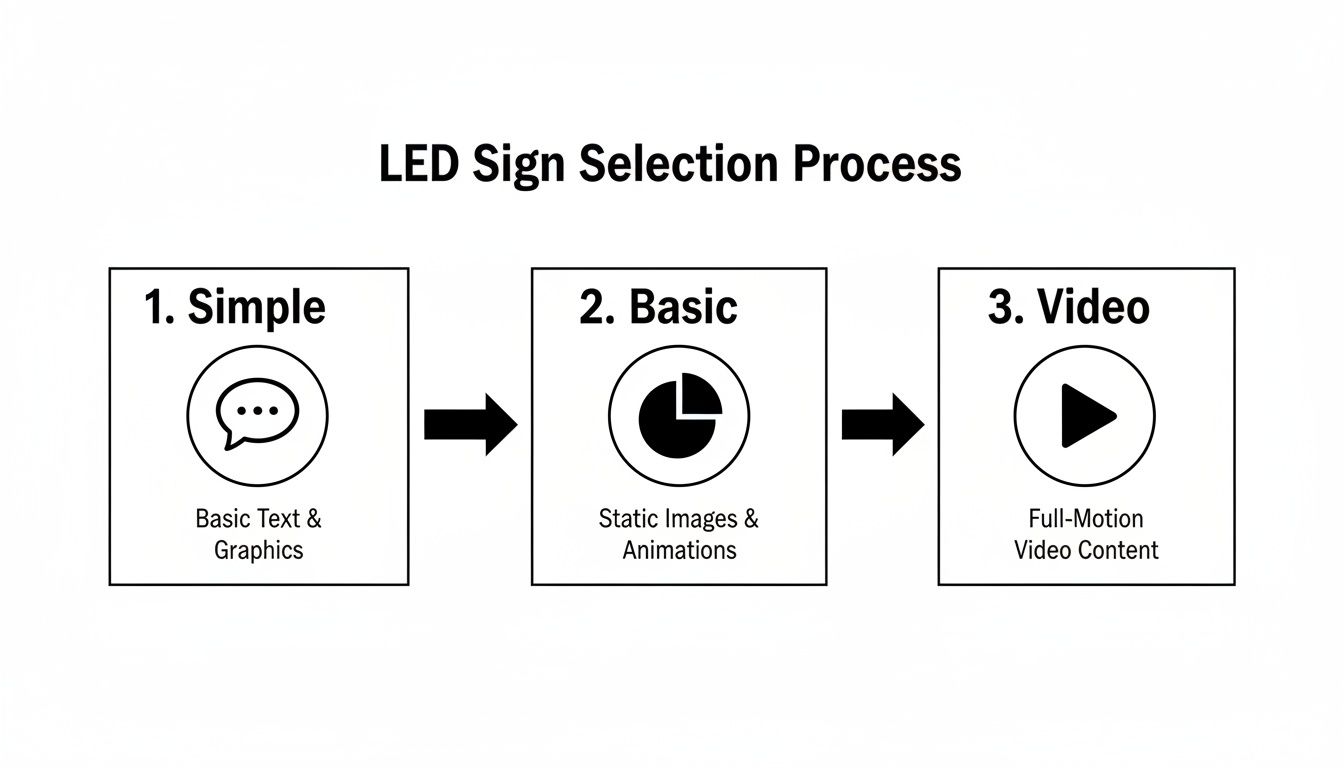
As you can see, the complexity of your content—from simple text to full-blown video—is the biggest factor in choosing the right hardware.
How you hang your sign is just as important as what it says. The mounting structure dictates visibility, stability, and whether you're even allowed to put it there in the first place.
Picking the right mount is a balancing act between where you want eyeballs to go and the physical reality of your property. For a closer look at how these different setups work in the real world, check out these examples of digital outdoor signage.
The power supply is the heart of your LED sign. A bad connection or the wrong voltage can cause everything from annoying flickers to catastrophic failure—or worse, a serious safety risk. You need a clean, stable, and completely weatherproofed source of electricity. Period.
Your sign will be rated for a specific voltage, usually 120V or 240V. Feeding it the wrong one is the fastest way to fry the electronics and turn your investment into a paperweight.
This is non-negotiable: a licensed electrician must handle the final wiring. They will make sure the circuit isn't overloaded, that every connection is sealed from the elements with weatherproof conduits, and that the whole system is properly grounded to protect against power surges.
Don't even think about cutting corners here. The electrical work is your sign's life support. A DIY job is a surefire way to void your warranty and set yourself up for some very expensive repairs.
Before you turn a single bolt, you have to talk to your local municipality. Just about every city, town, and county has a rulebook for outdoor signs, covering everything from size and placement to brightness levels and what kind of animations you can show.
Ignoring these rules is a recipe for disaster. You can face hefty fines and even be ordered to take the sign down completely.
Here’s where to start:
It can feel a little overwhelming, which is why partnering with an experienced sign company is a game-changer. They've been through this process hundreds of times and can handle the permits for you, ensuring a smooth ride from start to finish.
An outdoor LED sign is so much more than a way to get your message out there; it's a long-term financial asset. To really get a feel for its value, you have to look past the initial price tag and think about the Total Cost of Ownership (TCO). This is where the magic happens, revealing how a modern LED sign practically pays for itself over time through massive energy savings and almost zero maintenance.
When you stack it up against old-school fluorescent or neon signs, the numbers don't lie. LEDs aren't just brighter and more flexible—they're incredibly efficient, and that translates directly to a lower monthly utility bill. This efficiency is a huge reason the LED market is booming.
Energy efficiency is the defining advantage of modern outdoor LED sign lights. They're engineered to pump out maximum brightness while sipping electricity, a world away from the power-guzzling nature of older lighting tech.
This is a huge win for any business's bottom line. Modern LED displays use 50-70% less power than their conventional counterparts. It's a key factor driving the LED signage market from an estimated USD 8.42 billion in 2024 to a projected USD 16.78 billion by 2032. You can check out more on this trend from Intel Market Research.
An LED sign's efficiency isn't just about saving money—it's about smart resource management. Lower energy consumption means a smaller carbon footprint, aligning your business with modern sustainability goals while boosting profitability.
Figuring out how these savings add up is a critical part of maximizing profitability through energy management across your whole operation. Your sign becomes an active player in a leaner, more efficient business.
Working out your return on investment (ROI) doesn't require an accounting degree. A quick back-of-the-napkin calculation can show you just how much you stand to gain by switching to an energy-efficient LED sign.
Let's walk through a real-world example.
Example Scenario: Upgrading a Fluorescent Sign Box
Say your current fluorescent sign box is a power hog, using 1,500 watts and running for 12 hours a day. An equivalent outdoor LED sign light system might only need 450 watts to deliver the same, if not better, illumination.
Figure Out Daily Energy Use:
Turn That Into Annual Use:
Calculate the Annual Cost:
In this scenario, you'd be looking at annual savings of $689.85 on electricity alone. And that number doesn't even factor in the hassle and cost of replacing fluorescent tubes, which burn out constantly and often require a service call. For a deeper dive, check out our guide on the factors that influence outdoor LED sign cost.
This simple math shows just how fast an LED sign starts putting money back in your pocket. Over its incredible 100,000-hour lifespan, the savings just keep piling up, making it one of the smartest investments a business owner can make for their physical location.
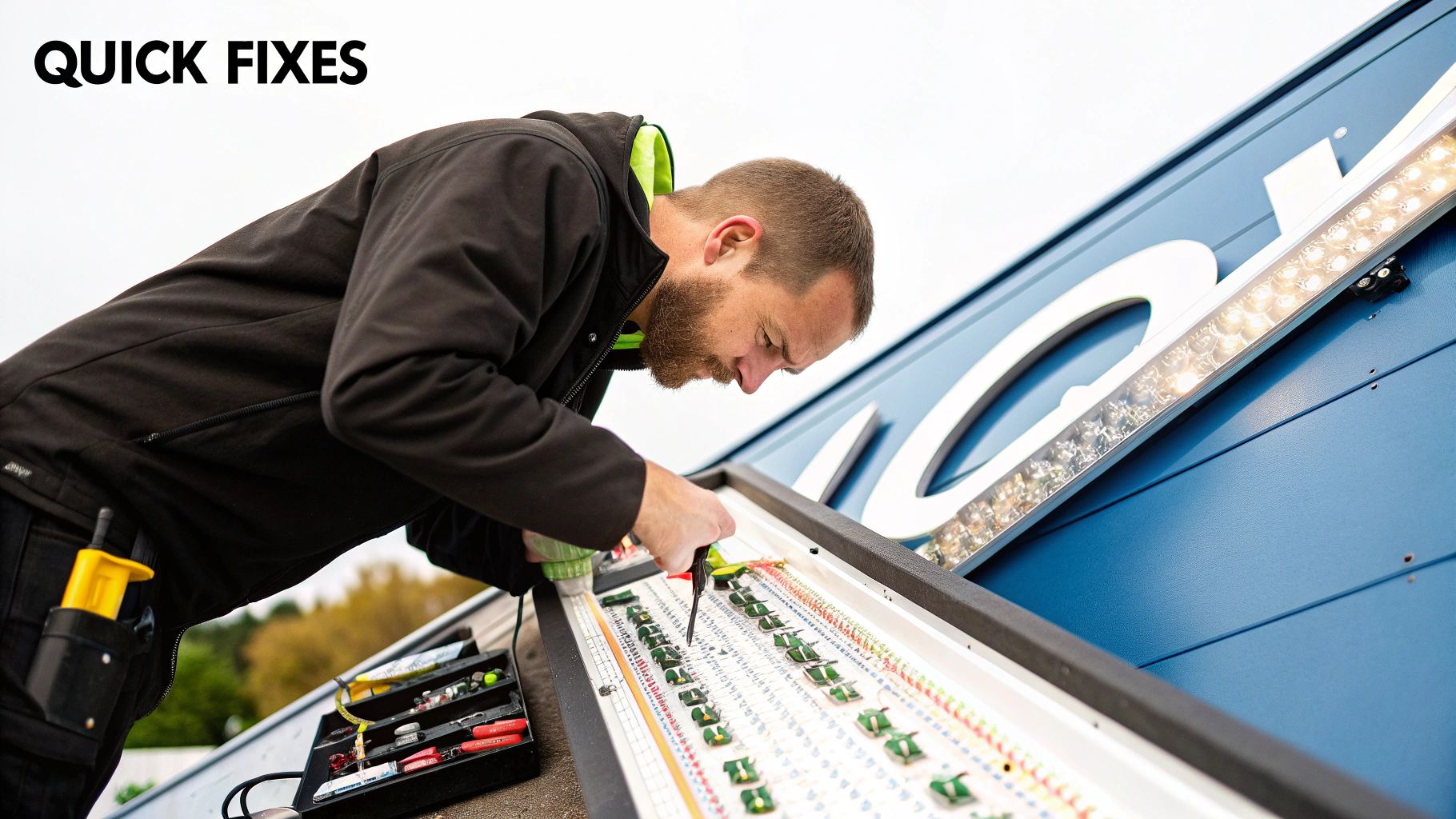
Your outdoor LED sign is built like a tank—a durable, low-maintenance workhorse that just keeps going. But even the toughest equipment benefits from a little proactive care to make sure it performs flawlessly for its entire lifespan.
Think of it like a car; a quick check-up every now and then prevents major headaches down the road. A simple routine keeps your sign bright, clear, and commanding attention. This isn't just about upkeep; it's about protecting your investment. With an expected lifespan of up to 100,000 hours, consistent care helps you get the most out of every single one.
You don't need a degree in electrical engineering to keep your sign in prime condition. Just a few minutes every few months will ensure clear messaging and long-term reliability.
Gentle Cleaning: The sign face is going to collect dust, pollen, and grime, which can dull its pop. Use a soft-bristle brush to gently sweep away anything loose. For tougher spots, a damp cloth with mild soap and water works wonders—just stay away from harsh chemicals or high-pressure washers that could damage the electronics.
Check All Connections: Give the power and data cables running to the sign a quick visual inspection. Look for any signs of wear, fraying, or loose connections. Make sure everything is securely plugged in and that the weatherproof seals are intact to keep moisture out.
Clear Ventilation Paths: Most signs use vents to dissipate heat, and these can get clogged with leaves, nests, or other debris. Keeping these pathways clear is critical for preventing overheating, which can shorten the lifespan of your sign's components.
Even the most reliable tech has its off days. Before you pick up the phone to call a technician, there are a few common hiccups you can often resolve yourself. Here’s a quick guide to playing detective.
Problem 1: A Few Pixels Are Out
Seeing a few dead pixels isn't usually a cause for panic. More often than not, this points to an issue with a single LED module—one of the small, replaceable panels that make up the larger screen.
Solution: First, try the classic "turn it off and on again." A simple power cycle can sometimes resolve the glitch. If the pixels stay dark, the module itself probably needs to be replaced. This is often a straightforward swap that your sign provider can easily walk you through.
Problem 2: A Section Is Flickering or Off
If an entire section or a big chunk of your sign is on the fritz, the problem is likely a breakdown in the power or data flow to that specific area.
Check the Ribbon Cable: The most common culprit is a loose or disconnected data ribbon cable that links the modules together. After safely powering down the sign, open the access panel and give these cables a gentle push to make sure they're seated firmly.
Inspect the Power Supply: It's also possible that the power supply unit for that section has failed. This is a more involved repair that we'd typically recommend leaving to a professional technician to handle safely.
Jumping into the world of outdoor LED signs is exciting, but it's natural to have a few questions before you make a decision. Getting the right answers is the key to feeling confident in your purchase. Here, we'll tackle the most common things we hear from business owners just like you.
Think of this as your final checklist. We've gathered the essential questions that usually pop up once you've got the basics down, making sure you have everything you need to choose and run your new sign like a pro.
A well-built outdoor LED sign is an investment in durability. You can generally expect a lifespan of around 100,000 hours of operation. To put that into perspective, that's more than 11 years if you left it running 24/7.
Of course, a few things can influence its actual lifespan, like the brightness settings you use, the local climate, and whether you perform some simple, routine maintenance. The big advantage over old-school signs is that LEDs keep their vibrant color and brightness for years, so you won't be dealing with faded signs or constantly changing bulbs. It’s a return on investment that really lasts.
Absolutely. One of the best parts about modern LED signs is that they're designed for you, the business owner, to control. They come with intuitive software that lets you design, schedule, and launch your content right from a computer. You’re in the driver's seat.
Connecting to your sign is just as easy, and you've got a few options:
This kind of flexibility means you can switch up your promotions, post new announcements, or change your graphics whenever you want, all without needing to call a tech.
This is a big one, and the answer really depends on your local city and county rules. The process can vary quite a bit from one place to another. Typically, the first step is submitting an application to your local planning or zoning department.
They’ll usually ask for a package of documents, including a site plan showing exactly where the sign will go, detailed drawings with its dimensions, and the engineering specs from the manufacturer. Many local codes have specific rules about a sign's size, how bright it can be, and if you're even allowed to use animations.
We can't stress this enough: talk to your local authorities or a professional sign installer before you buy anything. Taking this step first ensures the sign you’ve got your eye on will meet all the local requirements, saving you from potential headaches, fines, or delays down the road.
Outdoor LED signs are built tough, designed to handle pretty much anything Mother Nature can throw their way. The spec you really want to pay attention to is the IP (Ingress Protection) rating. Look for something like IP65 or higher.
So what does that mean? The first number, the '6', tells you the sign is completely sealed against dust and dirt. The second number, the '5', means it can handle low-pressure water jets from any direction—so heavy rain and snow are no problem. Quality signs are also engineered to work perfectly in a huge range of temperatures, from freezing cold winters to blazing hot summers, giving you reliable performance all year long.
Ready to transform your business's visibility with a high-impact, durable display? The team at Smart LED Inc. offers factory-direct pricing on a huge range of outdoor LED sign lights, backed by expert support from design to installation. https://smartledinc.com
Welcome to our helpful guide on gambling establishment financial institution repayment approaches. In this article, we will certainly discover the various repayment options offered to
Online slots have actually become one of one of the most preferred types of online gaming, bring in numerous gamers from around the world. With
Emotional Support Pets (ESAs) have actually become significantly acknowledged for the important support they offer to people coping with mental wellness problems. From minimizing anxiousness
"*" indicates required fields

We have sent a 6-digit verification code to your email. Please enter it below to continue.