Casino Site Bank Settlement Methods: A Comprehensive Guide
Welcome to our helpful guide on gambling establishment financial institution repayment approaches. In this article, we will certainly discover the various repayment options offered to

Ever seen a blank wall transform into a massive, breathtaking digital canvas? That's the magic of a video wall—a system of smaller screens, all working together as one to create a single, seamless, and seriously high-impact image. This isn't just a bigger TV; it's a technology that’s completely changing the game for retail stores, corporate headquarters, concert venues, and even home theaters.
The best way to think about a video wall is not as one giant screen, but as a collection of digital building blocks. Individual displays, whether they're LED or LCD panels, are arranged with incredible precision—almost like tiles in a mosaic—to form a screen of virtually any size or shape you can imagine. It’s this modular approach that makes the technology so incredibly flexible.
The whole point is to create an immersive visual experience that grabs an audience and doesn't let go. A big TV can show you a video, sure, but a video wall becomes the environment. It can wrap around corners, stretch across an entire lobby, or be pieced together into a unique artistic shape. This makes it an incredibly powerful tool for branding, sharing information, or just pure entertainment.
What really makes video walls a different beast is their scale and seamless design. If you tried to stick a bunch of regular TVs together, you'd be left with a distracting grid of black borders (we call those bezels). But with modern direct-view LED technology, you get a completely uninterrupted visual surface.
This opens up a world of possibilities:
A well-designed video wall does more than just show content; it transforms a physical space into a memorable experience. It’s the difference between looking at a picture and feeling like you can step right inside it.
This ability to build a totally custom visual solution is why video walls are popping up everywhere. From the dazzling digital billboards in Times Square to the complex, data-rich displays in a mission control center, the idea is the same: combine smaller elements to create one powerful, cohesive visual statement. This guide will break down how it all works, helping you understand the key pieces that bring these impressive displays to life.
Picking the right technology is easily the most important decision you'll make for a video wall. It’s the foundation for everything that follows, from the visual pop it delivers on day one to how reliable it is years down the road. The market really boils down to three main players: Direct View LED (dvLED), LCD, and old-school Projection systems.
Each has its place, but one has definitely pulled ahead as the go-to standard for high-impact video wall screens.
Direct View LED, or dvLED, is the powerhouse technology behind today's most stunning displays. The best way to think of it is like a set of digital building blocks. We assemble individual modules packed with tiny light-emitting diodes to create one massive, totally seamless canvas in any size or shape you can dream up.
This modular design is its secret weapon. Because there are absolutely no borders or bezels between the panels, the final image is perfectly smooth and uninterrupted. This is what creates that truly immersive, "wow" experience. On top of that, dvLEDs get incredibly bright, pumping out vivid images even when blasted with direct sunlight—which is why they own the outdoor market. Their insane longevity, often rated for 100,000 hours, means they just keep performing beautifully for a decade or more.
The magic of dvLED goes way beyond just a seamless picture. This approach gives you total creative freedom. We’re talking curved displays that wrap you in the content, screens that bend around corners, and even totally custom, non-rectangular shapes for artistic flair.
This kind of flexibility makes them a perfect fit for all sorts of environments:
To get a better sense of how different setups can solve different problems, this simple decision guide can help.
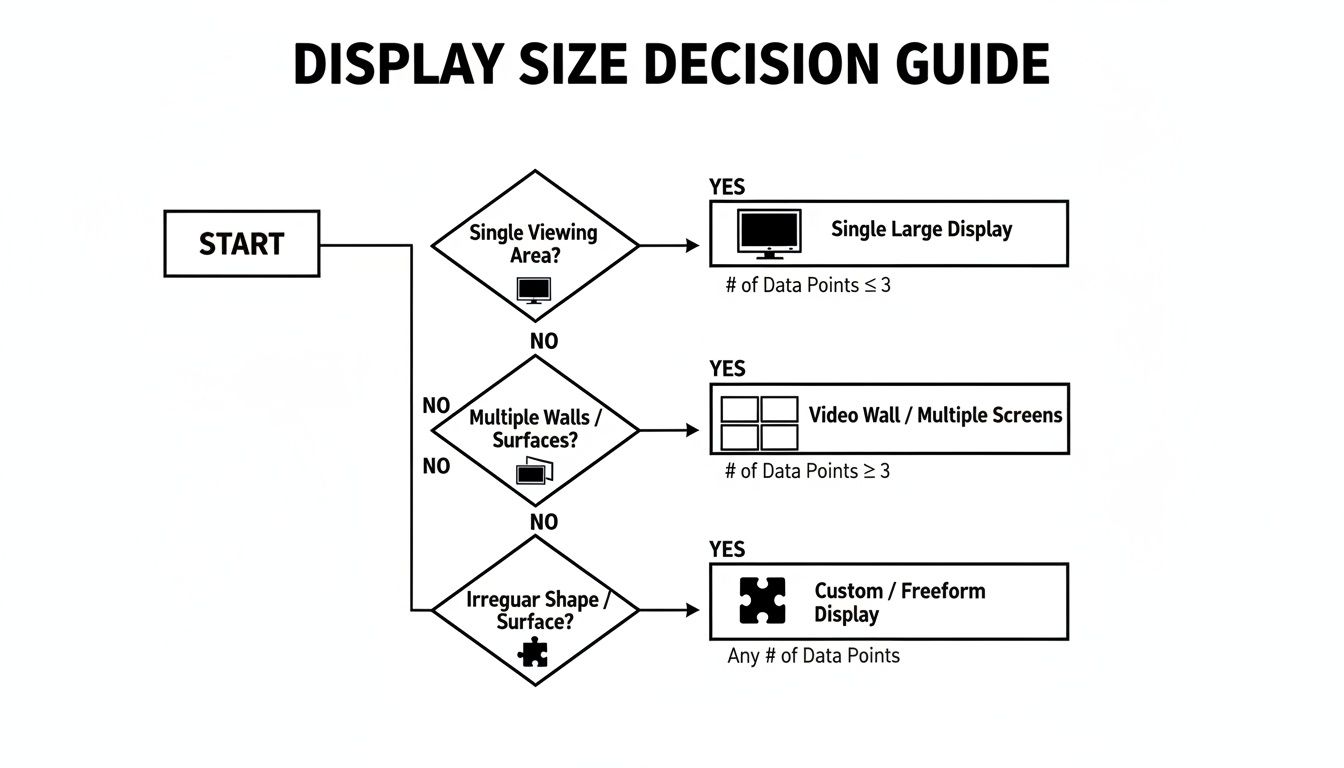
As you can see, when your vision grows from a single big screen to a multi-panel wall or a custom architectural piece, your technology has to be able to scale right along with it.
For a long time, LCD video walls were the default choice, especially indoors where people are standing close to the screen. And to be fair, LCD panels can pack in a lot of pixels for a good price, making them decent for displaying fine-print details. But they have one huge visual flaw you can’t escape: the bezels.
No matter how thin the manufacturers make those borders, an LCD video wall will always be a grid of black lines slicing up your image. This "grid effect" is distracting. It pulls you out of the experience and shatters the illusion of a single, cohesive picture.
While cost-effective for certain uses, the distracting grid of bezels on an LCD video wall fundamentally compromises the goal of creating a single, unified visual canvas.
Projection systems are the oldest trick in the book for making a big image. Their main selling point has always been creating a massive picture for a relatively low upfront hardware cost. The problem? Projectors are completely allergic to ambient light. In any room that isn’t practically pitch black, the image looks washed out, faded, and weak.
Worse yet, they’re a maintenance headache. You’re constantly swapping out expensive bulbs and cleaning filters just to keep the image looking decent. All of that adds up, increasing the total cost of ownership and leading to frustrating downtime.
To really see the differences side-by-side, this table breaks down how each technology stacks up across the most important features.
| Feature | Direct View LED (dvLED) | LCD Video Wall | Projection |
|---|---|---|---|
| Visual Experience | Completely seamless. No gaps or bezels for a single, unified canvas. | Visible grid of bezels between panels, which can be distracting. | Seamless image, but quality is highly dependent on surface and ambient light. |
| Brightness & Contrast | Extremely high. Excellent performance in any lighting, including direct sunlight. | Good for indoor use, but struggles in bright environments. | Very poor in ambient light. Image appears washed out and faded. |
| Longevity & Reliability | Exceptional. Rated for up to 100,000 hours with minimal color shift over time. | Moderate lifespan. Susceptible to image retention or "burn-in." | Low. Requires frequent and costly bulb replacements. |
| Flexibility & Shape | Highly flexible. Can be configured in curved, corner, or custom shapes. | Limited to flat, rectangular grid configurations. | Limited by screen surface and projector placement. |
| Best For | High-impact lobbies, retail, large venues, control rooms, and outdoor advertising. | Budget-conscious indoor applications where seamlessness isn't a top priority. | Dark environments like home theaters or classrooms with controlled lighting. |
For nearly every professional application today, the choice is clear. The superior brightness, flawless visuals, and rock-solid reliability of dvLED simply put it in another league. You can dive deeper and explore a variety of these modern solutions by learning more about the latest indoor LED wall panels and what they can do.
As the technology has matured, the powerful advantages of dvLED have cemented its position as the premier choice for almost any video wall screen you can imagine.
A spec sheet for a video wall can look like another language, packed with technical terms and acronyms that make your eyes glaze over. But here’s the good news: you don’t need an engineering degree to make a great choice. Understanding just a handful of key specs will turn that jargon into practical knowledge, giving you the confidence to pick a display that nails your vision.
Think of these specs as the DNA of your video wall. Each one defines a critical trait that shapes how your content will look and feel to the people watching it. Getting them right is the difference between a display that’s just "good" and one that’s truly unforgettable. Let's break down the most important terms you'll run into.
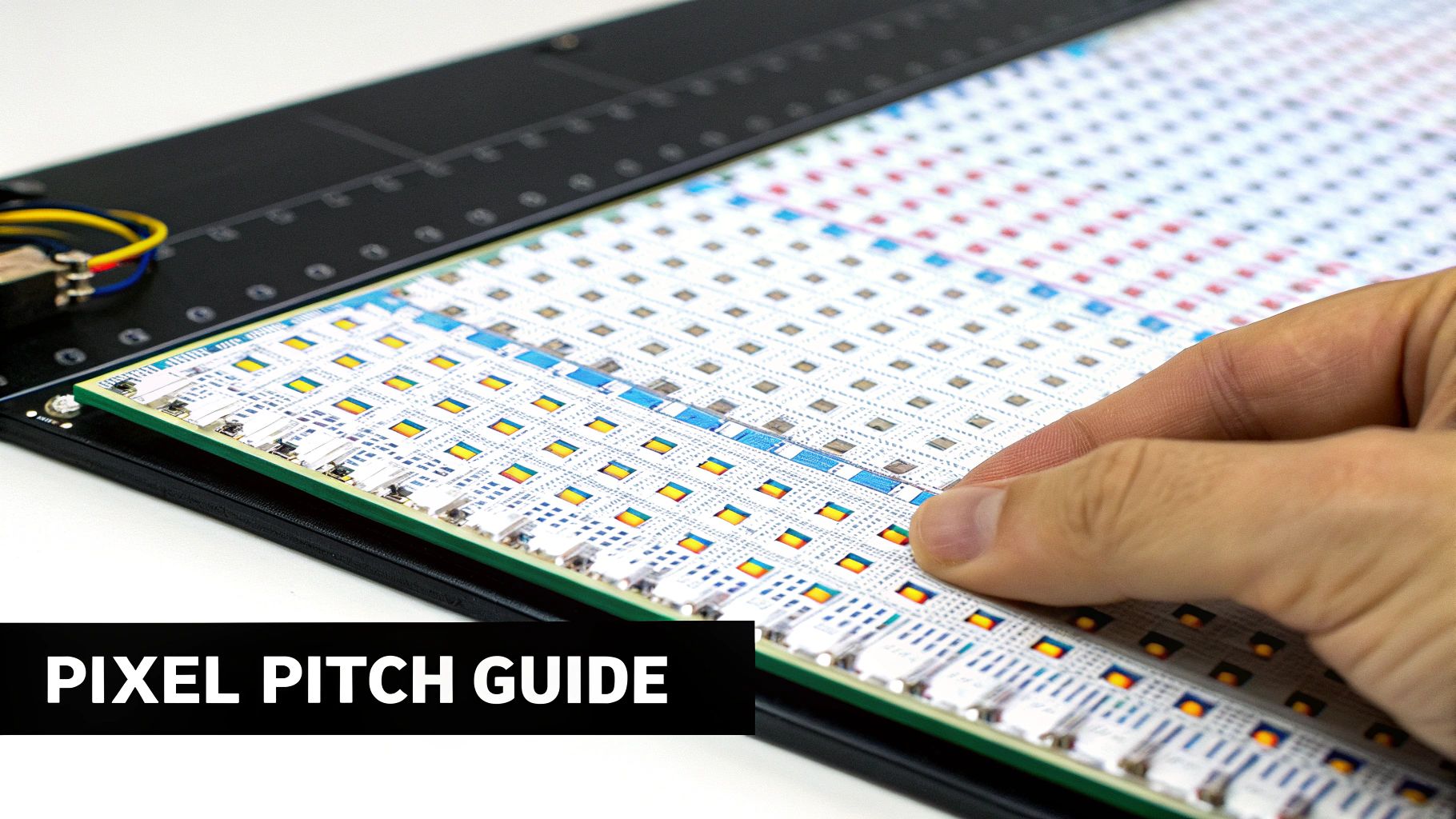
The first and most fundamental spec for any LED screen is pixel pitch. It’s simply the distance, measured in millimeters, from the center of one tiny pixel to the center of the one next to it. A smaller number, like 1.2mm, means the pixels are jammed tightly together, creating a super-sharp, high-resolution image. A larger number, like 6mm, means they're spaced further apart.
A great way to think about it is like the thread count on bedsheets. High thread count sheets feel silky smooth and look detailed because the threads are dense. Low thread count fabric looks and feels coarse up close. In the same way, a fine pixel pitch lets people stand right next to the screen without seeing individual dots, which is perfect for indoor spaces like lobbies or retail stores. A larger pitch works great for things like roadside billboards, where your audience is always going to be far away.
The Rule of Thumb: A handy trick for estimating the best viewing distance is the "1mm to 1 meter" rule. For a screen with a 2.5mm pixel pitch, the ideal minimum viewing distance is about 2.5 meters (or roughly 8 feet).
How do you make sure your video wall looks brilliant and not like a washed-out phone screen in the sunlight? It all comes down to brightness, which we measure in a unit called a nit. Fun fact: one nit is about as bright as a single candle.
The brightness you need depends entirely on where the screen will live:
Getting the nit level right is critical. Too dim outdoors, and your message is invisible. Too bright indoors, and you’ll give your audience a headache.
Beyond raw brightness, the quality of the colors themselves is what separates a good display from a great one. This is where color gamut and High Dynamic Range (HDR) come into the picture. Color gamut is just the total range of colors a screen can produce. A wider gamut means the display can show more subtle shades of red, green, and blue, making images look richer and more true-to-life.
HDR takes things to a whole other level. It dramatically expands the contrast ratio and color palette, allowing a screen to show intensely bright highlights and deep, inky blacks in the very same frame. This creates an incredible sense of depth and realism that makes visuals leap off the screen. For any application where image quality is everything—like a high-end home theater, a broadcast studio, or a luxury retail shop—HDR isn't just a feature, it's a must-have for a truly cinematic experience.
Finally, let’s talk about refresh rate. This spec determines how smooth and fluid motion looks on the screen. Measured in Hertz (Hz), it tells you how many times per second the display updates the image. A standard screen might have a 60Hz refresh rate, which is perfectly fine for static graphics or slow-moving videos.
But for fast-paced action—think sports, video games, or dynamic ads—a higher refresh rate is absolutely essential. A rate of 120Hz or more ensures that every movement is crisp and clear, without any of that distracting blur or stuttering. This is especially important on massive video walls, where any motion imperfection becomes much more noticeable and can ruin the immersive effect you’re going for.
The true power of a video wall comes to life when you see one out in the wild, turning an ordinary space into something unforgettable. Once you move past the tech specs, you start to see these dynamic canvases for what they really are: strategic tools that reshape how businesses communicate, entertain, and operate. They aren't just displays; they command attention and deliver real results across countless industries.
From the moment a customer walks into a store to the critical decisions made in a high-stakes control room, video walls are making a huge impact. Let's dig into some of the most compelling places where this technology is making a massive difference.
In retail, the battle for a customer’s attention is ruthless. Video wall screens give brands a powerful weapon to cut through the noise, creating a "wow" factor that literally stops shoppers in their tracks. Picture a flagship clothing store where the entire back wall is a fluid display, showing off runway footage or larger-than-life product shots that bring the brand’s whole vibe to life.
This isn’t just about looking cool; it’s about moving products. Bright, dynamic content can guide foot traffic, flash limited-time offers, and build an immersive brand world that a static poster could never hope to match. This kind of effectiveness is fueling some serious growth.
The global hunger for high-impact displays is surging, with the video wall market hitting USD 10.23 billion in 2024. Projections show it rocketing up at an 11.7% compound annual growth rate to reach USD 20.37 billion by 2030, a push largely driven by retailers and public venues looking for more engaging ways to advertise. You can explore more insights on the growing video wall market at Grand View Research.
First impressions matter, and corporate lobbies are the new frontier for telling a brand's story. Instead of just a simple logo on a wall, companies are installing massive video wall screens to create a stunning welcome for visitors and an inspiring backdrop for employees. These displays can showcase company wins, welcome important clients by name, or even feature generative digital art that reflects the company's innovative spirit.
But it goes way beyond the lobby:
A video wall in a corporate setting is more than just a piece of tech; it's a statement. It tells the world that a company is forward-thinking, confident, and invested in creating a world-class experience for everyone who walks through its doors.
In places where every second counts, information has to be clear, complete, and instantly available. Mission-critical control rooms—the nerve centers for transportation, energy grids, and security operations—lean heavily on video wall screens. They provide a seamless, unified view of incredibly complex data streams. Operators can monitor dozens of camera feeds, track assets on a map, and analyze real-time data on a single, massive canvas.
The seamless nature of Direct View LED technology is especially crucial here. With no distracting bezels breaking up the image, operators can follow a moving object across the entire display without interruption. Nothing gets missed. This ability to see huge amounts of information all at once leads to faster, smarter decisions when it matters most.
Houses of worship and live event venues are using video walls to pull people in and create more immersive experiences. In a large sanctuary, a vibrant LED wall can display song lyrics, scripture, and a live feed of the speaker, making sure even the folks in the back pews feel connected and engaged. The incredible brightness and rich colors make the visuals pop, adding real emotional depth to the service or performance.
It's the same story at concerts and festivals, where gigantic video walls act as dynamic backdrops that amplify the artist's performance. They give fans far from the stage incredible close-up shots and display custom visuals perfectly synced to the music, turning a great show into an unforgettable sensory experience. In every case, the technology closes the distance and brings the audience right into the heart of the message or the music.
Turning an exciting vision for a video wall into a stunning reality all starts with a solid plan. A thoughtful approach to planning and budgeting is what separates a successful, high-impact installation from one that causes headaches and unforeseen costs. Think of it as the blueprint that guides you from a great idea to a flawless execution.
The journey kicks off by getting crystal clear on your goals. Are you trying to create an unforgettable first impression in a corporate lobby? Is the aim to drive retail sales with eye-catching ads? Or maybe you need to display complex data in a control room. Your core objective will shape every single decision that follows, from the technology you choose to the content you create.
Next, you have to get hands-on with the installation environment. This goes way beyond just measuring wall space. You need to think about things like ambient lighting, which will tell you how bright (in nits) your video wall screens need to be. You'll also have to evaluate the structural support to make sure the wall can safely handle the weight of the display and all its mounting hardware.
Your content is the absolute lifeblood of your video wall, so mapping out a strategy early is critical. This isn't just about what you'll show on day one, but how you'll keep the content fresh and engaging over the long haul. Planning for content management is a huge part of this. In fact, a crucial step in budgeting is choosing the right video content management systems to organize, schedule, and push all your media to the wall effectively.
Start by asking a few key questions:
A clear content plan ensures your investment continues to pay off long after the installation is complete.
One of the biggest mistakes people make when budgeting for video wall screens is focusing only on the sticker price of the hardware. To build a realistic budget, you have to consider the Total Cost of Ownership (TCO), which covers every expense over the display's entire lifetime.
And this market is booming. One report puts the video wall market at USD 24.30 billion in 2024, expecting it to hit an incredible USD 69.82 billion by 2032. This explosion in growth shows just how many businesses are investing in this technology, especially when studies show it can lift visibility ROI by 300% compared to old-school print.
The smartest budget is a comprehensive one. Looking beyond the price of the panels to include installation, software, and potential service costs is the key to avoiding surprises and ensuring a successful project.
Your TCO should account for these key areas:
By getting a handle on all these factors, you can build a complete budget that sets your video wall project up for sustainable success. For a more detailed breakdown of related costs, you might find our guide on demystifying the cost of outdoor LED signs helpful, as it shares a lot of the same budgeting principles.
A brilliant video wall project doesn't end the moment you buy the screens. The real magic—and longevity—comes from a flawless installation and a smart maintenance plan. Think of professional installation as the foundation of your investment. It's so much more than just hanging panels on a wall.
A pro team handles the critical details that are easy to miss. They’ll start with a structural assessment to make sure the wall can handle the weight, manage the complex power needs to avoid electrical nightmares, and cleanly route all the data cabling for a setup that’s as reliable as it is beautiful. Cutting corners here is a recipe for poor performance and even safety hazards, completely undermining the money you just spent.
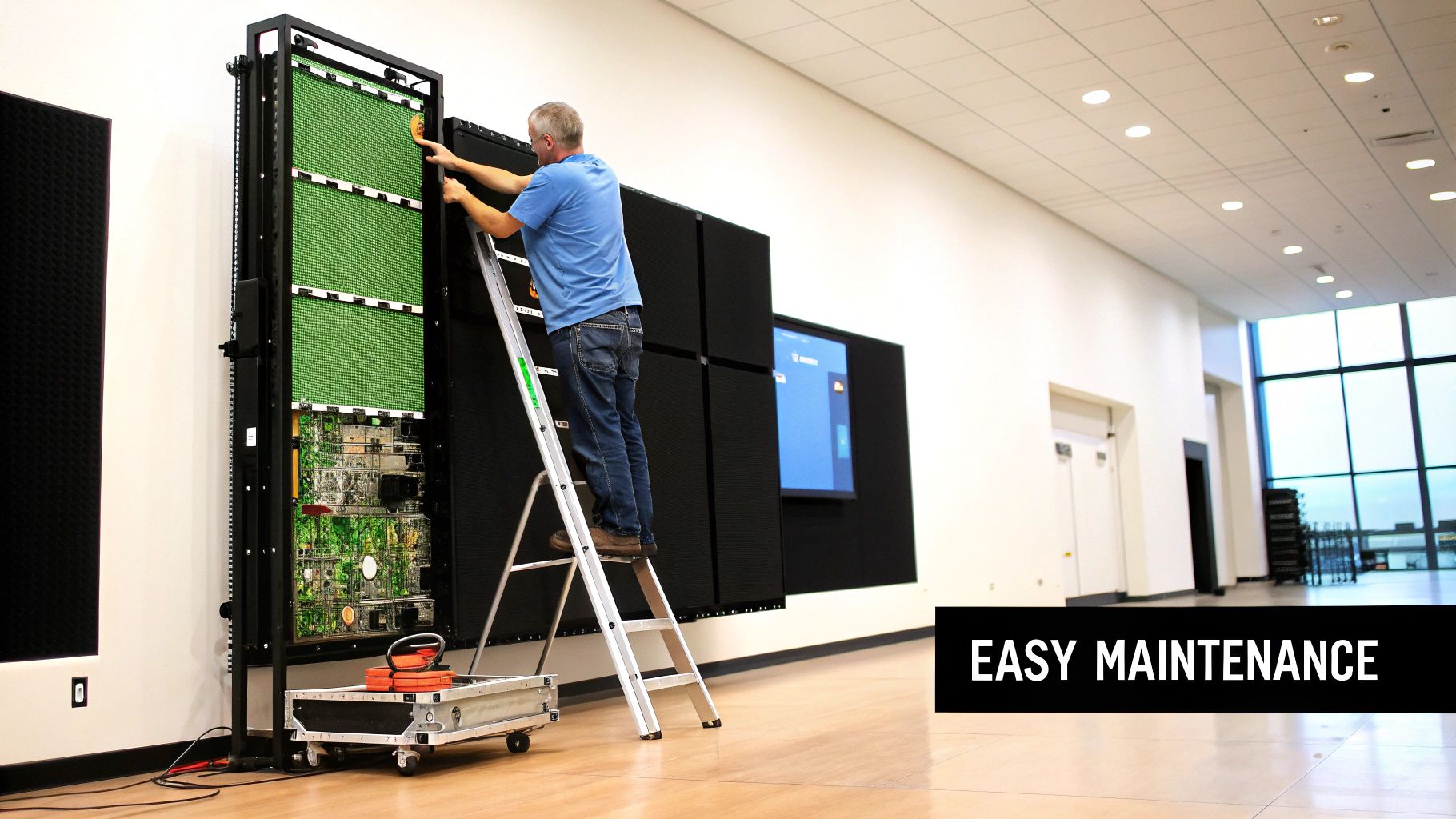
Once your wall is up and running, the focus shifts to keeping it that way. This is where modern Direct View LED systems have a massive leg up on older tech: their modular, front-serviceable design. It’s like having a floor made of high-tech tiles. If one gets scratched, you don't rip up the whole floor—you just pop out the damaged tile and replace it.
The modularity of modern LED video walls transforms maintenance from a major disruption into a minor task. Quick-swap panels minimize downtime and dramatically reduce long-term service costs.
This design means individual LED panels can be repaired or replaced in minutes, usually right from the front, without taking the entire display apart. For any business where uptime is money, this is an absolute game-changer. It gives you peace of mind and makes the long-term value of your investment crystal clear.
This preference for reliable, easy-to-service LED technology is why the market is booming. The LED video wall market is on track to hit USD 15 billion by 2032, driven by relentless demand and innovation. In fact, LED now commands a massive 59% market share of the entire video wall industry.
When you see a project executed with this kind of foresight, like a slick curved LED installation in Philadelphia, you understand how professional handling leads to a result that is both stunning and built to last. It’s the key to ensuring your video wall remains an incredible asset for years to come.
Here are some of the most common questions that pop up when people are considering a video wall. We'll tackle them one by one to clear up any lingering uncertainties and help you move forward with confidence.
A high-quality LED video wall is built for the long haul. You can realistically expect a lifespan of 80,000 to 100,000 hours.
To put that into perspective, that's more than a decade of non-stop, 24/7 operation. Unlike old-school projection systems that demand frequent and costly bulb replacements, a modern LED display keeps its brightness and color consistent for years. This makes a huge difference in the total cost of ownership over time.
It really comes down to two things: brightness and durability.
Outdoor video walls have to compete with direct sunlight, so they need to be incredibly bright—we're talking 5,000 nits or more—just to be seen clearly. They also need to be tough enough to handle whatever nature throws at them, so they come with a rugged IP (Ingress Protection) rating to guard against rain, dust, and temperature swings.
Indoor screens, on the other hand, are designed for much more controlled environments. They don’t need nearly as much firepower, usually landing in the 600-1,500 nit range. Since people will be standing closer to them, they also typically feature a finer pixel pitch for crisp, high-resolution images up close.
You'd be surprised how straightforward it is these days. Modern video walls run on user-friendly content management software (CMS) that takes the headache out of the process.
For the most part, you can upload and schedule your images, videos, and messages from a regular computer. The software does the heavy lifting, stitching everything together so it appears as one massive, seamless canvas. While there’s certainly advanced software out there for complex interactive setups, the day-to-day operation is usually no more complicated than running a digital slideshow—just on a much more impressive scale.
Absolutely. This is where Direct View LED technology really shines and opens up a world of creative possibilities.
Since these video walls are assembled from individual modules, they aren’t locked into a boring rectangle. They can be built into concave or convex curves, wrapped around corners, or even configured into totally unique, non-traditional shapes.
This flexibility is what allows for the most stunning and immersive architectural integrations. It frees designers from the constraints of a traditional rectangle and lets the display become part of the environment itself.
It’s this very capability that makes it possible to create one-of-a-kind visual experiences that were simply out of reach with older, more rigid display technologies.
Ready to transform your space with a stunning visual centerpiece? The team at Smart LED Inc. provides factory-direct pricing on industry-leading indoor and outdoor video wall solutions, backed by expert support from design to installation. Explore your options and get a personalized quote today at smartledinc.com.
Welcome to our helpful guide on gambling establishment financial institution repayment approaches. In this article, we will certainly discover the various repayment options offered to
Online slots have actually become one of one of the most preferred types of online gaming, bring in numerous gamers from around the world. With
Emotional Support Pets (ESAs) have actually become significantly acknowledged for the important support they offer to people coping with mental wellness problems. From minimizing anxiousness
"*" indicates required fields

We have sent a 6-digit verification code to your email. Please enter it below to continue.